He who knows does not speak;
He who speaks does not know.
He who is truthful is not showy;
He who is showy is not truthful.
He who is virtuous does not dispute;
He who disputes is not virtuous.
He who is learned is not wise;
He who is wise is not learned.
Therefore the sage does not display his own merits.
Lao-Tzu (fl. B.C. 600)
In some ways #QandA on Monday this week was a good episode, but it was at the same time totally frustrating as such things almost inevitably are.
Monday, 27 May 2013 Religion, Marriage & Euthanasia
Panellists: Lawrence Krauss, Theoretical Physicist & Cosmologist; Gene Robinson, America’s First Openly Gay Bishop; Fred Nile, Conservative Morals Campaigner; Amanda Vanstone, Former Howard Government Minister; and Susan Ryan, Age Discrimination Commissioner.
Naturally recent events in the UK and Stockholm coloured what was discussed. The media have been full of it lately. Here is the merest selection:
And from further afield:
On QandA one of the contributions I most related to was from Amanda Vanstone:
TONY JONES: Amanda Vanstone, the questioner began by talking about – thank you. The questioner began by talking about the murder of that young trooper in a suburb in London, hacked to pieces by two people who were trying to make a political point. How do you actually deal with that?
AMANDA VANSTONE: Well, I suspect British people can deal with it better than legislation or intelligence agencies can. If you were there, I think the best thing to do is find your Muslim friends, if you have got some, if you haven’t find some and make friends with them, and find your friends who have come from Africa or the children have come from Africa, and go out to dinner with them. Make a public statement that not everybody is like that. I think if you let the media stories of this push us into it’s us versus them, that is what you will get. What you have to do is say, no, it’s not us versus them. It is all of us over there against those few crazy nutters.
TONY JONES: Susan Ryan.
SUSAN RYAN: Well, I couldn’t put it better than Amanda has. It is about embracing and including people and I think we do that very well in Australia. Not well enough. We have still got some issues. But the more we provide every community opportunity to people of Islamic faith coming to live in Australia, the better it will be. And the other thing that always – I always say helps in any situation about religion or terrorism is educate the women.
AMANDA VANSTONE: Indeed.
SUSAN RYAN: The education of women is the great solution to many a problem.
I do not for a moment believe that approximately one quarter of the world’s population is single-mindedly bent on murdering and/or enslaving the rest of us. But at the same time I know there are parts of the world where what I believe to be true would not go down very well at all. I relate very much to this, for example.

Thus I cannot possibly admire reasoning such as the following:
At this stage, we want to know to what extent the relationship of a book with its author is authentic. Suppose we want to study the Diwan-Hafiz, or the Ruba’iyyat of ‘Umar Khayyam. At first, we have to see whether the work which is attributed to Hafiz, wholly belongs to him, or whether a part of it is Hafiz’s work and the rest is an apocryphal annexation to it. Similarly in the case of ‘Umar Khayyam, and others too, we must judiciously scrutinize their works. It is here that the matter of examination of manuscripts —and for that matter the oldest of them— becomes relevant. Thus we see that none of these books can dispense with such a treatment. The Diwan-e-Hafiz printed by the late Qazvini, which has been based on some of the most authentic manuscripts of Hafiz’s work, varies greatly from the ordinary editions of Hafiz. printed in Iran and Bombay, which are usually found in homes. The editions of Hafiz’s works published during the last thirty or forty years contain as much as twice the amount of Hafiz’s original works. In view of certain modern manuscript experts of repute, they are fake; although we occasionally come across in them some verses which match the sublime heights of Hafiz’s poetry. Likewise when we study the quatrains attributed to ‘Umar Khayyam, we shall find nearly two hundred quatrains of the same poetical standard with only minor differences usually possible even among the authentic verses of a single poet. However, if we look back at the history of Khayyam’s times, we shall notice that the number of quatrains attributed to him may perhaps be less than twenty. The authenticity of the rest of them is either doubtful, or may with certainty be said to belong to other poets.
It means that the first step towards the research study of any book is to see to what extent the book in our hands is authentic, whether all the things recorded on its pages are genuine, or if only a part of it is authentic. Moreover, what criteria and standards should be employed in order to judge the authenticity and genuineness of authorship? By what logic can the authenticity of any book be totally rejected or affirmed?
The Qur’an is absolutely exempt from all such criteria that may be applicable to all worldly books. It is regarded as the exclusively singular book since the ancient times. No book of ancient days has remained above doubt to such extent despite a long lapse of several hundred years. No one can ever say about it that such and such a surah has a questionable authenticity or such and such a verse that is present in such and such a manuscript is missing from another manuscript. The Qur’an stands above the notions of manuscript reading. There is no place for the slightest doubt that all of the verses that exist in the Qur’an are those conveyed to Muhammad ibn ‘Abd Allah (S) who communicated them as the miraculous Word of God.
Nobody can ever claim that another version of the Qur’an existed anywhere, or still exists. There has not been any Orientalist either who would begin the study of the Qur’an by saying, “let us trace from the earliest of the manuscripts of the Qur’an to see what was included in it and what was not.” The Qur’an is absolutely free from this kind of investigation necessary in case of such books as the Bible, the Torah, or the Avesta, or the Shahnameh of Ferdowsi, or the Gulistan of Sa’di and every other ancient or not so ancient work.
Only for the study of the Qur’an no such questions arise, and the Qur’an is far above the usual norms of authenticity and the craft of manuscript reading…
— “Understanding the Uniqueness of the Qur’an” by Ayatullah Murtada Mutahhari – Feedbooks 2013
Considering the obvious, based on my own reading of several English versions of the Qur’an, that the book is parasitic on Biblical sources and other sources too, I find that very hard to swallow. Rather, it is to me shockingly and blatantly dishonest. Talk about begging the question! It makes Fred Nile’s rather brain-dead Biblical theology — which cavalierly rejects several centuries of excellent critical scholarship — look almost reasonable in contrast.
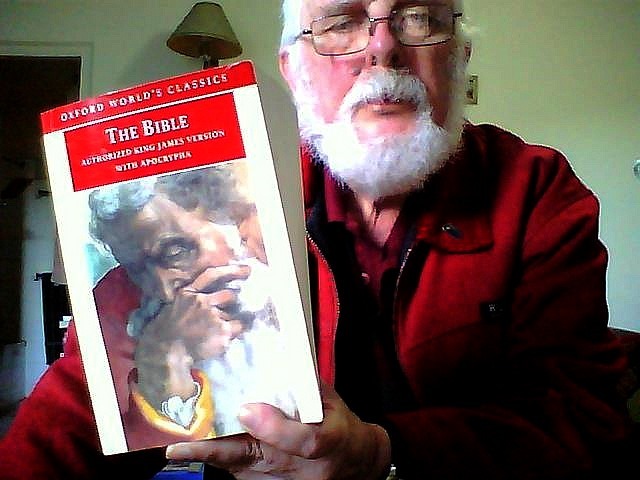
Excellent introduction and notes reflecting modern scholarship
But I also relate to this:

Perhaps we should all do well to look again at Lao-Tzu.
Nonetheless for those inclined and with plenty of bandwidth:
That is on the YouTube page of one of my former students.
Postscript 30 May
As a foil to Fred Nile’s theological approach: My Messy Faith.
Now, my faith is messy. Really messy. Where black and white once reigned obvious, gray and complexity has taken over. Without my rigid rules, relationships and beliefs become messy. And I can’t tell you how much I love it.
Instead of worrying about my appearance, I look at my heart. Instead of pointing at and judging others, I now pursue a relationship with them. Instead of focusing on my beliefs, I focus on creating a lifestyle of love. Instead of avoiding bad words, I speak words that give life and healing. Instead of taming Jesus, I invite his scandalous ways.
The more messy my faith becomes, the more I find myself turning to Jesus, asking for the Spirit’s wisdom and leading, and living a life of love. I allow relationships to grow and challenge me, no longer rules. I allow the Spirit room to move and breathe within me, no longer looking to humankind for all the answers. I allow myself to be a safe place for those who are marginalized, oppressed, and ignored, no longer thinking about my reputation. As this unfolds, the closer I feel to Jesus. The more I love his Word. The more radical my interactions become.
And this is exactly why Jesus came to earth: to undo our preconceptions of what is holy and unholy; to put the last first and the first last; to exchange judgment for love; to invite the sick and the broken, and to challenge the (self)righteous; to exchange this broken world for his Kingdom. Truly, the more God’s Kingdom comes and the more God’s will is done, the messier life gets and the more beautiful this world becomes.


 Neil's Commonplace Book