The last thing Mary Elizabeth needed was another baby. She already had five children, ranging in age from two to nine, and she and her husband, Elroy, were just barely getting by.
Her religious beliefs would not permit her to have an abortion, so she knew she was going be delivering her sixth child before the end of the year, a child Mary Elizabeth didn’t want and that they couldn’t afford.
But Mary Elizabeth had a plan. A plan directly from the pages of the Bible.
In December, Mary Elizabeth gave birth to a baby boy. She named him Moses, and just like Jochebed in the Bible, who put her son, Moses, in a basket and had him float down the Nile River to protect him and pray for a better life for him, so, too, did Mary Elizabeth put her son, Moses, in a basket and had him float down the Mississippi River to protect him and prayed that he, like his namesake from the Bible, would be found and saved to live a better life than she and Elroy could provide.
For this week’s Thursday Inspiration prompt, Jim Adams has gone spiritual on us. He’s asked us to respond to this challenge, by either using the prompt word “believe,” or going with An image of Dr. Martin Luther King, whose birthday we will be celebrating in America this coming Monday, or by means of the song “We Shall Overcome.” I’m actually going to take a very different path and feature a post I wrote on my old blog on November 4, 2009. If you choose to read it, be aware that it’s a fairly long post (compared to what I typically write these days), and, as the title suggests, it doesn’t pay homage to Dr. King.
In this past Sunday’s [11/1/09] Boston Globe, “The Word” column discussed the common use of spelling mnemonics to help people remember how to spell certain words or to remember names. Just in case you aren’t familiar with the term “mnemonic,” it is a device, such as a rhyme or an acronym, used as an aid in remembering.
Do I need to tell you what an acronym is, too? Okay, it’s a word formed from the initial letters or groups of letters of words in a set phrase or series of words, such as OPEC for Organization of Petroleum Exporting Countries, NATO for North Atlantic Treaty Organization, or GOP for Grievously Obnoxious Pinheads (or something like that, I can’t remember).
Back to mnemonics, I learned early on the mnemonic “every good boy does fine” (or the variant, “every good boy deserves fudge”) to remember that the musical notes in the scale are: E, G, B, D, and F. Of course, I still can’t read sheet music, nor can I play a musical instrument, so while I know the notes in the scale, thanks to this handy mnemonic, it’s of little practical use to me.
Then there is the little trick to help you remember which way to tighten or loosen bolts: “righty tighty, lefty loosey.” That sure comes in handy on those many occasions when I have to tighten or loosen bolts and can’t seem to remember which way to turn the wrench.
As far as remembering spelling rules, who can forget learning “i before e, except after c”? The Globe article, written by Erin McKean, offers a lot of great spelling mnemonics, such as “separate has a parachute in it” or “cemetery has three e’s because you scream “e-e-e” when walking past one.” And here’s one: “Accommodate is broad enough to accommodate two c’s and two m’s.” My personal corollary to that one is, “accumulate” is only broad enough to accumulate one m.
One specific mnemonic the author mentioned caught my attention. “There is a lie in the middle of believe and belief.” I suppose this mnemonic is designed to help people who have forgotten the “i before e, except after c” rule when faced with having to spell “believe” or “belief.” But what struck me most, as a “non-believer,” was the religious implication of this mnemonic.
As an atheist, I am occasionally challenged by those who claim to be “true believers” in the sense that they believe that the Bible is the literal word of God and that it is an accurate reflection of the history of this planet and of humankind. I’m often accused by these “holier-than-thou” types of being ignorant. They seem to believe that my non-belief will result in my being condemned to eternal damnation and they consider me to be an immoral person and a lost soul because I don’t accept the Bible, Jesus, or God as being real and true.
Don’t get me wrong. I am not saying that religious beliefs are lies as much as I’m suggesting that such beliefs are based upon mythology and superstition. Hey, if believing in mythology and superstition, and that some ancient guy dressed in robes with a long, flowing, white beard is somewhere in the sky looking down at and watching out for you helps to get you through the day or makes your feel better, go for it.
The Bible, though, is most definitely not a history book or a science book. It is a book of allegory. By allegory, I mean it is the representation of abstract ideas or principles by characters, figures, or events in narrative, dramatic, or pictorial form. The Bible is a fascinating, inspirational work of literature, but it is not a book of facts and anyone who believes it to be an accurate and historical account of Earth and man, or to be the literal word of God, is buying the “lie” in “belief.”
Let me give you a concrete example of how this “lie” in belief is perpetuated. In a recent letter to the editor published in my local newspaper, a woman wrote:
Sin is a blood-borne disease that infects all of humanity and gets passed on from generation to generation. To erase and eradicate sin, it required a blood sacrifice. Jesus is the only acceptable sacrifice which satisfies God’s requirement for holy justice. God transferred our sinsvto Christ on the cross so that through his blood we have redemption.
Seriously, does this woman actually believe that “sin is a blood-borne disease” that requires a blood sacrifice to eradicate and only through Jesus can this blood sacrifice be accomplished?
There is a new (to me, anyway) Mindlovemisery’s Menagerie prompt called Sunday Confessionals. I suppose, like confessions, it’s meant to be an opportunity for us to get something off our chests. For this week, we’ve been asked to share something that we have felt like yelling into a hole; a secret, an unpopular opinion.
I am an atheist. That’s not a secret. But being an atheist makes me misunderstood by many and reviled by some. So consider this VERY LONG POST (for me) to be me yelling into a hole about my unpopular opinion. If you don’t feel like reading my atheist rant or will take offense at my rejection of your religious beliefs, you may want to stop here.
So let’s do this.
You were a natural-born atheist. You did not come out of the womb believing in God. Religion is something you were taught. Your religious instruction was dictated by your parents. You learned about religion and about God from your parents and from the pastor, priest, rabbi, or imam at the church or temple you and your parents attended. Your religious beliefs as a child were your parents’ religious beliefs. As with just about everything else, you did what your parents told you. You followed their lead.
But like all children, you were naturally curious. You were always asking the “why” questions. So much so, that sometimes your parents, tired of hearing you ask why over and over, would say, out of frustration, “Because I’m your father [or mother] and I said so.”
An unanswered question is better than an unquestioned answer
When you asked the really tough questions, the ones even your parents didn’t know how to answer, it was just so much easier for them to say to you, “Because it says so in the Bible,” or “Because God made it that way.”
As you began to grow a little older and to think for yourself, you discovered that Santa Claus was not real. The Easter Bunny was not real. The Tooth Fairy was not real. Monsters hiding under your bed or in your closet were not real.
But God? Yes, God is real. Of course God is real.
Wait…what?
And then you got to high school and took some science, math, biology, chemistry, and physics classes. You thought about all of the things your parents taught you about your religion, about God. You thought about the Bible stories you were taught. And then you thought about what your science teachers were teaching you. And it dawned on you that something wasn’t right.
How can the earth be less than 10,000 years old when geologists, archaeologists, and paleontologists have uncovered rocks and fossils and bones that are millions of years old? Was Eve really created as a full-grown woman out of one of Adam’s ribs? Did she really succumb to the evil will of a talking snake?
Did God really instruct a 480 year old Noah to build an ark that took him 120 years to construct? Did Noah really collect one pair of every living animal on Earth while God flooded the entire planet and destroyed every other living creature besides those on Noah’s ark?
Did Jonah really live for three days and three nights inside the belly of a big fish? Did Moses really climb a mountain and come down from that mountain carrying two stone tablets with ten commandments etched by the hand of God? Was Jesus really born of a virgin mother? Could Jesus really walk on water?
Did all those things in the Bible really happen, or are they fairy tales and fables? Why do we give any more credence to our one God and to the Bible stories than we do the Egyptian, Greek, and Roman gods and their stories? Why is the God my parents believed in and the religion they practiced any better or more “right” than the gods and religions of others around the globe? Talk about a serious case of cognitive dissonance.
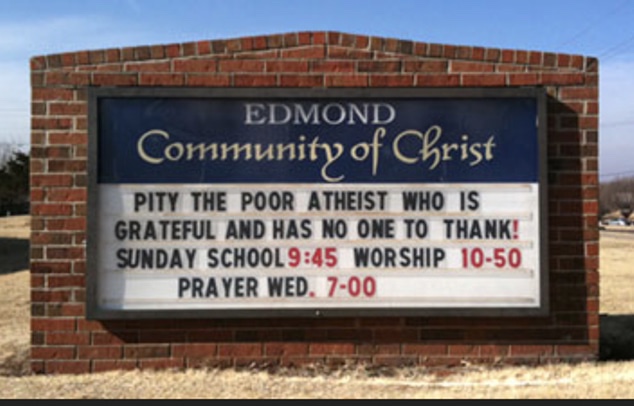
Pity the Poor Atheist
A lot of people believe that atheism is borne out of suffering or some traumatic event — some tragic, horrific experience — that caused these poor souls to lose faith in God. There must have had an abusive parent or relative who emotionally or physically tortured or sexually abused them.
These poor atheists must have thought that God can’t exist because, if he did exist, he wouldn’t have allowed them to suffer that way. “How can I believe in a God who would let this happen to me, who would abandon me?”
But I’ve found that not to be the case when it comes to any of the atheists I know. We ask questions and seek evidence. Answers like, “Because it says so in the Bible,” or “You just have to have faith, you just have to believe,” don’t cut it with us.
We weigh all of the available evidence and, having done so, choose to not believe in any supernatural deity or supreme being. We tend to be pragmatists who think deeply, rationally, and logically. Most of us were raised in the religion of our parents, but became skeptical by the inconsistencies, and in some cases, the outright hypocrisies, of our religions.
Many Christians seem to believe that atheists are a bad, sad, miserable, immoral, lost lot. They feel sorry for or pity us because we have lost our way; we have strayed from the path of righteousness. They can’t understand how we can be moral individuals if we don’t believe in God or an afterlife. It’s so sad that we can’t or won’t allow ourselves to bask in the glory that is God, or to accept Jesus as our savior. Which is why they want to “save” us. How magnanimous of them.
Or if they don’t feel sorry for us, they are angry at us. How dare we question their beliefs? How do we have the audacity to suggest that the Bible isn’t “The Truth,” and that God didn’t create us in his image, or that we evolved from monkeys?
We, as atheists, are, therefore, condemned to eternal damnation unless we change our evil, secular ways and embrace God and Jesus. Only then will we be saved. Only then will the light of God’s truth reveal itself to us.
We are not people you should feel sorry for or be angry at. We just don’t live our lives built around your myths.
Wouldn’t you like to expose your newer readers to some of your earlier posts that they might never have seen? Or remind your long term followers of posts that they might not remember? Each Friday I will publish a post I wrote on this exact date in a previous year.
How about you? Why don’t you reach back into your own archives and highlight a post that you wrote on this very date in a previous year? You can repost your Friday Flashback post on your blog and pingback to this post. Or you can just write a comment below with a link to the post you selected.
If you’ve been blogging for less than a year, go ahead and choose a post that you previously published on this day (the 15th) of any month within the past year and link to that post in a comment.
This was originally posted on April 15, 2018.
Is God Really Pro-Life?
I saw this bumper sticker above on a car the other day and it made me wonder how someone would know that God is pro-life.
Is this the same pro-life God who killed all the first born males in Egypt so that Pharaoh would “let His people go?”
Is this the same pro-life God who drowned all life on earth except for Noah and his family and the pairs of animals that gathered on Noah’s ark?
The same pro-life God who permitted the Nazis to exterminate more than six million living human beings (including, no doubt, pregnant women) during World War II? Who allowed hundreds of thousands of Japanese (including, no doubt, pregnant women) to die when the United States dropped atomic bombs on Hiroshima and Nagasaki? Who stands by twiddling His thumbs while Syria’s President Bashar al-Assad gasses his own people (including, no doubt, pregnant women)?
So where, exactly, do people get the idea that God is pro-life? From the Bible, you say? Oh really?
The God depicted in the Bible is the greatest mass murderer of all time. He killed millions of pregnant women and their fetuses in Noah’s flood. And what about the conquest of Canaan, the incineration of Sodom and Gomorrah, and in numerous other major slaughters described in the Bible? When the entire populations of towns are massacred as part of “God’s will,” you can be sure that pregnant women and their unborn children were among the victims.
Why did God, who allegedly loves the unborn and hates abortion, kill so many unborn children — as well as living children, adolescents, and adults — throughout biblical history? What makes anyone believe that God cares about unborn children?
The anti-abortion movement continues to declare that, in the name of God, abortion is murder. Do those opposing abortion on religious grounds know that the Bible does not consider a fetus to be a full human life or the killing of a fetus to be murder? The Bible requires the death penalty for 60 specified “criminal” violations, but abortion is not one of them.
In fact, nowhere in the Bible will you find any passage that describes a prohibition or penalty for a woman who chooses to terminate her pregnancy. Not a single verse. Yet many politicians and advocacy groups claim that their belief that abortion is murder originated in the Bible.
So where, then, is the evidence that God loves the unborn and disapproves of abortion?
Better yet, where is the evidence that God exists?
I realize that this post may piss some people off and I may even lose some followers as a result. But as Pharaoh said, “So let it be written, so let it be done.”
Isaac took off his glasses and rubbed his tired eyes. He stood up and walked into the kitchen where Hillary was preparing dinner. He knew what he was about to tell her would upset her, but he also knew that he couldn’t do what she had asked of him.
“How’s it going, sweetie?” Hillary asked as Isaac entered the kitchen.
“Listen, Hil,” Isaac said. “It’s not gonna happen.”
Hillary stopped what she was doing. “What’s not going to happen? What are you talking about?”
“I know how important your religion is to you, Hil,” Isaac said, “and I’ve spent the last four days locked away carefully reading the Bible.”
Hillary raised one eyebrow and said, “Yes, so?”
“So,” Isaac said, “it’s like reading a mashup of a fairytale and a soap opera.”
Hillary started to cry. “It’s God’s word. How can you say such a cruel thing?”
“I’m so sorry, Hil,” Isaac said. “I know you want me to embrace your religion and to share your beliefs, but I just can’t. It’s mythology and superstition and fantasy and I can’t take any of it seriously.”
Throughout his young life, Roger was required to read the Bible and to review it daily, chapter and verse, with his mother and father. He was taught that God’s laws, as expressed in the Bible, were unbreakable and must be obeyed. To disobey them would condemn Roger to eternal damnation.
Much to the chagrin of his parents, who were extremely religious, Roger had reached the age where he was beginning to question everything. He accepted nothing at face value and became very skeptical of his parents’ belief in a supernatural supreme being.
One Christmas Eve, after attending Midnight Mass with his parents, Roger announced that he was rejecting the dogma of the church. He told them that it couldn’t hold up under the scrutiny of an intrepid mind like his, and that, like sandcastles, it will ultimately be washed away by the waves of time.
His father was angry. His mother was distraught. They gave young Roger an ultimatum. “Either you return to the word of God, or we will disown you,” they told him. But Roger was unready to yield to his parents’ demand. He waved them off in a perfunctory manner and scurried to his room where he packed his suitcase.
“I’m leaving,” he announced to his parents. “I can’t deal with the sexism, racism, homophobia, and superstitions of the church. I need to find my own path, my own way, my own purpose. I may be back after my journey of self-discovery. Or I may be gone forever. I love you both and I thank you for everything you’ve given me and done for me. I genuinely wish you well. I hope you will also wish me well as I seek to find myself and my calling.”
Written for these daily prompts: Jibber Jabber (review; return), Word of the Day Challenge (unbreakable; racism), The Daily Spur (midnight; suitcase), Fandango’s One-Word Challenge (dogma; perfunctory), Your Daily Word Prompt (intrepid; scurry), and Ragtag Daily Prompt (sandcastle; unready).
This clip from The Late Show with Stephen Colbert is a great way to demonstrate the hypocrisy of the religious right. So much for “love thy neighbor as thyself.”
Jason’s kids spotted the two large boulders, ran over to them, and started climbing on them. “Be careful, kids,” he yelled after them.
When Jason caught up with them, they asked him how the boulders got to be in this lush, green, semi-tropical forest surrounded by brush and trees. They seemed to be strangely out of place.
As an amateur geology buff, he was happy to explain. “Geologists believe,” he said, “that the boulders were deposited around here back when the planet was going through the ice age. That was about two and a half million years ago. Huge boulders like these were pushed south ahead of the massive, migrating glaciers.”
“That can’t be right, Daddy,” said Michael.
“Yeah, Daddy,” chimed in Susan. “Mommy’s boyfriend told us that planet Earth is only six or seven thousand years old.”
“Right,” added Michael. “That’s what Peter told us. He says that the Bible says so.”
“I see,” said Jason, irritated that his ex-wife was allowing her new boyfriend to fill his kids’ heads with this young earth bullshit. “Well,” Jason said, “some people believe in what is called the ‘young earth theory.’ But there is no science behind that theory.” The Earth was actually formed more than four billion years ago.”
“Peter said that the scientists are mistaken,” Michael said. “He said that, according to the Bible, God created the Earth, which is the center of the universe, just six or seven thousand years ago.”
“And he said that because the Bible is the word of God, it must be true and the scientists are wrong,” Susan added.
“Okay, kids,” Jason said, “we can talk more about this later. Go ahead and play for a few more minutes and then we’ll have to start heading back before your mother starts wondering if we got lost on our hike.”
When the kids were out of earshot, Jason pulled out his cellphone and called his ex-wife. When she answered, he simply said, “Jane, we have to have a serious conversation.”
I saw this bumper sticker above on a car the other day and it made me wonder how someone would know that God is pro-life.
Is this the same pro-life God who killed all the first born males in Egypt so that Pharaoh would “let His people go?”
Is this the same pro-life God who drowned all life on earth except for Noah and his family and the pairs of animals that gathered on Noah’s ark?
The same pro-life God who permitted the Nazis to exterminate more than six million living human beings (including, no doubt, pregnant women) during World War II? Who allowed hundreds of thousands of Japanese (including, no doubt, pregnant women) to die when the United States dropped atomic bombs on Hiroshima and Nagasaki? Who stands by twiddling His thumbs while Syria’s President Bashar al-Assad gasses his own people (including, no doubt, pregnant women)?
So where, exactly, do people get the idea that God is pro-life? From the Bible, you say? Oh really?
The God depicted in the Bible is the greatest mass murderer of all time. He killed millions of pregnant women and their fetuses in Noah’s flood. And what about the conquest of Canaan, the incineration of Sodom and Gomorrah, and in numerous other major slaughters described in the Bible? When the entire populations of towns are massacred as part of “God’s will,” you can be sure that pregnant women and their unborn children were among the victims.
Why did God, who allegedly loves the unborn and hates abortion, kill so many unborn children — as well as living children, adolescents, and adults — throughout biblical history? What makes anyone believe that God cares about unborn children?
The anti-abortion movement continues to declare that, in the name of God, abortion is murder. Do those opposing abortion on religious grounds know that the Bible does not consider a fetus to be a full human life or the killing of a fetus to be murder? The Bible requires the death penalty for 60 specified “criminal” violations, but abortion is not one of them.
In fact, nowhere in the Bible will you find any passage that describes a prohibition or penalty for a woman who chooses to terminate her pregnancy. Not a single verse. Yet many politicians and advocacy groups claim that their belief that abortion is murder originate in the Bible.
So where, then, is the evidence that God loves the unborn and disapproves of abortion?
Better yet, where is the evidence that God exists?
I realize that this post may piss some people off and I may even lose some followers as a result. But as Pharaoh said, “So let it be written, so let it be done.”
Christian televangelist Jim Bakker has preached to his flock that Donald Trump was not cheating with Stormy Daniels on his third wife shortly after she gave birth to his fifth child. Oh no. According to Bakker, Trump was merely scheduling private time with the woman in a hotel suite in order to share with her the good news of Jesus Christ. He was concerned that she was not a good Christian.
“It is preposterous to assert that a virtuous believer like Mr. Trump,” Bakker said, “would cheat on his beautiful wife so callously, and while their child was only months old.”
Bakker explained that Trump “was so concerned with the eternal state of Miss Daniels’ soul that he scheduled some alone time with just the two of them, so he could share with her how Jesus Christ had changed his life and how He could also save her from her sins.”
(According to Stormy on her “60 Minutes” interview, she spanked his ass with a copy of Forbes Magazine on which his picture was on the cover. No doubt that act alone saved her from her immoral ways. But I digress.)
Getting back to Bakker, he further claimed that the $130,000 payment Trump arranged to have his attorney give to Daniels was to help rescue her from the destructive adult film industry and to help get her life back on track. “What a man of God Donald Trump is,” Bakker asserted.
I suppose if you actually believe every word of the Bible to be the word of God, you will believe just about anything. Good news, huh?
After publishing this post, I have learned that the article upon which I based this post came from what I now know to be a satirical website and the story is a complete fabrication. I apologize for having passed on fake news.




 Isaac took off his glasses and rubbed his tired eyes. He stood up and walked into the kitchen where Hillary was preparing dinner. He knew what he was about to tell her would upset her, but he also knew that he couldn’t do what she had asked of him.
 Throughout his young life, Roger was required to read the Bible and to
  Jason’s kids spotted the two large boulders, ran over to them, and started climbing on them. “Be careful, kids,” he yelled after them.
 Are you ready for this?
 Facts, Fictions & Fantasies