JYProvocative Question #45 — Offend and Offended

Our host for the weekly provocative question challenge is Jewish Young Professional, aka JYP. This week’s question was inspired by this quote:

“The feeling of being ‘offended’ is a warning indicator that is showing you where to look within yourself for unresolved issues.” ~ Bryant H. McGill

JYP’s question is:

Do you agree or disagree with the above quote? Is feeling offended a warning indicator to the offender or the offended? What responsibility does the offender and/or the offended have with respect to self-reflection in the face of offensive acts?

The quote from Bryant McGill, a “human potential thought leader” and “social entrepreneur,” whatever that means, implies that if someone says something mean, nasty, or offensive to or about me and I feel offended by what they said, it’s my problem. I call bullshit on that. So no, I don’t agree.

I may take a moment of self-reflection to see if I can identify what I may have done to have a person say mean, nasty, or offensive things about me. But I’ve gotten to the age where I don’t give a rat’s ass what, in their mind, may have precipitated their offensive comment. Whatever offense they believe I did commit does not warrant them being offensive toward me.

Besides, I never say anything offensive to or about anyone else. Well, unless they are MAGA people and support Donald Trump, in which case I find their very existence offensive.

Fandango’s Provocative Question #204

FPQ

Welcome once again to Fandango’s Provocative Question. Each week I will pose what I think is a provocative question for your consideration.

By provocative, I don’t mean a question that will cause annoyance or anger. Nor do I mean a question intended to arouse sexual desire or interest.

What I do mean is a question that is likely to get you to think, to be creative, and to provoke a response. Hopefully a positive response.

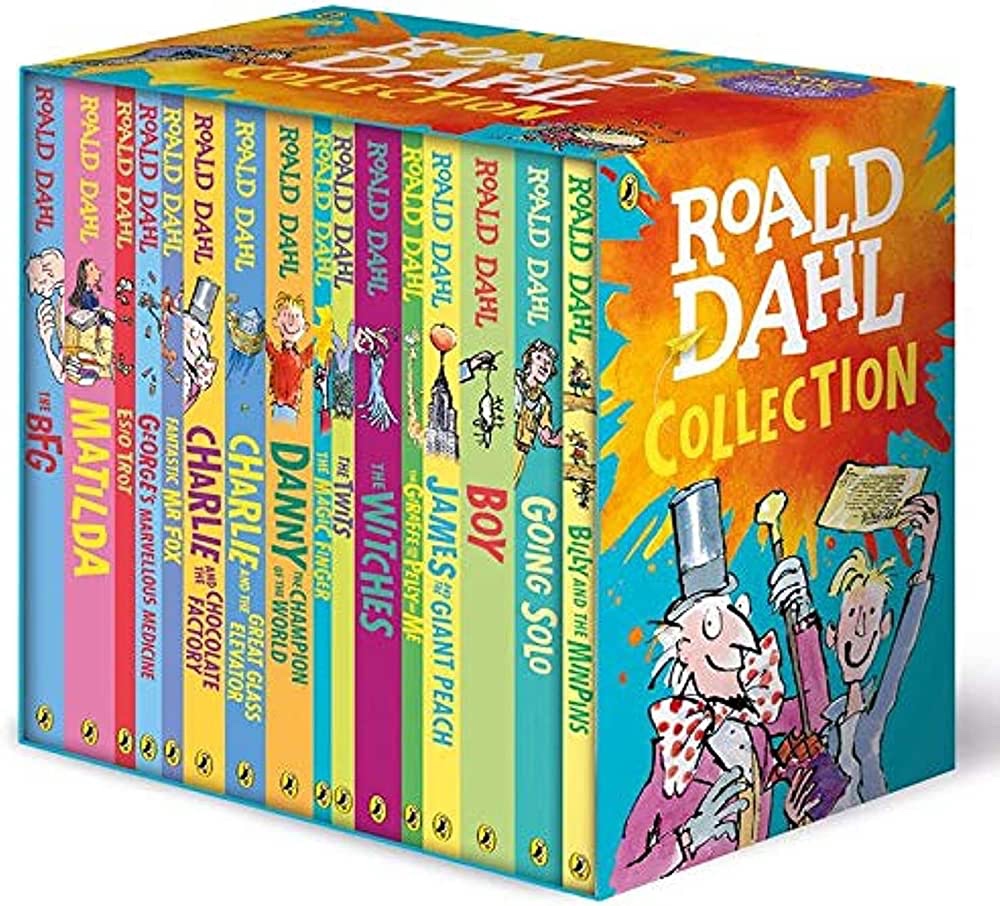
I recently read an article that the publisher of the late author Roald Dahl’s children’s books is working with a group called Inclusive Minds, a consortium of “sensitivity readers,” whose objective is to make children’s books “more inclusive.”

Dahl’s books, including “Charlie and the Chocolate Factory,” “James and the Giant Peach,” and “Matilda,” are some of the best known and widely read children’s books. Yes, they have been characterized as dark, irreverent, and edgy. Yet they have been beloved by generations of children because of their occasionally prickly, mean-spirited nature, not in spite of it.

Dahl’s publisher, Puffin Books U.K., is now rewriting his language to remove hundreds of possibly “damaging” words. To-date, the publisher has changed parts of at least 10 of Dahl’s books. Gone are references to people being “fat,” “ugly,” “bald,” and “crazy.” Scary tractors are no longer “black.” Boys and girls are referred to as the more gender-neutral “children.”

Facing a firestorm of accusations of “censorship,” Puffin announced that, alongside the sanitized versions of 17 Dahl’s books, it will also publish unaltered “classic” versions.

And that brings me to today’s provocative question.

How do you feel about book publishers altering the language in classic books to “sanitize” them by eliminating or changing words, phrases, and sentiments that some readers might find upsetting? Is it wrong to rewrite the words of a published author, living or dead, without the author’s permission?

If you choose to participate, you may respond with a comment or write your own post in response to the question. Once you are done, tag your post with #FPQ and create a pingback to this post if you are on WordPress. Or you can simply include a link to your post in the comments. But remember to check to confirm that your pingback or your link shows up in the comments.

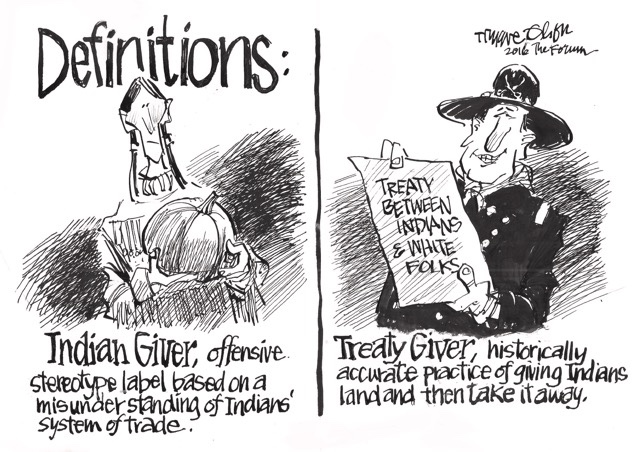
Indian Giver

In this post the other day, Nancy Richy, at The Elephant’s Trunk, mentioned someone who earned a reputation as an “Indian giver.” Nancy the said that she realized that the phrase “Indian giver” these days is “totally un-PC and not acceptable.”

That got me thinking about how the phrase “Indian giver” came about. The expression means one who gives a gift but later takes it back. It derives from the alleged practice of American Indians of taking back gifts from white settlers. Settlers did not understand that gift giving was central to Native American culture. When a gift was presented, it was done so with honor, and with the notion that the gift would be used and valued.

But, if the recipient of the gift did not use it, then that was viewed as disrespect, and the item was taken back, and likely given to someone else who would use it and appreciate it. The settlers, not understanding these aspects of the Native American culture, were, in turn, offended, and phrase Indian giver was born.

Which is interesting because historians would now agree that, where deceit was concerned, it was the settlers who were the front runners. Especially when it came to taking back lands granted to the Native American in peace treaties.

By the 1900s, the term Indian giver had made its way into the American vernacular, eventually used mostly as a schoolyard taunt, such as, “Teacher, Billy gave me the ball and now he wants it back! He’s being an Indian giver!”

Considering the roots of the term Indian giver, it is today considered offensive.

No wonder the Washington professional football team changed the team’s name from the “Redskins” to the “Commanders,” and the Cleveland Major League Baseball team changed its team’s name from the “Indians” to the “Guardians.”

Fandango’s Provocative Question #168

FPQ

Welcome once again to Fandango’s Provocative Question. Each week I will pose what I think is a provocative question for your consideration.

By provocative, I don’t mean a question that will cause annoyance or anger. Nor do I mean a question intended to arouse sexual desire or interest.

What I do mean is a question that is likely to get you to think, to be creative, and to provoke a response. Hopefully a positive response.

I blog anonymously, and so do a significant number of other bloggers. I’m not on Facebook, Twitter, or other social media sites, but I understand that a lot of people on those sites are posting anonymously, using pseudonyms or aliases.

In my case, I use a pseudonym on WordPress to protect my personal privacy and because I’ve had my identity stolen for fraudulent purposes twice already. But I don’t use my anonymity for malicious purposes or to be offensive.

So, along those lines, my provocative question this week is…

How do you feel about online anonymity? Do you believe that when people are hiding their real world identity, it encourages them to misbehave or to be offensive? Or does it allow people to reveal who they really are or possibly how they would choose to be and act all the time if they could?

If you choose to participate, write a post with your response to the question. Once you are done, tag your post with #FPQ and create a pingback to this post if you are on WordPress. Or you can simply include a link to your post in the comments. But remember to check to confirm that your pingback or your link shows up in the comments.

Tasteless and Offensive

AE24E8F8-FD87-4CEE-9A9C-16E4E53EB8EF“You really need to do something about your sense of humor,” Gary said. “That comedian was very funny.”

“I thought his jokes were way too abstract,” Judy said. “And that joke, if that’s what you’d call it, about how men can empower women, was just tasteless and offensive.

“See, that’s what I mean,” Gary said. “The fact that you didn’t appreciate his joke about female empowerment is yet another manifestation of your lack of wit.”

“You know, Gary,” Judy said, “Sometimes the words that escape from your mouth frighten me.” She looked at her watch. “It’s getting late. I told the babysitter we’d be home before midnight.

Now it was Gary’s turn to look at his watch. “It’s only 11:25, Judy,” he said. “It takes approximately ten minutes to drive home from here.” At least let me finish my beer.”

“If we don’t leave this instant,” Judy said, “it won’t be my alleged lack of wit that will manifest itself.”


Written for these one-word prompts: Weekly Prompt (humor), Fandango’s One-Word Challenge (abstract), Ragtag Daily Prompt (empower), Word of the Day (manifestation), Your Daily Word Prompt (frighten), Scotts Daily Prompt (late), and Daily Addictions (approximate).

FFfAW — Hot Pink

99EE5B84-EB08-443F-951D-EF4A772CC418“Why would anyone paint a wall on campus hot pink?” Harvey asked.

“That’s the classroom where they teach women’s studies,” William noted.

“Don’t you find that sexist?”

“Why would you say that?” William asked.

“You know,” Harvey answered, “Pink for girls, blue for boys. It’s so stereotypical to paint the wall outside of a women’s studies classroom pink. It’s offensive and demeaning.”

William saw a coed walking toward them and motioned to her. “Excuse me, may I ask you a question?”

The girl shrugged. “Sure.”

“This wall,” he said, pointing to the hot pink wall, “is outside of a women’s studies classroom. Does that offend you?”

“Why would that wall offend me?”

“My friend thinks that a pink wall outside of a women’s studies classroom is stereotypical and is degrading to women. Do you agree?”

The girl thought for a few seconds and then reached into her fanny pack, pulled out a piece of chalk, and drew a smiley face on the wall.

“That should answer your question.” And then she turned and walked away.

(175 words)


Written for this week’s Flash Fiction for Aspiring Writers from Priceless Joy. Image by Grant-Sud.