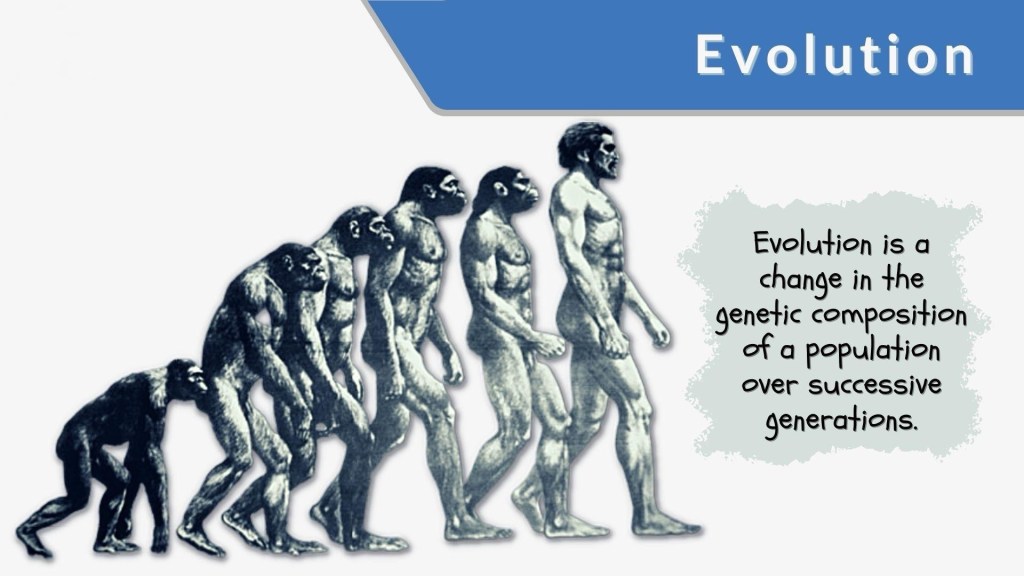
MLMM Friday Faithfuls — Evolution

For this week’s Mindlovemysery’s Menagerie Friday Faithfuls challenge, Jim Adams asks us to respond by writing anything about evolution.

I do believe in the theory of evolution. Take humans beings for example. Human beings, specifically anatomically modern Homo sapiens, first appeared on Earth around 300,000 years ago. Fossil and genetic evidence suggests that these early humans originated in Africa. The emergence of Homo sapiens marked a significant point in human evolution, characterized by a large and complex brain, the ability to make and use tools, and the capacity for language.

Over time, Homo sapiens developed more advanced traits, including complex symbolic expression and art, which mainly emerged during the past 100,000 years. The “great leap forward,” a period of rapid technological and cultural advancement, occurred between 65,000 to 50,000 years ago, indicating the evolution of a fully modern human brain.

But what about God and creationism? Well, I personally don’t believe that God exists. But let’s say, for the sake of this discussion, that there was some sort of being that created everything, including, about 4.5 billion years ago, the planet Earth 4.5. God did a lot of experimenting with the kind of life he wanted to have on Earth. He started out populating the planet with simple creatures from the sea. But then, for about 180 million years, dinosaurs ruled the planet, until about 66 million years ago, when God threw in the towel on his dinosaur experiment.

So humans are, in terms of the age of the planet, relatively recent life forms. And it took us 300,000 years to evolve into what we are today — for better or worse.

Jim also asked if we believe that evolution and religion are incompatible. I don’t see why people can’t believe in some magical being that created everything and in the lessons in the Bible, and also believe in evolution. But, if someone believes that the planet Earth is 6,000 to 10,000 years old, that human beings have always existed in their present form on planet Earth, and that humans and dinosaurs roamed the planet at the same time, then those religious beliefs (creationism) and evolution are incompatible.

MFFFC — A Monkey’s Uncle

“Look at that monkey sitting on that rock eating an ear of corn. Doesn’t he look like he could almost be human?” James said to his son, Kyle.

“Hey Dad, I have a question for you,” Kyle said. “When I was in Sunday school last weekend, the teacher was talking about how God created everything, including humans. But then she said some people don’t believe that. She said they believe that humans evolved from monkeys. But she said that if humans evolved from monkeys, how can monkeys and humans be alive at the same time? So there is a monkey,” Kyle said, pointing to the corn on the cob-eating monkey, “and I’m a human, and we are both alive now. So humans can’t have evolved from monkeys, right?”

“That’s a great question, Kyle,” James said. “Let me explain. Humans did not directly evolve from modern-day monkeys. Instead, both humans and modern-day monkeys share a common ancestor from which they evolved around 25 million years ago. So, in the vast evolutionary family tree, humans and monkeys are cousins. It’s like you and your cousin Mike. You and Mike both have the same grandparents but different parents. You and Mike are related, but you’re in different branches of the same family tree!”

“I’m going to tell my Sunday school teacher that she is wrong and that monkeys and humans can be alive at the same time because we have the same grandparents,” Kyle said.

“I’ll tell you what, Kyle,” James said. “You don’t need to correct your Sunday school teacher. I’ll talk to her and make sure she understands how evolution works, okay?”

Kyle thought for a moments and finally said okay. “But I have another question for you. If that monkey and I are cousins because we share the same grandparents, does that make you that monkey’s uncle?”


Written for Melissa’s Fandango Flash Fiction Challenge. Photo credit: Bao Menglong on Unsplash.

I is for Inherit the Wind

For this year’s A-To-Z Challenge, my theme is MOVIES. I will be working my way through the alphabet during the month of April with movie titles and short blurbs about each movie. Today’s movie is “Inherit the Wind.”

“Inherit the Wind” was a 1960 American film based on the 1955 play written by Jerome Lawrence and Robert Edwin Lee. The film was directed by Stanley Kramer and starred Spencer Tracy as lawyer Henry Drummond and Fredric March as his friend and rival Matthew Harrison Brady. It also featured Gene Kelly, Dick York, Harry Morgan, Donna Anderson, Claude Akins, Noah Beery Jr., Florence Eldridge, and Jimmy Boyd.

In the 1920s, Tennessee schoolteacher Bertram Cates (Dick York) is put on trial for violating the Butler Act, a state law that prohibits public school teachers from teaching evolution instead of creationism. Drawing intense national attention in the media with writer E. K. Hornbeck (Gene Kelly) reporting, two of the nation’s leading lawyers go head to head: Matthew Harrison Brady (Fredric March) for the prosecution, and Henry Drummond (Spencer Tracy) for the defense.

The film is based on the so-called “Monkey Trial” of 1925, that put a young high school teacher named John T. Scopes on trial for violating a state law, passed the same year, prohibiting the teaching of any theory that denied the biblical account of divine creation. Darwin’s theory of evolution was also therefore on trial. Two of the most famous lawyers and orators in the land contested the case. Scopes was defended by the legendary Clarence Darrow, and the prosecution was led by three-time presidential candidate William Jennings Bryan. Darrow’s expenses were paid by the Baltimore Sun papers, home of the famed journalist H.L. Mencken, who meticulously covered the trial.

In the movie, after his six expert scientific witnesses are not allowed to testify, Drummond boldly calls Brady onto the stand as a defense witness. The bombastic Brady is unable to refuse a chance to show off, and Drummond quizzes him on biblical details, more or less destroying his credibility in the process; Brady is finally reduced to agreeing with Bishop Usher that God created the Earth at exactly 9 a.m. on Oct. 23, 4004 BC. This impactful movie scene was an actual, masterfully performed reenactment of what Darrow really did when he called Bryan to the stand and methodically ground him down.

Spencer Tracy was nominated for the Best Actor Academy Award for his performance in “Inherit the Wind.” The movie was also nominated for Best Screenplay based upon material from another medium, Best Cinematography, and Best Film Editing. From my personal perspective, it is one of the best films ever, and I highly encourage anyone who hasn’t seen it to watch it.


Previous A2Z 2022 posts: A B C D E F G H I J K L M N O P Q R S T U V W X Y Z

Fandango’s Flashback Friday — November 5th

Wouldn’t you like to expose your newer readers to some of your earlier posts that they might never have seen? Or remind your long term followers of posts that they might not remember? Each Friday I will publish a post I wrote on this exact date in a previous year.

How about you? Why don’t you reach back into your own archives and highlight a post that you wrote on this very date in a previous year? You can repost your Friday Flashback post on your blog and pingback to this post. Or you can just write a comment below with a link to the post you selected.

If you’ve been blogging for less than a year, go ahead and choose a post that you previously published on this day (the 5th) of any month within the past year and link to that post in a comment.


This was originally posted on my old blog all the way back on November 5, 2005

The End of Evolution

The so called “Monkey Trials” of 1925 captured the interest and imagination of the public and contributed to the growing chasm between men of science and men of faith. But men of science won that round and evolution has since prevailed over creationism as the accepted theory for the origin of the species.

Yet those who shun Darwin’s theories of evolution and natural selection and consider it to be an affront to the bible, to faith, and to religiosity have not been silently sitting around taking it on the chin for all these years. They have continued to espouse their belief that evolution is nothing more than a flawed theory and has no basis in fact.

Until recently, this argument against decades, if not centuries, of exhaustive scholarly research and overwhelming scientific evidence was accepted only by the far religious right. But more recently there has been an all-out assault on the science of evolution by Christian evangelicals and even some religious mainstreamers through the aggressive promotion of creationism in sheep’s clothing. It goes by the name of “intelligent design,” or “ID.”

In their effort to remove religion and to avoid overtones of theocracy in this new wave of creationism, proponents of intelligent design are carefully crafting their messaging in secular terms and are going to great lengths to avoid mentioning the identity of the “designer.” The belief of this movement is that the use of secular terms, cultivation of ambiguity around the “designer,” and dialog that avoids religious overtones are necessary to reintroduce the religious notion of God as the designer. The idea is to get the bible out of the discussion and to put this “scientific theory” on an even footing with evolution.

Charles Krauthammer, in an article that appeared in the August 1, 2005 issue of Time Magazine, observed that intelligent design is nothing more than a “new and gratuitous attempt to invade science, and most particularly evolution, with religion.” He continued to note that “evolution is one of the most powerful and elegant theories in all of human science and the bedrock of all modern biology.” But those who support ID focus on only one word in that observation: “theory,” and attempt to fill what they perceive to be gaps in the theory of evolution with the notion of an intelligent designer — and a divine one, at that.

Intelligent design is a fine curriculum for Sunday school and religious schools. Let’s keep it out of our public, academic schools’ science curriculums.


Note: The Doonesbury (©️Garry Trudeau) strip above was not included on the original post.

Fandango’s Provocative Question #133

FPQ

Welcome once again to Fandango’s Provocative Question. Each week I will pose what I think is a provocative question for your consideration.

By provocative, I don’t mean a question that will cause annoyance or anger. Nor do I mean a question intended to arouse sexual desire or interest.

What I do mean is a question that is likely to get you to think, to be creative, and to provoke a response. Hopefully a positive response.

On Sunday, for my Who Won the Week post, I designated “evolution” as the week’s winner because, for the first time, more than half of American adults surveyed said that they believe that modern humans developed from earlier species of animals. But at the same time, around 40% of American adults ascribe to a strictly creationist view of human origins, believing that God created them in their present form within roughly the past 10,000 years.

The study suggested that education, specifically having a college degree, is one of strongest factors leading to the acceptance of evolution. It also identified religious fundamentalism as the strongest factor leading to the rejection of evolution.

So with this in mind, my provocative question this week is this…

Do you believe that modern human beings, Homo sapiens, evolved between 150,000 to 200,000 years ago from earlier species? Or do you believe that God created humans in their present form within the past 10,000 years? Or, if you believe something else, what is it?

If you choose to participate, write a post with your response to the question. Once you are done, tag your post with #FPQ and create a pingback to this post if you are on WordPress. Or you can simply include a link to your post in the comments. But remember to check to confirm that your pingback or your link shows up in the comments.

Who Won the Week — 8/29/2021

The idea behind Who Won the Week is to give you the opportunity to select who (or what) you think “won” this past week. Your selection can be anyone or anything — politicians, celebrities, athletes, authors, bloggers, your friends or family members, books, movies, TV shows, businesses, organizations, whatever.

I will be posting this prompt on Sunday mornings (my time). If you want to participate, write your own post designating who you think won the week and why you think they deserve your nod. Then link back to this post and tag you post with FWWTW.

My pick for who won the week this week is Evolution. In a recently published study by the University of Michigan, the level of public acceptance of evolution in the United States is now solidly above the halfway mark. The study was based on a series of national public opinion surveys conducted over the last 35 years.

The study determined that 54% of Americans now agree with the statement that, “Human beings, as we know them today, developed from earlier species of animals.” Just a decade ago, only 40% believed in evolution.

Examining data over 35 years, the study consistently identified aspects of education — civic science literacy, taking college courses in science, and having a college degree — as the strongest factors leading to the acceptance of evolution. “It’s hard to earn a college degree without acquiring at least a little respect for science,” one of the study’s co-authors noted.

The Michigan study consistently identified religious fundamentalism as the strongest factor leading to the rejection of evolution. and predicted that religious fundamentalism would continue to impede the public acceptance of evolution. Further, like almost everything else in America. As of 2019, 34% of conservative Republicans accepted evolution compared to 83% of liberal Democrats.

So congratulations evolution. It seems that the thinking of at least a small majority of Americans is beginning to evolve. At least with respect to evolution.

What about you? Who (or what) do you think won the week?

The Evolution of Male Pattern Baldness

I was born with a full head of dark, curly hair.

In my first decade, my hair grew fast and my mother used to cut my hair with a bowl on my head.

In my second decade, my favored haircuts were crewcuts and flattops.

In my third decade, I was a hippie, grew my hair long, and let my freak flag fly.

In my fourth decade, my thick, wavy hair started to thin out and my forehead got larger.

In my fifth decade, my hair started to turn gray.

In my sixth decade, my combover was suspect.

In my seventh decade, I gave up and started shaving my head.

Note: None of these photos, except the one below, is of the real Fandango.

Fandango’s Provocative Question #80

FPQWelcome once again to Fandango’s Provocative Question. Each week I will pose what I think is a provocative question for your consideration.

By provocative, I don’t mean a question that will cause annoyance or anger. Nor do I mean a question intended to arouse sexual desire or interest.

What I do mean is a question that is likely to get you to think, to be creative, and to provoke a response. Hopefully a positive response.

I saw this question on a site that offers up a bunch of “deep, philosophical” questions and this one intrigued me. It’s about evolution, but not in the context of Darwin’s evolution of the species. It’s more about evolution of the individual and about who you are and how you change over time. Here’s this week’s question, which is essentially about you. I hope you’ll have fun with it.

Is the concept of “you” continuous or does the past “you” continually fade into the present and future “you”? Considering that your body, your mind, and your memories are changing over time, what part of “you” sticks around?

If you choose to participate, write a post with your response to the question. Once you are done, tag your post with #FPQ and create a pingback to this post if you are on WordPress. Or you can simply include a link to your post in the comments. But remember to check to confirm that your pingback or your link shows up in the comments.

Share Your World — Cool and Hip Rainy Afternoons

Share Your WorldMondays mean Melanie’s Share Your World questions. Let’s get right to it.

When you’re 90 years old, what do you suppose will matter most to you?

Good health, enough money to live comfortably, and making it to 91.

What’s the best way to spend a rainy afternoon?

Staying dry.8FCE89C2-2027-46DD-B9E7-F052B86A1A5F

What is one thing you don’t understand about yourself?

Who I really am.7B717F8E-8C91-43DB-BBBC-F3A796322410

When was the last time you tried something to look ‘cool’ (hip), but it ended in utter embarrassment? Details?

It’s been a long time since I tried to look cool or hip. At my age, there’s little that I could to do to achieve being cool or hip, and I fear that any attempt to appear that way would end in embarrassment.

Share a picture, a story, or an event that shows your gratitude

One day after a gunman in Texas killed seven and wounded 21 others,Tony Perkins, head of the Family Research Council, said on “Fox & Friends” that mass shootings are caused by “driving God from the public square,” and specifically by teaching kids about evolution. Why am I grateful for this? Because it illustrates, for the whole world to see, how moronic far-right, Christian conservatives are.

One-Liner Wednesday — The Monkey Trial

FD42016C-4230-4D60-AC4E-F2637599D171

“Do you think about things you do think about?”

Clarence Darrow

Today’s One-Liner Wednesday comes from the recorded transcript of the Scopes (Monkey) Trial, which took place in a Dayton, Tennessee courtroom in July of 1925.

Dayton teacher John T. Scopes was being prosecuted for teaching Charles Darwin’s theory of evolution in his high school class, despite a new Tennessee state statute banning the teaching in public schools of any theory that denied the biblical story of Creation.

Chicago criminal attorney Clarence Darrow served as the defense attorney for Scopes and former presidential candidate William Jennings Bryan acted as opposing counsel.

It was day seven of the trial and Clarence Darrow had called William Jennings Bryan, as an expert on the Bible, to the stand.

Darrow was asking Bryan when the “Great Flood” took place and Bryan said he couldn’t fix the date, although he did say that some biblical scholars put it at 4004 BC.

Darrow then asked, “What do you think?”

Bryan responded, “I do not think about things I don’t think about.”

Darrow then asked Bryan, “Do you think about the things you do think about?”