SoCS — It’s Not Funny

For this week’s Stream of Consciousness Saturday prompt, Linda G. Hill has challenged us to respond with the word “joke.”
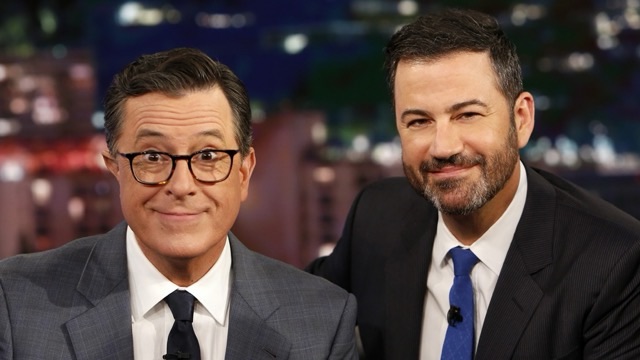
Late night talk show hosts and stand-up comedians are not politicians, heads-of-state, captains of industry and commerce, or religious leaders. They’re friggin’ comedians. They try to make their audiences laugh a lot — and squirm a little. One of the greatest stand-up comedians of all time, George Carlin, said, “I think it’s the duty of the comedian to find out where the line is drawn and cross it deliberately.”

Comedy, by definition, is meant to be somewhat controversial. The reality is that, for as long as there has been comedy, there has been “offensive” comedy (i.e., comedy that may offend some people).

Although not stand-up comics, humorists, philosophers, and writers like Mark Twain, Will Rogers, and H.L. Mencken were often biting in their witty social and political commentaries. In the Fifties and Sixties, political and social satire worked its way into small folk music and comedy clubs, where comedians like Mort Sahl and Lenny Bruce expanded both the language and boundaries of stand-up.

Today, it’s the comic talents of people like Stephen Colbert, Jimmy Kimmel, Jon Stewart, and John Oliver who are using political satire to speak truth to power. But power these days (e.g., Donald Trump) is so thin-skinned and insecure that he can’t take a joke where he happens to be the punchline. And then he uses his power, influence, and vindictiveness to get them fired. Kimmel’s show was pulled off the air for a week and Colbert’s show is ending next May.

If Trump had his way, any joke about him would result in jail time for the jokester. He has openly criticized late-night hosts and networks, using both social media and his administration to call for the cancellation or regulation of shows critical of him. He has made statements suggesting that late-night programming that criticizes him should face license revocation and further regulatory scrutiny.

Despite political and regulatory pressures, prominent hosts like Jon Stewart, Stephen Colbert, and Jimmy Kimmel have made it clear through on-air commentary and guest appearances that they are unwilling to back down from political satire. There is a spirit of solidarity within the industry to defend free speech and resist overt political influence.

Trump’s war against political satire that is aimed at him is not funny. He may ultimately be successful at shutting down late-night comedy shows that have existed and made jokes about those in power from both parties for decades. But political satire and the impulse to lampoon those in power is likely to persist in new and evolving formats regardless of Trump’s efforts to shut them down.

America, just because Donald Trump can’t take a joke doesn’t mean that we need to give up our collective sense of humor and shy away from good political satire.

Y is for Young Frankenstein

For this year’s A-To-Z Challenge, my theme is MOVIES. I will be working my way through the alphabet during the month of April with movie titles and short blurbs about each movie. Today’s movie is “Young Frankenstein.”

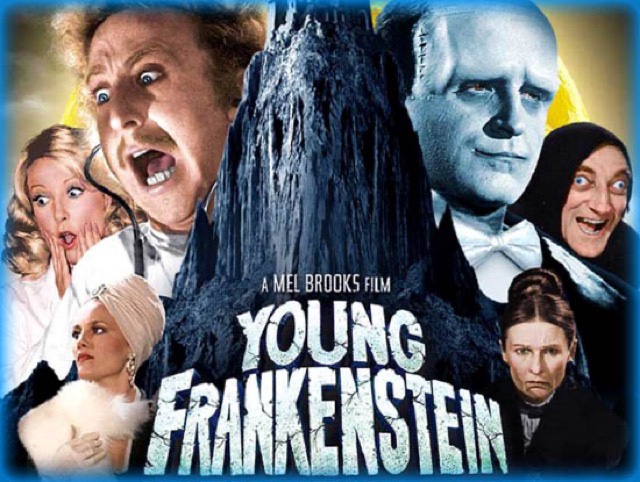
“Young Frankenstein” is, arguably my favorite movie. Certainly my favorite comedy movie. It was a 1974 American comedy/horror film directed by Mel Brooks. The screenplay was co-written by Brooks and Gene Wilder. Wilder also starred in the lead role as the title character, a descendant of the infamous Dr. Victor Frankenstein, and Peter Boyle as the monster. The film co-starred Teri Garr, Cloris Leachman, Marty Feldman, Madeline Kahn, Kenneth Mars, Richard Haydn, and Gene Hackman.

The film is considered to be one of writer-producer-director Mel Brooks’ best films. It’s a nostalgic, hilarious spoof-tribute to classic horror films. “Young Frankenstein” was, like many of Brooks’ films, filled with physical gags, terrible puns, one-liners, and shattered taboos. Old-style wipes, fades to black and iris shots were numerous throughout the movie.

Dr. Frederick Frankenstein (Gene Wilder) is the grandson of the infamous Baron Von Frankenstein. But he wants to distance himself from this legacy, going so far as to insisting that his name be pronounced “Fronk-en-steen.” After telling his students at an American university that there is no way to generate life after nerves are severed and declaring that the work of his grandfather was “doodoo,” he is confronted and informed by Herr Falkstein (Richard Haydn) that he has inherited his family’s Transylvania estate and must travel there immediately.

Upon his arrival, Dr. Frankenstein meets Igor, (Marty Feldman), pronounced “Eye-gore,” his hunchback servant, and Inga (Teri Garr), his beautiful assistant. At the castle, he meets the frightening housekeeper, Frau Blücher (Cloris Leachman). Soon, Dr. Frankenstein discovers a secret entrance into his grandfather’s laboratory, where he finds a book written by his grandfather entitled, How I Did It, by Victor Frankenstein. Dr. Frankenstein, along with his sidekicks, and driven by a curiosity about his grandfather’s work, begins to experiment with creating life. Stealing the body of a hanged criminal (Peter Boyle), Dr. Frankenstein begins to recreate and improve upon his grandfather’s legacy. Igor, entrusted with the task of procuring the brain of a famed historian, drops the container holding the brain, damaging it beyond use. Instead, he takes the abnormal brain, assumed to be the brain of a criminal. Dr. Frankenstein is successful in his experiment and “The Monster” is brought to life.

Hilarity ensues as Dr. Frankenstein and his sidekicks, along with Inspector Kemp (Kenneth Mars), and a group of angry villagers, trying to contain “The Monster” who only wants to be loved, hates being mocked, and will only be soothed by the melancholy music of the violin. All ends well as Dr. Frankenstein succeeds with a partial “transference” meant to switch the brains of himself and “The Monster” in order to make “The Monster” more human. Dr. Frankenstein then marries Inga, and “The Monster” marries Elizabeth (Madeline Kahn), Dr. Frankenstein’s ex-fiancé.

A bit of trivia. You’re heard of the band Aerosmith, right? Well, band member Joe Perry came up with the guitar riff for a song and the band developed the track, but four days later Steven Tyler still didn’t have any lyrics for the song. With no lyrics forthcoming, they considered dumping the track, but inspiration struck when the band (minus Tyler and Perry) took a break and went for a walk around New York City, where they were recording.

“Young Frankenstein” was playing in Times Square, so they went to see it. There is a famous scene in the movie where Igor tells Dr. Frankenstein to “Walk This Way,” meaning to follow him. Dr. Frankenstein imitates Igor’s walk, which the band thought was hilarious. When they saw Tyler the next day, they informed him that the title of the song would be “Walk This Way.” Other than the title of the song, though, it and the movie had nothing in common.

Interesting factoid: “Young Frankenstein” was filmed in the same castle and with the same props and lab equipment (created and loaned by property manager Ken Strickfaden) as the original James Whale 1931 horror film “Frankenstein.”

If you’ve never seen this movie, and if you like to laugh, I highly recommend watching it. I promise you won’t regret it.


Previous A2Z 2022 posts: A B C D E F G H I J K L M N O P Q R S T U V W X Y Z

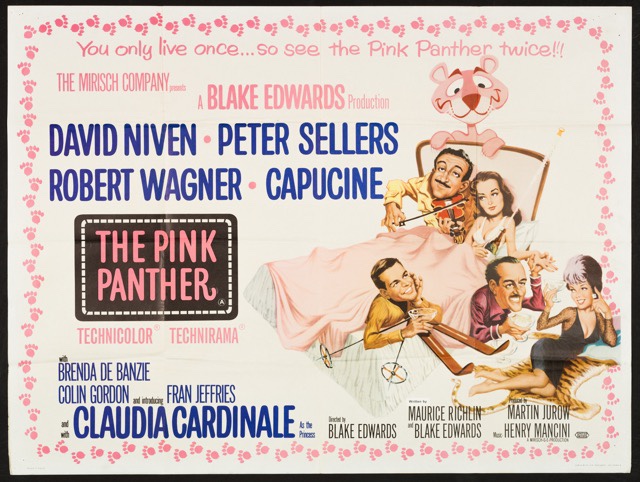
P is for The Pink Panther

For this year’s A-To-Z Challenge, my theme is MOVIES. I will be working my way through the alphabet during the month of April with movie titles and short blurbs about each movie. Today’s movie is “The Pink Panther.”

“The Pink Panther” was a 1963 American comedy film directed by Blake Edwards. It was written by Maurice Richlin and Blake Edwards and starred David Niven, Peter Sellers, Robert Wagner, Capucine, and Claudia Cardinale. My focus is on this first Pink Panther movie, not on the myriad sequels in what became a Pink Panther franchise.

In this film, a dashing European thief, Sir Charles Lytton (David Niven), plans to steal a diamond, but he’s not the only one with his eyes on the famous jewel known as the “Pink Panther.” His nephew George (Robert Wagner) also aims to make off with the gem, and to frame Charles for the crime. Blundering French police inspector Jacques Clouseau (Peter Sellers) intercedes, but finds his career — and his freedom — jeopardized.

In the film, Clouseau tries to stop the theft of the Pink Panther, but his clumsy attempts fail. He doesn’t realize that his wife, Simone (Capucine), is the Phantom’s lover, and throughout the movie, she is dodging her husband while trying both to carry out Sir Charles’ plans and to avoid George, who is smitten by her. Clouseau manages to capture Sir Charles and his accomplices, and a conviction looks inevitable until Sir Charles and Simone hatch a plan to frame Clouseau. The defense calls a surprised Clouseau to the stand as their lone witness. The barrister asks a series of questions that suggest Clouseau himself could be the Phantom. The unnerved Clouseau pulls his handkerchief out of his shirt pocket, revealing the jewel planted there by Madame Clouseau.

The cartoon Pink Panther then closes the film by holding the card reading THE END after getting run over by the police car carrying Clouseau to prison.

“The Pink Panther” was meant to be the first in a series of films based on David Niven’s character “The Phantom.” But despite the fact that Inspector Clouseau may not have been intended as the movie’s main character, Peter Sellers stole the show. The popularity of Sellers’ character, bumbling Inspector Clouseau, led to Clouseau, not the Phantom, headlining the rest of the series. The film also introduced the cartoon character of the same name, in an opening credits sequence, as well as a score from Henry Mancini.

As a side note, the 1964 sequel, “A Shot in the Dark,” where Peter Seller’s Inspector Clouseau becomes the focus of the movie, is arguably one of the greatest comedy films of all time. This was the film that introduced many of the most famous elements of The Pink Panther film series, such as the karate fights with Cato and Clouseau’s disgruntled boss Commissioner Dreyfus. Peter Sellers was at his best.


Previous A2Z 2022 posts: A B C D E F G H I J K L M N O P Q R S T U V W X Y Z

O is for Oh Brother, Where Art Thou?

For this year’s A-To-Z Challenge, my theme is MOVIES. I will be working my way through the alphabet during the month of April with movie titles and short blurbs about each movie. Today’s movie is “O Brother, Where Art Thou?”

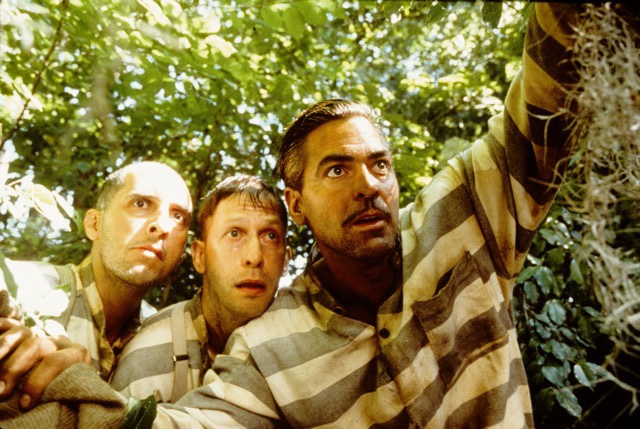
“O Brother, Where Art Thou?” was a 2000 crime comedy-drama musical film written, produced, co-edited and directed by Joel and Ethan Coen. It starred George Clooney, John Turturro, and Tim Blake Nelson, with Chris Thomas King, John Goodman, Holly Hunter, and Charles Durning in supporting roles.

I didn’t think I was going to like this movie, but oh brother, was I wrong. It was a hoot. The film was loosely based on Homer’s “Odyssey.” It deals with the twisted adventures of Ulysses Everett McGill (George Clooney) and his “companions” Delmar (Tim Blake Nelson) and Pete (John Turturro) in 1930s Mississipi.

McGill scams his way off of a hard-labor chain gang, and still shackled to his own chain-mates from the chain gang, he, Delmar, and Pete set out to pursue freedom and the promise of a fortune in buried treasure. With nothing to lose, their hasty run takes them on an incredible journey of awesome experiences and colorful characters in this hilarious, offbeat road picture. It’s an odyssey filled with chases, close calls, near misses, and betrayal that left me laughing out loud at every outrageous twist and turn.

The movie was nominated for two Academy Awards: Best Adapted Screenplay and Best Cinematography.

Music plays a key role in the film when the trio of convicts record a bluegrass song called “Man of Constant Sorrow” that becomes a hit. In the film and on the soundtrack, they’re billed as the Soggy Bottom Boys. The voices were actually those of Alison Krauss and Union Station member Dan Tyminski, Nashville Bluegrass Band member Pat Enright, and Music City songwriter Harley Allen.

The song was a hit in the real world, too. “Man of Constant Sorrow” charted in the Top 40 on the Billboard Hot Country Songs chart, and earned three major awards: Best Country Collaboration With Vocals at the Grammys, Song of the Year at the International Bluegrass Music Association Awards, and Single of the Year at the CMA Awards.

I’d love to share more with you about this hugely entertaining movie, but I’m afraid I’d be spoiling it for you should you ever choose to watch it, which I seriously recommend that you do.


Previous A2Z 2022 posts: A B C D E F G H I J K L M N O P Q R S T U V W X Y Z

V is for “Veep”

“Veep” was an American political satire comedy television series that aired on HBO from April 22, 2012, to May 12, 2019. The series was created by Armando Iannucci as an adaptation of his sitcom “The Thick of It.”The main character in “Veep” was Selina Meyer (Julia Louis-Dreyfus), a fictional Vice President of the United States. The series follows the personal life and political career of Meyer. Her party affiliation is never discussed, although it is hinted in the fourth season finale that it was Democratic. After Meyer was elected Vice President, her staff, upon whom she was almost totally reliant, includes chief of staff Amy Brookheimer (Anna Chlumsky), director of communications Mike McLintock (Matt Walsh), deputy director of communications Dan Egan (Reid Scott), body man Gary Walsh (Tony Hale), and personal secretary Sue Wilson (Sufe Bradshaw). Later additions to her team as president include White House Chief of Staff Ben Cafferty (Kevin Dunn) and political strategist Kent Davison (Gary Cole). Jonah Ryan (Timothy Simons), initially a White House liaison to the Vice President’s office and later a New Hampshire congressman, also features prominently.

“Veep” received critical acclaim and won several major awards, including seven consecutive nominations for the Primetime Emmy Award for Outstanding Comedy Series, winning that award for its fourth, fifth, and sixth seasons. Louis-Dreyfus’ performance won her six consecutive Primetime Emmy Awards, three Screen Actors Guild Awards, two Critics’ Choice Television Awards, a Television Critics Association Award, and five consecutive Golden Globe nominations. For his portrayal of Selina’s personal aide, Gary, Tony Hale received six consecutive Emmy nominations for Outstanding Supporting Actor in a Comedy Series, winning in 2013 and 2015. Other members of the cast who received Emmy nominations include Anna Chlumsky (six nominations), Gary Cole (one nomination), Matt Walsh (two nominations), Martin Mull (one nomination), Hugh Laurie (one nomination), and Peter MacNicol (one nomination).

I really enjoyed “Veep,” but by the time the show ended in 2019, I was sick of watching anything to do with politics — even satirical political shows that made fun of political maneuverings. The political realities were enough and, had “Veep” been renewed for another season, as good as the show was, I’d probably have skipped it.


Previous BATZAP 2021 posts: A B C D E F G H I J K L M N O P Q R S T U

Truthful Tuesday — Movie Time

E14D5C78-0C96-49DB-BDA9-38CCE034EEABIt’s time for another installment of PCGuy’s Truthful Tuesday. This week he’s looking for our honest and truthful answer to the question:

What three movies best sum up your taste in movies, and why?

Okay, this is a hard one because I have a very eclectic taste in movies. I enjoy powerful dramas, psychological thrillers, science fiction, comedy, fantasy, and…well, that’s enough.

So, I’m going to go with my favorite movies in three of those genres. Let’s start with comedy. My all time favorite comedy is the Mel Brooks 1974 film, “Young Frankenstein.”Young-FrankensteinAs far as I’m concerned, it is the funniest movie ever. It is terribly clever and it always makes me laugh out loud whenever I see it, which is often.

There are so many great science fiction movies out there, but I’m going with the first one I ever saw and, while this 60+ year old film is dated from the perspective of what Sci-Fi filmmakers can do today with CGI and other special effects, the 1956 classic, “Forbidden Planet,” was a technological breakthrough for its time and remains high on my list of favorites.Forbidden PlanetThis next film is one I consider to be in two genres: powerful dramas and psychological thrillers. There are so many movies in these two genres to choose from, but I’m going to select one that I consider to be the classic neo-noir psychological thriller and that I thought was ingeniously crafted. “Memento” was presented in reverse chronological order based upon the story of a man with short-term memory loss who attempts to track down his wife’s murderer. I had to watch it two or three times to see how brilliantly it was put together.Memento posterAnyone else care to join in the fun? What three movies best reflect your taste in movies?

Our Cheerless Leader

B9A3601A-52EF-4457-B94F-FAE7657538E3Yes, our Cheerless Leader apparently feels that satirical comedy, especially when it satirizes him, is unfair and should not be legal.

This goes way beyond being thin-skinned. It’s conclusive proof that Donald Trump wants to negate the First Amendment, to control the free press, and to suppress all criticism.

He wants to be a dictator.

#FOWC — Mission Accomplice

img_1781Donald Trump has managed to make both the Republican majority in Congress and the swamp creatures he calls his Cabinet members complicit in his mission to undermine everything the United States has stood for since the Declaration of Independence was signed 242 years ago.

What Donald Trump doesn’t realize — or maybe he does and just doesn’t care — is that he is Putin’s unwitting accomplice in the Russian autocrat’s drive to bring down America and to make Russia great again. And relevant again. Putin realizes that he cannot destroy America from the outside, so he has recruited an oblivious Donald Trump to help him destroy the country from within.

And the thin-skinned con artist from the Big Apple has acceded to Putin’s flattery and is tearing apart the diverse tapestry that makes America the great country that it is. Or that it has been, anyway.

There is little solace to be taken in this dire situation, even with the upcoming midterm elections coming up in November. Who knows if the so-called “blue wave” will actually materialize or will be of sufficient magnitude to actually turn the tide on this sad and tragic comedy that is Donald Trump.

Unless something radical happens soon, it will be too late to stop Trump from becoming the American Putin and from the United States from becoming the world’s newest autocracy.

For some excellent insight into how the principals on which our country has stood for have come undone, I strongly suggest you read this post from Judy Dykstra-Brown.


Written for Teresa’s Three Things Challenge where the three things are tapestry, comedy, and Big Apple. Also for the Word of the Day Challenge, “solace,” and for Fandango’s One-Word Challenge, “accomplice.”