Fandango’s Flashback Friday — December 26th

This was originally posted on December 26, 2013 on my old blog.

Confessions of an Atheist on the Day After Christmas

Image conjured by Ideogram on 12/26/25

While doing my research for this post (yes, readers, I do research before posting…well, sometimes), I came across a blogger who wrote…and I’m not making this up:

As a rule, atheists tend to be a pretty miserable lot, while the best Christians I know are also the most put-together, positive, and effective people in the room.

Seriously, have you ever been in a room full of Christians? Okay, it’s difficult in this country to not be in a room full of Christians, since four out of five Americans identify themselves as Christians. But that’s not my point. To say that atheists are miserable and that Christians are “put-together, positive, and effective people” is as silly as, well, believing in the existence of some sort of omnipotent, infallible, supernatural, bearded white guy who stares down at us from heaven and watches over everything we do.

This same blogger also wrote, “Nowhere does the Bible try to prove the existence of God. He is. Period. Deal with it, earthlings.” See what I mean? Silly.

The word — or perhaps I should say the label — “atheist” has, for many in this country, had a very powerful — and negative — stigma attached to it. If you are an atheist, as am I, and you openly admit to being an atheist, some people will react toward you as if you are a leper with AIDS who comes from another planet. No wonder Christians consider us to be a pretty miserable lot.

By the way, no offense meant to any of my readers who have leprosy, AIDS, or come from another planet. Should anyone ask, just tell them you’re an atheist. They’ll understand.

The word atheist has such a negative connotation these days (except among other atheists), that some atheists don’t want to be identified as atheists. Instead, they have embraced the label “non-believer.” And in doing so, people, especially religious people, often equate the two terms: an atheist is a non-believer; a non-believer is an atheist.

I call bullshit on that. According to Dictionary.com, an atheist is “a person who denies or disbelieves the existence of a supreme being or beings.” A non-believer is “a person who lacks belief or faith, as in God, a religion, an idea, or an undertaking.”

Okay, I admit that the definitions are similar, but they are not identical. The key words in the definition of a non-believer that differentiate it from that of an atheist are “idea” and “undertaking.” And that’s where I wish to expound upon why calling an atheist a non-believer is inaccurate…or at least why I believe it to be so.

Everyone, be they Christian, Jew, Muslim, Hindu, Buddhist, Pagan, atheist, has beliefs. Even Scientologists have beliefs. Weird fucking beliefs, but beliefs nonetheless.

I’m an atheist and I believe that God does not exist. I also believe in women’s rights, in climate change, in evolution, in free speech, in freedom of (or from) religion, in equal rights for gays, and in gun control.

Yeah, I know. You’re thinking that these beliefs make me a liberal, which is the next worst label a person can have after atheist, right?

I also believe in the Oxford comma and that a good command of grammar, usage, punctuation, and spelling is essential for bloggers. And to some of you in the blogosphere, that makes me an asshole. A liberal, atheist, asshole.

I believe that humans are fallible and that we all make mistakes…some more than others. I believe that most people are good, decent, and moral, regardless of their religious beliefs. And I believe in my country. Just not in “God and country.”

You’re probably thinking that these are not beliefs. These are philosophies. These are ideologies. I’m expressing political opinions, not, you know, beliefs.

Sorry, I don’t believe that. Yes, these are philosophical beliefs. They are ideological and even political beliefs. But they are, nevertheless, beliefs.

So except from a very narrow religious perspective, just because I don’t believe in God, doesn’t make me a non-believer. If you must put a label on me regarding what I belief with respect to a deity, label me an atheist. I’m fine with that. But don’t call me a non-believer. I have a whole host of beliefs, ideas, and undertakings. There is not one of us…unless you’re dead…who doesn’t.

Yesterday was Christmas day. For those of you who do believe in God and celebrated the birth of Jesus Christ, I hope you had a very merry Christmas.

Sunday Poser — Compartmentalization

For today’s Sunday Poser, Sadje wants to know:

How do you deal with stuff that is beyond your control, such as illness or loss?

We all have stressful times that we need to deal with. These can include grief and the sense of loss from losing a close friend or a loved one, financial worries, family issues, and other life stresses, like having your blog inundated with views from China or watching Donald Trump destroy the country you love.

I can’t say that I use prayer or faith or my belief in god or some other magical mystery deity to help me get through difficult times. After all, I am an atheist and don’t believe in the existence of an all-knowing, all-seeing, ever-present, all-powerful supernatural being.

Instead, I use a process that I call compartmentalization to help me deal with situations that I might otherwise find overwhelming.

Shit happens, you know, but as the Beatles sang, “Ob-La-Di, Ob-La-Da, life goes on,” and I believe that, despite the challenges we face, life does, indeed, go on.

So rather than feeling paralyzed by life’s dilemmas and catastrophes, I can deposit them into their appropriate compartment inside my head or my heart and get on with my activities of daily living until I have time to focus on those more difficult, more challenging, more emotion-packed matters.

Some of you who read this may think of me as a cold, calculating human for being able to do this, but I have always defined myself as a practical and pragmatic man, a rational and logical man. And that has served me well over my life. I am who I am and I make no apologies for being who and what I am.

WDP — In Case You Missed It…

Daily writing prompt
What topics do you like to discuss?

Here, with a few minor edits, is what I posted when this question was posed one year ago today.


They say to avoid discussing sex, religion, and politics. I don’t know who “they” are, but they are probably right, especially when I was still part of the working world. Most of the companies that I worked for, particularly the larger ones, were relatively conservative, both politically and religiously. The fact that I am a liberal atheist was best left unsaid.

Now that I’m retired and my family and most of my friends — at least the ones whose opinions I care about — already know about my views on politics and religion, I feel less inhibited about expressing my true beliefs, views, and perspectives, be it in the real world or on my blog. I will frequently publish posts that cover sex, religion, and politics. Why? Because they are interesting and potentially controversial and I have strong opinions about all three topics.

So let’s discuss sex:

Now let’s discuss religion:

And now let’s discuss politics:

A Very Special Dog

Christian and Eileen had been together for about ten years. When they first met at a Starbucks just over a decade ago, it was a case of love at first sight for both of them.

Eileen was in line behind Christian at the Starbucks and when the barista asked his name for the caramel macchiato he ordered and he said “Christian,” her interest was piqued. After she placed her order, she sat down at the table Christian sat at while patiently waiting for his name to be called. “I couldn’t help catching your name when you gave it to the barista. I just came from my morning church service. Do you go to church around here?”

Christian grinned and said, “No, I don’t go to church. I’m an atheist.”

“An atheist named Christian,” Eileen said. “How ironic.”

“Exactly,” Christian said. “That’s why I still go by that name and don’t use ‘Chris’ instead. I love the irony of being an atheist named Christian.”

They called Christian’s and Eileen’s names one after the other and Eileen got up to retrieve both of their drinks and returned to the table. They sat and talked for almost two hours that first time together and a year later they got married. Twice actually. The first was a civil ceremony at city hall for Christian, the second was a religious ceremony at Eileen’s church.

While many of their friends called them an odd couple, they were very much in love and were able to work out their fundamental differences in beliefs, neither asking the other to change.

Early in their tenth year of marriage, Eileen was diagnosed with a fast-growing case of stomach cancer and by May she succumbed to the cancer. Christian was inconsolable with the loss of his beloved Eileen and couldn’t fathom how, if there was a god, he could take a truly devoted woman like Eileen while he left a denier like him to carry on.

Feeling as if half his heart was stolen from him, Christian threw himself into his work as a systems engineer. He asked if he could work remotely so he didn’t have to interact and be personable with other employees, and his request was granted.

One afternoon Christian was in the kitchen cleaning up after having eaten lunch when he heard some scratching at his front door. He went to investigate and when he opened up the door, a large, black Great Dane was sitting there. Christian looked around to see if the dog’s owner was anywhere in sight, but one one was around.

Christian’s first inclination was to tell the dog to go away and shut the door in its face, but when he looked into the dog’s expressive brown eyes, his heart melted. As strange as it sounds, the dog’s eyes reminded him of Eileen’s.

He stepped aside and the dog walked in and made itself at home as if it owned the place. Christian had never had a dog, so he made a quick appointment with a local vet. He put a rope around the dog’s neck, managed to get the dog into the back of his truck, and drove to the vet’s office.

The vet, Dr. Marion Hampshire, examined the Great Dane and congratulated Christian on his new dog, who she said was a healthy female dog that she estimated to be about two years old. Christian decided then and there to name his dog “Eileen” and explained that name choice to the vet after telling her that the dog just showed up at his front door earlier that day. “I know nothing about the care and feeding of a dog,” he said. “Could you make some suggestions as to what I need to get?”

Dr. Hampshire noted that it was almost 5:00 and offered to go with Christian and Eileen to the pet store to help Christian get everything his new dog would need. “Thank you, Dr. Hampshire,” Christian said. “I really appreciate your help.”

“Please, call me Marion,” the vet said. “This is the least I can do after God gifted you with this very special animal.”

“Well, as an atheist, I don’t believe that God gifted me this dog, but however she managed to get to my door, I’m happy that it brought me to your veterinarian practice. You are a very nice woman.”

“An atheist named Christian,” Marion said. “How ironic.”


Written for this prompt from AM at Weirdo82.blog.

Copyright © 2017-present by Fandango, fivedotoh.com, This, That, and the Other. All rights reserved. This blog, or any portion thereof, may not be reproduced or used in any manner whatsoever without the express written permission of the author.

WDP — Practicing Religion

Daily writing prompt
Do you practice religion?

Kyle was an atheist but his girlfriend, Tina, was pressuring him to find his spirituality. “I’m not saying that you need to embrace and practice a particular religion, but I’d like you to get in touch with your spiritual side.”

“Tina,” Kyle said, “how mant times do we have to have this discussion? I don’t have a spiritual side. I don’t believe that there is a higher being, I’m not searching for deep and profound answers to the purpose or meaning of life. I believe in living life to the fullest because this is the only life there is.”

“But haven’t you ever experienced a moment in your life when you’ve felt connected to something bigger than yourself,” Tina asked.

“When I’m with you, I feel that way,” Kyle said. “I feel that together we are greater than we are when we are apart. You are my higher purpose, you bring meaning to my life. I don’t need God to feel love. Can’t we just be with one another and be happy with that?”

“I love you, Kyle, and I love how you feel that I complete you,” Tina said, “but I think we could have something even deeper, even more meaningful if we could explore and awaken your spiritual self.”

“Tina,” Kyle said, “I am who I am. What you see is what you get. There is no wellspring of spirituality buried deep within me.”

“Kyle, don’t be angry with me, but I’ve made an appointment for us to go see a spiritualist,” Tina said. “Please say you’ll go.”

Kyle sighed. “You want us to sit across from some old woman dressed in flowing silk scarves, sitting in front of some ancient holy book with a crystal ball emitting blue light and with little flickering, fairy lights at the windows?”

Tina took in a breath. “Kyle, my darling, you have second sight. How could you possibly have known that?”

“It’s nothing supernatural, Tina,” Kyle said. “The woman, your so-called “spiritualist” is, I’m ashamed to say, my mother and she is a fraud who will tell you what you want to hear and take you for all you’re worth.”


Written for Sadje’s What Do You See prompt. Photo credit: Dollar Gill @ Unsplash.

MLMM Friday Faithfuls — Integrating New Beliefs

For this week’s Mindlovemysery’s Menagerie Friday Faithfuls challenge, Jim Adams asks us to respond to this challenge by writing if we think that religious doctrines should evolve as man gets smarter, or why religions don’t seem to be receptive to change even when there seems to be a flaw in their beliefs, or write anything about the sunk cost fallacy, or write about whatever else that we think might fit.

I’ve been debating with myself all day about whether or not to respond to this prompt. Here is why. Believing in the existence of a supernatural deity (or deities) is foundational to almost all organized religions. But I’m an atheist and not believing in the existence of such a deity (or deities) is foundational to being an atheist.

Most people I know in the real world are not atheists and believe there is something — God — out there that is larger than themselves. And I am equally sure that most of the bloggers I interact with here in the blogosphere also believe in God. So even though I personally don’t participate in any organized — or even unorganized or disorganized — religion, I’m not about to throw everyone under the bus who does believe in God and who does practice their religion by denigrating their religion or their belief in God.

So I’ll just say that being an atheist suits me. And if believing in an omnipotent, omniscient, and omnipresent supernatural being and following the dogma, tenets, and rituals that were created thousands of years ago suits you, well, whatever floats your boat.

WDP — Topics to Not Avoid

Daily writing prompt
What topics do you like to discuss?

They say, whoever “they” are, to avoid discussing sex, religion, and politics. And that was probably sound advice when I was still part of the working world. Most of the companies that I worked for were relatively conservative, and the fact that I am a liberal atheist was best left unsaid.

But now that I’m retired and my family and most of my friends know about my views on politics and religion, I feel less inhibited about expressing my true beliefs, views, and perspectives. On my blog I will frequently publish posts that discuss the topics of sex, religion, and politics. Why? Because they are interesting and potentially controversial and I have strong opinions about all three topics.

So let’s discuss sex:

Now let’s discuss religion:

And now let’s discuss politics:

WDP — People Bore Me

Daily writing prompt
What bores you?

Well, okay, not all people. Just certain types of people.

For instance,

  • Trump supporters who try to persuade me that Trump is the second coming of Jesus Christ and that his election is the only way to save America.
  • Democrats who complain that Joe Biden, who is only four years older than Trump, is too old to seek reelection. Yes, he’s old, but would you rather have an old man who behaves like a vindictive, narcissist and a petulant child in the White House or an old man who is sane, thoughtful, and cares more than just about himself?
  • Religious people who tell me that, as an atheist, I am condemned to eternal damnation if I don’t accept Jesus Christ (and/or Donald Trump?) as my personal savior so that I can experience salvation and be saved.
  • Most Repugnican politicians whose unenlightened self-interests and quest for power and wealth surpass any desire on their part to help out their constituents.

There are probably a few other types of people I could include on this list, but I’m getting bored and I’m sure you must be too.

MLMM Sunday Confessionals: I’m an Atheist

There is a new (to me, anyway) Mindlovemisery’s Menagerie prompt called Sunday Confessionals. I suppose, like confessions, it’s meant to be an opportunity for us to get something off our chests. For this week, we’ve been asked to share something that we have felt like yelling into a hole; a secret, an unpopular opinion.

I am an atheist. That’s not a secret. But being an atheist makes me misunderstood by many and reviled by some. So consider this VERY LONG POST (for me) to be me yelling into a hole about my unpopular opinion. If you don’t feel like reading my atheist rant or will take offense at my rejection of your religious beliefs, you may want to stop here.

So let’s do this.

You were a natural-born atheist. You did not come out of the womb believing in God. Religion is something you were taught. Your religious instruction was dictated by your parents. You learned about religion and about God from your parents and from the pastor, priest, rabbi, or imam at the church or temple you and your parents attended. Your religious beliefs as a child were your parents’ religious beliefs. As with just about everything else, you did what your parents told you. You followed their lead.

But like all children, you were naturally curious. You were always asking the “why” questions. So much so, that sometimes your parents, tired of hearing you ask why over and over, would say, out of frustration, “Because I’m your father [or mother] and I said so.”

An unanswered question is better than an unquestioned answer

When you asked the really tough questions, the ones even your parents didn’t know how to answer, it was just so much easier for them to say to you, “Because it says so in the Bible,” or “Because God made it that way.”

As you began to grow a little older and to think for yourself, you discovered that Santa Claus was not real. The Easter Bunny was not real. The Tooth Fairy was not real. Monsters hiding under your bed or in your closet were not real.

But God? Yes, God is real. Of course God is real.

Wait…what?

And then you got to high school and took some science, math, biology, chemistry, and physics classes. You thought about all of the things your parents taught you about your religion, about God. You thought about the Bible stories you were taught. And then you thought about what your science teachers were teaching you. And it dawned on you that something wasn’t right.

How can the earth be less than 10,000 years old when geologists, archaeologists, and paleontologists have uncovered rocks and fossils and bones that are millions of years old? Was Eve really created as a full-grown woman out of one of Adam’s ribs? Did she really succumb to the evil will of a talking snake?

Did God really instruct a 480 year old Noah to build an ark that took him 120 years to construct? Did Noah really collect one pair of every living animal on Earth while God flooded the entire planet and destroyed every other living creature besides those on Noah’s ark?

Did Jonah really live for three days and three nights inside the belly of a big fish? Did Moses really climb a mountain and come down from that mountain carrying two stone tablets with ten commandments etched by the hand of God? Was Jesus really born of a virgin mother? Could Jesus really walk on water?

Did all those things in the Bible really happen, or are they fairy tales and fables? Why do we give any more credence to our one God and to the Bible stories than we do the Egyptian, Greek, and Roman gods and their stories? Why is the God my parents believed in and the religion they practiced any better or more “right” than the gods and religions of others around the globe? Talk about a serious case of cognitive dissonance.

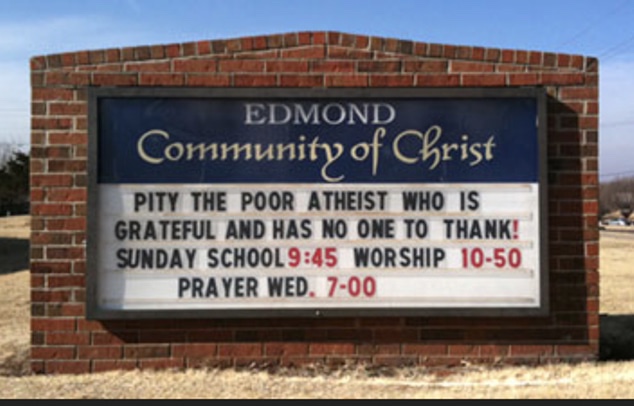
Pity the Poor Atheist

A lot of people believe that atheism is borne out of suffering or some traumatic event — some tragic, horrific experience — that caused these poor souls to lose faith in God. There must have had an abusive parent or relative who emotionally or physically tortured or sexually abused them.

These poor atheists must have thought that God can’t exist because, if he did exist, he wouldn’t have allowed them to suffer that way. “How can I believe in a God who would let this happen to me, who would abandon me?”

But I’ve found that not to be the case when it comes to any of the atheists I know. We ask questions and seek evidence. Answers like, “Because it says so in the Bible,” or “You just have to have faith, you just have to believe,” don’t cut it with us.

We weigh all of the available evidence and, having done so, choose to not believe in any supernatural deity or supreme being. We tend to be pragmatists who think deeply, rationally, and logically. Most of us were raised in the religion of our parents, but became skeptical by the inconsistencies, and in some cases, the outright hypocrisies, of our religions.

Many Christians seem to believe that atheists are a bad, sad, miserable, immoral, lost lot. They feel sorry for or pity us because we have lost our way; we have strayed from the path of righteousness. They can’t understand how we can be moral individuals if we don’t believe in God or an afterlife. It’s so sad that we can’t or won’t allow ourselves to bask in the glory that is God, or to accept Jesus as our savior. Which is why they want to “save” us. How magnanimous of them.

Or if they don’t feel sorry for us, they are angry at us. How dare we question their beliefs? How do we have the audacity to suggest that the Bible isn’t “The Truth,” and that God didn’t create us in his image, or that we evolved from monkeys?

We, as atheists, are, therefore, condemned to eternal damnation unless we change our evil, secular ways and embrace God and Jesus. Only then will we be saved. Only then will the light of God’s truth reveal itself to us.

We are not people you should feel sorry for or be angry at. We just don’t live our lives built around your myths.