


The graph likelihood of a simple graph is defined by starting with the set  . The following procedure is then iterated to produce
a set of graphs
. The following procedure is then iterated to produce
a set of graphs  of order
  .
At step
.
At step  ,
randomly pick an integer
,
randomly pick an integer  from the set
  . Now randomly pick one of the graphs in
  (keeping the probability that it was constructed in
step
(keeping the probability that it was constructed in
step  )
and add a new vertex joined to
)
and add a new vertex joined to  randomly selected vertices of that graph. Now merge any isomorphic
graphs produced by this procedure by totalling their probabilities. The likelihood
of a graph
randomly selected vertices of that graph. Now merge any isomorphic
graphs produced by this procedure by totalling their probabilities. The likelihood
of a graph  on
on  vertices is then defined as the probability that
  appears in
  .
.
The more general sequential-growth process, with an arbitrary distribution of the vertex degree of each new vertex, was studied by Janson and Severini (2013). The graph likelihood arising from the discrete uniform distribution on the possible degrees was introduced by Banerji et al. (2014).

The  th
iteration of this procedure produces every possible graph on
th
iteration of this procedure produces every possible graph on  vertices. The results for graphs of orders
  to 4 are illustrated above. Likelihoods for all simple graphs
of order up to 10 have been computed by E. Weisstein (Dec. 23, 2013).
to 4 are illustrated above. Likelihoods for all simple graphs
of order up to 10 have been computed by E. Weisstein (Dec. 23, 2013).
 , where
  is the graph complement
of
is the graph complement
of  .
.
 and
and  are therefore co-likely.
Since the values are probabilities, the sum of likelihoods over all  -node graphs is 1 and individual likelihoods satisfy
 |
(1)
|
with  holding only for
  .
.
 also satisfies the stronger inequality
 |
(2)
|
where  is the order of the automorphism group of
  (Banerji et al. 2014).
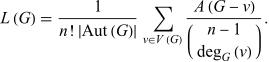
An exact recurrence is obtained by defining
 |
(3)
|
Then  ,
and for a graph
,
and for a graph  on
on  vertices,
 |
(4)
|
where  denotes the vertex deletion of
  from
from  . Equivalently,
 |
(5)
|
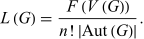
Choosing any representative of the isomorphism class of  with vertex set
  , the same exact recurrence gives a subset dynamic program
![F(S)=sum_(v in S)(F(S-{v}))/((|S|-1; deg_(G[S])(v))),](/https/mathworld.wolfram.com/images/equations/GraphLikelihood/NumberedEquation6.svg) |
(6)
|
with  and
and
 |
(7)
|
Thus graph likelihood can be computed exactly either by recursive evaluation of the vertex-deletion recurrence or, after choosing such a representative, by the subset
dynamic program above. The latter uses  arithmetic operations and
  space (Severini and Weisstein 2026).
The following table summarizes the likelihoods for members of a number of special classes.
| graph | OEIS | values |
| Andrásfai graph | 1/2, 1/270, 1909/2540160000, 197065201/167682078305280000000, ... | |
| antiprism graph | 13/21600, 1909/2540160000, ... | |
| barbell graph | 97/129600, 79/282240000, ... | |
cocktail party graph  | A394956/A397599 | 1/2, 1/36, 13/21600, 11/1587600, ... |
complete
graph  | A000012/A000142 | 1, 1/2, 1/6, 1/24, 1/120, 1/720, ... |
| crown graph | 29/64800, 11/40642560, ... | |
cycle
graph  | 1/2, 1/270, 1909/2540160000, ... | |
empty graph  | A000012/A000142 | 1, 1/2, 1/6, 1/24, 1/120, 1/720, ... |
hypercube
graph  | 1, 1/2, 1/36, 11/40642560, ... | |
| ladder graph | 1/2, 1/36, 61/43200, 20299/2540160000, ... | |
| ladder rung graph | A394956/A397599 | 1/2, 1/36, 13/21600, 11/1587600, ... |
Möbius ladder  | 23/259200, 1909/2540160000, ... | |
path graph  | 1, 1/2, 1/3, 1/9, 29/1080, 2/405, 2509/3402000, 1889/20412000, ... | |
prism graph  | 29/64800, 11/40642560, ... | |
star graph  | A293458/A010796 | 1, 1/2, 1/3, 5/72, 17/1440, 77/43200, 437/1814400 |
| sun graph | 59/25920, 101/9072000, ... | |
| triangular graph | 1, 1/6, 13/21600, ... | |
wheel graph  | 1/24, 13/720, 203/129600, 2393/18144000, ... |
Classes with known closed form values include
 |  |  |
(8)
|
 |  |  |
(9)
|
 |  |  |
(10)
|
 |  |  |
(11)
|
Here  is a complete graph,
  is an empty graph,
  is a star
graph,
is a star
graph,  is a factorial, and
  is a subfactorial.
For the ladder rung graph  ,
,
 |
(12)
|
Equivalently, its likelihood has the series-coefficient form
(sqrt(2/pi)z))^2,](/https/mathworld.wolfram.com/images/equations/GraphLikelihood/NumberedEquation9.svg) |
(13)
|
where ![[z^k]](/https/mathworld.wolfram.com/images/equations/GraphLikelihood/Inline67.svg) denotes coefficient notation and
denotes coefficient notation and  is the inverse erf
function. Since the cocktail party graph
is the inverse erf
function. Since the cocktail party graph  is the graph
complement of
is the graph
complement of  and
and  ,
both formulas also hold for it.
,
both formulas also hold for it.
In addition, there is a relationship between  for a cycle graph and
 for a path
graph given by
for a path
graph given by
 |
(14)
|
(Banerji et al. 2014).
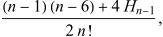
In general, a graph on  vertices with
  isolated edges has likelihood
 |  |  |
(15)
|
 |  |  |
(16)
|
giving special cases
 |  |  |
(17)
|
 |  |  |
(18)
|
where  is a harmonic number.

Values of  for
for  -node
graphs are plotted above.
-node
graphs are plotted above.
Computations by E. Weisstein in 2013 found that, for all  except
  , 3, and 5, the minimum is attained by the balanced complete
bipartite graph
, 3, and 5, the minimum is attained by the balanced complete
bipartite graph  when
when  and by
  when
when  ,
together with their graph complements. For the
three exceptional orders, the minima occur for
,
together with their graph complements. For the
three exceptional orders, the minima occur for  ,
,  , and
, and  , respectively. Citing this numerical evidence, Dervovic
et al. (2018) conjectured that these complete
bipartite graphs and their graph complements
give the minima for all
, respectively. Citing this numerical evidence, Dervovic
et al. (2018) conjectured that these complete
bipartite graphs and their graph complements
give the minima for all  .
.
Severini and Weisstein (2026) proved that, among complete bipartite graphs of a given order, the balanced one uniquely minimizes graph
likelihood. Exact computations show that it also minimizes over all graphs for  , apart from the known exception
at
, apart from the known exception
at  .
However,
.
However,  is the first failure of the global conjecture. The graph
blow-up
is the first failure of the global conjecture. The graph
blow-up ![C_5[K^__3]](/https/mathworld.wolfram.com/images/equations/GraphLikelihood/Inline104.svg) of the cycle graph
of the cycle graph  by independent sets of
size 3, equivalently the circulant graph
by independent sets of
size 3, equivalently the circulant graph  , satisfies
![(L(C_5[K^__3]))/(L(K_(7,8)))=(1535460265677768)/(7628328998218493)=0.20128...<1.](/https/mathworld.wolfram.com/images/equations/GraphLikelihood/NumberedEquation11.svg) |
(19)
|
This counterexample is both a triangle-free graph and a vertex-transitive graph.
More generally, Severini and Weisstein (2026) proved
![log_21/(L(K_(|_n/2_|,[n/2])))](/https/mathworld.wolfram.com/images/equations/GraphLikelihood/Inline107.svg) |  |  |
(20)
|
 |  |  |
(21)
|
as  .
Thus the ratio between the likelihood of the balanced complete
bipartite graph and the minimum grows exponentially in
.
Thus the ratio between the likelihood of the balanced complete
bipartite graph and the minimum grows exponentially in  , so the conjecture fails for every sufficiently large
  . They also showed that the Shannon
entropy of the graph-likelihood distribution is
. They also showed that the Shannon
entropy of the graph-likelihood distribution is  bits. Consequently, the graph likelihood
of the balanced complete bipartite graph
is asymptotically greater than that of a typical graph generated by the uniform sequential-attachment
process defining graph likelihood.
bits. Consequently, the graph likelihood
of the balanced complete bipartite graph
is asymptotically greater than that of a typical graph generated by the uniform sequential-attachment
process defining graph likelihood.
The minimum values of  for
for  , 2, ... are 1, 1/2, 1/6, 1/36, 1/270, 23/259200, ... (OEIS
A234234 and A234235).
, 2, ... are 1, 1/2, 1/6, 1/36, 1/270, 23/259200, ... (OEIS
A234234 and A234235).
The situation for maximum  as a function of
  is less clear, with maxima occurring for
  , 2, ... for
  ,
,  ,
,  , paw graph, dart
graph, ... and their complements. The corresponding maximum values are 1, 1/2,
1/3, 13/72, 307/4320, 1927/86400, ... (OEIS A234236
and A234237).
, paw graph, dart
graph, ... and their complements. The corresponding maximum values are 1, 1/2,
1/3, 13/72, 307/4320, 1927/86400, ... (OEIS A234236
and A234237).
