Review of Texas Landscapes, LLC

The following is a review of the contractor’s work (Texas Landscapes, LLC) from the homeowner’s perspective and is the homeowner’s opinion…

Type of project:
Basic, simple covered patio addition connected to the existing home located in Plano, Texas. Three columns, lower part of columns wrapped in stone, covered/shingled roof, paver flooring, six recessed lights, two ceiling fans, three power outlets.

Not part of the patio design: outdoor kitchen, gas lines, outdoor TV mounting/outlets, remote controls, planters, fire pit, fireplace, screens, shades, landscaping.

No need to install/relocate gas lines, no need to install plumbing.

The homeowner experienced the following…

Poor quality

GFCI protection not installed for any of the new outdoor patio power outlets. GFCI protection for outdoor electrical was clearly specified in the city construction code. Homeowner, friends, and family were subjected to risk of electrocution due to no GFCI protection installed on outdoor patio addition. Homeowner had to call to inform contractor that GFCI protection was not installed and to request GFCI protection. See further details in the review below.

Leaks in multiple locations in the patio addition’s roof and related risk of water damage to the home due to mold, mildew, or wood rot related to water penetrating the home. Flashing installed incorrectly on outside of home’s vertical siding (see photos and details below).

Stone work with visible damage or discoloration (cracks in capstone, deep gauges in what was supposed to be flat capstone surface, bricks discolored with construction mortar on face of bricks, bricks discolored with construction dust and left unfinished).

Uneven paver flooring (floor pavers at different heights, trip hazard).

Gaps between patio ceiling and brick wall of patio left uncaulked.

Construction mortar, dust, and debris discolored brick wall, homeowner asked contractor for workers to return to clean brick walls to restore original brick color (to perform quality work before project was considered complete).

Demolition debris, construction debris, and construction materials in yard and driveway. Demolition debris and constructions debris not removed from project site in a timely manner (multiple weeks of construction debris left in yard and in driveway created an eyesore of living at a construction site for a prolonged period of time – to project dragging on much longer than communicated by contractor).

Homeowner did not observe the project manager (the business owner) visit the work site to review company work product during the during the duration of the project, with one exception: homeowner observed project manager visit the project site one time (at end of project when homeowner withheld final payment due to poor quality issues – see more information below). Homeowner had to report poor quality issues to contractor for rework/repair because project manager was not reviewing company work product.

Contractor declared project work complete, asked for final payment, and accepted final payment when the following was outstanding:
1) GFCI protection on outdoor electrical outlets was not installed.
2) Leaks in multiple locations in the patio addition’s roof.
3) Two city code inspections not complete.

Contractor communicated to the homeowner that the final city code inspection was complete and this was not true. Two city code inspections were not yet complete. In the written contract, final payment was tied to the final city code inspection being complete and passing. Based on contractor’s untruthful statement, homeowner submitted final payment to contractor.

Homeowner placed a “stop payment” on the final payment after discovering the three (3) outstanding items (above). Homeowner communicated his displeasure with contractor for seeking and accepting final payment with the three items outstanding. Homeowner expressed his displeasure that homeowner had to discover all three outstanding items (rather than contractor), report the outstanding items to the contractor, and ask the contractor to rework/repair the outstanding items.

City inspector performing electrical inspection observed that GFCI protection had not been installed for outdoor patio power outlets and wrote up a failed electrical inspection. GFCI protection for outdoor electrical was clearly specified in the city construction code. The homeowner, friends, and family were subjected to risk of electrocution due to no GFCI protection installed on outdoor patio addition. The homeowner thanked the city code inspector for finding the dangerous safety hazard that did not comply with city construction code and immediately reported the issue to the contractor.

Work foreman and/or work crews did not review completed work with homeowner. Rather than review what they considered “completed work” with homeowner, they simply left the worksite when they thought that they had completed their deliverable (for example, demolition, site grading, stone work, framing, roofing, electrical, finish out, etc). Multiple times, the homeowner had to call the contractor company to have features re-worked due to poor quality.

Roof leaks in multiple places

On August 15 (four days after homeowner submitted final payment), homeowner discovered multiple leaks (seven locations) on the patio roof installed by the contractor.

Homeowner informed contractor of leaks on August 16 and informed contractor that homeowner could not risk water damage to the home due to mold, mildew or wood rot related to water penetrating the house.

Homeowner informed contractor that the newly installed roof flashing on the new porch addition appeared to be installed over the outside of the house siding (rather than up underneath the inside of the house siding). A photo (taken by homeowner) was attached to the email communication showing the flashing installed on the outside of the siding.

Homeowner communicated that standard construction methods (where a roof butts up to a vertical wall) is to place flashing under the home’s vertical siding (rather than incorrectly placing flashing outside the vertical siding).

Homeowner requested the contractor repair the roof leaks to prevent further damage to the home, to complete the project, and informed contractor that homeowner had placed a “stop payment” on homeowner’s final payment check (submitted to contractor five days earlier).

Contractor employee inspected roofing flashing and said he will install trim over the top of the flashing. Homeowner asked questions and insisted that trim on top of incorrectly installed flashing will not stop roof leaks. Homeowner insisted that contractor correctly install the flashing under the home’s vertical siding. Contractor employee said he needed to acquire materials to install flashing correctly and leaves site.

Contractor workers arrived at site to remove the incorrectly installed flashing on the roof addition (business owner admitted that the flashing was incorrectly installed outside of the vertical siding, rather than correctly installed under the vertical siding). Workers correctly installed new flashing under the vertical siding.

Homeowner tested roof for leaks, found less leaks, and informed contractor of the leaks (provided photos as evidence). Contractor came out, inspected roof and flashing, added caulk to flashing around the leak areas.

Homeowner re-tested for leaks and found one leak. Homeowner was tired of the project dragging on and informed contractor that homeowner would apply additional caulk to flashing around leak area to finish the project (and to speed up project completion). Homeowner climbed on roof, completed caulk repairs to roof flashing, water tested, and found no leaks in roof.

It took 9 days to repair the roof leaks (from time of discovery of roof leaks to final leak repair), thus further delaying the project completion.

Possible fraud

Homeowner added a contract term (prior to signing the contract) that final payment was tied to project completion and successful completion of city code inspection was required as an element of project completion. Contractor accepted the city code inspection contract term written in contract.

On August 10, contractor employee sent homeowner an email indicating that the project was complete, attached the final invoice to the email, and asked for a time to come by and to collect final payment. Homeowner responded to contractor’s email that asked for final payment – homeowner asked contractor when the final city inspection was scheduled (a passing final city code inspection was required prior to final payment). Contractor did not respond to homeowner’s email regarding city code inspection.

Contractor employee came to home on August 11 to collect final payment. Homeowner asked contractor employee if the project had passed final city inspection. Contractor employee replied that the project manager (business owner) had informed contractor employee that the project had passed final city inspection, and that the contractor could provide the homeowner with proof that the project had passed final city inspection. Homeowner replied and asked contractor to provide proof of final inspection. Contractor employee confirmed that contractor employee would provide proof of a passing final city code inspection via email. Homeowner handed final payment check to contract employee on August 11 (based on contractor informing homeowner that the project had passed final city inspection and that the contractor would provide proof via email that such final city inspection had completed prior to August 11).

As of August 14, contractor had still not provided homeowner proof of final city code inspection (as promised by contractor three days earlier).

On August 14 (three days after contractor had informed homeowner that the project had passed final city inspection), city code inspector arrived on site to perform a pending electrical inspection. City inspector observed that GFCI protection had not been installed for outdoor patio power outlets and wrote up a failed electrical inspection. GFCI protection for outdoor electrical was clearly specified in the city construction code. The homeowner, friends, and family were subjected to risk of electrocution due to no GFCI protection installed on outdoor patio addition. The homeowner thanked the city code inspector for finding the dangerous safety hazard that did not comply with city construction code.

Homeowner communicated with business owner (after the failed city inspection) that homeowner was not pleased with being lied to by contractor in order to receive final project payment. The homeowner communicated to the business owner that such behavior was unethical and inappropriate. Homeowner asked business owner to not cash the final payment check and to call the homeowner back. Homeowner reminded owner that the project was far behind schedule – at almost five months and still not completed. Homeowner informed business owner that homeowner has placed a stop payment on the final check pending successful completion of all city code inspections (final payment tied to successful final city inspection).

On August 15, contractor sent an electrician to project site and the electrician installed GFCI protection on outdoor patio power outlets. City inspector arrived on August 16 (after contractor electrician installed GFCI protection on patio power outlets) and the inspector passed the electrical inspection. On August 17, a final/last city code inspection (after passing the electrical inspection) passed. The city inspector performed the final building inspection on August 17.

On the date that the contractor informed the homeowner that all city inspections had passed (August 11), there were actually two outstanding (not yet completed) city inspections, one of which did not pass due to lack of GFCI protection issues (the electrical inspection). In addition, research conducted by the homeowner on the city permitting website indicated that that the contractor (the project manager/business owner) had placed a request with the city for the electrical inspection on August 11.

City of Plano Building Permit and Inspection website (eTrakiT).

The contractor knew (on August 11) that the final city code inspection had not yet occurred, but the contractor did not inform inform the homeowner that the final inspection had not yet occurred. Instead, on August 11 the contractor requested final payment, the contractor informed the homeowner that final inspection had passed, and the contractor collected the final payment from homeowner (despite the fact that the homeowner specifically asked if the final city inspection was competed and had passed city code compliance, and that final payment depended on a passing final city inspection).

According to the Merriam Webster dictionary, the definition of fraud is “perversion of truth in order to induce another to part with something of value or to surrender a legal right”. The contractor knew that final payment was tied to successful completion of city inspections (per the written contract, and per communications with the homeowner who asked for proof of final city inspection). Clearly, the contractor communicated to the homeowner on August 11 that the final city inspection had passed, when, in fact, the final city inspection had not yet happened. Based on the contractor’s untruthful statement, the homeowner released the final payment to the contractor on August 11.

The reader of this review can decide whether such an act by the contractor is fraudulent.

Contractor poor communication

More than a week would pass with no communication from any individual in the company and with no with no onsite progress on the project for more than a week. This happened multiple times. Project materials were onsite (stored on driveway or in back yard), but no work was being performed. Homeowner would initiate communication with contractor, ask what was causing the delay, and ask for resources to be applied to the behind-schedule project.

Work foreman and/or work crews did not review completed work with homeowner. Rather than review what they considered “completed work” with homeowner, they simply left the worksite when they thought that they had completed their deliverable (for example, demolition, site grading, stone work, framing, roofing, electrical, finish out, etc). Multiple times, the homeowner had to call the contractor company to have features re-worked due to poor quality (see poor quality section in this review).

Project manager (the business owner) did not communicate with the homeowner that the sales person was no longer the project manager. Homeowner contacted the business owner on May 26 when the sales person was not responding to homeowner’s issues regarding the project – business owner responded, “Sorry, I forgot to tell you that I am the project manager now. Once we go to city permitting, I am the project manager. You can contact me for project questions.” No one from the contractor had informed homeowner of this handoff of project management mid-project – homeowner had to experience lack of response from sales person, call business owner, and find out that the sales person was no longer the homeowner’s “go to” person for the project.

Homeowner did not observe the project manager (the business owner) visiting the work site during construction with one exception: Homeowner met project manager for the first time at end of project when homeowner withheld final payment pending satisfactory completion of project (pending contractor installing GFCI electrical protection and contractor repairing multiple leaks in the patio roof). The project manager visited the project site so that the homeowner could show the project manager the poor quality work product that required repair/rework/correction.

For a majority of the project’s timeframe, the homeowner initiated communications with the the contractor – homeowner asked contractor for information on project schedule, reasons for project delays, and informed contractor of project quality issues. The homeowner felt that contractor did not provide adequate information and was not proactive in communication with the homeowner. Communication is free (a quick call or text message costs nothing). The homeowner was not looking for a detailed schedule, or a detailed communication – just wanted a short text message or a brief phone call. But homeowner felt that the contractor was not communicative with homeowner. Homeowner felt as if homeowner was often “chasing up” the contractor to deal with project delays throughout the project, or that homeowner was having to initiate communication with contractor to document/highlight contractor’s poor quality work.

Since the contractor’s workers, foreman, and the project manager allowed the poor quality (see the poor quality items above), homeowner was compelled to document/highlight the poor quality items to contractor. Homeowner had to request that the poor quality items be repaired, had to request items to be installed correctly, and/or request to be installed in compliance with city code. As a result of the foreman and the project manager not performing their jobs appropriately, the homeowner took on some of the role for the foreman and the project manager (homeowner performed a part of the project manager’s job).

Early in the project, the homeowner asked the business owner how long the project would take to complete. The business owner replied, “It goes quick. Once we start work on the job site, only a couple of weeks.” The demolition and site prep began June 12 and the project completed August 24 – a total of 10.5 weeks (more than five times the two week estimate). Homeowner commented multiple times during the project that the project was far behind schedule – contractor employees would respond that they had lots of crews working in Frisco, Plano, Dallas, etc. The homeowner perceived that the contractor had significant resources, but that the contractor had chosen to apply those resources on other projects that were not the homeowner’s project.

On multiple occasions, the homeowner communicated (with the business owner) that the project was far behind schedule. The business owner confirmed multiple times that the project was behind schedule. Multiple times during the project, no work was done on site for a week (or longer). Thus, the project dragged on far beyond a reasonable time frame causing the homeowner to live in a construction zone with construction trash/debris that contractor work crews chose not to remove, construction materials stored on driveway and had for prolonged periods of time, resulting in the homeowner having to store new patio furniture in homeowner’s garage and having to park cars outside on the street for prolonged periods of time. Using the business owner’s timeframe, the project should have been complete on June 26, but the project actually completed on August 24. Homeowner signed the contract on March 17 and the project completed on August 24 – more than five months duration for the simple porch addition.

After the contract was signed, the homeowner asked for zero feature changes (change in scope of project) – the homeowner only requested features/deliverables as specified in the written contract, no extras, no changes that required a price change. Thus, homeowner was not the cause of project delays.

The homeowner responded quickly to each request from contractor – usually responding same day as the request, and always responding within 24 hours to requests for information from the contractor. Homeowner gave design feedback usually on the same day, but always within 24 hours of the contractor’s request. Thus, the homeowner was not a factor causing project delay.

Project delays and prolonged project time frames were due to poor contractor planning, contractor placing its significant resources on other projects, poor quality work product, and work crews having to return to the project site to correct/repair the poor quality work product after homeowner reported poor quality work to contractor.

Summary

Homeowner contracted for a basic, simple covered porch addition connected to the existing home and expected basics from the contractor: basic expectations such as adequate communication, adequate work product quality, city code compliance, a patio roof that did not leak, patio electrical power that did not expose home occupants and visitors to the risk of electrocution, and project completion in a reasonable time frame. The homeowner perceived that the contractor failed to deliver on some of the basics.

Based on the homeowner’s experience with the contractor, the homeowner would not recommend contractor, and would not refer the contractor to the homeowner’s friends and neighbors.

My First Triathlon

Mark Johnson riding the triathlon’s bike section.

I ran my first triathlon on September 19, 2021 at the age of 59.

I was inspired to enter the triathlon by my son-in-law Ben Cork, and by my daughter Rachel Tomajczyk. Ben had recently signed up for an off-road triathlon called an Exterra (swim in Lake Tahoe, mountain bike on trails around Lake Tahoe, and run trails around Lake Tahoe). Rachel is a distance running athlete and coach. In addition, I had watched the summer Olympics triathlon, and felt inspired to attempt to run a triathlon race.

I found an event near where I live in northeast Texas and registered for the Olympic distance triathlon. The Olympic distance triathlon is a 1500 meters swim, followed by a 40K bike ride, followed by a 10K run. Of the three activities, running is my weakest activity. I felt like I could run a 10K after the swim and bike activities. But I was not convinced that I could run anything that was longer than a 10K.

So I began to train two months prior to the event. I swam in my neighborhood outdoor pool, biked on the local roads, and ran in the area. Another challenge to my training popped up – my 90 year old mother lost one of her two caregivers. Thus, I was forced to jump in and perform caregiving services in the morning for about three weeks. This was hard – I trained outdoors in July and August – in this part of Texas, you want to do all your training in the morning before the heat reaches 90 degrees F. So for several weeks, after morning caregiving for my mother, I trained later in the day, in the relentless Texas summer heat.

My friend Bobby Adams registered for the same triathlon. He planned to run a Half Ironman triathlon in October 2021. So he thought that the Olympic distance triathlon would be a good training activity in preparation for his Half Ironman triathlon. We swam in Lake Lewisville a few times before the Olympic distance triathlon event.

As part of my preparation for the triathlon race, I ran the Olympic distance triathlon in reverse order several times before the actual race. I ran in reverse order because it was August in Texas and I could not bear running in the heat of the mid-day sun. So I ran the 10K first, followed by the 40K bike ride, followed by the 1500 meter swim. With this reverse order, I was running early in the morning, and completing the swim at mid-day before it became excessively hot.

The triathlon race was called the “Disco Triathlon”. The race was held on a Sunday morning at Lake Ray Roberts in a state park on the lake shore.

Since this was my first triathlon, my primary objective was to simply finish the race. My secondary objective was to finish within four hours.

I began my detailed preparation about a week before the race…

  • Began tapering from my more intense training in order to arrive at race day rested.
  • Made a checklist of supplies/gear, racewear/clothing, nutrition items, and race strategies.
  • Picked up my event participant packet (bib number, RFID ankle tag, etc) four days prior to the race.
  • Began hydrating 48 hours before the race (this is Texas after all).
  • Got good night’s sleep the night before the race.

Woke up at 5 am on race day to travel the hour to the race area north of Denton, TX. Arrived at the race location at 6:30 pm. The race was scheduled to begin at 7:30 am.

It was still dark when I moved my gear from the car to the transition area. I had forgotten to label my bike, and learned that you cannot enter the triathlon transition area until your bike was labeled (affixed with the participant’s bib number). A “newbie” mistake.

Dawn’s light began to creep in as I set up my gear in the transition area (set up my bike, helmet, shoes, gloves, towel, hydration, and nutritional items). The race officials announced that participants needed to get to the starting area and I felt rushed, so I slammed down a mini Payday bar and drank some Powerade. I walked down to the lake shore where the start line was located wearing my biking/swim/run shorts, a swim shirt, swim cap and goggles. The lake shore had a good number of people at the starting area. There were about 600 athletes at the starting area in addition to race officials and fans.

I felt as if I had prepared well for the race and was as ready as I would ever be. I had trained for the triathlon and had not been injured during training. My body was rested, hydrated, and fueled for the race.

The race started 30 minutes late. The first wave of athletes entered the water at 8 am. The race organizers had grouped athletes into starting waves based on age and sex. My wave did not start until about 8:45 am. I was concerned about the late start for several reasons. The Texas sun was already beginning to heat up (and I get overheated easily). In addition, I had hydrated (so I needed to urinate after waiting so long to start). It was sunny and was 78 degrees at my start time, with a 8-10 mph south wind. As the race announcer called my wave, we put on our swim googles, adjusted out gear, and got ready.

My wave of about 60 males was released to start. We ran from the beach into the water. I began with a freestyle stroke and was surprised by the number of people who were passing me. Athletes were close together at the beginning of the swim, so there was some body contact (kicking and nudging). We swam through the waves created from wind across the water. I got a little over-excited in the first 600 meters – I took in a few unexpected mouthfuls of lake water in the first 600 meters. The swim course was two laps around a square course of four buoys placed in the water. I tried alternating between freestyle strokes and the elementary back stroke. But after sensing that many athletes had passed me, I changed to freestyle stroke only (at about 600 meters into the race). After that point, I became more calm and just stroked it out to the end of the 1500 meter course. It took me 45 minutes to complete the swim.

I slogged out of the water onto the beach and ran about 150 meters to the transition area. I changed from my swim shirt into a biking jersey, put on socks and biking shoes, and put on my helmet, sunglasses and bike gloves. Grabbing my bike, I ran my bike out of the transition area and began the biking portion of the race. I spent 4 minutes from the time I left the water until I began pedaling my bike (outside the transition area).

The 40K bike wound through the state park, and out onto a blacktop country road outside the state park. The majority of the bike course was on country roads that were open to automobile traffic, so race organizers had instructed race athletes to ride on the road’s shoulder. The shoulder contained various hazards – gravel, broken glass, pieces of wood, pieces of car tires, and other roadside debris. I took care to avoid debris when possible. Cars blew past at 55-65 mph. The sun was up and the blacktop began to bake. The temperature while I was on the bike was 80-86 degrees, with the sun cooking the blacktop, and cooking me on the shadeless Texas rural road. My body began to sweat and use up liquid. I passed a few athletes, and some athletes passed me. But for the most part, I rode separate from other athletes – distanced from other race participants. During the ride, I drank almost two bottles of electrolyte Powerade, consumed two mini Payday bars, and ate three Cliff block energy gels. I felt good during the biking section of the race – several times on the ride I said to myself out loud, “You are strong. You are fast.” I felt thankful that I did not have a flat tire, considering the debris on the shoulder of the road. I completed the biking portion of the race in 83 minutes.

Racing back into the state park towards the transition area, I dismounted my bike and ran it into the transition area. I removed my bike shoes, removed my helmet and biking gloves, and put on my running shoes. I spent two minutes from the time I entered the transition area until the time I exited the transition area to begin the 10K run.

Of the three events, running is my weakest event. The temperature was 86-88 degrees F during the 10K run. The course followed a paved path through the state park. Some of the path was shaded, some of the path was in the sun. I was hurting, but was determined to run (not walk) during the running portion of the race. I am embarrassingly slow – most people would call my “run” a jog. Many athletes ran past me, and some of the them gave me encouraging words. There were several aid stations with water along the course. I grabbed two cups of water at each aid station – poured one cup over my head to cool down, drank the other cup for hydration. I finished the run, but it was not a pretty sight, crossing the finish line in a over-heated, sweaty mess. It was a relief to cross that finish line. I ran the 10K in 71 minutes.

I finished the Olympic distance triathlon in 3 hours and 25 minutes.

Race helpers handed me a finishing medal and a cold bottle of water. I headed for the shade under a few trees and cooled down. It was around noon and the mid-day sun was baking everyone. I found my friend Bobby Adams, we took some photos, and we debriefed our race experiences together. My family had been tracking my progress and sent me text messages with congratulations and encouragement.

I felt thankful that I had achieved my primary objective (to finish the triathlon) and had achieved my secondary objective (to finish within four hours). God gave me a healthy body, the ability to train, and the ability to run the race – I acknowledge that non of this would be possible without the Lord’s blessings upon me.

Returning to the transition area, I ate more mini Payday bars, collected my gear, moved my gear to my car, and headed home. My wife Susan was ready to hear about the race when I arrived home.

It had been a good day, a significant day.

Triathlon ankle tag.

Triathlon body marking.

Mark Johnson at the finish line after the triathlon race.

Mesmerizing Murmuration

I was cycling on my road bike on an October day and ran into a flock of black birds. I have been cycling solo, avoiding group road rides due to risks associated with COVID-19.

The setting was a fall morning in Allen, Texas near some farm fields. I rode towards a large flock of black birds crossing the road. I estimate that the group consisted of several thousand birds. As my bike and I approached, their flight pattern created a wonderous phenomena of murmuration (a flock of birds in flight creating patterns in the sky as the flock reacts to various stimuli). As I rode nearer, it seemed to be a bird cloud – a flying, flitting, fluttering cloud (thus I coined the phrase for this bird cloud – a floud!!!). This fluttering floud began to envelope me as it covered the road. I continued cranking away at the pedals, propelling the bike down the road at 20 miles per hour. The bird cloud began at ground level with some black birds skimming the surface while other black birds soared perhaps a hundred feet above me.

At times, the bird cloud (floud) was dark and opaque – the bird’s dark wings angling perpendicularly to me. And in a flash, the floud pivoted, wings paralell to me, allowing me to see through the floud to the clear blue sky. Then again, the floud would flash back in another wave of dark opacity. Wave after wave of whirling synchronized patterns dazed my amazed eyes. The bird cloud parted as I rode through it, each bird responding to my bike racing down the road, each bird flitting away from me. I rode with heightened senses that had been jolted into overload mode by the pattern of wings, the roar of wind, and a dizzying, dazzling display of swooping synchronicity, each bird responding to those birds around it. The floud’s dance seemed to be coordinated by some master choreographer.

I continued riding inside the bird cloud, amazed at the aerial ballet playing out around me. After a minute or so, I exited the flittering floud and continued down the road. God had reached out to me (again), letting me know that morning of his amazing creation. The sun, the wind, the bird cloud, and a morning of healthy bike exercise – all gifts from God. I reveled in God’s goodness, his creativity, his choreography, and his awesome power as my wheels rolled down the road.

Day 7 – Sedialia, MO to St Louis, MO to Plano, TX

We woke on Thursday morning about 7 am and broke camp at the Missouri State Fair Campground in Sedalia, MO. We rode to a Burger King restaurant and ate a quick breakfast. Next we rode 3 miles to the Sedalia train depot to catch the Amtrak train bound for St. Louis. MO.

We arrived at the train station, removed the bags from our bikes and waited for the train. The train was 20 minutes late from its scheduled arrival in Sedalia. We loaded our bikes and gear onto the train and left Sedalia about 10:30 am. The train took us across Missouri to St. Louis, MO. We arrived in St Louis around 3 pm, late by about an hour.

Since we had a layover until the Amtrak train left for Dallas, TX, we rode our bikes to a coffee shop, hung out, visited, made calls and caught up on email. We ate dinner at a Panera Bread in downtown St. Louis, then rode back to the Amtrak train station.

Amtrak Train - St Louis, MO.

Amtrak Train – St Louis, MO.

We loaded our bikes and gear onto the Amtrak train bound for Dallas, TX. The train left St. Louis at 8 pm. I was better prepared for this overnight train ride – I had my long pants, hoodie, and pullover hat to keep me warm on the cold train. And I chose the rear of the last car on the train – not as many people walking by and also farther away from the wailing train horn located on the front engine. I wrote notes about the trip and tried to get some sleep beginning with quiet hours (beginning at 10 pm).

I awoke from a fitful night of sleep at about 6:30 am. Ate breakfast in the train’s snack car (purchased coffee cake, coffee, and orange juice). The train arrived in Dallas, TX around noon on Friday. The weather was hot in Dallas (mid-90’s) – a change from the weather in Missouri.

I purchased a Dallas Area Rapid Transit (DART) ticket, loaded my bike and gear onto the DART train from downtown Dallas, TX bound for Plano, TX. I rode my bike from the Plano DART station to my home, arriving home about 2 pm.

Trip Summary:
Bikepacked and camped for 353 miles on the Katy Trail in five days of riding in late September 2019. Rode more miles than expected due to detours related to flood damage from the spring 2019 flood of the Missouri River.

Bikepacking the Katy Trail in Missouri.

Day 6 – New Franklin, MO to Clinton, Mo to Sedalia, MO

We woke up on Wednesday morning at Katy Roundhouse in New Franklin, MO. We left at 10 am for what I though was going to be an easy day of riding to Sedalia, MO.

There was a detour West of New Franklin for trail repair.

We rode to Pilot Grove, MO and ate at Katrina’s Restaurant – had a cheeseburger, corn fritters and apple pie, and tea. It hit the spot.

Katy Trail - Pilot Grove, MO.

Katy Trail – Pilot Grove, MO.

Lunch at Katrina's Restaurant, Pilot Grove, MO.

Lunch at Katrina’s Restaurant, Pilot Grove, MO.

After lunch I felt energized and asked my friend Bobby if I could leave him and ride ahead to Clinton, MO and back to Sedialia, MO. My friend had bike repair gear, a phone, food, and water. I left him about 12 miles before Sedalia and rode ahead at a faster pace. Upon reaching Sedalia, I dropped by bags at our Sedalia campsite location. My friend would rid into town later and set up camp. For my quick ride from Sedalia, I only took essentials – bike repair kit, snacks, water, phone, wallet, light, map, helmet. The weather was pleasant. I left Sedalia at 3:45 pm.

Katy Trail - Windsor, MO depot.

Katy Trail – Windsor, MO depot.

There was a sandy section of the trail between Windsor and Green Ridge. The riding was slower there, but I had mountain bike tires to get through the sand. I saw some riders pushing their bikes through the sandy section.

Katy Trail - Clinton, MO depot.

Katy Trail – Clinton, MO depot.

I arrived at the Clinton, MO depot at 6:45 pm. I snapped photos, ate breakfast bar and chips, filled up on water and went to restroom. Headed out from Clinton, back to Sedalia at 7 pm. I stopped in Windsor, MO and ate two slices of pizza from Casey’s General Store, a drink, and fruit snacks for dinner. Due to the length of the ride, I did some night riding. The night was filled with the sound of crickets, breeze, and an occasional nocturnal animal.

I rode into the Missouri State Fairgrounds Campground, took a shower and went to bed in my tent. The campground had water, restrooms, and hot showers. The campground was in town, was lit very bright at night time and was next to a a very loud factory (an Owens Corning factory  across the street from the campground). Due to the lights and the loud factory across the street, I did not sleep very well.

I rode 118 miles that day (including detours due to flooding damage).

Day 7 – Sedalia, MO to St Louis, MO to Plano, TX

Day 5 – Tebbetts, MO to New Franklin, MO

We woke up at 7 am Tuesday morning and ate breakfast in the Turner Katy Trail Shelter in Tebbetts, MO. We packed up our bikes, saddled up, and began riding westward about 8:30 am. We stopped at the North Jefferson trailhead depot to fill our water bottles, eat a snack, and take a break.

Katy Trail Depot - North Jefferson, MO.

Katy Trail Depot – North Jefferson, MO.

We rode to Hartsburg for lunch,  but nothing was open. We took a break at Hartsburg and enjoyed the chimes of a church bell (many small towns along the Katy Trail have church bells that chime on the hour). We rode on. I got a flat on my rear tire west of Hartsburg. I changed the flat in 20 minutes and rolled on.

Repairing a flat tire on the Katy Trail

Repairing a flat tire on the Katy Trail

Around Wilton, MO, we met a gravel rider who lived in Columbia, MO. He was out riding gravel roads on his gravel bike. He rode with us about five miles and told us about the flooding, trail conditions, and local detours. The trail was muddy in places and it was slow going.

Katy Trail - Cooper's Landing.

Katy Trail – Cooper’s Landing.

We ate lunch east of Easley, MO, at Coopers Landing. The establishment was located on the banks of the Missouri River. It had significant flood damage and the owner was still working to repair his establishment before he could open for business. We sat at picnic tables and ate from supplies on our bikes (trail mix, breakfast bars, water, etc). The river  was high stage (still running swiftly with high volume, even months after the spring floods).

Katy Trail - Rocheport, MO Depot.

Katy Trail – Rocheport, MO Depot.

We rode west, following a major detour from Rocheport to New Franklin. Our gravel-riding friend from Columbia, MO informed us that that section of the trail was impassable – sections of the trail had silt five foot deep where the river had covered the trail and dumped large volumes of mud and silt. We followed paved highways (highways 40 and 240) in our detour from Rocheport, MO to New Franklin, MO. We stopped to get dinner and supplies at a Casey’s General Store in New Franklin, MO.

Then we rode to our camping destination – Katy Roundhouse in New Franklin. It was $10 per person per night to tent camp at Katy Roundhouse. This cost included drinking water, hot showers, and restrooms. We visited with John, the owner while he was out mowing grass on a riding lawn mower.

Katy Roundhouse stage - New Franklin, MO.

Katy Roundhouse stage – New Franklin, MO.

Camping on the Katy Roundhouse stage - New Franklin, MO.

Camping on the Katy Roundhouse stage – New Franklin, MO.

We inquired about his unique covered stage. He told us he built it for the Pedaler’s Jamboree. It was decorated with various items found in his barn. It also held some hay for their horses. The weather forecast called for a significant chance of rain – so we asked if it would be okay to pitch our tents under the roof of his stage. He said that would be okay. So we pitched our tents on the stage and avoided rain showers that night. We ate dinner, took showers, and went to bed about 9:30 pm.

Camping on the Katy Roundhouse stage - New Franklin, MO.

Camping on the Katy Roundhouse stage – New Franklin, MO.

Katy Roundhouse - New Franklin, MO.

Katy Roundhouse – New Franklin, MO.

Katy Roundhouse - New Franklin, MO.

Katy Roundhouse – New Franklin, MO.

Katy Roundhouse - New Franklin, MO.

Katy Roundhouse – New Franklin, MO.

We rode 67.2 miles for the day (including several detours that added 10 miles to day’s ride).

Day 6 – New Franklin, MO to Clinton, Mo to Sedalia, MO

Day 4 – Marthasville, MO to Tebbetts, MO

We arose about 6:30 am on Monday morning, ate breakfast from our supplies, and got some hot coffee from a convenience store in Marthasville. We broke camp, packed our bikes, got on the trail by about 8:15 am.

We headed west out of Marthasville on the Katy Trail. Some of the Katy Trail follows Lewis and Clark’s expedition in the 1800’s (their exploration after the Louisiana Purchase). As we rode along, we saw trail signs marking the path of Lewis and Clark’s expedition. The trail was shady and beautiful.

We intended to stop for lunch in Rhineland, but it was Monday and the only restaurant in town was closed Mondays. So we filled up on water and rolled on toward Blufton. We stopped at the Steamboat Junction campground (located right on the trail). The Steamboat Junction owner keeps a refrigerator inside a shelter. The refrigerator is stocked with snacks and drinks (chips, Gatorade, water) with prices marked. There is a drop slot for your money – it is unmanned and on the honor system. We bought some items from the refrigerator and ate lunch from our supplies, sitting under the shade of a tree in chairs provided by the Steamboat Junction owner – right next to the trail. It was a beautiful day – we felt rested after eating lunch and sitting in a nice place in the shade.

We got back on our bikes and rolled west. Just west of Portland, MO to just east of Steedman, MO, there was a detour. The spring rains had caused a large landslide where some earth had detached from a bluff and had covered the trail. We took the detour using paved highway 94.

Standing Rock on the Katy Trail near Steedman, MO.

Standing Rock on the Katy Trail near Steedman, MO.

We intended to eat dinner in Mokane, MO. Bit it was Monday and the Mokane Bar and Grill was closed on Mondays. The Mokane Market was open (a convenience store on the main street in town). We ate there. The store’s owner told us about the devestation caused by the spring 2019 flood. We saw the flood’s water lines on the side of brick buildings as we rode through town.

Katy Trail depot - Tebbetts, MO.

Katy Trail depot – Tebbetts, MO.

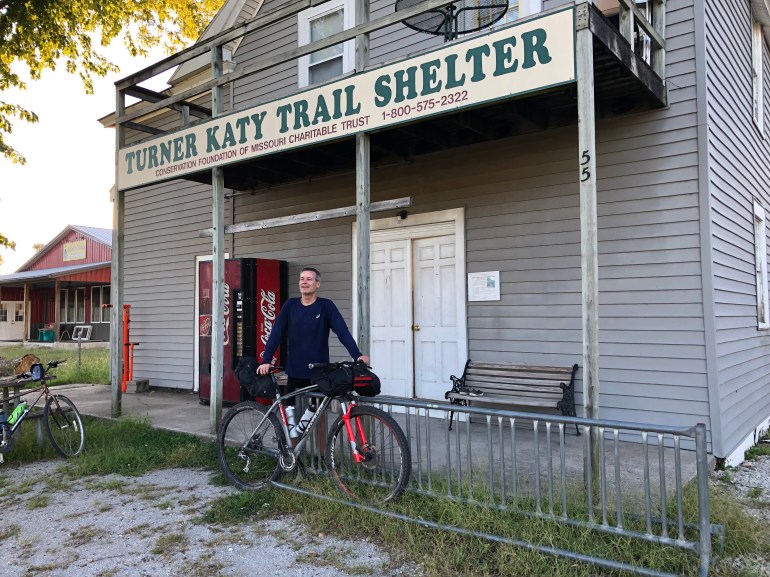
We rode on to Tebbets, MO, arriving about 6:00 pm. We found our destination – the Turner Katy Trail Shelter Hostel. It was a large building that had been a store, and was donated to a charity to provide a place for Katy Trail users to stay overnight. The shelter had many bunk beds, hot showers, restroom, a refrigerator, air conditioning, indoor lighting, power plugs, a bike repair room, and bike racks to park/lock your bike. We were the only people using the shelter that night. We took our showers, did some bike maintenance in the bike repair room, and discussed our next day’s riding plan. We went to sleep about 10 pm an slept well on the bunk bed mattresses. We paid for our stay there using the drop box and left an extra donation to support the shelter.

Turner Katy Trail Shelter in Tebbetts, MO.

Turner Katy Trail Shelter in Tebbetts, MO.

Bike repair room in the Turner Katy Trail Shelter in Tebbetts, MO.

Bike repair room in the Turner Katy Trail Shelter in Tebbetts, MO.

We rode 57 miles that day (including trail detours for flood damage).

Day 5 – Tebbetts, MO to New Franklin, MO

Day 3 – St Charles, MO to Marthasville, MO

We woke on Sunday morning about 6:45 am, packed up, and rode out of our hotel in St Charles, MO about 8 am.  We rode through St Charles to the Katy Trail trailhead and headed west, Our riding objective that day was Blufton Barn – it was going to be a long day’s ride – more than 75 miles.

The trail was beautiful – trees overarching much of the gravel packed trail. At each town that had been a stop on the old Katy Railroad (MKT Railroad), the Missouri State Parks Department had constructed a covered train depot. Each covered depot had the name of the town, benches, trail maps, points of interest in town, and a history of the specific town. Some depots had water, some had restrooms, and some had bike repair stations. These covered depots made for a good place to stop and rest along the Katy Trail.

We made good time riding that day. We had several detours (trail closures due to spring 2019 floods). The trail closed west of Matson and was closed west of Augusta.

We were watching the weather as the forecast indicated an afternoon thunderstorm. At about 1:15 pm we made it to Marthasville where we stopped for lunch. We ate at Philly’s Pizza restaurant in Marthasville, MO. We checked the weather on our phones and saw that the storm was rolling through Marthasville from west to east about 2:30 pm. Due to the storm, we made the decision to stop for the night in Marthasville.

Marthasville, MO Depot on the Katy Trail.

Marthasville, MO Depot on the Katy Trail.

We rode over to the the Marthasville Community Club Park – a city park with a covered pavilion situated between two baseball fields. The storm began as we sat under the covered pavilion. We had searched the internet for a way to register and pay for an overnight stay in the park, but found no information. Buddy, a maintenance person, was working in the park and  helped us to register and pay (in person) for our overnight stay at the Community Club park. We pitched our tents on the cement floor of the pavilion and set up camp while the rain was falling on the tin roof. The facility had hot showers, restrooms, and power plugs.

Under the tin roof of the covered pavilion at Community Club Park in Marthasville, MO.

Camping under the pavilion at Community Club Park in Marthasville, MO.

Parked under the covered pavilion at Community Club Park in Marthasville, MO.

We ate dinner in town at Philly’s Pizza. While we were eating, we discussed our week’s ride – the rain had stopped us well short of our day’s riding objective. We needed to shorten the trip and decided to cut off the ride all the way to Clinton, MO, planning to stop in Sedalia, MO instead. Later that evening we showered and went to sleep about 10 pm.

We rode 41 miles for the day.

Day 4 – Marthasville, MO to Tebbetts, MO


Day 2 – St Louis, MO to St Charles, MO

Our train was 2.5 hours late arriving at St. Louis, Missouri on Saturday morning. My quick internet search showed that Amtrak’s on-time percentage was low – apparently due to the fact that Amtrak does not own the track on which it operates. Amtrak shares the track with the freight train companies that own the track. Freight trains often receive priority over the Amtrak train – we pulled off to a siding on multiple occasions to let freight trains pass through. Thus, we arrived late in St Louis.

I claimed my bike from the baggage car and wheeled it off the train platform into the St Louis station. We went to the restroom, changed into riding clothes, and attached our bikepacking gear to our bikes. At about 10:30 am, we left the Amtrak station, riding our bikes. We rode through downtown St. Louis to the famous Gateway Arch where we stopped to take photos.

Gateway Arch - St Louis, MO

Gateway Arch - St Louis, MO Gateway Arch - St Louis, MO

Then we headed out of St. Louis on the Riverfront Trail, following the West Bank of the Mississippi River. It was a bit difficult to follow the Riverfront Trail in urban St. Louis – the route in town was very industrial with old abandoned factories, brick warehouses, riverfront docks, and riverfront offloading operations. Once we navigated the industrial urban section of the trail, the trail became somewhat easier to follow. We rode across the Mississippi River to Illinois using the McKinley bridge. On the Illinois side of the river, we rode the Madison County Transit Confluence Trail.

McKinley Bridge over the Mississippi River

Crossing the Mississippi River from Missouri to Illinois on the McKinley Bridge.

My friend had a mechanical breakdown before we arrived in Hartford, IL. His new rear bike rack lost two of its attachment screws. The “shake and bake” of riding gravel roads apparently loosened the screws and they had dropped somewhere on the trail. He had no replacement screws. So we replaced the screws using zip ties and bent safety pins to create a temporary attachment (zip ties of various sizes, safety pins, and electrician’s tape work wonders for temporary bike repair – don’t leave home without it).

Then we got on our phones, located a bike shop in Alton, IL and rode there. We arrived at The Alton Cyclery about 3 pm. They guys at the bike shop recommended a sturdier bike rack. My friend bought the recommended bike rack, and a few extra attachment screws. The guys at the bike shop were super helpful and installed the new rack on the spot. We thanked the bike shop guys and rode to a Panera Bread restaurant in town and ate “lunch” around  4 pm. Now that we had completed a two hour, 8-10 mile detour (to fix the broken bike rack), we rode out of Alton, IL and crossed the Mississippi River back in to Missouri. We rode across the river, from Illinois to Missouri, on Highway 67, using the Clark Bridge. Vehicle traffic on the bridge and the highway move at high rates of speed, so we were careful as we rode the highway.


Arriving back in Missouri.

It was evening as we rode towards the eastern end of the Katy Trail and found the trailhead in Machens, MO. Almost immediately after starting our ride on the Katy Trail, we ran into trail closures. The temporary signs announced the closure, but the signs had no suggested alternate route. Being behind time for the day (due to a mechanical breakdown), and with no suggested alternate route, we rode past the signs onto the closed trail. The first closure was a 200 meter section that had apparently washed out in the spring floods. We bushwhacked around it and rolled on.

The second closure was a few miles down the trail. Same story – a temporary sign announcing the closure with no alternate route suggested. We rode on the closed trail – a longer section of a mile or so. The closed area appeared to have been flooded in the spring rains and was being regraded and resurfaced. The closed trail was soft – a mixture of damp mud and gravel. The mud was lightly soft and tacky, but did not stick to tires. It was tougher going, but we made it through.

The sun set and we rode in the dark toward’s our night’s destination – TownPlace Suites (a Marriott hotel property) in St. Charles, MO. We rode into the outskirts of St. Charles at about 8 pm and stopped at a Canes Chicken restaurant for dinner. We rode to our hotel, arriving there at 9:30 pm. We checked in, showered, discussed the next day’s riding route, and got to bed about 11 pm.

We rode 66.5 miles that day.

Day 3 – St Charles, MO to Marthasville, MO

Day 1 – Dallas, TX to St Louis, MO

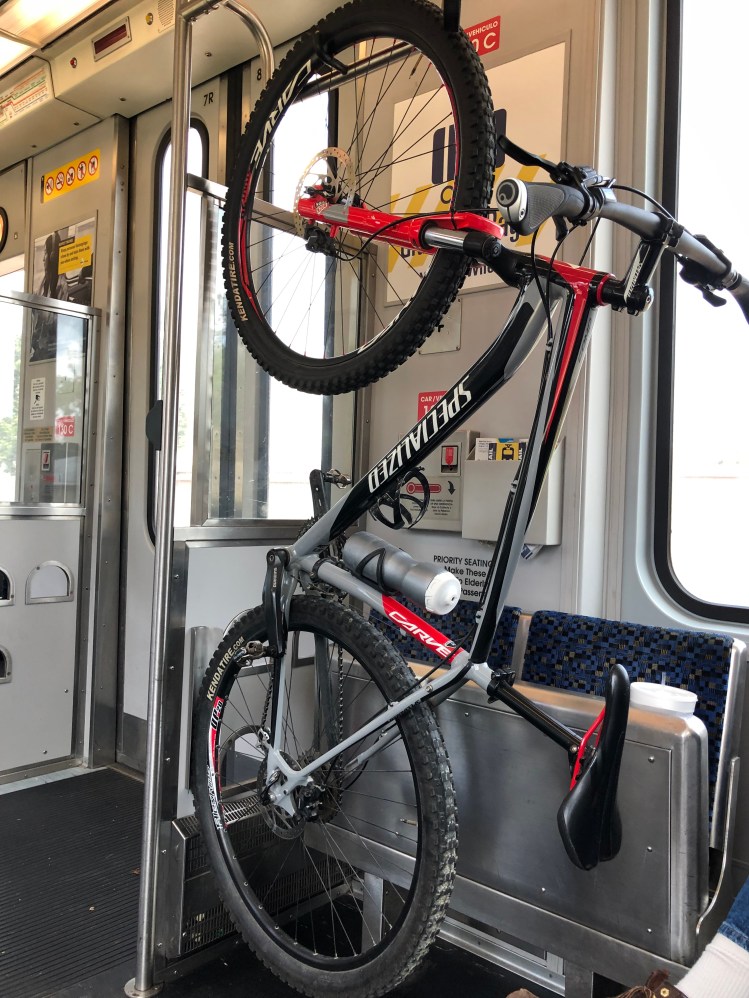
About 2 pm on a Friday afternoon, I took the Dallas Area Mass Transit (DART) train from Plano, TX to downtown Dallas, TX. I hung my bike up on the train, stowed my gear, and took a seat near my bike.

Bike hanging (for transport) on the Dallas Area Rapid Transit (DART) train.

Bike hanging (for transport) on the Dallas Area Rapid Transit (DART) train.

I met my friend, Bobby Adams, at the Dallas Amtrak station, located on downtown Dallas.

We checked in at the Amtrak check-in desk and got a baggage claim tag for our bikes (similar to a airline baggage claim tag). We wheeled our bikes and gear out to the Amtrak train platform and to the baggage car.

amtrak train

Amtrak train at the station.

Amtrak trains have limited bike mounting stations. You can purchase a ticket to bring your bike aboard (bike transport is an additional cost to your ticket). In the baggage room, your bike is stored hanging from the wall by the front tire, or (alternatively) may be strapped to the wall standing upright. Take care to make sure that the Amtrak train personnel load your bike in a secure manner (I watched them load my bike, to make sure that it would not shake too much and that it would not get friction on any parts that could not handle friction (brake rotors, painted metal, etc).

We had pre-purchased coach class tickets and I used the email confirmation as my boarding pass (I showed the email to the Amtrak train personnel for proof of ticket). I boarded the Amtrak train at Dallas Union Station headed for St. Louis, MO. The train left on schedule at 3:40 pm.

Amtrak does not have assigned seats for a coach class ticket. We boarded and found open seats. I moved to another seat after an hour on the train – the passenger in the seat diagonally across the aisle was loud – an incessant talker, on the phone often, with his phone making loud, unnecessary sounds (beeps and chimes) because the phone’s sound was turned up to maximum volume. The incessant talker  did not seem to grasp the the concept that the train’s observation car was where you should go to have loud phone conversations.

Amtrak keeps their trains at a very cool temperature. I put on my long pants and a jacket. Most people had brought a blanket aboard to keep warm. Meals were available on the train – either a sit down meal in the dining car, or in a snack bar. I ate one breakfast in the snack bar – the rest of the meals I ate were food and snacks that I had brought onboard).

amtrak train snack bar

Amtrak train snack bar in the dining car.

Amtrak trains have an observation car where people can sit, talk on their phones, and visit at all hours. I used it the observation car when I talked on the phone. Quiet hours in the passenger cars were from 10 pm- 7 am, at which time passengers in the passenger cars were encouraged to engage in quiet activities (sleep, read, listen to music on headphones, watch a movie with audio playing through headphones, etc). Amtrak personnel lowered the lights and did not make announcements during quiet hours.

Amtrak coach sears were spacious and allowed for adequate sleep (bring a blanket or items to stay warm). I brought a inflatable travel pillow and was glad I did. I also brought a pair of earplugs to soften the noise (the ever-present train horn blowing at each rail crossing, train car bouncing and creaking, passengers talking, etc) when I was sleeping. I slept in short naps throughout the night, but it was not a deep restful sleep.

Day 2 – St Louis, MO to St Charles, MO