Showing posts with label school lunch. Show all posts

Monday, March 31, 2025

Kitchens, March 2025

New in My Kitchen in March

New spoon rest or teabag holder that Evelyn made me.

What’s new on the refrigerator this month? Just one new and timely magnet.
For a thought-provoking essay on Orwell see: “We are all living in George Orwell’s World Now
in the New York Times Magazine.


Things We Ate in March

Vietnamese shrimp and snap peas. Recipes from Andrea Nguyen.

Favorite dish: au gratin potato casserole prepared in my French baking dish that I’ve had for many years.

Roast lamb, roast potatoes, broccoli, and a glass of red wine.

An omelet and a pita bread.


In our kitchen one morning. Toast, jam, butter, orange juice, coffee. Other mornings, other selections.

Alice at our favorite bakery, Tous Les Jours — lunchYes, we three ate all these pastries!

A visual recipe from the website Recipe Tin Eats. It was very good!


A great meal from Carol’s kitchen.

Recently opened in Ann Arbor: one of a small chain of Vietnamese/French coffee shops. 


Beyond my own Kitchen: US Food Aid Disrupted

Destructive actions by our government have been constantly increasing. 

Last week, the USDA cut an initiative called the Local Food for Schools Cooperative Agreement Program, which helped schools receive fresh ingredients from small farms.” (source)

Food-insecurity is a major concern that has been addressed by some very effective programs during the past five years, but those programs are being abruptly discontinued. Farmers have suddenly been abandoned by government programs that purchased their goods on behalf of food banks. Agencies like Feeding America are struggling to cope with these losses. 

“USDA had previously allocated $500 million in deliveries to food banks for fiscal year 2025 through The Emergency Food Assistance Program. Now, the food bank leaders say many of those orders have been canceled.” (source)

Food banks throughout the country, which have struggled to help those in need as their numbers increased, are now profoundly challenged as many millions of dollars in food aid has been cut off: 

“USDA’s cancellation of the Local Food for Schools and Local Food Purchase Assistance programs has garnered headlines, but they are just two of more than a dozen programs supporting small farms and regional food infrastructure that have been impacted. (source)


Source: “Feds cancel #4.3M worth of poultry, cheese, eggs to Michigan Food Banks” (March 29, 2025)

Here in Ann Arbor, throughout our state of Michigan, and in most other states, needy families that relied on USDA food supplies for nutritional help are facing a grim future. 

“Nearly $5 million worth of food for Michigan food banks has been cut by the Trump Administration, according to the CEO of one of Battle Creek's food banks. Although that number accounts for about 4% of food distributed to Michiganders across eight counties, South Michigan Food Bank CEO Peter Vogel is hopeful the cuts won't cause southwest Michiganders to go hungry. Canceled meals, including products such as chicken, eggs, pork, turkey and cheese, were expected to be delivered this spring and summer.” (source)

Farmers, already jeopardized by international trade cancellations in the tariff wars, are additionally faced with these newly cancelled orders. (The impact on farmers of new tariffs scheduled to begin this week is a major issue, separate from the various program cancellations.)

“Funding pauses at the U.S. Department of Agriculture are affecting sustainable agricultural programs in Michigan. The program Partnerships for Climate-Smart Commodities funds 41 projects, including 28 in Michigan. Grants support programs that increase economic opportunities for farmers who use sustainable practices. The disbursement of those funds has been stopped, according to two of those projects in Michigan.” (source)

Thinking of my own kitchen, where I am so extremely fortunate, makes me also think of the less fortunate people in my community, my state, and my country — one of the tragedies that is unfolding in the tsunami of federal injustice.

Blog post and original photos © 2025 mae sander.
Other photos as credited.
Shared with In My Kitchen at Sherry’s blog.

Friday, March 31, 2023

March Food Thoughts

The American Food Situation 

“It should shock the American conscience that in the wealthiest and one of the most agriculturally productive countries — awash in cheap food, no less — one in 10 households still live with food insecurity, a grim reality with which we’ve become startlingly comfortable. But hunger, as we learned during the pandemic and in its aftermath, is a policy choice.” (Source: VOX)

Whose policy? That of the Republicans in Congress, who refuse to renew the SNAP benefits that keep more than 30 million Americans from going hungry each day. Some benefits were discontinued earlier, but March, 2023, was the end of this program that’s essential for so many American families.

“The lapse in the additional benefits will reduce Snap allotments for the average recipient by $90 a month, with some households losing $250 a month or more. Older adults at the minimum benefit level will see their monthly Snap benefits drop from $281 a month to $23.” (Source: The Guardian

And along with the cancellation of the SNAP program, many states and cities have discontinued programs that provided lunch and sometimes breakfast to school children, regardless of need. The school lunch programs were cost-effective because of the reduction in complex record-keeping. Furthermore, they resulted in better learning by the school children, as measured by better test scores! 

To put it bluntly: March was a very bad month for hunger in America, and there may be further cuts if the Republicans in congress implement their policies. Charitable food banks are stepping in, but the cancellation of government programs will fall heavily on those in need. Globally there are many more issues of hunger and want, but I can only focus on one at a time!

In My Kitchen in March

From my California trip: fridge magnets and a menu from a lovely cafe.
I’m hoping the menu will help me with ideas for lunches.

Pad Thai: Another Asian Food Challenge

Condiments for Pad Thai. The “Sour Soup Base” (a new ingredient in our kitchen).
This is essential for the correct flavor, according to the recipe.
Len’s resulting Pad Thai was great.

Ingredients for the Pad Thai.

Rice noodles for Pad Thai.


A Sweet Breakfast Treat


A Few Simple Meals

Lunch: a tortilla and bean casserole and a
fruit and vegetable salad.

Turkey meatballs, cheese, and asian slaw on sourdough bread.
I made the meatballs with aquafaba from a can of chickpeas
instead of the usual raw egg in the meat mixture.

New ingredient: TJ’s Pepper Flakes.
Used in stir-fried Brussels Sprouts (recipe here)


The main course for this dinner was potato chips with Tzatziki!
Side dishes: green salad and fruit salad.

New ingredients to try soon: coconut oil and coconut water.
To be used in making some Thai recipes.

New Kitchen Cabinet: A Work in Progress

Installed this month: a new custom-built cabinet, still waiting for handles.
The added space is enabling us to organize our kitchen equipment much better.
When the handles are in and the reorganization is done, I’ll post more photos.

Shared with In My Kitchen at Sherry’s blog.
Blog post and photos © 2023 mae sander.

Monday, March 15, 2021

The Juice Box

Packed lunch with Juice Box (photo from my 2015 visit
to our local school lunch hour; © 2015 mae sander)

Schools are reopening throughout our country after a year of remote classes, Most are opening safely as teachers are being vaccinated. Among the many consequences of this genuinely wonderful event is that the children's lunchboxes are once again in use. Thus, at lunch time, many children will be skillfully unwrapping the cellophane from tiny straws and skillfully poking them into the tiny foil-covered hole in their juice boxes without causing a spill. (Not all adults have mastered this skill.)

A Classic Juice Box


Juice boxes -- that is, disposable single-serving containers of juice with a straw attached -- are one version of the paper or cardboard beverage carton. They were introduced in the US in 1980. Juice boxes quickly became extremely popular here. In recent years, annual sales have been $1.5 billion, but the industry is challenged by recommendations that kids should reduce their sugar consumption. Some juice box producers have been developing little boxes of water instead of juice. It's probably not news to you that kids love the sugary juice in their boxes, though!

Disposable beverage cartons -- the precursors of the juice box -- were invented in the 1940s and 1950s. Originally, these innovative containers replaced glass milk bottles, which were commonly returned to the processing plants to be cleaned and re-used. The newly invented cartons made milk delivery cheaper, and also enabled the production and sale of ultra-pasteurized milk that did not require refrigeration. The juice box extended the capabilities of these containers, being constructed from layers of paper to keep its shape, polyethylene to provide its label, and aluminum foil to preserve the quality and purity of the contents. The invention of the tiny straw was also an important contributor to their popularity.

The question of recycling the multi-material juice boxes was a concern almost from their introduction, and remains a concern in some elementary schools, where children are encouraged to bring their lunch in reusable containers to minimize waste. Because of the issue of recycling, juice boxes were banned in the state of Maine in 1990, but reinstated a few years later when recycling technology caught up with packaging technology. Curbside recycle pickup here in Ann Arbor currently accepts juice boxes. However, nationwide almost all recycling programs are undergoing challenges, and not everything designated as recycling can actually be returned to usefulness. In some places, what goes into the recycling bin ends up in the dump. It's a complex issue but not for this blog post. 

An Adult Version of the Juice Box

Sophisticated New York Cocktails 2019 -- source

Another Juice Box

40 calories
10 grams of sugar from HFCS
10% juice (source)

Hi-C Orange Lavaburst is a popular juice-box drink. This flavor is also returning as a fountain beverage at McDonald's this month after an absence of several years (source). The fountain version of this drink at McDonalds delivers quite a bit more to drink than a single 8-ounce juice box, and thus contains even more sweetener and calories. Here is the list of ingredients: High Fructose Corn Syrup, Water, Citric Acid, Ascorbic Acid (Vitamin C), Potassium Benzoate (To Protect Taste), Modified Food Starch, Natural Flavors, Glycerol Ester of Wood Rosin, Yellow 6, Brominated Vegetable Oil, Red 40. I can’t find any fruit juice on this list at all! (source

I'm sharing this blog post with the bloggers who offer pictures of drinks for Elizabeth's weekly blog event at her blog,  Altered Book Lover. This post © 2021 mae sander.

Saturday, January 09, 2016

New Food Guidelines 2015-2020 and What's Being Said About Them

Burns Park School lunch, October 1, 2015.
Our local elementary school. See this post.
"Secretary of Health and Human Services Sylvia M. Burwell and Secretary of Agriculture Tom Vilsack today released updated nutritional guidelines that encourage Americans to adopt a series of science-based recommendations to improve how they eat to reduce obesity and prevent chronic diseases like Type 2 diabetes, hypertension, and heart disease. The 2015-2020 Dietary Guidelines for Americans is the nation's trusted resource for evidence-based nutrition recommendations and serves to provide the general public, as well as policy makers and health professionals with the information they need to help the public make informed choices about their diets at home, school, work and in their communities."

Thus began a press release from the Department of Agriculture on January 7, 2016.

The most dramatic suggestion from these new guidelines is a 10% limit on the quantity of added sugar that one should consume. They could have just said "avoid drinking too many sweetened beverages," but the soda industry and others have a say-so in how they present their guidelines. They also suggested less "animal protein" for men and teenage boys. They could have said "eat less meat" but the cattle industry and others have a lot of influence. So much politics!

"Shift to healthier food and beverage choices" is one of their not particularly controversial suggestions. They did recommend conventional things like eating vegetables, fruit, whole grains. Also, "By removing dietary cholesterol as a 'nutrient of concern for overconsumption,' the guideline authors bowed to research suggesting that foods rich in the fatty substance contribute only marginally to levels of cholesterol circulating in the bloodstream." (Source: "New Dietary Guidelines," Baltimore Sun.)  

These federal guidelines are important because they become legal requirements for federally subsidized school lunch programs and other government-sponsored programs. I'm not qualified to analyze the guidelines professionally, but I have gathered some material about them from various sources --

Marion Nestle, nutrition expert, has a focus on real foods not "nutrients," which she feels doesn't help people develop good eating patterns. She suggests that the guidelines would be simpler and easier to follow if they just said to eat less processed and junk food. From her blog:
"These Dietary Guidelines, like all previous versions, recommend foods when they suggest 'eat more.' But they switch to nutrients whenever they suggest 'eat less.'
  • "In the 2015 Dietary Guidelines, saturated fat is a euphemism for meat.
  • "Added sugars is a euphemism for sodas and other sugar-sweetened beverages.
  • "Sodium is a euphemism for processed foods and junk foods."  -- Source: "The 2015 Dietary Guidelines, at long last" by Marion Nestle. 
Michael Pollan agrees about "nutrients" vs. "foods."  In an interview anticipating the release of the guidelines, he says this:
"Don't get lost in the details. It’s very important to keep an eye on the big picture. Eating real food is the most important thing you can do if you’re concerned about your health. The precise amount of various nutrients really is not going to make a difference. Those very specific recommendations are probably most useful to institutions that need to conform their feeding programs to federal standards — like the school lunch program.
"[The recommendations] are also important to the industry, which loves nothing better than to launch another conversation around nutrients because that leads to opportunities for new health claims. For example, if this time around "added sugar" becomes a food category, which it hasn’t been in the past, it’ll be an opportunity for foodmakers to boast about how little added sugar they have in their products. But that won’t turn unhealthy food into healthy food.
"In general, any nutrient-based advice becomes another distraction from the really important project of focusing on food." -- Source: "Michael Pollan on how America got so screwed up about food" by Julia Belluz at Vox.
About the "protein" recommendation, here's some history from a Baltimore Sun Editorial:
"The dietary guidelines released yesterday by the U.S. departments of Agriculture and Health and Human Services mark the ninth time in a row that the meat industry has successfully suppressed scientific findings recommending reduced meat consumption ... .
"Reduced meat consumption was first recommended in 1977 by the U.S. Senate Select Committee on Nutrition and Human Needs in the 'Dietary Goals for the United States,' a precursor to the Dietary Guidelines. 
"But the meat industry forced the committee to destroy all copies of the report and to remove the offending recommendation from a new edition. 
"That wanton government sell-out to the meat industry has replayed itself with every new edition of the guidelines since then." -- Source: "Our adulterated dietary guidelines"
And from the Los Angeles Times:
"One thing lawmakers did was fund a peer-reviewed study by the National Academy of Medicine of the science behind the dietary guidelines. The added research can only improve the next recommendations, but it's likely to leave unanswered what may be the most important question about the guidelines: Why don't more people follow them?" -- Source: "Feds serve up more dietary guidelines for Americans to ignore," Editorial in the Los Angeles Times.  

Friday, October 02, 2015

Ann Arbor School Lunches

I've lived in the Burns Park School district in Ann Arbor for a number of years. Recently, a lot of news articles have discussed federal regulations concerning school lunches and how they have been implemented and received in schools throughout the country. These have made me curious about the lunch program at Burns Park and throughout the Ann Arbor Public Schools (AAPS). So I received permission to visit and observe the lunch hour at Burns Park.

The fruit and vegetable bar, offering apples, cucumbers, applesauce, carrots,
and chick-pea salad. Burns Park Elementary School, October 1, 2015.
US Dept. of Agriculture requires that school lunches include fruit and vegetables.
Lunch lasts 25 minutes for pupils at Burns Park School, with three seatings to accommodate 470 pupils in Kindergarten through 5th grade. The lunch line goes very fast: I doubt if it was more than 5 minutes from the moment when the first impatient kid got in line until everyone was seated with their trays or with lunch boxes and beginning to eat. For the first 15 minutes or so, the kids seemed pretty absorbed in eating, though they were socializing all the time as well. Some got up to take more applesauce or cucumbers. By the last 5 minutes, the noise level was noticeably rising, and I think they were really ready for their half-hour of outside play time!

Today's lunch: hot dogs, corn, and choices from the fruit and vegetable bar.
Chuck Hatt, Burns Park School Principal, greets each child by name as he dispenses catsup or mustard for their hot dogs.
When the bell for lunch rings, he says "I'm on!"
The weekly lunch menu from the school district's webpage -- my visit was on Thursday.
Food and service for the Ann Arbor Public School program are supplied by a unit of Chartwells, an international corporation, under a contract for the school year. (Chartwells Webpage here.) At the lunch I observed, a serving of corn was included with every hot dog, meeting the USDA requirement. Children were allowed to make their own choice among the other fruits and vegetables. Chartwells has been the AAPS lunchroom supplier since 2007.

Chartwells also participates in the "Farm to School" program using Michigan growers to supply produce; the program also sponsors school vegetable gardens. Today's apples came from one of several Michigan orchards and cucumbers from Ruhlig Farms in Carleton, MI. "Using local food in our school food service also supports local and regional farms in their efforts to be sustaining contributors to our local economy. Chartwells provides Michigan-grown produce in all AAPS cafeterias," says Heather Holland, Director of Dining Services, AAPS.

Meals at Burns Park School are mainly prepared in a small kitchen adjacent to the cafeteria. For example, the hot dogs were heated in the oven and placed in buns by a Chartwell's employee, who also dishes out the hot dogs and corn to the lunch line, and replenishes the fruit and vegetable bar. If the menu included stovetop preparations, such as boiling pasta, the cooking would be done at the larger, more fully equipped kitchen at Pioneer High School around a mile away, and brought to Burns Park for final prep. Both breakfast and lunch are served in the cafeteria, but I only visited at lunchtime.

School meals, as I mentioned, get a lot of attention nationwide -- especially the requirement that fruit and vegetables be a major part of school nutrition programs, which became Department of Agriculture policy in 2012. A recent article in the New York Times said:
"Food and nutrition directors at school districts nationwide say that their trash cans are overflowing while their cash register receipts are diminishing as children either toss out the healthier meals or opt to brown-bag it. While no one argues that the solution is to scrap the law and go back to feeding children junk, there’s been a movement to relax a few of the guidelines as Congress considers whether to reauthorize the legislation, particularly mandates for 100 percent whole grains and extremely low sodium levels, so school meals will be a bit more palatable and reflective of culinary traditions." ("Why Students Hate School Lunches," Kate Murphy, September 26, 2015) 
Reporters and authors of studies of school meals seem to me to be somewhat obsessed by the topic of children throwing away the fruit and vegetables from their lunches. At Burns Park School, I did see kids eating only part of their lunch -- some left the hot dog, some left the bun. I saw a lot of the corn being left on their trays and discarded. But I also saw them eating and seeming to enjoy applesauce, apples, and also cucumbers, which they were dipping in ranch dressing. I saw only one child take a portion of chickpea salad from the vegetable and fruit bar. Quite a few kids were going back for seconds: unlike many school districts the Ann Arbor program allows return visits to the lunch line for more fruit and vegetables -- but not more hot dogs.

While a lot of fruit and vegetables from the lunch trays did go in the trash, I also saw a lot of kids throwing away whole wrapped items or half-eaten items from the lunch boxes they brought from home. And I wonder: is this just the way kids act when no one is coercing them to clean their plates?

Another recent article illustrates the focus on food thrown away rather than on food that's eaten: they observed that more fruit and vegetables were tossed away now -- more than before the program started. As far as the article reported, the study didn't actually observe what the kids ate, only what they wasted. ("Children Tossing School Lunch Fruits and Vegetables,"Nicholas Bakalar,   New York Times, September 7, 2015)

As the kids finish lunch and dump their trash, they are supposed to sort the recyclables from the other garbage. In a few weeks, when everyone is more adjusted to the new school year, Principal Chuck Hatt says there will be fifth graders wearing gloves who serve as the "Green Team" helping to keep the cafeteria clean and make sure the trash is properly sorted.

Vegetarian option: hummus, pita, and grapes. I only saw one of these chosen.
Kids like hot dogs!
Could the food be better? Healthier? Tastier? I'm sure it could, but I'm not sure how much better, considering the constraints of pleasing varied tastes and backgrounds, meeting government mandates, using USDA donated food (which is covered in the AAPS-Chartwells contract, though I don't know any details), and meeting very stringent cost requirements. I think the trend away from junk food in schools is overall a good one.

Lunch boxes from home contained a variety of foods.
Of 470 pupils in the school, around 120 buy the school lunch,
and the rest bring lunch from home. 50% of purchased meals are subsidized. 

After they finish eating, kids have another half hour to play outside.
Lining up to return to class after lunch.
I am grateful to Heather Holland, Director of Dining Services, AAPS; Andrew Cluley, Communications Specialist, AAPS; and Principal Chuck Hatt, Burns Park School/AAPS, for arranging my visit, hosting me, and answering my questions about school lunches.

For all my posts on school lunches, including this one, CLICK HERE.

Thursday, July 16, 2015

Fighting Hunger

Maybe you live in Ypsilanti, Michigan, and your family needs help. SOS Community Services is a social-service organization that offers housing services, help with utilities, food assistance, and various social services. Earlier this week, I visited one of the two SOS centers in Ypsi, which is around 20 minutes drive from my home in adjacent Ann Arbor. My goal was to learn more about SOS, which has been developing social services to meet the changing needs of the community for 45 years.

I was particularly interested to find out more about their food pantry, which offers families in the community choices of bread, produce, meat, and a variety of canned and packaged goods, all at no charge. Six times per year, a family member makes an appointment to visit the pantry and select from a variety of foods to supplement groceries that they buy, perhaps using government assistance like SNAP. Every week, produce is available to all clients on a walk-in basis. Most of the food comes from Food Gatherers in Ann Arbor, says Marti Lachapell, coordinator of the food bank.

The SOS Community Services Food Pantry -- staples, personal care products, produce, recipes.
At left: Marti Lachapell.
Some SOS families have homes with kitchens. Foods from the pantry that are helpful to them are bags of rice or dried beans, boxed mac & cheese, waffle mix, frozen beef or pork, fresh vegetables like potatoes and carrots, fresh fruit, bread and sometimes desserts, large bottles of juice, and many pantry staples. The quantity of food each family receives depends on family size. Certain items, like baby food and large containers of juice, may be limited, due to high demand, but every family goes home with a useful selection of needed groceries.
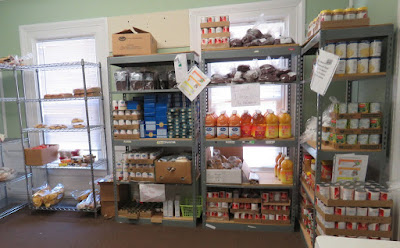
Produce, bread, canned goods, juice, peanut butter... to be chosen by the users.
The bakery goods shelves are nearly empty in the photo because my
visit was the afternoon after the pantry's morning open hours.
Homeless families or those living in an unstable situation are also among the SOS clients. For them, helpful items are foods like peanut butter, saltine crackers, or single-servings of apple sauce: portable foods that don't need refrigeration. Some families are "surfing" -- that is, they live temporarily with a series of friends or relatives. The food they receive here from often helps them to be more welcome as guests.

"SOS never charges for food," explained Chelsea Brown, SOS development director. "All of our food is free to consumers so that they can stretch their limited budgets."

This week, as pictured above, the pantry received a lot of radishes among the produce available, so Marti researched some recipes to help people figure out how to cook them, not just to eat them raw. Labels "GO" or "SLOW" appear on some shelves to suggest what's good to eat in any quantities, like produce, and what might be less healthy choices, like sweets or waffles from the available waffle mix. In the pantry there's also a bulletin board offering recipes for healthy snacks.

Rhonda Weathers, SOS executive director, and Chelsea Brown, joined Marti in showing me around the center and answering my questions. They described how SOS responds to changing needs and situations. For example, opening up the pantry shelves to allow families to meet their own needs is a new process. It replaced the old way that SOS distributed food until last year, which was to provide each family with a bag of pre-selected foods.

Also recently, Marti explained, they've expanded the choices of fresh fruit and vegetables in the pantry. Some produce is local; some comes from national distribution centers. Most of the items in the pantry are able to be restocked when needed; the category where demand usually exceeds supply is personal care items, which for the most part are not part of the Food Gatherers offerings.
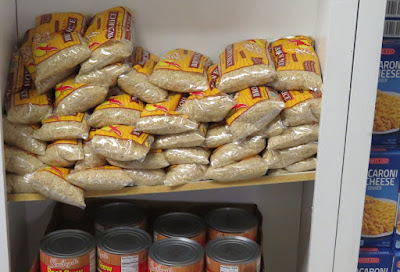
Rice, mac & cheese boxes, more canned goods.
Food insecurity exists in every county in America. Around 14% of American families experience hunger. Here in Washtenaw County, Michigan, where I live, a number of organizations including SOS attempt to help people in need to overcome many of their problems, including housing, jobs, and stability for children. SOS works in partnership with other organizations, both local and national.

SOS, using HUD funding, provides temporary housing for homeless families, and attempts to place them in permanent homes and better jobs. They run a summer enrichment program for 40 kids called Sunny Days, which also includes a lunch program. Other sponsored activities for kids are a Girl Scout troop, tutoring programs, and after-school activities during the school year.

Maybe your family needs help, I said when I started this post. But maybe you are much more fortunate, and could help SOS Community Services with a donation or could volunteer in one of their volunteer programs. I hope more fortunate people will think about this.

Note: For more information see the SOS website. For nation-wide hunger statistics see this Feeding America Fact Sheet.

Tuesday, October 07, 2014

Pizza for lunch?

School lunch spending from the New York Times article
What's for lunch? Pizza. What's on the pizza? Tomato sauce that the government counts as a whole lot of vegetables. School-lunch pizza these days is low in salt with maybe a whole wheat crust -- not as good as salty pizza with regular crust. But do you like it better than broccoli, which you'll be told to eat tomorrow? Well duh.

"How School Lunch Became the Latest Political Battleground" in the New York Times Magazine describes in detail the struggle to improve school lunch programs. It illustrates the dizzying and constant back-and-forth about the nutritional value of pizza and potatoes. It documents the machinations of the food industry. It highlights the startling political involvement of the "lunch ladies" and their lobbyists in opposition to the new rules. The Healthy, Hunger-Free Kids Act was "an ambitious bill that would impose strict new nutrition standards on all food sold in public schools." Well-meaning, but fraught!
"As the government began turning the broad guidelines into specific rules — specific rules with specific consequences for specific players — life became more difficult. What began as a war on obesity turned into war among onetime allies. Republicans now attack the new rules as a nanny-state intrusion by the finger-wagging first lady. Food companies, arguing that the new standards are too severe, have spent millions of dollars lobbying to slow or change them. Some students have voted with their forks, refusing to eat meals they say taste terrible."
Children who refuse vegetables for school lunch are a double whammy -- the lunches they eat don't count towards federal reimbursements AND the kids come away hungrier because their hamburger or pizza has been downsized since they are supposed to get some calories from their vegetables. We put all the kids on a diet to solve obesity -- what about the thin, active, hungry ones? And "schools of all sizes and income levels were struggling with higher costs, lower participation and what they call plate waste — kids throwing away perfectly good food." It's so complicated when one set of guidelines apply to all. The net result of all the politics is a complicated program full of bad incentives and bad faith, and any compromise is likely at best to remain that way.

This mess is all about money, as you would imagine. Varying interest groups earn big money from the enormous federal school lunch program -- that's no surprise. From the first efforts at the beginning of the Obama administration, they have lobbied and otherwise influenced Congress and affected the USDA in its rule-making. The loudest voices are the most financially engaged voices.
"Next September, when the entire Healthy, Hunger-Free Kids Act will be up for reauthorization, the soccer moms of America may not get a vote. Just a few years ago, President Obama’s school-lunch reform seemed like a kind of armistice in Washington’s eternal culture of influence and partisanship. Today Obama’s lunch reform, much like Obama’s presidency, feels mired in an endless insurgency — against a stealthy, well-financed and infinitely patient foe."

Monday, September 01, 2014

What's in your lunchbox?

Mona Lisa Lunchbox -- $47.95
Back to school this week! I'm again thinking of kids and their lunches... at right is a very pricy Mona Lisa lunchbox, that for me suggests a lot of gaps between what kids need and what they might want. Clearly kids need healthy food and often want junk. (My own family is an exception of course.)

In a study published this summer, photos of the contents of 600 lunches packed for children in third and fourth grade in several Massachusetts schools revealed rather depressing facts: home-packed lunches were like many over-rated things in the old joke.

“When deciding what to pack, parents are juggling time, cost, convenience, and what is acceptable to their children. Unfortunately, these factors are not always in harmony with good nutrition,” according to Jeanne Goldberg, a researcher at Tufts University and a senior author of the study of the lunchbox contents.

“Lunches were comprised more of packaged foods than anything else. ... Almost a quarter of the lunches lacked what would be considered an entrée, such as a sandwich or leftovers, and were instead made up of a variety of packaged snack foods and desserts.”

"This study points to the need to help parents find ways to build nutrition into the packed-lunch routine. The researchers acknowledge that this is a challenge that will require creative approaches to packing lunch boxes with affordable, easy-to-prepare, and healthy options while at the same time creating a demand for these options among children." (source)

Government guidelines now require among other things that school lunches include fruit and vegetables, and avoid sugary drinks -- unlike the home-packed lunches on average. Kids and parents complain and threaten, but follow-up studies of the changed school lunch suggest that kids get used to it, and actually eat healthier meals: eventually. From a commentator at CalorieLab, here's a key observation: "There are a number of things the kids probably don’t like about school in addition to healthy lunches, such as the teachers, tests and homework, but their wishes are not our command. Please tell me I don’t have to explain why letting children make their own food decisions is nuts." (source)

Thursday, September 05, 2013

What's in your lunch box? An extended answer.

Elaine writes about lunches at home and at school:
I just wish someone would make me the Bon Appetit lunches--an awful lot of work even for a retired person. I usually eat at home, often one of the Yoplait yogurts that you decry for their lack of good nutrition, a piece of fruit and some bread and butter and jelly. (Or cookies or pie or cake if we have some). I think eating the yogurt in addition to a sandwich would be excessive, but instead of it's not so bad. I used to often pack the same lunch when I was working. 
Delmar-Harvard Elementary School where we ate those lunches
(though the cafeteria was in another building)
I mentioned earlier this year that I've gone back to peanut butter after many years hiatus, but now I sometimes use creamy style horseradish instead of jelly. I remember once as a kid that Mom put butter on my peanut butter sandwich instead of jelly. It was probably worse for me and tasted weird. I also remember the Halloween peanut butter open face sandwiches, cut round with jack-o-lantern faces. Those were served at home on Halloween, before we went back to the school parade. (Butterscotch pudding with jack-o-lantern face was I think for dinner dessert). I loved those! 
As a member of the local school parent council when the kids were small, I designed and administered a survey at the elementary school to see what the kids liked and didn't--most of the disliked stuff went into the trash, since there were no eating enforcers. The items they hated the most were green and gold salad (cheese and peas) and Reuben sandwiches. We shared our results with the cafeteria directors but am not sure we got much attention. The staff wanted to open the minds (palates) of the children, but the kids were pretty much completely closed to some of the ideas, and I doubt they actually tried some of the food.

What's in your lunch box? Another answer.

Evelyn wrote about what's in lunch boxes packed at her house:
I read your blog entry about packed lunches, and I think maybe I don't agree with some of it.
Pesto-Chicken Rolls from Bon Appetit
For example that Bon Appetit article -- maybe a little pretentious, but I am going to show it to Alice, because I bet she would get up early to make herself some of those lunch ideas. They actually sound very good for dinner with leftovers for the lunch. Maybe that's why it sounds pretentious -- I seriously doubt anyone really makes those only to pack in a lunch, whereas as a leftover that would be completely reasonable. Miriam even made sushi for dinner a few times for the purpose of taking it in her lunch the next day. 
I don't think that Miriam and Alice's lunches are too far off from the norm, or they would rebel, and yes they often have a piece of candy or a yogurt, but they don't seem all that much worse than what you described you bringing healthwise. For example, today Miriam had a PBJ sandwich, 5 ritz crackers, a bit of candy, a peach, and a chocolate milk (It's not really just her lunch -- she has been eating a little lunch at school and finishing it up the rest for afternoon snack). 
Alice had the same crackers and candy, but she had a tortilla wrap with melted swiss cheese for her sandwich, a fruitable for her drink (it is fruit juice with water added), and blueberries for her fruit. This seems to be well within the range. Yes, it has more sugar than you had, but not enormously more. 
My own lunch was leftovers from the salad last night for dinner -- quinoa, avocados, tomato, corn cut off the cob, garlic, onion, and the wonderful Cajun seasonings you brought me from Baltimore (which I have been adding to pretty much everything all summer). That is just as pretentious as any Bon Appetit lunch in that article! But this was an exceptional day -- on Tuesday I didn't have time to make a lunch at all and had a pain au chocolat from the coffee shop. And  I'm sure that kind of lunch is exactly what Michelle Obama is talking about.