What’s New?
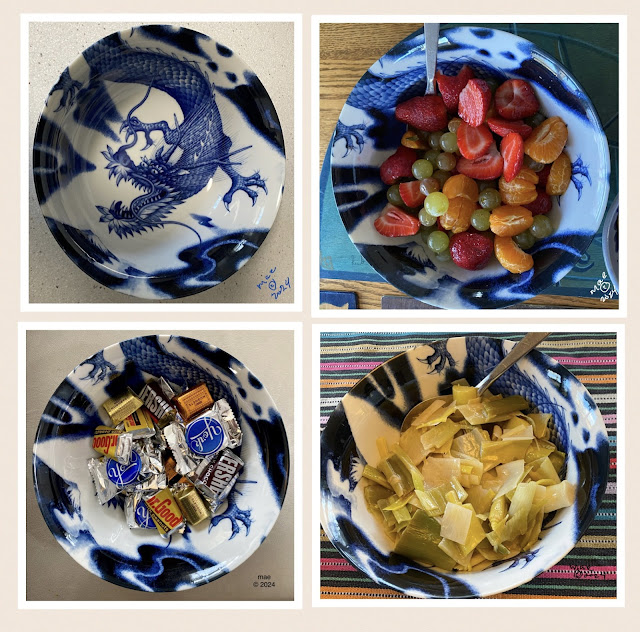 |
| Using my new dragon bowl for fruit, for candy, and for leeks vinaigrette. |
 |
Using a new set of little bowls for tomatoes, artichokes, mushrooms, and grated cheese— to go on pasta.
They were perfectly designed for this use: mis en place. |
Cooking in April
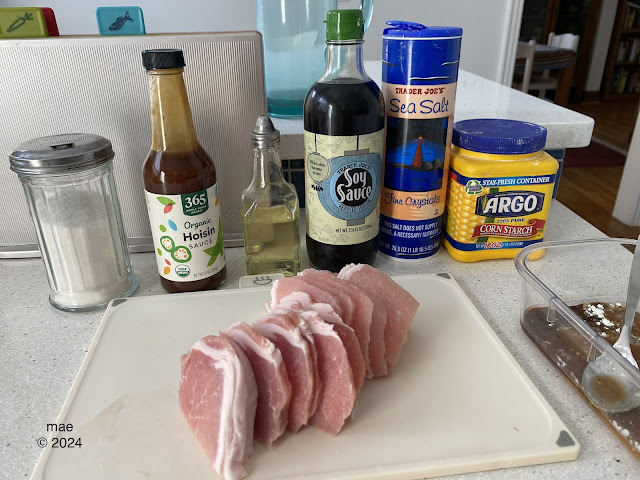 |
| Preparation for making stir-fried pork. |
 |
| Salad and roasted peppers. |
My kitchen this month has been busy, as we have had a few invited guests to share meals. I’ve just selected a few of the foods that Len and I cooked or prepared. I’ve posted already about our Passover food, our first outdoor cooking, and some of the things we ate elsewhere. I’m sharing these food images with a group of bloggers who post kitchen thought each month at
Sherry’s blog in her link-up called “In My Kitchen.” Now for some thoughts about the possible fate of one of my favorite foods!
Climate Change Is Coming for the Chocolate Supply
 |
Cocoa pods growing on the trunk of a cocoa tree. The beans in these pods must undergo considerable
processing — fermentation, drying, roasting, and conching — before they become cocoa or chocolate.
(Tree is in Matthaei Botanical Gardens, Ann Arbor.) |
Climate change and its effect on farming is often in the news, but reading about it seems very distant and maybe not even urgent. If you love chocolate as much as I do, you’ll see one issue as more pressing; specifically, rising chocolate prices due to supply disruption. Ultimately, the problems with the global chocolate supply are caused by poor growing conditions in the tropical areas where cocoa is produced. Recently, these areas have had bad weather — temperatures are high or rainfall is too little or too much, leading to stressed or diseased trees, lower harvests, higher prices, and instability of processors.
Many factors prevent the logical response; that is, the expansion of cocoa farms. The main obstacle is that it takes years to grow new productive trees. Expansion is limited because chocolate can grow only in a narrow area within 20 degrees of the Equator.
According to the trade association World Wide Chocolate (
article here), many people “have no idea how difficult cocoa ‘the commodity’ is to grow, procure, process and ultimately apply to different applications and create all of those wonderful chocolate products we’ve come to love.” This article uses two West African countries and their difficulties as examples — the challenges to poor third-world farmers are much more profound than one would guess, and rising prices don’t generally mean that the impoverished farm workers receive more for their labor. As an article in yesterday’s Guardian explains: “Nine in 10 west African growers are smallholders, while the confectionery market is dominated by huge players: Oxfam notes that Lindt, Mondelēz, and Nestlé
raked in nearly $4bn in profits from chocolate sales last year, while Hershey’s confectionery profits totalled $2bn.” (
link)
But the problems of growers and injustices to workers are just one area of many. More detail about the many difficulties of farmers and processors in Africa appeared in an article in Reuters in March titled “African cocoa plants run out of beans as global chocolate crisis deepens” (
link). It’s complicated, involving pre-set prices from farmers who are experiencing very poor harvests. Opportunistic dealers step in and disrupt the expected supplies to the local processing plants:
“In normal times, the market is heavily regulated - traders and processors purchase beans from local dealers up to a year in advance at pre-agreed prices. Local regulators then set lower farmgate prices that farmers can charge for beans. However, in times of shortage like this year, the system breaks down - local dealers often pay farmers a premium to the farmgate price to secure beans. The dealers then sell the beans on the spot market at higher prices instead of delivering them at pre-agreed prices. As global traders rush to purchase those beans at any price to meet their obligations with the chocolate firms, local processors are often left short of beans.”
Chocolate candy production requires more than just cocoa. The Wells Fargo Investment service (
article here) summarizes the situation: “To some extent, chocolate’s escalating cost can be understood by looking at the overall rise in product manufacturing costs, with the Producer Price Index (PPI) for Food Manufacturing increasing 28% since January 2020. This rising inflationary environment has increased the cost of labor, processing, manufacturing, packaging, and transportation. Higher raw material costs for two of chocolate’s crucial ingredients - sugar and cocoa - are also included in this overall cost increase.”
In an article in this month’s Atlantic, titled “Chocolate Might Never Be the Same,” author
Yasmin Tayag wrote:
“By one estimate, retail prices for chocolate rose by 10 percent just last year. And now this is the third year in a row of poor cocoa harvests in West Africa, where most of the world’s cocoa is grown. Late last month, amid fears of a worsening shortage, cocoa prices soared past $10,000 per metric ton, up from about $4000 in January. To shoulder the costs, chocolate companies are gearing up to further hike the price of their treats in the coming months. Prices might not fall back down from there. Chocolate as we know it may never be the same.”
This week’s Guardian article cites even more increase in prices: “Soaring prices for cocoa beans recently hit a record $12,000 a tonne: roughly four times last year’s price. Many think they will go higher.” Issues of sustainability and fairness to workers are not easy to address. For an extremely detailed study of these issues related to global chocolate production and processing, see the recent report from Oxfam (link).
Chocolate candy seems to me to embody a whole range of cultural and economic concerns for our time. Exploitation of third-world agricultural and processing workers, including child labor abuses and even slave labor are of great concern. Chocolate plantations, which must be in the tropics, are especially affected by climate change. All chocolate is a highly processed food and an economic commodity handled by huge corporations. Consumers of luxury goods such as high-end chocolate candy provide a giant contrast with the extreme poverty of the producers.
So many issues! As I thought about this, it occurred to me that the expression “first-world problems” is a good description for people who are inconvenienced by high candy prices — in contrast to impoverished and exploited third-world farmers and their children who are paid a pittance for the produce for which they labor.
 |
In 2021, this bag of Hershey Nuggets cost $8.98.
It now costs typically $12.58 (though a terrific sale price has been in effect).
I’ve been buying this and other chocolates quite often. |
Blog post and photos © 2024 mae sander.
Shared with Sherry’s In My Kitchen.


