Showing posts with label Passover. Show all posts

Thursday, April 02, 2026

Happy Passover

Wednesday evening was the start of Passover, and we celebrated with a few other people.
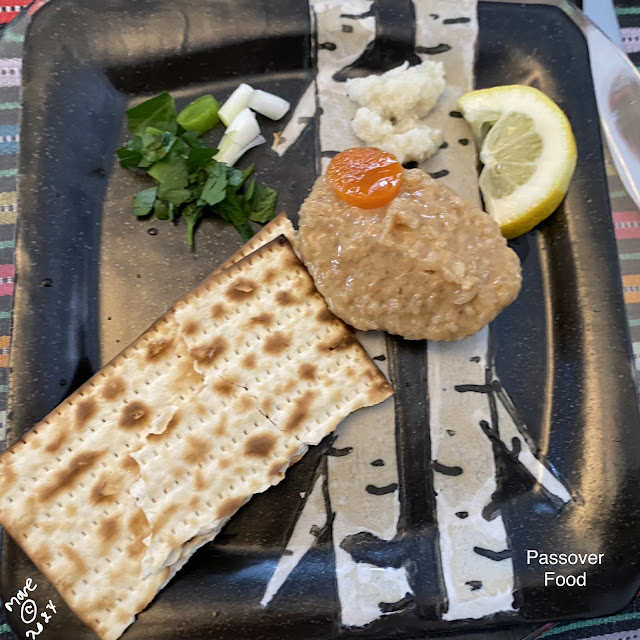
This photo shows the ritual items: the matzoh, the lamb bone, the egg, horse-radish root,
and the greens that symbolize spring. Matzoh reminds us of our ancestors’ exodus from Egypt.

At the table.

Another view of the ceremonial items, as well as the gefilte fish that we
like to have as part of the meal.

Our main course was Chicken Marbella, a 1980s favorite that I had never cooked before.

Gefilte fish (photo by Alice).


What it all means: From 2007

In 2007, I wrote a child-friendly explanation of the symbols on the Passover plate. Here it is again in case you would like to see it. We celebrate the same way each year (you might notice that it’s even the same tablecloth). Back then, I was writing for Miriam and Alice who were small children. Happily, Alice was with us in person this year!

In the spring we celebrate the Jewish holiday called Passover. We have a special ceremony called a Seder, and we tell a story about Jewish history a long, long time ago. To tell this story, we have special food on the table. The picture shows the table from last year.

At the Seder, we tell the story of how the Jews were slaves in the land of Egypt in this long-ago time, and how Moses, their leader, helped them to escape. We celebrate freedom and the coming of spring.

Moses and all the people ran away from Egypt so fast that they didn't have time to bake bread, but ate a flat bread called matzoh. For the holiday of Passover, many Jewish people do not eat any other type of bread or crackers for 8 days, because they want to remember the story.

When the Jewish people were slaves, they had to work very hard making big buildings for the Egyptians. On the Seder plate is a special fruit jam called charoses that tastes very good.

Charoses looks like the mortar that holds a brick or stone building together, and we eat it to remind us of the lives of the Jewish slaves who worked on the buildings in Egypt.

The next special food is called "bitter herbs," or horseradish. This is a very bitter, sharp-tasting root. This taste makes all the people at the Seder remember the hard and "bitter" lives that the Jewish people had when they were slaves around 3000 years ago. They make us remember that freedom is a good thing.

One part of the Seder is to eat matzoh with some charoses and ground-up horseradish on it, and remember the bitter and the sweet parts of the story.


Salt water on the Passover plate makes us remember the tears that people wept when they were not free men and women.


The egg on the Passover plate reminds us that spring is here.
Parsley or other mild-tasting green herbs is also on the Seder table to remind us of spring. Another part of the Passover celebration is to eat egg with salt water and matzoh, and to dip the parsley in salt water.


Also on the Passover plate is a bone from a lamb. We also drink wine as we tell the story.

When Moses helped the Jews to escape, the first thing they did was to cross a big sea named the Red Sea. Here is the magical part of the story: the water of the sea opened up, and everyone could walk between the walls of water.

While they walked, Moses's sister sang and danced to help them on their way. Her name was Miriam, and she has an important part in the story. After all the Jews crossed the Red Sea and escaped from slavery, they lived in the desert for a long time. Miriam had a magic well so that wherever they went, they found water to drink. Even though the desert is a very dry place, Miriam's magic well was always with them.

 Photos © 2007, 2026 mae sander

Saturday, April 12, 2025

Passover, 2025


Cooking for Passover, 1478

A full-scale Seder meal for Passover includes four cups of wine, hard-boiled eggs, matzos, matzoball soup, gefilte fish, roast chicken (or another roast), side dishes, and several desserts. This year we were alone, just the two of us, so we are having several simpler meals with only some of these favorite dishes.

Ritual foods: salt water, horseradish (bitter herbs), parsley (sweet herbs), charoset (apple mixture).
(Missing: a hard-boiled egg and a shank bone)


We ate the traditional soup on an earlier night.


The prophet Elijah travels throughout the world. When he is ready to announce the coming of Messiah, he will make himself visible and share the wine at the Seder. We pour some wine in hopes that he will show up.


We’ll have the traditional fish later this week.

Photos © mae sander 2025


Monday, April 22, 2024

Passover


Elijah the Prophet, from a 16th century Haggadah. The traditional belief is that Elijah will herald the coming of the Messiah.
To welcome Elijah a cup of wine is left on the Seder table -- "Elijah's cup" -- and near the end of the
ritual, someone opens the door, inviting him in, all hoping that his arrival will bring peace to mankind.
 
From the Haggadah: “This is the promise — not only once did they arise to destroy us, rather in every generation they rise to destroy us. But the Holy One Blessed Be He will save us from their hands.”

This evening, April 22, is the first Seder, the traditional meal that celebrates the beginning of Passover. The Passover holiday is celebrated mainly in people’s homes, though there are sometimes communal meals as well, especially for those who are separated from their families such as students who live away from home. The “Haggadah” is the book of rituals, readings, and prayers that is used for the service that accompanies the meal. I suspect that the above quotation is on a lot of people’s minds this year, along with the irony of a wish for a peaceful world.

Although not religiously observant, we usually celebrate Passover in our home or with family or friends. I’ve written about it many times. Because we had a family visit last week, we ate Passover food early, so here are some pictures illustrating traditional foods that we enjoyed ahead of time.

“Conundrum” is a great name for a wine at Passover.

Wine is one of the traditional items on the Passover table. During the ceremony, all participants drink four glasses of wine at specific times as the Haggadah requires. The start of the ritual is the reading of The Four Questions, asking “Why is this night different from all other nights,” and beginning the explanation of the celebration of the Exodus from Egypt as presented in the Biblical book of Exodus. Since a conundrum is a puzzling question I thought the wine was very aptly named. (Note: for those who observe the kosher dietary laws, this is not kosher wine.)


Two foods that are part of the ritual: Matzo, the unleavened bread eaten as the Israelites fled Egypt,
and Charoset, a combination of grated apples and nuts, representing the mortar that the enslaved Israelites used to build the Pyramids.


Our table setting for our pre-Seder meal.

Symbolic foods: egg, parsley, horseradish, wine.

Another food that’s not required but is traditional: matzo ball soup.

Gefilte fish is not part of the Haggadah ritual, but it’s a key dish in many people’s Passover meal.

Recipes using dried fruit such as prunes are a Passover tradition.


Blog post and photos © 2024 mae sander

Thursday, November 16, 2023

Zingerman's Class: Roman-Jewish Cuisine

Cookbook author Leah Koenig in the Zingerman's Classroom in Ann Arbor.


"Feasting in Rome's Jewish Kitchen," with presenter Leah Koenig took place Wednesday evening at Zingerman's. In addition to the locally famous bakery, Zingerman's has a teaching center for bakers and cooks offering a wide variety of classes and presentations. Len and I enjoyed the evening. Leah demonstrated three recipes from her recently-published book; we also received small samples of each dish, which we found delicious. The three dishes were:

  • Semolina Gnocchi Gratin (Gnocchi alla Romana) -- layered disks of semolina pasta and cheese, baked until golden.
  • Sauteed Spinach with Pine Nuts and Raisins (Spinaci con Pinoli e Passerine) -- a delicious flavor combination with onions, pine nuts, golden raisins, and lemon zest. Len, who normally detests spinach, found it quite tasty.
  • Chocolate and Almond Cake (torta di Mandorle e Cioccolata) -- flourless almond and chocolate cake suitable for Passover, and very similar to many other Passover cakes I've eaten.

Images from Leah's Cooking Demonstration

On the table: cheese, egg yolks, butter for the gnocchi recipe.


Chocolate and Almond Cake, Leah's recipe at Real Simple

From the cookbook: a delicious-sounding pastry bar with pine nuts, almonds, and dried fruit.
A specialty of a famous bakery in the Roman Ghetto. Leah told us quite a bit about her experiences in Rome and about this bakery.

Portico: Cooking and Feasting in Rome's Jewish Kitchen

Blog post and original photos © 2023 mae sander

Wednesday, April 05, 2023

At the Passover Seder


In our Passover Seder we use the Haggadah illustrated above, with illustrations by the American artist and sculptor Leonard Baskin. His water colors are very delightful and modern. Our Seder this year was short and very nice.

The Seder plate with greens, salt water, charoset,
and a horseradish root. Missing: a shank bone.
These are the symbols used to tell the Passover story during the Seder.

Our table, including the Haggadahs, ready for our guests.
The Seder celebrates the Exodus of the Jews from Egypt under the leadership of Moses,
Aaron, and Miriam.

Ritual foods: matzoh, charoset, wine, and the Seder plate.
Charoset is a mixture of fruit, nuts, honey, and wine ground up to represent the mortar that the slaves
used to build the pyramids before they escaped from Egypt. The matzo represents the unleavened bread
that was eaten during the Exodus because the Jews fled so fast that they didn’t have time for bread to rise.

The Haggadah: Traditions of Illustrations and Text

The origins of the Haggadah, the book detailing the order of prayers and readings for the Passover ritual, begin with the rabbis who lived around the third and fourth centuries of the common era. These scholars and sages based some of the rituals on the traditional celebrations of the Passover holiday in the Temple before its destruction. The Haggadah as we know it now includes many additions made during the following centuries. Hand-written Haggadahs in museum collections date to as early as the tenth century, and printed Haggadahs were first produced in the fifteenth century in Soncino, Italy, not long after the introduction of printed books in Europe.

Certain prayers and texts are standard parts of the ritual in every Haggadah, but the exact format and content varies from one version to another. Illustrations are almost always included, making these documents — from the earliest time until the present — very beautiful, historically informative, and extremely enjoyable. Bibliographies of printed Haggadahs include several thousand examples! New versions appear every year.

The Plagues: Boils, pestilence, frogs, and wild animals visited on the Egyptians.
From “The Golden Haggadah,’ 1320. (British Museum)


Illustration of the song "An Only Kid" from a Haggadah by Eliezer Lissitzky , 1917.
The addition of this song to the Seder ritual probably dates from the 15th century.

Page from the Sarajevo Haggadah, 14th century Catalonia.
Top of page: Moses and the Burning Bush.
Bottom of page: Aaron and the Magicians.

A page from a 15th century German Haggadah.
Each of the figures is holding a book: that is, a Haggadah.

Passover is a celebration of freedom, which takes on new meaning each year. Unfortunately, there are always current events that can be interpreted in the context of this holiday, as well as a long history of struggling for freedom from persecution, freedom of worship, and freedom for all people.

Blog post © 2023 mae sander.