Showing posts with label France. Show all posts

Friday, June 19, 2026

Martin Walker: “A Murder in Springtime”


A Murder in Springtime is Martin Walker’s latest police mystery, as always starring Bruno, the police chief of a small town in (idyllic) rural France. With each successive Bruno book, Walker seems to become increasingly interested in the food that’s served at village festivals and that Bruno cooks for himself and his friends (and even for his dog). Walker spends less and less effort on the murder mystery side of the book. In this one, I felt as if solving a crime is less the main point of the book than ever. The real focus is a méchoui — that is, communally roasting a lamb on a spit over an open fire. This ritual is popular with French people who live in the countryside or visit it for a long summer stay, mainly at one’s second home outside of Paris.

In the spirit of the novel, I’ll skip describing the plot and proceed directly to a quote about the méchoui — the all-day cooking task was performed by Bruno (always dedicated to culinary activity) and several of his close friends in the village:

“The morning passed in a blur of activity. Momu taught Fabien how to build the spit for an aboveground méchoui, with Jack Crimson watching, offering unsolicited and inexpert advice. The four men made fast work of carting the lamb down from Pamela’s dining room table in its insulated box, the task made easier when Bruno pointed out they could drain the melted ice onto the lawn and lighten their load. Once the animal had been prepped, speared and hung over the hot embers, Momu asked Pamela for some large mixing bowls. Into them went several liters of cooking oil and his magic box of herbs from his car. He banished the others indoors while he set about preparing his secret baste, keeping a watchful eye on their makeshift furnace.” (p. 194)

In a way, it’s surprising that so little development of the plot can result in such a long book. If you’ve never read this series, I strongly suggest that you start with some of the earlier mysteries about Bruno and the idyllic village. 

A Méchoui in 1989

A photo from our experience with a méchoui in 1989 
at a country house in France. The revolutionary hat was part of
a celebration of 200 years since the French Revolution.

Blog post © 2026 mae sander; photo © 1989

Friday, September 19, 2025

Time Flies

Autumn is coming

Time to hide some nuts and berries! (This is Mr.Chips who lives on our porch.)

A few leaves have gone from green to yellow, red, or even white.


Recent Reading


Martin Walker’s latest book about detective Bruno in rural France is a sad shadow of the earlier books in this series. There’s no real plot, no real crime, and no real character development! Bruno does cook a lot — to the point where it feels like one is reading a cookbook, with the detailed descriptions of prep and ingredients for one local dish after another. In earlier books, the cooking was an interesting distraction — here it’s totally over used. Sad to see this travesty on what was once a good detective series.


In Bury Your Past detective Tom Janssen in the English town of Wells-by-the-Sea solves the mystery of a body that has been hidden for six years. The body is uncovered by a violent storm that sets a grim mood for the many revelations that explain this and also other crimes. The detective is relatable, and the plot is well-thought-out. I hope to read more of the books by J.M.Dalgliesh.


Published in 1933, Death on the Oxford Road by E.C.R.Lorac is still a suspenseful and enjoyable read — though the author expresses some outdated attitudes towards people who didn’t fit into village society. A body is found on a little-traveled road, where very few cars pass by. Just this lack of traffic is a notable feature of life 90 years ago: cars were a rarity! Life was different then, but the main conventions of detective fiction were already in place.


 Samantha Schweblin’s short stories, set in argentina, are a little strange. What peculiar characters she depicts!

Good Food

Left: two different ways that we prepared salmon: patties and pan-broiled.
Right: blueberry pancakes and apple-peach cobbler with ice cream.

Classic dinner: lamb chops and corn-on-the-cob with butter.

© 2025 mae sander

Wednesday, April 09, 2025

Oh, Please


The Seventh Function of Language by Laurent Binet (2015)

There must be fifteen people in the world (outside of French academia) who would be interested in this book. I hope I never have to meet them. Of course it’s a satire, a send-up, a burlesque… but it’s also very pretentious. In fact, beyond pretentious, beyond supercilious, beyond self-congratulatory. And do take note: this book is about French intellectuals and politicians, named and identified (if you can recognize them, their fame doesn’t really go past the borders of France) — and it’s set in 1980, so these are the intellectuals of yesteryear. These are the same French intellectuals who are contemptuous of Americans who don’t fully appreciate Jerry Lewis. Not to mention sneering at Americans who don’t know about structuralism post-structuralism, and a lot of other isms.

“How do you know that you’re not in a novel? How do you know you are not living inside a work of fiction? How do you know that you’re real?” one character asks another, shortly after a third character has been brutally mutilated by the self-appointed philosophical authorities. It’s that kind of book. 

By the way: Yes, there are six other functions of language. The plot of this novel involves a madcap search for a missing piece of paper with a summary of “The Seventh Function of Language” which is the inscrutable final “function” in a semiotic analysis of a whole lot of abstract thoughts that appeal to the pretensions of one of these French school of philosophy. At the beginning, the actual death of Roland Barthes, one of these intellectuals, is revealed not to have been caused by a random auto accident (which actually happened) but by a complicated murder plot which draws in almost every other French intellectual in the field and numerous non-French ones too, including Umberto Eco and Noam Chomsky. As the novel proceeds, there are more and more violent deaths (odd for such an intellectual story)!

I feel as if this review has started circling the drain, maybe because the book goes on and on and on… Never mind. 

Here are a few more quotes to show what I mean:

“Simon makes friends with a young Jewish feminist lesbian, coming out of Cixous’s conference on women’s writing. Her name is Judith, her family is from Hungary, she is doing a PhD in philosophy, and it so happens that she is interested in the performative function of language and suspects the patriarchal powers that be of resorting to some sneaky form of the performative in order to naturalize the cultural construction that is the model of the heteronormative monogamous couple: in plain English, according to Judith, all it takes is for the white heterosexual male to declare that something is in order for it to be.”

“Roland’s great semiological lesson that has stayed with me is pointing to any event in the universe and explaining that it signifies something. He always repeated that the semiologist, walking in the street, detects meaning where others see events.” 

“In spite of his reputation, Foucault is pretty groggy after his exploits last night. He dips a huge pecan cookie in a remarkably drinkable double espresso. Slimane sits with him, eating a bacon cheeseburger with blue cheese. The restaurant is at the top of the hill, at the campus entrance [Cornell University, Ithaca, NY, site of an academic meeting with all the famous people], on the other side of the gorge spanned by a bridge where depressed students commit suicide from time to time. They are not really sure if they’re in a bar or a tearoom.”

Full disclosure: I bought the Kindle edition of this book, which had somehow been on my reading list, because it was only $2.99. 

Review © 2025 mae sander 

Saturday, February 22, 2025

In My Life This Week

Source: Fiona Katauskas in the Guardian

Escape Watching

“Willy Wonka” — a very silly and watchable film from 1971.

“The Battle of Algiers” a very serious Italian film from 1967, which we had always wanted to see.
The colonial war in Algeria is mostly forgotten by now, at least by Americans (if we ever heard
of it in the first place). The horrors of war and politics never seem to change. 

Escape Reading 

Here are the books I’ve been reading during the past week, along with a quote from each that shows how the authors use food to create characters and atmosphere.

Ann Cleves: The Long Call. A good police procedural.

Quote from The Long Call — “The house felt different without Simon. Empty. Quieter. It wasn’t that he’d made much noise, except when he was cooking and those had only been good sounds: the rhythmic beat of a knife on the chopping board, the sizzle of searing fish in a pan, the rattle of pots. He’d given up drinking quite so much recently and so even those noises had been calmer, less frenetic.” (p. 333)

Alice Munro (1931-2024) has recently become notorious for being a hideously cruel mother.
Despite this, I decided to read some of her stories, which I didn’t find especially wonderful.
If they had to find a Canadian woman for the prize, I wish it had been Margaret Atwood.

Quote from “The Progress of Love” short story by Alice Munro — “I didn’t have a problem right away with Beryl’s story. For one thing, I was hungry and greedy, and a lot of my attention went to the roast chicken and gravy and mashed potatoes laid on the plate with an ice-cream scoop and the bright diced vegetables out of a can, which I thought much superior to those fresh from the garden. For dessert, I had a butterscotch sundae, an agonizing choice over chocolate. The others had plain vanilla ice cream. Why shouldn’t Beryl’s version of the same event be different from my mother’s?” (p. 44)

Every story in this collection of the best from last year seems better to me than the
stories I read by Alice Munro. Sad.

Quote from  “Democracy in America” short story by Allegra Hyde — “I turned onto my back, my hands behind my head, pretending to ponder Honey’s question. The rented room was above a local grocer and below us the register clanged with the afternoon rush, shrill with its clattering belly of coins, the swish of paper money, credit card beeps, as locals purchased pumpkin pie filling, mint ice cream, meat, for one of their culture’s holidays. This was the kind of American town I had come to see, but it had not yet shown me what I wanted to know.” (p. 146)

I keep trying to read fantasy and si-fi, but it rarely speaks to me.
Definitely this well-regarded novel did not speak to me.

Quote from Binti — “I stood up, realizing that my time of death was not here yet. I took a quick look around the giant hall. I could smell dinner over the stink of blood and Meduse gases. Roasted and marinated meats, brown long-grained rice, spicy red stews, flat breads, and that rich gelatinous dessert I loved so much. They were all still laid out on the grand table, the hot foods cooling as the bodies cooled and the dessert melting as the dead Meduse melted.” (p. 30)

Escape Eating (In Real Life)


Lots of Clementines and Mandarins.


I made Beef Bourguignon according to the recipe of Julia Child (which I know by heart).
We enjoyed it with a salad and some of Len’s bread.


A light dinner salad. Farro and arugula are under the apples.

Mugs from the past.


 Blog post shared with Deb at Readerbuzz — © 2025 mae sander


Wednesday, February 12, 2025

Catching up on the Classics

 Reading


Giovanni’s Room by James Baldwin is a brutal and powerful book. I felt as if it was providing a deep look into past prejudices and how they destroyed their targets: namely, gay men. Published in 1956, it must have been a shock to readers — or perhaps the readers of that time held such negative views of gay men that they were insensitive to the impact of the self-hatred experienced by the narrator. Baldwin is brilliant in describing his character’s clear consciousness of how his peers must have detested him. I wonder if some readers were indifferent to the way the character bows to society’s cruel judgement of him, a judgement that he internalized. I chose this book because I wanted to read about Paris in the 1950s, and of course there is plenty of Paris atmosphere in the book, but it’s the ugly atmosphere of low-life bars and poverty.

In a 1956 review in the New York Times, I found little sympathy for the suffering of the narrator: “Much of the novel is laid in scenes of squalor, with a background of characters as grotesque and repulsive as any that can be found in Proust's ‘Cities of the Plain.’ But even as one is dismayed by Mr. Baldwin's materials, one rejoices in the skill with which he renders them.” (Granville Hicks, “Tormented Triangle,” NYT October 14, 1956)

The Dream is one of the twenty novels in Zola’s series titled Les Rougon-Macquart, published between 1871 and 1893. Each volume in the series highlights a character or a family that typify some aspect of French society in the second half of the 19th century in France. I’m enjoying The Dream, which is about the life of a young girl — an adopted orphan — in a town around 2 hours outside Paris: that is, two hours by the transportation that was available in the 19th century. The plot is slightly exaggerated with the angelic nature of the girl and her extreme religiosity, despite Zola’s famous antipathy to religion. She has a dream to marry a wealthy prince, and the book follows this as if it’s a fairy tale, not a story about an orphan taken in by a middle class couple. It’s lyrical (as the reviews all note) but I also feel a sense of irony in the much-too-happy plot.

I’ve only read a few of the novels in this amazing and fascinating series (maybe I’ve read six of them), and my ambition is to read more, as well as to read some of Zola’s other novels. I think I like his brutal realism better than this maybe fake idyl. 

And Watching…

Hitchcock Classic (1938)

Another Hitchcock classic but not quite as wonderful.  (1936)

All-around classic with Marilyn Monroe, Tony Curtis, Jack Lemmon,
directed by Billy Wilder (1959)

…and my Favorite Classic


Blog post © 2025 mae sander

Tuesday, August 06, 2024

Two More French Novels


French Windows by Antoine Laurain (published 2024) is fun to read. My friend Deb at Readerbuzz sent me her copy when she finished reading it, and I’m very grateful to her for this thoughtful gift!

The novel consists of  a series of stories about the residents of a single apartment building. The narrator is a psychiatrist, and his patient is a photographer who has lost her ability to take photos. When he asks about the subject of the last photo she took, she says: “A murder.” (p, 20) Because she isn’t responsive to his questions, he suggests that she write the stories. As he reads them he becomes engaged in trying to discover if they are true or if she has invented them — in other words, he becomes very engaged in his patient’s narrative, probably inappropriately so.

I enjoyed the stories about the various residents of the building, I enjoyed the narrative by the psychiatrist, and I loved the surprise ending.

Other apartment-building novels that I’ve read include Elif Shafak’s The Flea Palace, published in 2002; Manil Suri's The Death of Vishnu, published in 2001; and Georges Perec's Life a User's Manual, published in 1978 (English translation, 1987). There are many others, and it’s fascinating to see how different authors use this device.


The Great Swindle by Pierre Lemaitre (published 2013) is ANYTHING BUT fun to read! It’s a story about the horrors of World War I and the aftermath of pain, corruption, and cynicsm. I can’t remember how I heard of it, but I regret reading it. Though it made me miserable, it also made me curious because the villains were so appalling that I could not resist continuing to read and see if they were suitably punished.

A reviewer in the New York Times, Sarah Lyall, wrote about the author’s “fondness for graphic descriptions, a tendency he shows with perhaps too much relish in ‘The Great Swindle.’ But objecting to the grotesque scenes in Mr. Lemaitre’s books would be like going to the Galápagos and complaining that there were too many turtles: futile and beside the point.”

Tuesday, July 30, 2024

Paris Memories, Juxtaposed

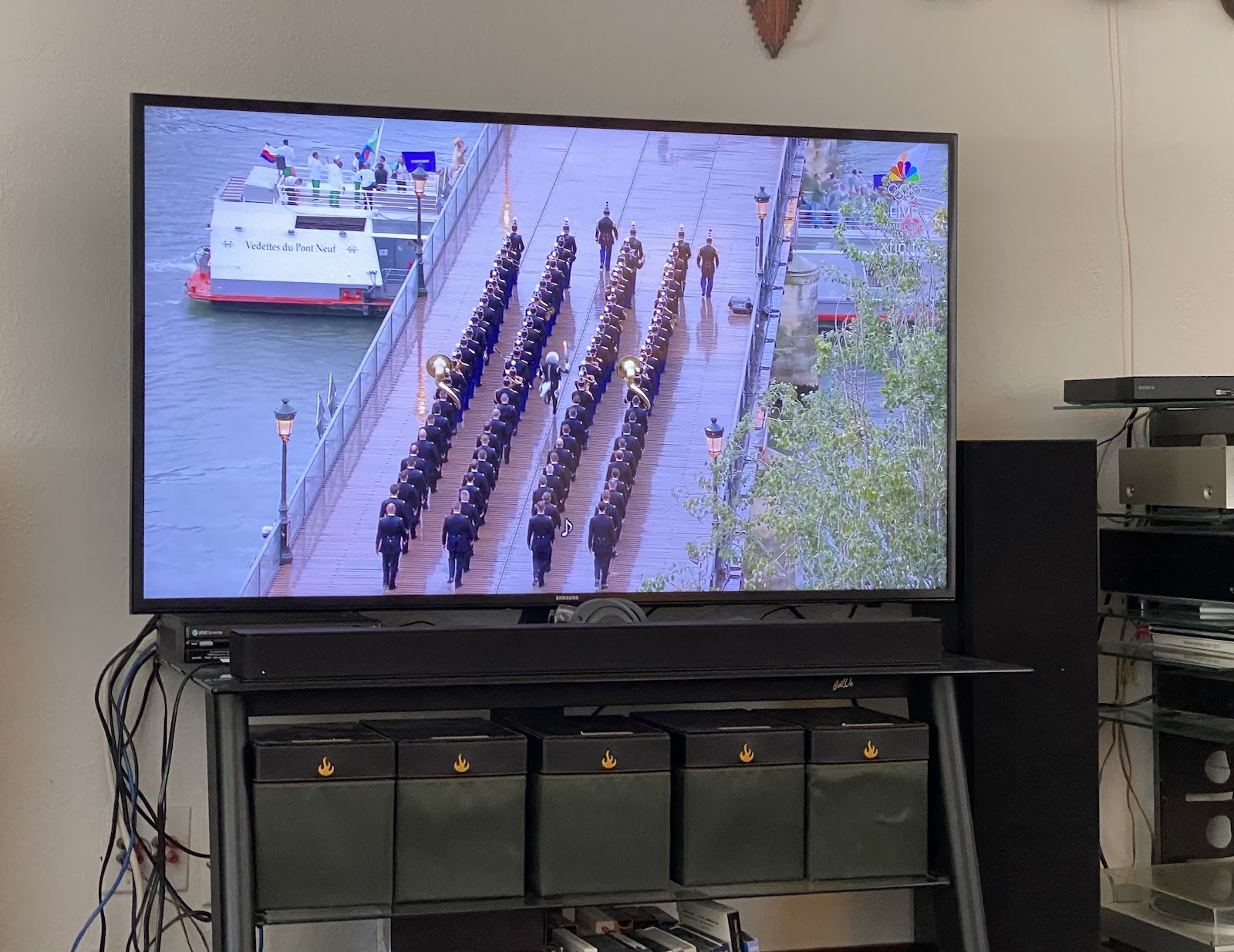
During the opening Olympic ceremony the athletes were transported in boats down the Seine River.
Along the river were numerous entertainments. This image shows a commemoration of the
French Revolution at the  Conciergerie, a building that was of importance during the Revolution itself.

This week it’s time for a wrap-up a blog event that I’ve been enjoying all month: Paris in July

Throughout this month, bloggers have shared more than 100 posts about Paris and France. Over 60 book reviews have appeared, along with posts on many other subjects. For the full list of blog posts about Paris in July, see this post at Emma’s blog: https://wordsandpeace.com/2024/07/01/paris-in-july-2024-all-the-links/ 

Emma has done a fantastic job of organizing lists of all the posts. Now, for my final Paris post this July, I’ve interwoven many memories of Paris through the years. The inspiration for these memories comes from two sources: watching the Olympics on TV and reading The Years by Annie Ernaux.

Watching the Olympics and Reading a Book

The Olympic opening ceremony last Friday included references to many French cultural events, as well as entertainments honoring many great women and men. Among them of course were athletes, especially previous Olympic champions, and the two earlier Paris Olympic Games in 1900 and 1924. But also included were many examples of both popular culture and fine art — anything from Mona Lisa to Edith Piaf.

I had many moments of recognition as I watched the ceremony, and I enjoyed these memories. By coincidence, I had just begun to read the book The Years by Annie Ernaux (published in French in 2008) — a book of memories of France during Ernaux’s long life, beginning when she was an infant during World War II. As I read, I often thought about the televised scenes along the Seine where the Olympic opening was set — a remarkable Paris spectacle that I watched for its entire four hour duration.

The memories invoked by the Olympics were not at all the same type of experiences as those described by Ernaux. Above all, her memories deal with the story of a girl growing up and learning what it means to be a woman, including intimate memories of her own body and her relationships with others, especially boys and later men. Relationships with family and friends, eventually marrying and having children …. not at all like the entertaining pageants incorporating the most famous of Paris monuments along the ceremonial route down the Seine. Despite the many differences, Ernaux’ interactions with popular culture throughout her life seem to me very connected with  the Olympic ceremony’s spectacular musical numbers and visual reenactments of history. And her repeated descriptions of her life as a consumer and a shopper particularly seemed apt — a middle class consumer life: maybe the opposite of the showy wealth of the Olympic costumed performances.

Ernaux’s family’s memory of World War II (when she was an infant) and of other events and wars weren’t necessarily present at the Olympic ceremony, though there were echoes of French colonial and other wars if you knew to watch for them. Such different thoughts in such different media!

Both the book and the ceremony, in their totally different styles, brought back my own appreciation of Paris, of France, and of French culture over a life almost as long as hers. It seemed as if all these images were flashing before me with one set of memories reinforcing and complementing the other. Memories triggered by both the book and the TV became more and more vivid as I read and as I watched.

A Few Moments from the Olympic Ceremony

French patriotism and French history were a strong element in the incredible opening ceremony.
Annie Ernaux’s memories of World War II, the final battles of the French war in Vietnam, the rise of
DeGaulle’s leadership in the post-World War II era, and the Algerian war all featured in her memories and are implied by the patriotic and military displays of the ceremony.

On a lighter note: Lady Gaga’s tribute to French music included a group of dancers doing
the CanCan, celebrating one of the attractions for which Paris was famous.


Aya sings at the Olympic Ceremony in front of the Académie Française

The Republican Guard accompanied Aya.

Aya, currently the most-streamed singer from France, performed some of her own original music. She was accompanied by the musicians of the French Republican Guard, a government institution since 1848, and known for the fact that some of its members were loyal to DeGaulle in World War II (that is, they fought against the Nazis). As part of this performance, this orchestra also played Charles Aznavour's "For Me Formidable." Of course Annie Ernaux mentions Aznavour (1924-2018), who was an icon of French music, among her memories of the past. Aya represents the present.

In fact, Aya’s participation in the ceremony has importance in redefining what it means to be French. Op-ed writer Roger Cohen in the New York Times wrote this: “When Aya Nakamura, a French Malian singer, came sashaying in a short fringed golden dress out of the august Académie Française, she redefined Frenchness. Adieu the stern edicts of the Académie, whose role has been to protect the French language from what one of its members once called ‘brainless Globish.’ Bonjour to a France whose language is increasingly infused with expressions from its former African colonies that form the lyrical texture of Ms. Nakamura’s many blockbuster hits.”

Life is always changing. Identity changes. Culture changes. Memories have to adapt to this. As I project my own memories of France into what I saw in the Olympic ceremony, and as I compare to the lifetime of memories in Annie Ernaux’ book, I feel it’s necessary also to see how things are changing.

French Olympic athletes from the past carry the Olympic flame to the huge symbolic torch.
One of many tributes to French experiences and famous people from the past.
We happened to be living in Paris during one Olympics and I recall watching the games on French TV.

As the final performance at the opening ceremonies, Celine Dion sang a song that represented
the lasting memory of the famous French singer Edith Piaf (1915-1963)

From The Years: one of many memories from Annie Ernaux’s choice of music in her adolescent years  —  “… when, in the tiny island of her bedroom, she listened to Sidney Bechet, Edith Piaf, and the 33 rpms ordered from the Concert Hall Record Club.” (p. 60). Ernaux directly mentions Piaf once or twice; in fact,  many people, not just French people, have never forgotten her songs. Dion’s choice was Piaf’s “L’Hymne à l’amour” (“Hymn to Love”), of which Piaf composed the lyrics and sang dramatically. Of course the personal story of Dion’s health struggles, which have kept her from performing for the last four years, made this a deeply emotional moment, perfectly embodied in this deeply emotional song.

Contrast: Ernaux describes the clothing she wore. In childhood, it was the clothing of a poor and socially disadvantaged child. In later years she recalled the clothing trends of the young, hip, and rebellious youth of the 1960s, and eventually the clothing she wore as a teacher, who was a woman becoming recognized for her work. In contrast — the Olympic ceremony’s use of clothing was to make an insanely extravagant statement of wealth and opulence! 

Contrast: Ernaux shares political observations defining her views of ideologies, politicians, elections, and civic commitments. The politics of the Olympic ceremony, in contrast, are about power and glory, and one can’t miss the significance of the “dignitaries” in a place of honor. Much of the Olympic politics are unspoken. Seeing this, I feel as if I’m receiving a subliminal message about French glory.

In Sum…

Annie Ernaux’s life as she presents it, one memory at a time, was lived in the aura of many French national experiences, particularly including the youth rebellion of May, 1968, and the changes in attitudes and social norms that followed. We remember witnessing the result of these monumental events as they changed the lives of several close friends — perfectly described in The Years. Effectively, this book is a memoir of the twentieth century, and our century involves much that’s new.

Each time we visited France (or lived there for a while) we were aware of many of the cultural trends she describes. At home, we had many of the same experiences that she had: lots of the same music and films she mentioned were popular here in the USA. For example, the first time I heard a Beatles song it was being played in a cafe in a small town in France in the 1960s.

While the impersonal patriotic history and blander popular culture expressed in the Olympic ceremony is very different from Ernaux’ lived experience, I find all these memories — and also the new realities — pretty amazing and remarkably familiar.

The end of the ceremony. The beginning of the games…

No more nostalgia: watching women’s gymnastics and the unbelievable Simone Biles.

Also watched kayaking.


Review © 2024 mae sander

Wednesday, July 17, 2024

“Liberty Equality Fashion”


Three women created a new world of clothing — “Revolutionary Dress”  — during the chaotic 1790s as the French Revolution dominated life in Paris. Their names were Juliette Récamier, Térézia Tallien, and Joséphine, and each one is famous in her own way. In Liberty Equality Fashion: The Women Who Styled the French Revolution (published in April, 2024) author Anne Higonnet not only describes the lives of these three women, she details the dramatic events of the Revolution as the three women experienced it — including Térézia’s imprisonment and narrow escape from the Guillotine. And she provides fascinating insights into the way that the revolution in dress was a part of a huge change in the rights of women, though many of the gains were lost again when the revolutionary era ended and the Empire replaced it.

A wonderful feature of this fascinating book is the wide variety of illustrations. Each of the three featured women was often painted by the most famous portrait artists of the era. Two of these paintings today are in the Louvre museum in Paris. The author also includes numerous plates from the fashion magazines of the era, showing the types of dress that these three women innovated. A selection of images also shows the sources of inspiration for the abrupt change in clothing — including the drapery worn by Roman and Greek statues, the clothing and textiles characteristic of India (made familiar by a diplomatic visit) and the characteristic dress of people in the French colonies in the Caribbean.

Here are a few images that show who these women were and why you probably know about them, though maybe not about their role in inventing modern dress.

Portrait of Madame Récamier (1800) by Jacques-Louis David. This painting hangs prominently in the Louvre.
It shows the daring freedom of the new style dress — not to mention bare feet!

Térézia in prison. Painted by Laneuville in 1796. At that time, women wore intensely fitted clothing
with highly restrictive corsets and voluminous skirts. This prison dress, meant to humiliate her,
was one of the inspirations for the new style that she popularized. The painting was staged at her request.

Another portrait of Térézia Tallien by Jean-Bernard Duvivier, 1806.

Joséphine “in a dress whose luxurious fabric pools like mist at her feet,” painted by Gérard in 1801.
As you may have guessed, this is Joséphine Bonaparte, wife of Napoleon.

Joséphine in a red Kashmiri shawl, painted by Prud’hon.
Shawls were also a  new fashion statement of the era. 

Napoleon crowns Joséphine. The revolution was over, and severely formal dress was back!

For her coronation robes, there was so much fabric in Joséphine’s train that she couldn’t walk with it on: two women had to carry it. By this time, Joséphine had given up the simple "Revolutionary" dress of earlier years. She wore sumptuous fabrics and amazing jewels. The painting may look familiar to you:

“David’s painting of the imperial coronation now hangs in a place of honor in the Louvre, not far, ironically, from his Portrait of Madame Récamier. Without being conscious of it, visitors see the zenith and the nadir of the Fashion Revolution together.” (p. 228)
  
Marie Antoinette: pre-Revolutionary fashion at its most extreme. (Wikipedia)

I enjoyed learning about the remarkable change from the restrictive and excessive fashions of the Royal Court, especially of Marie Antoinette, before the Revolution. I was fascinated by the change in dress that followed. In sum:

“The classicism already prevalent before 1789 cannot explain the speed with which fashion changed between 1794 and 1796. The sudden rupture of the Terror explains it, coupled with the immediate availability of ready-made models from France’s colonies. Térézia and Joséphine were jolted into what might be called either appropriation or appreciation. In a wild moment when nothing was normal, they were able to introduce a radically new style to Paris at lightning speed because its elements existed already elsewhere.” (p. 101)

In this post, I've repeated some of the generalizations about the rapid evolution of women's fashion during the French Revolution. The details are totally new to me: so much that I didn't notice that was in fact before my eyes. I very much recommend this book if this type of social history interests you. 

Blog post © 2024 mae sander