I'm on the verge of getting a new apartment, though not looking forward to the actual move. Have been trying to reduce books and clothes, will probably buy a couple new pieces of furniture, etc. Pro: More room for the cats, a second bedroom for a game room. Con: no washing machine and no screen door. Not that I have a screen now...
Taking a Sunday break from the increasingly nervous process, I visited the War Office for weekend DBA. Jim Dundorf was there, of course, but also a newish medieval enthusiast named Jacob. He brought some 28mm Hundred Years War minis, attractively painted with a characterful, toylike air.
 |
| French |
 |
| English |
Not having quite enough for a full DBA game, Jim put us through a skirmish of seven bases a side to give Jacob's figures a workout. Sometime before Agincourt, a French raiding party are trying to bypass an English rear guard to plunder the baggage train. Basically, the win would be at three points rather than four, and the French could gain their points by dashing off the English side of the table (mine). To be fair, this would not technically be in character for the fastest (ie knightly) of the French, who properly should prefer to charge the noblest enemy they could find. In practice, it was what they did anyway, after we'd got properly to grips with each other and the rules. A couple roll-exchanges included ones on one side and sixes on the other, meaning improbably quick-kills of superior units. Ultimately the French won.
 |
| The oversized field, after rolls for terrain. |
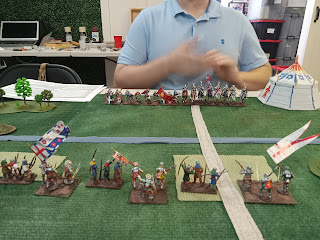 |
Both sides set-up in line. Distances are 1.5 normal,
and touch between bases was assumed and declared due to
the unorthodox base sizes and sticky-out bits. |
 |
French horse (Knights and Light Cavalry) has separated
from the infantry - Solid Blades and crossbows for Solid Bows
- versus my even mix of Blades and Bows. |
 |
Climax in the center - fight between commanders as
one of the French Knight bases breaks towards my table edge. |
My enthusiastic opponent had come upon our 18th-century stockade, so next wanted to try a siege scenario. Trouble was that DBA doesn't have rules for that, or even for artillery battering down walls. The best Jim and I could suggest was a Free-Kriegspiel wargame, with pre-1974 GM-added "events" and Warhammer-inspired rules for the bombardment mortars (proxied by ACW ones).

My opponent had never played rpgs, and became disconcerted by the fact there were no hard-and-fast rules for the events I was adding in. For example, I had secretly rolled that the fort only had a week of food, so when his army tramped onto the field they observed one of my few infantry bases in the nearby cropfield hastily gathering supplies, but did nothing about it and waited patiently for their guns to get hauled onto the board. He chose to wait overnight before opening fire, so I sent a forlorn hope to try and disable the guns; this led to our first combat when his sentries woke up and managed to wipe my unit before they did more than temporarily disable one of his three guns.
We decided that each week would be represented by two rounds of mortar fire. Fire had three rolls to it.
- - First, a misfire roll before shooting. If the gun team rolls a one, PHUT and the gun doesn't shoot that turn.
- - Second, a scatter roll after choosing an aiming point. We had no scatter dice, but used the old expedient of "a one or six is a direct hit, otherwise in the direction of the one-face."
- - Third, D6" scatter.
I secretly declared "locations" for my own bombard, food supplies, and each of my unit bases. (He couldn't see over the walls, though he could see the flagstaff of the command tent.)
Incidentally, my opponent did NOT send the traditional parley flag in to demand the garrison surrender. Nor did he expect, or accept, a desperate wave of a parley flag from the walls, or a messenger riding across the fields with an urgent message for him. The messenger was trussed up and later executed without being able to deliver a message more than screaming "The PRINCESS is in there! Please, you can't bombard us!" This was also disregarded as an obvious ruse.
Over the course of two weeks, during which each gun got to attempt two firings, the garrison lost its own gun, a week of supplies, and one base of troops to the bombardment before a breach was made in the gate. The garrison, down to two infantry bases and a light cavalry base (presumably the garrison commander and retinue) opted to ambush the first attacking base through the breach.
At this point, we reverted again to DBA rules. Even though I had an advantage, one garrison base was forced to recoil, making room for further assaulting bases to get through the breach in following turns.
 |
After I lost one of the two infantry bases,
I sent the hastily mounted commander in as a reserve,
but it was no good. |
The garrison offered surrender; it was refused and the fort sacked and everyone in it killed.
Jim, who had been acting as auxiliary GM due to note-passing and DBA expertise, ruled that this was a tactical win for Jacob but a strategic faux pa, because there had been a high-born woman in the besieged fort and the attackers had failed to conduct themselves according to chivalric norms. To be fair to Jacob, he had never encountered a GM-run game before and was more eager to reduce a fortress than to "act" as a period commander with all the options that such commanders actually had. Since he preferred set rules for such things, I suggested next time we try Christopher Duffy. That said, hopefully we have a new member and regular for the club; it also has a new social media presence.


