Showing posts with label history. Show all posts

Saturday, 21 March 2015

Solar eclipse and museum visit

Yesterday was a special day, it was my birthday - thank you all who remembered me! -


and a 84% solar eclipse at noon.This photo is taken during the eclipse with light clouds in the sky but the light was like at dusk. Mr K. quickly made a camera obscura (without the 'camera') by piercing a piece of paper with a fishing fly hook, and we could see the upside down reflection of the eclipse on another piece of paper. The sun was only a crescent like a boat, or actually like a hat in our reflection. We were on our way to this museum, Erkkola, the home of the poet and playwright J.H. Erkko (1849-1906).


The house was built in 1902 in national romantic style as a part of the artists' colony on the East side of the Tuusulanjärvi lake. At the same time Erkko's friend, the painter Pekka Halonen, was building his atelier house Halosenniemi.


Here you can see some interior pictures from Erkkola, as taking photos was not allowed inside the house.


The exhibition I wanted to see was children's book illustrations by Maija Karma (1914-1999. Her pictures belonged to my childhood. Here is a link to pictures, so you can see with your own eyes her style. She made book covers but many of the books had also lots of black and white drawings inside, and naturally there were real picture books as well.

On our way to Erkkola we passed this shabby little building, the hut where the Finnish national writer Aleksis Kivi (1834-1872) lived for the ten last months of his life in his brother's family. Erkko wanted to build his house near this place because he admired Kivi's work.


I'm taking a course in tatting at the local open college, just four Thursday evenings. Some years ago I tried to learn it by myself and with a DVD, but my knots just didn't turn the right way. At the moment I'm half way through the course and finally learned to make a flower, with picots, and the petals are joined with picots. Next week we will learn to make arches, whatever that means.


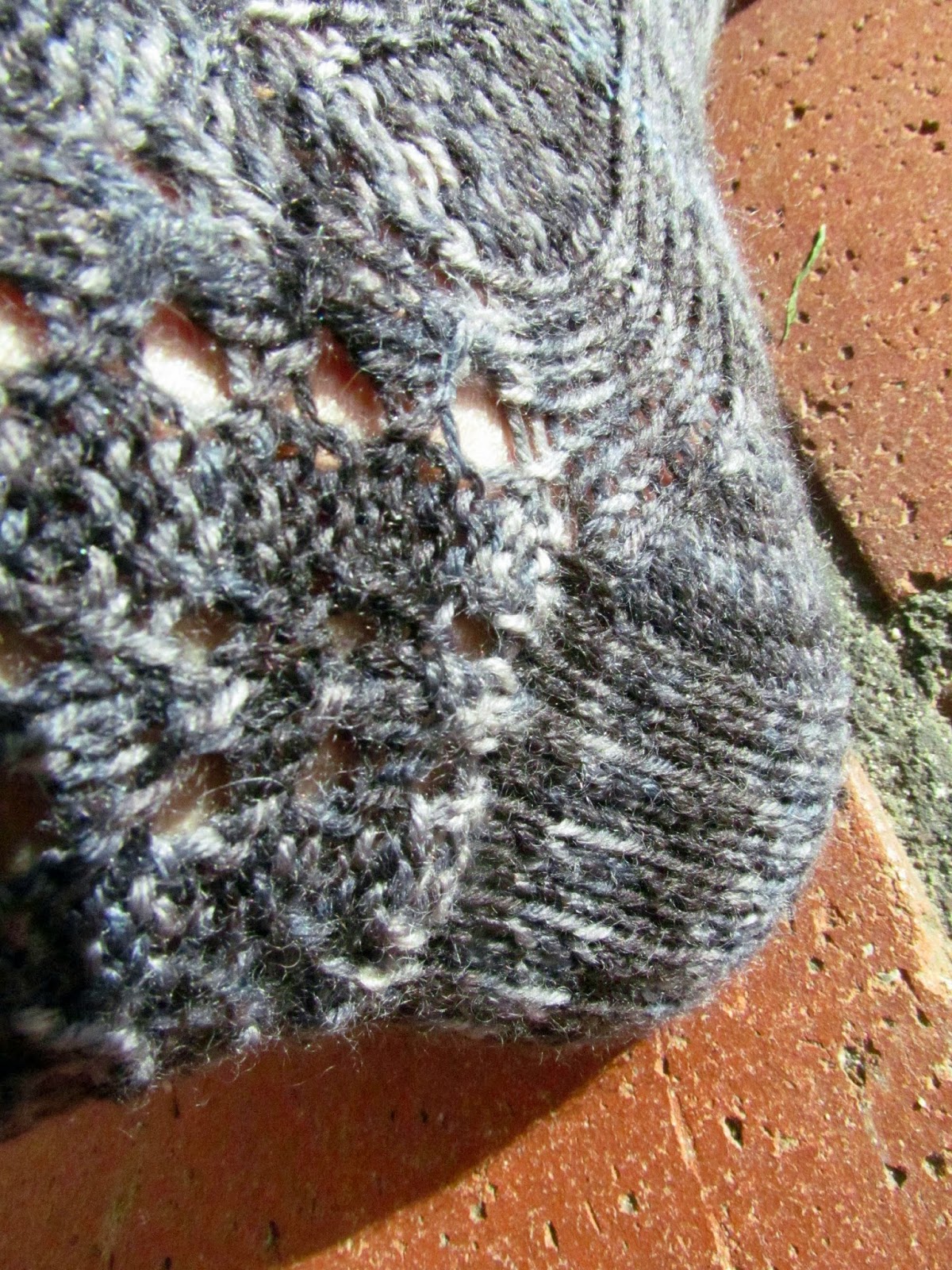
I'm also taking baby steps to the world of cables: these socks have cables that are two stitches wide. You just can't make them with less than two! I have just turned the heels, and the soles will be plain but on the top side the cables will go all the way to the toes.


I'll leave you with this picture of two little ones who enjoy the sunflower seeds the birds have dropped from their feeder. If you can't see the mouse, click to make the picture larger.


Tuesday, 24 September 2013

London day 2 - Victoria & Albert, and my new finish

Our first morning in London was warm and sunny, and after a nice breakfast at Pret a Manger near our hotel we took the Underground to South Kensington Station. I loved looking at the beautiful tile decorations at the old stations when passing them, and here you can see the old ironwork behind the text. They really made an effort to make the places look beautiful when they were built.
 
 
Our destination was the V  & A Museum, but we were a bit early so we took a look at the Natural History Museum across the street too.


Look at all the lions and fish and other animals on the walls:


Lizards with a lion,

and a pelican, I think.


OK, it is 10 am and the doors are opened. This is the entrance to the V&A Museum. This museum, and the Natural History Museum and the Science Museum were all founded after the Great Exhibition of 1851, masterminded by Prince Albert,  was a great success and made a surplus that equals over £ 17 million in today's money.

 
Relief portraits of Queen Victoria and Prince Albert. You may know that Queen Victoria ruled for over 63 years, until her death in 1901, and she wore only black after her dear husband and cousin Albert died in 1861. It was not considered suitable to wear gold when in mourning, so Victoria had a little silver crown made to wear with her black dress and and lace veil.


We concentrated on fashion and jewelry. These are clothes for a doll.


In this dress one would have to go sideways through doors!

 
Oriental ideas and kimono style were high fashion in 1905 to 1915.


A tennis dress and chic woollen swimsuits. I wonder if those patterns are still available?


After all the fashion Kaija wanted to show me a very special carpet. To protect it from light, it was only lit for 10 minutes ever hour, and photographing was not allowed. Pictures in the next link. Click here to read about it:

 
The Ardabil Carpet was made as one of a matching pair. They were damaged in an earthquake in the 1870's, and sold off to fund the repair of the shrine where they had been placed. One carpet was used to repair the other. The result was one like the originals, and one without borders. The V & A Museum bought this big carpet after William Morris had travelled to inspect it and urged the museum to add it to the collections. On an earlier visit to V & A Kaija had learnt that in order to make the very large carpet look symmetrical when seen from the usual point of looking, the pattern at the far end was elongated. How clever was that! Next time you make a quilt that is more than 30 ft tall, remember this little tip!
 
This is the John Madejski Garden, surrounded by the V & A Museum buildings. (Seems like John is a chap with some extra money to spend.)


Click to enlarge and read the text.

 
This is the Cast Courts where plaster cast copies of monuments are on display. This massive column, here in two pieces and still without the bronze statue of Saint Peter on the top, is a copy of the Trajan's Column in Rome. Today the originals have suffered from pollution and erosion, but the copies from the 19th century keep many details intact.


This is a copy of Puerta de la Gloria from Santiago de la Compostela, the famous destination of several pilgrimage routes.

 
At this point we were desperate for a moment off our feet so we had a delicious light baguette lunch at the museum's cafe. You must be tired too so we'll finish the rest of the day trip on another day.
 
I had my circular needles and two balls of sock yarn with me, and I started knitting these socks in the hotel room while resting my feet.


Now they are finished - I'm so happy knitting two socks at a time, this time the usual way from top to toe.


I have the book you can see in my link, but I was annoyed that the pattern of the cover picture was not included.

 
I have half of my yarn left so I think I'll make another pair, with a different pattern.
 

Tuesday, 24 February 2009

Laskiainen - carne lasciare

Today is a special day known as the last day of the carnival season. Mardi gras is in Finnish laskiainen. The name may come from the Latin "carne lasciare", farewell to meat at the beginning of the Lent. Our Lutheran church doesn't require fasting before Easter, but we still enjoy fat food on this day. The traditional meal is thick pea soup with fat smoked pork in it; and as a dessert or afternoon coffee treat we have a sweet wheat bun filled with whipped cream and almond paste or strawberry jam. When I was a child, the buns were served on a deep plate with hot milk, which I found most awful.

An old agricultural tradition has remained, too, because it means lots of fun. It is sledging down the hill. This was supposed to make the flax grow tall, and make the harvest good in many ways. The longer the slide, the taller the flax.


These pictures show big and small children having fun this morning, sliding downhill on binliners or plastic sledges.


It was heartwarming to hear the merry laughter and shouts of the kids of different ages. I remember from my own childhood the feel of the bumps on the slope, falling off the sledge and getting snow in my neck and wrists, and climbing uphill again and again. Rosy cheeks, and moist hair clinging to the forehead, fingers and toes pricking with the cold. Oh happy times!


My sister P who was a student at the time, went with her friends in a bigger slope later in the evening, and afterwards there was a dance where everyone went in their sporty clothes. I can imagine there was romance in the air, too, when young adults were playing like kids in the dark winter evening.

Tuesday, 14 October 2008

A little bit of history

Today I'm taking you on a tour in Villa Cooper, the house where my sewing club Järvenpään Käsintekijät has its shop since this summer. This log villa was built at the same time and by the same team as Sibelius' Ainola, in 1904. The architect for both houses was Lars Sonck, a famous Finnish architect. The cathedral of Tampere is also by him, so I have known his work already as a little girl when I lived in Tampere.

This villa was originally Villa Enckell, built for the daughter of the Järvenpää Estate, Sigrid Ehrström, and her husband Carl Gustaf Enckell. They were members of the artist society by the lake Tuusulanjärvi. The couple gave up their villa, and in 1919 or thereabouts the villa was moved to the present location, to be used as an eating house for the workers of the plant improvement farm of the estate. However, the estate went bankrupt like many farms at that time, and in 1931 the carpet manufacturer Edward Cooper and his wife Agneta bought the building. It was renamed Villa Cooper. In 2004, when Agneta Cooper died, the town of Järvenpää became the owner of the villa.


There are a couple of corners left in the original state, and the hand made items our club has for sale are exhibited on the original tables and shelves of the Cooper home. This was the office of Edward Cooper:


On the wall of the office are examples of the weaving skills of the carpet manufacturer, portraits of some famous personalities:


The next picture shows the big dining room with the dining table. The room is very dark, as the walls are untreated, round logs.


This is a closer look at the long row of windows.


The upstairs rooms are not in use before the renovation is completed. There will be office facilities for the club and the floor will not be open for public.


The books here arefrom my talented daughter Kaija, who has not seen this house yet.


This closet is next to the bookshelf, it is filled with toys now.


And this last picture completes the tour in the dining room, in the background is the office again.


I took some more pictures of the kitchen and the maid's room, but they will have to wait for next time.


The house is now open for the public at weekends when our shop is open from 10 a.m. to 4 p.m.; and the members who are working there as salespersons can give information about the villa and its history.