Top Storey Murder, 1931 (The Roger Sheringham Cases #7) by Anthony Berkeley

Rare Treasure Editions, 2025. Book Format: Kindle Edition. File Size: 481 KB. Print Length: 288 pages. ASIN: ‎B0GMFXWS94. ISBN: 978-8087888995. Originally published in the UK as Top Storey Murder by Hodder & Stoughton in 1931, and in the US as Top Story Murder by Doubleday Crime Club also in 1931. Top Storey Murder is the seventh Roger Sheringham mystery, after The Second Shot (1930) followed by Murder in the Basement (1932).

710z5xPaB7L._SL1500_Overview: Top Storey Murder by Anthony Berkeley is a classic mystery featuring gentleman sleuth Roger Sheringham, who investigates the strangulation of a reclusive woman, Miss Adelaide Barnett, in her top-floor flat, a seemingly simple burglary gone wrong that Scotland Yard initially pursues but Sheringham finds suspect, uncovering hidden motives and secrets, including the victim’s miserly habits and her niece’s strange behavior, leading to a complex solution with plenty of clues and red herrings.

My take: Anthony Berkeley Cox (1893–1971) was a prominent British satirical journalist, crime and mystery writer, and literary critic who wrote under the pseudonyms Francis Iles, Anthony Berkeley, and A. Monmouth Platts.

Cox was educated at Sherborne School and University College, Oxford. At the outbreak of the First World War, he enlisted in the British Army, attaining the rank of lieutenant in the 7th Northumberland Regiment. While serving in France, he was severely affected by a gas attack. Invalided out of the army, he suffered from ill health for the remainder of his life. Details of his professional activities in the years immediately following the war are somewhat obscure, but he gradually devoted himself increasingly to writing.

His professional literary career began around 1922, when he started contributing satirical stories to Punch and other popular periodicals. His first detective novel, The Layton Court Mystery, was published anonymously in 1925. Over the following fifteen years, between 1925 and 1939, Cox produced twenty-four books, including fourteen classic full-length detective novels and two outstanding psychological thrillers.

In 1930, alongside leading figures of the genre such as Gilbert K. Chesterton, Agatha Christie, R. Austin Freeman, Baroness Orczy, and Dorothy L. Sayers, Cox founded the legendary Detection Club in London. Indeed, the Crimes Circle featured in The Poisoned Chocolates Case may be regarded as a fictional precursor to the Detection Club itself.

In 1938, writing under his Francis Iles pseudonym, he began reviewing books for John O’London’s Weekly and The Daily Telegraph. During the 1940s, he also contributed to The Sunday Times, and from the mid-1950s until 1970 he served as a reviewer for the Manchester Guardian (later The Guardian). A pivotal figure in the development of modern crime fiction, Cox died in 1971 at St John’s Wood, London.

His 1932 novel Before the Fact (published under the name Francis Iles) was adapted into Alfred Hitchcock’s celebrated 1941 film Suspicion, starring Cary Grant and Joan Fontaine. Another of his novels, Trial and Error, was adapted as the unusual 1941 film Flight from Destiny, starring Thomas Mitchell.

Top Storey Murder opens with Roger Sheringham meeting Detective Chief Inspector Moresby for lunch. Sheringham likes to think of the arrangement as “keeping in touch with Scotland Yard”, whereas Scotland Yard called it “Mr Sheringham working the pump-handle”.

Just as they are about to set off, Moresby is compelled to cancel their engagement in order to investigate the murder of Miss Adelaide Barnett, a notoriously miserly woman who has been found strangled in her top-floor flat at Monmouth Mansions.

Moresby has no objection to Sheringham accompanying him, though he warns him that it is likely to prove a routine case of little interest to the amateur detective — “no fancy fandangos, like those in storybooks”. Sheringham, however, decides to go along all the same. Despite the warning that it is a straightforward matter, he immediately begins to form theories as he examines the various clues and apparent red herrings at the crime scene.

As the investigation unfolds, Sheringham meets Stella Barnett, the victim’s niece, whom he hires as his secretary. Their relationship adds a layer of both humour and intrigue to the narrative.

Sheringham develops the theory that the killer is someone connected with the building rather than an outside intruder. As he examines the residents and their possible motives, he challenges the police’s assumptions and repeatedly revises his own conclusions as new evidence comes to light.

In classic Berkeley fashion, the final solution reveals hidden motives and mistaken assumptions, transforming what initially appears to be a straightforward robbery-murder into a far more intricate and surprising case..

If Anthony Berkeley’s novels are distinguished by anything—particularly the Roger Sheringham series—it is their originality, and this novel is no exception.

However, to sum up, I fully agree with Kate Jackson when she wrote:

A contemporary review from The Spectator said of this book that, ‘the first part is dull, the second interesting and the third thrilling,’ yet for me I think I would definitely swap the first two adjectives around as I did find the middle dragged a bit. The final solution has a tad too many flashes of inspiration in it, but I still found it very enjoyable and I was glad Berkeley managed to end on a high note with the tale. If you like a good Crofts novel then you should have no problem with this one, but if you’re new to Berkeley’s work I would perhaps look to one of his other titles.

Top Storey Murder has been reviewed, among others, by Kate Jackson at “Cross-examing Crime”, TomCat at “Beneath the Stains of Time”,  Steve at “Mystery File”, Martin Edwards at “Do You Write Under Your Own Name?”.

Roger Sheringham Cases: A Crime is Afoot

  1. The Layton Court Mystery (1925)
  2. The Wychford Poisoning Case (1926)
  3. Roger Sheringham and the Vane Mystery (1927) aka The Mystery at Lovers’ Cave
  4. The Silk Stocking Murders (1928)
  5. The Poisoned Chocolates Case (1929)
  6. The Second Shot (1930)
  7. Top Storey Murder (1931) aka Top Story Murder
  8. Murder in the Basement (1932)
  9. Jumping Jenny (1933) aka Dead Mrs Stratton
  10. Panic Party (1934) aka Mr. Pidgeon’s Island

And a collection of short stories The Avenging Chance and Other Mysteries from Roger Sheringham’s Casebook (Crippen & Landru, 2004); 2nd edition with an additional story (Crippen & Landru, 2015).

Further reading:

The Layton Court Mystery (Roger Sheringham Cases #1), 1925 by Anthony Berkeley

The Langtail Press, 2010. Book Format: Kindle Edition. File Size: 323 KB. Print Length: 224 pages. ASIN: B004GXA5SY. ISBN: 979-1-78002-020-4. Fist published in 1925 by Herbert Jenkins in London.

{1CAA7E55-686E-461B-965D-123E8CA97185}Img100Overview: In a typical English country house, a murder is committed. The wealthy Victor Stanworth, who’d been playing host to a party of friends, is found dead in the library. At first it appears to be suicide, for the room was undoubtedly locked. But could there be more to the case? As one of the guests at Layton Court, gentleman sleuth Roger Sheringham begins to investigate. Many come under suspicion, but how could anyone have killed the man and gotten out of the room, leaving it all locked behind?

My take: The Layton Court Murder is Anthony Berkeley’s debut novel. It was published anonymously in 1925 by Herbert Jenkins in London as by “?” and it was the first in the series featuring amateur sleuth Roger Sheringham. It was followed by The Wychford Poisoning Case published in 1926 as by the author of The Layton Court Mystery by Collins, in London.

The complete series, published until 1934, is made up of ten books and several short stories collected in “The Avenging Chance and Other Mysteries from Roger Sheringham’s Casebook,” by Crippen and Landru, 2004, with a second edition with an additional story by Crippen and Landru, 2015. See the full bibliography below.

The story begins with Roger Sheringham being invited to a party at Layton Court, a country house hosted by Victor Stanworth, a wealthy and charming man. However, the weekend takes a dark turn when Stanworth is found dead in his library. The matter seems pretty much staightforward. Both the door and windows of the library were locked from the inside. Mr. Stanworth held a small revolver in his right hand, his fingers still convulsively gripping the trigger. In the center of his forehead was a small circular hole. His head lolled indolently over the back of the chair, his open eyes staring up at the ceiling. Not to mention a note that read: “To whom it may concern. For reasons that concern only myself, I have decided to kill myself.” And his signature at the bottom. In short, it doesn’t seem like it will take the coroner very long to arrive at his verdict.

However, Sheringham, skeptical of the suicide theory, decides to investigate. With characteristic confidence, he interviews guests, deciphers clues, and challenges alibis. Over time, he develops theories that prove misleading, if not completely wrong, but which serve to uncover dark motives and secret relationships. Ultimately, Sheringham’s unconventional investigation leads him to unmask the murderer in a denouement full of unexpected twists.

In conclusion, The Layton Court Mystery is a classic example of the Golden Age detective fiction, notable for its wit, social satire, and psychological insight. It stands out, in my view, thanks to the character of Roger Sheringham, an arrogant amateur detective who frequently makes mistakes in his conclusions; its narrative style, which mocks the genre’s conventions; its unexpected twists and its subtle critiques of other detective novels. However, as some critics have already pointed out, long discussions and monologues take up most of the narrative, which at times makes the story a bit dull.

The Leyton Court Mystery has been reviewed, among others, by Nick Fuller at “The Grandest Game in The World”, Kate Jackson at Cross-Examining Crime”, Martin Edwards at “Do You Write Under Your Own Name?and Noah Stewart at “Noah’s Archive”(with spoilers).

About the Author: Anthony Berkeley Cox (1893 – 1971) was a popular British satirical journalist, crime and mystery writer, and literary critic who wrote under the pseudonyms Francis Iles, Anthony Berkeley, and A. Monmouth Platts.

Cox was educated at Sherborne School and University College, Oxford. With the outbreak of the First World War, he enlisted, attained the rank of lieutenant in the 7th Northumberland Regiment and was gassed in France. Invalided out of the army, his health was seriously affected for the rest of his life. Details about his professional life in the years immediately after the war are somewhat sketchy. As time went by he devoted himself more and more to writing.

Cox’s professional writing career began around 1922, writing satirical stories for Punch and other popular publications. His first detective novel, The Layton Court Mystery, was published anonymously in 1925. In a period of fifteen years, between 1925 and 1939, Cox published twenty-four books, including fourteen classic full-length detective stories and two sublime phycological thrillers.

In 1930, Cox founded the legendary Detection Club in London together with leading practitioners of the genre, such as Gilbert K. Chesterton, Agatha Christie, R. Austin Freeman, Baroness Orczy and Dorothy L. Sayers. In fact, the Crimes Circle in The Poisoned Chocolates Case can rightly be considered a predecessor of the Detection Club in fiction.

In 1938, he took up book reviewing for John O’London’s Weekly and The Daily Telegraph, writing under his pen name Francis Iles. He also wrote for the Sunday Times in the 1940s and for the Manchester Guardian (later The Guardian) from the mid-1950s until 1970. A key figure in the development of crime fiction, he died in 1971 in St John’s Wood, London.

His 1932 novel (as Francis Iles), Before the Fact was adapted into the 1941 classic film Suspicion, directed by Alfred Hitchcock, starring Cary Grant and Joan Fontaine. Trial and Error was turned into the unusual 1941 film Flight from Destiny starring Thomas Mitchell.

Bibliography:

Roger Sheringham series: The Layton Court Mystery published as by “?” (Herbert Jenkins, 1925; Doubleday, 1929); The Wychford Poisoning Case: An Essay in Criminology published as by the author of The Layton Court Mystery (Collins, 1926; Doubleday, 1930); Roger Sheringham and the Vane Mystery (Collins, 1927; reprinted by Collins as The Vane Mystery; US title: The Mystery at Lovers’ Cave, Simons & Schuster, 1927); The Silk Stocking Murders (Collins, 1928; Doubleday, 1928); The Poisoned Chocolates Case (Collins, 1929; Doubleday, 1929); The Second Shot (Hodder & Stoughton, 1930; Doubleday, 1931); Top Storey Murder (Hodder, 1931; US title: Top Story Murder, Doubleday, 1931); Murder in the Basement (Hodder, 1932; Doubleday, 1932); Jumping Jenny (Hodder, 1933; US title: Dead Mrs. Stratton, Doubleday, 1933); Panic Party (Hodder, 1934; US title: Mr. Pidgeon’s Island, Doubleday, 1934); and The Avenging Chance and Other Mysteries from Roger Sheringham’s Casebook (Crippen & Landru, 2004); 2nd edition with an additional story (Crippen & Landru, 2015).

Other Crime Novels: Cicely Disappears published as by A. Monmouth Platts (John Long, 1927, a shorter version appeared as a serial, The Wintringham Mystery, as by A.B. Cox, in The Daily Mirror); Mr Priestley’s Problem published as by A.B. Cox (Collins, 1927; US title: The Amateur Crime (Doubleday, 1928), The Piccadilly Murder (Collins, 1929; Doubleday, 1930); Trial and Error (Hodder, 1937; Doubleday, 1937); Not to Be Taken (Hodder, 1938; US title: A Puzzle in Poison (Doubleday, 1938); and Death in the House (Hodder, 1939; Doubleday, 1939).

Novels as Francis Iles: Malice Aforethought: The Story of a Commonplace Crime (Gollancz, 1931; Harper, 1931); Before the Fact: A Murder Story for Ladies (Gollancz, 1932; Doubleday, 1932); and As for the Woman: A Love Story (Jarrolds, 1939; Doubleday, 1939)

Collaborative works with members of the Detection Club: The Floating Admiral (Hodder, 1931; Doubleday, 1932); Ask a Policemen (Barker, 1933; Morrow, 1933); Six Against the Yard (Selwyn & Blount, 1936; US title: Six Against Scotland Yard, Doubleday, 1936); and The Scoop and Behind the Screen (both collaborative detective serials written by members of the Detection Club which were broadcast weekly by their authors on the BBC National Programme in 1930 and 1931 with the scripts then being published in The Listener within a week after broadcast. The two serials were first published in book form in the UK by Victor Gollancz Ltd in 1983 and in the US by Harper & Row in 1984)

Further reading: Elusion Aforethought: The Life and Writing of Anthony Berkeley Cox by Malcolm J. Turnbull (Bowling Green State University Press, 1996); The Golden Age of Murder by Martin Edwards (Harper Collins, 2015)

Ranking the Work of Anthony Berkeley by Kate Jackson

The Urbane Innovator: Anthony Berkeley, Aka Francis Iles by Martin Edwards

Not to Be Taken aka A Puzzle in Poison, 1938 by Anthony Berkely

British Library Publishing, 2025. Book Format: Kindle Edition. File Size: 2,6 MB. Print Lenght: 257 pages. ASIN: B0F2SJXKJ8. eISBN: 978-0-7123-6878-0. Originally serialised in John o’ London’s Weekly from November 1937 to March 1938 as Poison – Not to Be Taken. with a prize offered to readers who could solve the mystery before its final chapter, this new edition includes Berkeley’s final competition report as an appendix. It was republished in book form as Not to Be Taken in 1938 by Hodder & Stoughton, London; and as Puzzle in Poision in 1938 by Doubleday, New York.

71liqcNfIXL._SY425_Overview: John Waterhouse has died of some gastric complication. Exhumed at his brother’s request, the discovery of death by arsenical poisoning catches the interest of a hungry press and fans the flames of gossip in the sleepy village of Anneypenny. The problem is, nobody seems to have a motive for having killed the victim.

My take: Not to Be Taken, set in Anneypenny, Dorset, near the Somerset border, is a stand-alone novel by Anthony Berkeley.

The story is narrated in the first person by Douglas Sewell, a fruit grower. His nearest neighbour, John Waterhouse, a kindly, old-fashioned chap, feels ill one evening. He dismisses it as indigestion, but his doctor, Glen Brougham, believes it to be an incipient gastric ulcer, caused by eating and drinking too much for too many years and smoking a pipe too often. In any case, Waterhouse refuses to take any medication. But after five days of apparent improvement, Waterhouse dies unexpectedly after a brief coma. His doctor, Glen Bougham, surprised but not astonished, issues a death certificate, listing epidemic diarrhea as the cause of death.

The matter would have ended there if not for his estranged brother, Cyril Waterhouse, who insists on an autopsy, likely resentful of not having been properly notified of his brother’s death. In any case, he suspects his brother was poisoned and considers it his duty to verify or refute that suspicion. As expected, this situation will generate much gossip in Anneypenny, even though the autopsy doesn’t confirm any other illness, except for slight reddening of the duodenum and, to a lesser extent, the jejunum—precisely what anyone would expect, in fact, after a diarrhea epidemic—the matter obviously doesn’t end there. Cyril insists that the usual organs be sent to a hospital for analysis. And as expected, given this is a mystery novel, the results confirm that death was due to acute arsenic poisoning.

Waterhouse’s death raises several questions. Who would have wanted to kill him? He was a kind and caring man. Everyone loved him and wished him well; it was impossible to believe that someone could have deliberately poisoned him. Besides, John wasn’t the type to commit suicide, especially without the required coroner’s note. And if it was a fatal accident, how could he have ingested the arsenic?

The tone of the story is rather discreet, and Berkeley himself, through Sewell, the narrator, points out that his story cannot be considered a detective novel for the simple reason that there is no detection: that is, there is no detective as a central figure whose investigations, findings and suspicions can be shared with the reader.

It’s also worth noting that Berkeley offers an Elley Queen-style “Challenge to the Reader,” inviting lectors to answer the following questions:

1. Who (or what) was responsible for John Waterhouse’s death?

2. How did the arsenic find its way into John Waterhouse’s body, and why? Give a concise outline of the story behind his death.

3. List as many deductions as you can draw from Douglas Sewell’s narrative, and the clues to them.

4. Do you think there is a Dominant Clue in this story? If so, what is it?

In an appendix, Anthony Berkeley analyses in depth, in a fascinating article dated 11 March 1938, reprinted in this issue, the best responses received. And in this same article he explains what fair play means in a detective novel.s. An author plays fair with the reader by presenting all the clues, without withholding any vital evidence. Therefore, the solution is simply a matter of careful reading and the ability to distinguish a hare from a red herring.

In this sense, I have no doubt that Berkeley plays fair with the reader. While it’s true that the story may be somewhat slow at first, it’s also worth noting that toward the middle of the plot, it begins to gain substance and becomes very engaging. It’s a clever and well-crafted story. The characterization is superb, and Berkeley embellishes his narrative with a good dose of red herrings. Some critics consider it Berkeley’s most conventional work; I don’t think so, especially taking into account that the story was an editor’s request for a competition. In any case, that doesn’t make it any less interesting, even if it has been overshadowed by Berkeley’s other, better-known titles.

Not to Be Taken has been reviewed, among others, by Nick Fuller at “The Grandest Game in the World”, Kate Jackson at “Cross-examining Crime”, Martin Edwards at “Do You Write Under Your Own Name?”, Xavier Lechard at “At the Villa Rose” and Jim Noy at “The Invisible Event”.

About the Author: Anthony Berkeley Cox (1893 – 1971) was a popular British satirical journalist, crime and mystery writer, and literary critic who wrote under the pseudonyms Francis Iles, Anthony Berkeley, and A. Monmouth Platts.

Cox was educated at Sherborne School and University College, Oxford. With the outbreak of the First World War, he enlisted, attained the rank of lieutenant in the 7th Northumberland Regiment and was gassed in France. Invalided out of the army, his health was seriously affected for the rest of his life. Details about his professional life in the years immediately after the war are somewhat sketchy. As time went by he devoted himself more and more to writing.

Cox’s professional writing career began around 1922, writing satirical stories for Punch and other popular publications. His first detective novel, The Layton Court Mystery, was published anonymously in 1925. In a period of fifteen years, between 1925 and 1939, Cox published twenty-four books, including fourteen classic full-length detective stories and two sublime phycological thrillers.

In 1930, Cox founded the legendary Detection Club in London together with leading practitioners of the genre, such as Gilbert K. Chesterton, Agatha Christie, R. Austin Freeman, Baroness Orczy and Dorothy L. Sayers. In fact, the Crimes Circle in The Poisoned Chocolates Case can rightly be considered a predecessor of the Detection Club in fiction.

In 1938, he took up book reviewing for John O’London’s Weekly and The Daily Telegraph, writing under his pen name Francis Iles. He also wrote for the Sunday Times in the 1940s and for the Manchester Guardian (later The Guardian) from the mid-1950s until 1970. A key figure in the development of crime fiction, he died in 1971 in St John’s Wood, London.

His 1932 novel (as Francis Iles), Before the Fact was adapted into the 1941 classic film Suspicion, directed by Alfred Hitchcock, starring Cary Grant and Joan Fontaine. Trial and Error was turned into the unusual 1941 film Flight from Destiny starring Thomas Mitchell.

Bibliography:

Roger Sheringham series: The Layton Court Mystery published as by “?” (Herbert Jenkins, 1925; Doubleday, 1929); The Wychford Poisoning Case: An Essay in Criminology published as by the author of The Layton Court Mystery (Collins, 1926; Doubleday, 1930); Roger Sheringham and the Vane Mystery (Collins, 1927; reprinted by Collins as The Vane Mystery; US title: The Mystery at Lovers’ Cave, Simons & Schuster, 1927); The Silk Stocking Murders (Collins, 1928; Doubleday, 1928); The Poisoned Chocolates Case (Collins, 1929; Doubleday, 1929); The Second Shot (Hodder & Stoughton, 1930; Doubleday, 1931); Top Storey Murder (Hodder, 1931; US title: Top Story Murder, Doubleday, 1931); Murder in the Basement (Hodder, 1932; Doubleday, 1932); Jumping Jenny (Hodder, 1933; US title: Dead Mrs. Stratton, Doubleday, 1933); Panic Party (Hodder, 1934; US title: Mr. Pidgeon’s Island, Doubleday, 1934); and The Avenging Chance and Other Mysteries from Roger Sheringham’s Casebook (Crippen & Landru, 2004); 2nd edition with an additional story (Crippen & Landru, 2015).

Other Crime Novels: Cicely Disappears published as by A. Monmouth Platts (John Long, 1927, a shorter version appeared as a serial, The Wintringham Mystery, as by A.B. Cox, in The Daily Mirror); Mr Priestley’s Problem published as by A.B. Cox (Collins, 1927; US title: The Amateur Crime (Doubleday, 1928), The Piccadilly Murder (Collins, 1929; Doubleday, 1930); Trial and Error (Hodder, 1937; Doubleday, 1937); Not to Be Taken (Hodder, 1938; US title: A Puzzle in Poison (Doubleday, 1938); and Death in the House (Hodder, 1939; Doubleday, 1939).

Novels as Francis Iles: Malice Aforethought: The Story of a Commonplace Crime (Gollancz, 1931; Harper, 1931); Before the Fact: A Murder Story for Ladies (Gollancz, 1932; Doubleday, 1932); and As for the Woman: A Love Story (Jarrolds, 1939; Doubleday, 1939)

Collaborative works with members of the Detection Club: The Floating Admiral (Hodder, 1931; Doubleday, 1932); Ask a Policemen (Barker, 1933; Morrow, 1933); Six Against the Yard (Selwyn & Blount, 1936; US title: Six Against Scotland Yard, Doubleday, 1936); and The Scoop and Behind the Screen (both collaborative detective serials written by members of the Detection Club which were broadcast weekly by their authors on the BBC National Programme in 1930 and 1931 with the scripts then being published in The Listener within a week after broadcast. The two serials were first published in book form in the UK by Victor Gollancz Ltd in 1983 and in the US by Harper & Row in 1984)

Further reading: Elusion Aforethought: The Life and Writing of Anthony Berkeley Cox by Malcolm J. Turnbull (Bowling Green State University Press, 1996); The Golden Age of Murder by Martin Edwards (Harper Collins, 2015)

Ranking the Work of Anthony Berkeley by Kate Jackson

The Urbane Innovator: Anthony Berkeley, Aka Francis Iles by Martin Edwards

The Second Shot, 1930 (Roger Sheringham # 6) by Anthony Berkeley

The Langtail Press Ltd, 2010. Format: 236 pages Paperback Edition. ISBN: 978-1-78002-019-8.  Originally published in the UK by Hodder & Stoughton, 1930, it was published in the US by Doubleday in 1931.

31YtdES3scLOverview: A Roger Sheringham mystery. Detective writer John Hillyard is entertaining a small house party at Minton Deeps Farm when a shocking accident takes place. Shortly after enacting a murder drama for their own amusement, the guests are returning to the house when Eric Scott Davies, the man who played victim, is found dead after two gunshots go off. The police suspect murder, but when Roger Sheringham is summoned from London it is not by Superintendent Hancock but by one of the guests. In a web of scandal, opportunity and multiple motives, the case turns out to be more complex than even Sheringham could have expected.

By way of introduction: Berkeley bought his very own country house, Linton Hills, in a remote part of north Devon, and promptly set a murder there. …. The Linton Hills, renamed ‘Minton Deeps’, featured in The Second Shot, another Berkely novel which expanded a short story, this time ‘Perfect Alibi’. In finest Golden Age tradition, the book include an elaborate map of the estate on the endpapers, showing the position of the main suspects at the critical time on the afternoon of the murder. But Berkeley recognized that the conventional country house murder story was becoming to played out.

His fresh twist was an idea which Christie later adopted for Towards Zero, namely that, although detective stories typically begin with the discovery of a murder, events preceding the crime are key to the process of detection. Roger Sheringham – fallibe as ever – distracts the police into believing that the victim suffered an accidental death, when really the case involves a ‘justifiable homicide’. Murder motivated by good intentions became a recurrent theme in detective fiction in the Thirties. But the real significance of The Second Shot is that it shows Berkeley beginning to focus on the point of view of the criminal, rather than the detective. (Edwards, Martin. The Golden Age of Murder. Collins Crime Club. Paperback edition 2016. Pages 131-32.

My Take: Following the dedication of this book to a. d. peters, Berkeley asks himself: What is the future of the detective novel? An he answers: “To quote the only reviewer of detective fiction whom we who write it can take seriously (because the only one who takes us seriously). ‘As to technique, it apears that there are two directions in which the intelligent novelist is at present trying to develop …: he may make experiments with the telling of his plot, tell it backwards, or sideways, or in bits; or he may try to develop character and atmosphere.’ This, I think, is exactly the case; and having, as a convinced experimentalits, already tried the former alternative [in The Poisoned Chocolates Case], I am here making my attempt at the latter.

The story is then divided into a prologue, sixteen chapters, and an epilogue. The prologue offers the reader a brief summary of the plot taken from a newspaper clipping dated Thursday, June 9, 1930, recounting a fatal accident at a house party.

A shocking accident occurred today at Minton Deeps Farm, the residence of the well known detective story writer Mr John Hillyard. The Hillyards were entertaining a smal house party at his farm, which included Mr Eric Scott-Davis, a popular and well known man-about-town. The young members of the party had arranged to enact a little drama in which one of their number should pretend to have been murdered by another. Mr Hillyard was the to follow up the clues that had been laid and discovered the pseudo-criminal.  Mr Scott-Davis was to represent the victim. After the investigation was over, the whole party returned to the farm. On their way, it is alleged, two shots were heard, at an interval of about five minutes.

As Mr Scott-Davis did not arrive, two of the party went down to look for him. They found him lying on his face a short distance away from the glade which had been the scene of the pretended ‘murder’.

When the doctor finally arrived, he could only pronounce him dead.

The story then shifts into the first person narrative.

In my view, this book fully justifies the adjective ‘innovative’ often applied to Berkeley. I must add that I thoroughly enjoyed it and I fully agree with TomCat when he wrote: “…. the story, as a whole, is an excellent showcase of Berkeley’s originality and talent as a plotter, which shined even when he was shining the spotlight on the characters – complimented with a superb use of the multiple twists and false solutions.” An author worth discovering if you haven’t read him yet.

The Second Shot has been reviewed, among others, by Kate Jackson at “Cross-examining Crime”, Nick Fuller at “The Gratest Game in the World”, Jim Noy at “The Invisible Event”, TomCat at “Beneath the Stains of Time”, Martin Edwards at “Do You Write Under Your Own Name

About the Author: Anthony Berkeley, whose real name was Anthony Berkeley Cox, was a popular British satirical journalist, crime and mystery writer, and literary critic who wrote under the pseudonyms Francis Iles, Anthony Berkeley, and A. Monmouth Platts.

Born in Watford, Hertfordshire on 5 July 1893, he was the son of Alfred Edward Cox, a doctor who invented a kind of X-ray machine that allowed shrapnel to be detected in wounded patients, and Sybil Cox (née Iles), who claimed descent from the 17th-century Earl of Monmouth and a smuggler named Francis Iles. The family inheritance included two estates in Watford: Monmouth House and The Platts. Cox was educated at Sherborne School and University College, Oxford. With the outbreak of the First World War, he enlisted, attained the rank of lieutenant in the 7th Northumberland Regiment and was gassed in France. Invalided out of the army, his health was seriously affected for the rest of his life. Details about his professional life in the years immediately after the war are somewhat sketchy. As time went by he devoted himself more and more to writing.

Cox married twice, the first with Margaret Farrar when he was on leave in London in December 1917. Although their marriage did not last long, they did not divorced until 1931 and Margaret Cox remarried. Apparently their breakup was amicable. The second in 1932 with Helen Peters (née MacGregor), the ex-wife of his literary agent, A. D. Peters. He has no children from either of his two marriages, although Helen brought her two children by Peters with her. His second marriage broke up in the late 1940s, and their parting again appears to have been reasonably amicable.

Cox’s professional writing career began around 1922, writing satirical stories for Punch and other popular publications. His first detective novel, The Layton Court Mystery, was published anonymously in 1925. In a period of fifteen years, between 1925 and 1939, Cox published twenty-four books, including fourteen classic full-length detective stories and two sublime phycological thrillers.

In 1930, Berkeley founded the legendary Detection Club in London together with leading practitioners of the genre, such as Gilbert K. Chesterton, Agatha Christie, R. Austin Freeman, Baroness Orczy and Dorothy L. Sayers. In fact, the Crimes Circle in The Poisoned Chocolates Case can rightly be considered a predecessor of the Detection Club in fiction.

After 1939, Cox decided to stop writing fiction for reasons that are still subject to speculation. For the next thirty years his literary output was limited to book reviews for the Sunday Times and the Manchester Guardian. Considered a key figure in the development of crime fiction, Anthony Berkeley Cox died at St Mary’s Hospital, Paddington, on 9 March 1971. On his death certificate his name was mistakenly recorded as Anthony Beverley Cox.

Bibliography:

Roger Sheringham series: The Layton Court Mystery published as by “?” (Herbert Jenkins, 1925; Doubleday, 1929); The Wychford Poisoning Case: An Essay in Criminology published as by the author of The Layton Court Mystery (Collins, 1926; Doubleday, 1930); Roger Sheringham and the Vane Mystery (Collins, 1927; reprinted by Collins as The Vane Mystery; US title: The Mystery at Lovers’ Cave, Simons & Schuster, 1927); The Silk Stocking Murders (Collins, 1928; Doubleday, 1928); The Poisoned Chocolates Case (Collins, 1929; Doubleday, 1929); The Second Shot (Hodder & Stoughton, 1930; Doubleday, 1931); Top Storey Murder (Hodder, 1931; US title: Top Story Murder, Doubleday, 1931); Murder in the Basement (Hodder, 1932; Doubleday, 1932); Jumping Jenny (Hodder, 1933; US title: Dead Mrs. Stratton, Doubleday, 1933); Panic Party (Hodder, 1934; US title: Mr. Pidgeon’s Island, Doubleday, 1934); and The Avenging Chance and Other Mysteries from Roger Sheringham’s Casebook (Crippen & Landru, 2004); 2nd edition with an additional story (Crippen & Landru, 2015).

Other Crime Novels: Cicely Disappears published as by A. Monmouth Platts (John Long, 1927, a shorter version appeared as a serial, The Wintringham Mystery, as by A.B. Cox, in The Daily Mirror); Mr Priestley’s Problem published as by A.B. Cox (Collins, 1927; US title: The Amateur Crime (Doubleday, 1928), The Piccadilly Murder (Collins, 1929; Doubleday, 1930); Trial and Error (Hodder, 1937; Doubleday, 1937); Not to Be Taken (Hodder, 1938; US title: A Puzzle in Poison (Doubleday, 1938); and Death in the House (Hodder, 1939; Doubleday, 1939).

Novels as Francis Iles: Malice Aforethought: The Story of a Commonplace Crime (Gollancz, 1931; Harper, 1931); Before the Fact: A Murder Story for Ladies (Gollancz, 1932; Doubleday, 1932); and As for the Woman: A Love Story (Jarrolds, 1939; Doubleday, 1939)

Collaborative works with members of the Detection Club: The Floating Admiral (Hodder, 1931; Doubleday, 1932); Ask a Policemen (Barker, 1933; Morrow, 1933); Six Against the Yard (Selwyn & Blount, 1936; US title: Six Against Scotland Yard, Doubleday, 1936); and The Scoop and Behind the Screen (both collaborative detective serials written by members of the Detection Club which were broadcast weekly by their authors on the BBC National Programme in 1930 and 1931 with the scripts then being published in The Listener within a week after broadcast. The two serials were first published in book form in the UK by Victor Gollancz Ltd in 1983 and in the US by Harper & Row in 1984)

Further reading: Elusion Aforethought: The Life and Writing of Anthony Berkeley Cox by Malcolm J. Turnbull (Bowling Green State University Press, 1996); The Golden Age of Murder by Martin Edwards (Harper Collins, 2015)

Ranking the Work of Anthony Berkeley by Kate Jackson

The Urbane Innovator: Anthony Berkeley, Aka Francis Iles by Martin Edwards

Notes On: The Poisoned Chocolates Case, 1929 (Roger Sheringham Cases # 5), by Anthony Berkeley (Revised as of November, 6 2022)

Esta entrada es bilingüe, desplazarse hacia abajo para ver la versión en castellano

British Library Publishing, 2016. Format: Kindle edition. File Size: 2627 KB. Print Length: 247 pages. ASIN: B01KIHJMAS. eISBN: 978-0-7123-6424-9. Introduction and new Epilogue by Martin Edwards, 2016. Originally published in 1929 by W. Collins Sons & Co. Ltd. in the UK and by Doubleday The Crime Club in the US the same year. This new edition includes an alternative ending by the Golden Age writer Christianna Brand, as well as a brand new solution devised specially for the British Library by the crime novelist and Golden Age expert Martin Edwards.

51ePsaKHWRL._SY346_Blurb: Graham and Joan Bendix have apparently succeeded in making that eighth wonder of the modern world, a happy marriage. And into the middle of it there drops, like a clap of thunder, a box of chocolates. Joan Bendix is killed by a poisoned box of liqueur chocolates that cannot have been intended for her to eat. The police investigation rapidly reaches a dead end. Chief Inspector Moresby calls on Roger Sheringham and his Crimes Circle – six amateur but intrepid detectives – to consider the case. The evidence is laid before the Circle and the members take it in turn to offer a solution. Each is more convincing than the last, slowly filling in the pieces of the puzzle, until the dazzling conclusion.

My Notes: Anticipating the presentation of Who Editorial at Tipos Infames bookshop  in Madrid, I’ve reread Anthony Berkeley’s The Poisoned Chocolates Case. We can find the origin of this novel in a short story written also by Anthony Berkeley, “The Avenging Chance”, published in Pearson’s Magazine, September 1929. In the story, Sheringham solves Joan Beresford’s murder mystery and then Berkeley expands it on into the full-length novel The Chocolates Poisoned Case (Collins, June 1929) in which he discards the solution at which Sheringham arrived at in the story. Paradoxically, the novel was published before the short story came to light. The novel revolves around Roger Sheringham, the most fallible of the great detectives of the time, who first appeared in The Leyton Court Mystery published anonymously in 1925 and who will reappear in a total of ten novels and several short stories by Anthony Berkeley. The character is considered to have been inspired by E. C. Bentley’s Philip Trent. When the action begins Roger Sheringham had founded the Crime Circle, a select group of amateur criminologists made up of six members.

“It was the intention of the club to acquire eventually thirteen members, but so far only six had succeeded in passing their tests, and these were all present on the evening when this chronicle opens. There was a famous lawyer, a scarcely less famous woman dramatist, a brilliant novelist who ought to have been more famous than she was, the most intelligent (if not the most amiable) of living detective-story writers, Roger Sheringham himself and Mr. Ambrose Chitterwick, who was not famous at all, a mild little man of no particular appearance who had been even more surprised at being admitted to this company of personages than they had been at finding him amongst them.”

The Crimes Circle can be rightly considered a fictional predecessor to the Detection Club, formed in 1930 by a group of British mystery writers, including Agatha Christie, Dorothy L. Sayers, Ronald Knox, Freeman Wills Crofts, Arthur Morrison, Hugh Walpole, John Rhode, Jessie Rickard, Baroness Emma Orczy, R. Austin Freeman, GDH Cole, Margaret Cole, EC Bentley, Henry Wade, and HC Bailey. A Club in which Anthony Berkeley was instrumental in setting it up and of which G. K. Chesterton was its first president.

The plot begins when Sir Eustace Pennefather, a notorious womanizer, receives a box of chocolates at his London club. He disapproves of modern marketing techniques and is about to throw them out when Graham Bendix, another club member he barely knows, needs one. Bendix had lost a bet with his wife and that would save him the hassle of having to buy one. Sir Eustace gives him the box, Bendix accepts it, takes it home and gives it to his wife. Both taste them after lunch. His wife eats seven, he only two. A few hours later, Joan Bendix dies of nitrobenzene poisoning. Bendix, though seriously ill, manages to recover. It becomes clear that the intended victim was Sir Eustace rather than the innocent Joan Bendix. Scotland Yard proves unable to solve the mystery, and Inspector Moresby accepts a rather unusual suggestion made by Roger Sheringham. He would never have encouraged it but, although somewhat reluctantly, lets Sheringham try it since he didn’t find anything wrong with it. The odd suggestion is that each member of the Crime Circle picks up the investigation of the case where the authorities left off. Each and every member, working independently, will have a week to formulate their own theories and carry out the investigations they deem necessary. After this time they will meet again for six consecutive nights and each member will read their papers presenting their own conclusions in the order that will be drawn by lot. Each solution will be believable, but the problem is that each one points to a different killer and the reader will remain baffled until the last page. To reinforce this idea of an indefinite number of possible solutions both Christianna Brand in 1979 and Martin Edwards in 2016 have provided us with alternative endings.

In short, The Poisoned Chocolates Case not only marked a milestone in the history of crime fiction, but it is still a brilliant novel that is worth reading. As pointed out in some reviews, the art of detection is not an exact science and it allows us different possible solutions, if we think about it carefully. The two additional endings are a good proof of that. It is also extremely interesting to see how the way in which the facts are presented can condition the conclusions that can be reached. An excellent novel, very entertaining, which I highly recommend.

The Poisoned Chocolates Case is included in The Story of Classic Crime in 100 books by Martin Edwards (British Library Publishing, 2018).

The Poisoned Chocolates Case has been reviewed, among others, by Jon at Golden Age of Detection Wiki, Karyn Reeves at A Penguin a week, Noah Stewart at Noah’s Archives, dfordoom at Vintage Pop Fictions, Moira Redmond at Clothes in Books, Steve Barge at In Search of the Classic Mystery Novel, Martin Edwards at ‘Do You Write Under Your Own Name?’, Kate Jackson at Cross-Examining Crime, Marcia Muller at Mystery File, Jim Noy at The Invisible Event, Dan at The Reader is Warned, thegreencapsule at The Green Capsule and Xavier Lechard  At the Villa Rose.

218

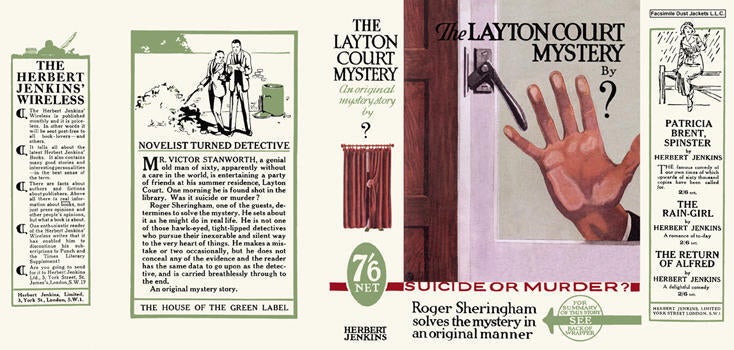
(Source: Facsimile Dust Jackets LLC. Collins Detective Novel, UK, 1929)
219

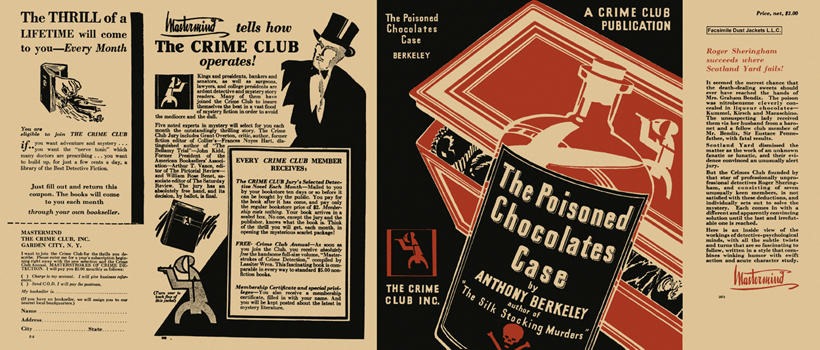
(Source: Facsimile Dust Jackets LLC.Doubleday The Crime Club, US, 1929)

About the author: Anthony Berkeley Cox born in 1893, was an English journalist and novelist who wrote under the pen names of Anthony Berkeley, Francis Iles, A. B. Cox and  A. Monmouth Platts. He was a founding member of the Detection Club and one of the greatest innovators of detective fiction. He wrote at a time when the main form of crime story was that of a puzzle, with an emphasis on plot rather than character. He was also one of the first to foresee the development of the ‘psychological’ crime novel and to successfully carry out its predictions. In Malice Aforethought (1931), written as Frances Iles, there is no problem in the conventional sense as the assassin’s intended plans are declared at the start of the action. The interest lies in whether these plans will be carried out successfully and in the interaction between the characters in the book. Two more novels written under the pseudonym Francis Iles were Before the Fact (1932), where again there is no puzzle of the classical type, and As for the Woman (1939), which was to be the first part of a planned trilogy that he never ended. Other novels written as Anthony Berkeley include The Wychford Poisoning Case, 1926; Cicely Disappears aka The Wintringham Mystery written as by A. Monmouth Platts (1927); The Silk Stocking Murders, 1928; The Piccadilly Murder, 1929; The Second Shot, 1930; Murder in the Basement, 1932; Jumping Jenny, aka Dead Mrs. Stratton, 1933; Panic Party aka Mr Pidgeon’s Island, 1934, Trial and Error, 1937; Not to be Taken aka A Puzzle in Poison, 1938; Death in the House, 1939; and, probably the best known of all, The Poisoned Chocolates Case, 1929. Altogether, he wrote twenty-four novels, ten of which featuring the amateur detective, Roger Sheringham. After publishing his last novel, Berkeley  lived thirty-two more years and he took up work as a book reviewer for John O’London’s Weekly and The Daily Telegraph. He later wrote for The Sunday Times in the mid 1940s, and then for The Guardian from the mid 1950s until 1970. A key figure in the development of crime fiction, he died in 1971.

British Library Publishing publicity page

The Urbane Innovator: Anthony Berkeley, Aka Francis Iles by Martin Edwards 

El caso de los bombones envenenados, de Anthony Berkeley

El-caso-de-los-bombones-envenenados-1000-600x901 (2)Propaganda publicitaria: Todo comenzó el día en que sir Eustace Pennefather, un conocido mujeriego, recibe una caja de bombones en su club de Londres. Poco aficionado al chocolate, se la entrega por casualidad a un conocido del club, cuya mujer es una apasionada de estos dulces. La pobre señora muere al poco tiempo, víctima de una intoxicación por nitrobenceno. El asesinato tiene desconcertado a todo Scotland Yard. El presidente del Círculo del Crimen, un excéntrico club compuesto por seis aficionados a la criminología, propone a sus miembros el reto de esbozar cada uno de ellos una teoría que esclarezca el crimen. Los resultados de sus investigaciones serán expuestos por turnos en las ponencias más sorprendentes que el lector pueda imaginar. El final no dejará a nadie indiferente.

El caso de los bombones envenenados, publicada en 1929 por Anthony Berkeley, es una obra de ingeniería y de inteligencia, una auténtica exhibición de habilidad para construir rompecabezas y para conducir al lector por donde menos se lo espera. Supone toda una reflexión acerca del género detectivesco y, al mismo tiempo, una apasionante aventura intelectual en busca de la verdad. ¿O quizá solo se trata de una broma?

Al texto original se han añadido, a modo de apéndices, dos capítulos más salidos de las plumas de dos grandes maestros del policial: nada menos que Christianna Brand y Martin Edwards. Ambos recogieron el testigo de Berkeley y fabularon sendas hipótesis alternativas a las propuestas por el autor original. ¿Con cuál de todas se quedará el lector?

Esta edición incluye, además, un estudio introductorio a cargo de José Ignacio Escribano y Noemí Calabuig. Un clásico indiscutible de la novela policiaca que todo aficionado al género debe atesorar en sus estanterías.

Mis Apuntes: Anticipándome a la presentación de Who Editorial en la librería Tipos Infames de Madrid, he releído El caso de los chocolates envenenados de Anthony Berkeley. Podemos encontrar el origen de esta novela en un relato escrito también por Anthony Berkeley, “The Avenging Chance”, publicado en Pearson’s Magazine, septiembre de 1929. En el relato, Sheringham resuelve el misterio del asesinato de Joan Beresford y luego Berkeley lo amplía en el novela The Chocolates Poisoned Case (Collins, junio de 1929) en la que descarta la solución a la que llegó Sheringham en la historia. Paradójicamente, la novela se publicó antes de que saliera a la luz el relato. La novela gira en torno a Roger Sheringham, el más falible de los grandes detectives de la época, que apareció por primera vez en The Leyton Court Mystery publicado de forma anónima en 1925 y que reaparecerá en un total de diez novelas y varios cuentos de Anthony Berkeley. Se considera que el personaje se inspiró en Philip Trent de E. C. Bentley. Cuando comienza la acción, Roger Sheringham había fundado el Crime Circle, un grupo selecto de criminólogos aficionados formado por seis miembros.

“La intención del club era llegar a tener trece miembros, pero hasta el momentosolo seis habían logrado pasar las pruebas. Todos ellos estaban presentes en la tarde en que comienza esta crónica. Contaban con un famoso abogado, una dramaturga apenas menos famosa, una brillante novelista que debería haber sido más famosa de lo que era, el más inteligente (si no el más amable) de los escritores de novelas policiacas vivos, el propio Roger Sheringham y el Sr. Ambrose Chitterwick, que no era famoso en absoluto. Se trataba de un hombrecillo apacible y de apariencia nada particular que se había sorprendido al ser admitido en este selecto club tanto o más que los msmos miembros al encontrarlo entre ellos.” (traducción de Tino Navarro Villanueva).

El Cículo del Crimen puede considerarse con razón un predecesor en la ficción del Detection Club, formado en 1930 por un grupo de escritores de misterio británicos, incluidos Agatha Christie, Dorothy L. Sayers, Ronald Knox, Freeman Wills Crofts, Arthur Morrison, Hugh Walpole, John Rhode, Jessie Rickard, la baronesa Emma Orczy, R. Austin Freeman, GDH Cole, Margaret Cole, EC Bentley, Henry Wade y HC Bailey. Un Club en el que Anthony Berkeley jugó un papel decisivo en su creación y del que G. K. Chesterton fue su primer presidente.

La trama comienza cuando Sir Eustace Pennefather, un notorio mujeriego, recibe una caja de bombones en su club londinense. Desaprueba las técnicas modernas de marketing y está a punto de desecharlas cuando Graham Bendix, otro miembro del club al que apenas conoce, necesita una. Bendix había perdido una apuesta con su mujer y eso le ahorraría la molestia de tener que comprar una. Sir Eustace le da la caja, Bendix la acepta, se la lleva a casa y se la da a su mujer. Ambos los degustan después del almuerzo. Su mujer come siete, él sólo dos. Unas horas más tarde, Joan Bendix muere por envenenamiento con nitrobenceno. Bendix, aunque gravemente enfermo, logra recuperarse. Queda claro que la víctima prevista era Sir Eustace en lugar de la inocente Joan Bendix. Scotland Yard no puede resolver el misterio y el inspector Moresby acepta una sugerencia bastante inusual hecha por Roger Sheringham. Él nunca lo habría alentado pero, aunque algo a regañadientes, deja que Sheringham lo intente ya que no encontró nada malo en ello. La extraña sugerencia es que cada miembro del Crime Circle retome la investigación del caso donde lo dejaron las autoridades. Todos y cada uno de los miembros, trabajando de forma independiente, dispondrán de una semana para formular sus propias teorías y realizar las investigaciones que estimen necesarias. Pasado este tiempo se volverán a reunir durante seis noches consecutivas y cada miembro leerá sus ponencias presentando sus propias conclusiones en el orden que se sacará por sorteo. Cada solución será creíble, pero el problema es que cada una apunta a un asesino diferente y el lector se quedará desconcertado hasta la última página. Para reforzar esta idea de un número indefinido de posibles soluciones tanto Christianna Brand en 1979 como Martin Edwards en 2016 nos han proporcionado finales alternativos.

En definitiva, El caso de los bombones envenenados no solo marcó un hito en la historia de la novela policíaca, sino que sigue siendo una novela brillante que merece la pena leer. Como se apunta en algunas reseñas, el arte de detectivesco no es una ciencia exacta y nos permite diferentes soluciones posibles, si lo pensamos bien. Los dos finales adicionales son buena prueba de ello. También es sumamente interesante ver cómo la forma en que se presentan los hechos puede condicionar las conclusiones a las que se puede llegar. Una excelente novela, muy entretenida, que recomiendo encarecidamente.

El caso de los bombones envenenados está incluída en The Story of Classic Crime in 100 books de Martin Edwards (British Library Publishing, 2018).

Otras reseñas de El caso de los bombones envenenados: Juan Mari Barasorda en Calibre 38 y Noemí Calabuig en Whodunit.

Acerca del autor: Anthony Berkeley Cox, nacido en 1893, fue un periodista y novelista inglés que escribió bajo los seudónimos de Anthony Berkeley, Francis Iles, A. B. Cox y A. Monmouth Platts. Fue miembro fundador del Detection Club y uno de los mayores innovadores de la novela policíaca. Escribió en un momento en que la forma principal de la novela policiaca era la de un enigma, con énfasis en la trama más que en los personajes. También fue uno de los primeros en prever el desarrollo de la novela policíaca ‘psicológica’ y en llevar a cabo con éxito sus predicciones. En Malice Aforethought (1931), escrito como Frances Iles, no hay ningún problema en el sentido convencional, ya que los planes del asesino se declaran desde el comienzo de la acción. El interés radica en si estos planes se llevarán a cabo con éxito y en la interacción entre los personajes del libro. Dos novelas más escritas bajo el seudónimo de Francis Iles fueron Before the Fact (1932), donde nuevamente no hay un rompecabezas del tipo clásico, y As for the Woman (1939), que iba a ser la primera parte de una trilogía planeada que él nunca terminó. Otras novelas escritas como Anthony Berkeley incluyen The Wychford Poisoning Case, 1926; Cicely Disappears, también conocida como The Wintringham Mystery, escrito como A. Monmouth Platts (1927); The Silk Stocking Murders, 1928 (titulo en español: El crimen de las medias de seda); The Piccadilly Murder, 1929; The Second Shot, 1930; Murder in the Basement, 1932 (tílulo en español: Asesinato en el sótano); Jumping Jenny también conocida como Dead Mrs. Stratton, 1933 (titulo en español: Baile de máscaras); Panic Party también conocida como Mr Pidgeon’s Island, 1934, Trial and Error, 1937; Not to be Taken también conocida como A Puzzle in Poison, 1938; Death in the House, 1939; y, probablemente, la más conocida de todas, The Poisoned Chocolates Case, 1929 (Título en español: El caso de los bombones envenenados). En total, escribió veinticuatro novelas, diez de las cuales protagonizadas por el detective aficionado Roger Sheringham. Después de publicar su última novela, Berkeley vivió treinta y dos años más y comenzó a trabajar como crítico de libros para John O’London’s Weekly y The Daily Telegraph. Más tarde escribió para The Sunday Times a mediados de la década de 1940, y luego para The Guardian desde mediados de la década de 1950 hasta 1970. Figura clave en el desarrollo de la novela policíaca, murió en 1971.

Who Editorial página publicitaria

Design a site like this with WordPress.com
Get started