
The Langtail Press, 2010. Book Format: Kindle Edition. File Size: 323 KB. Print Length: 224 pages. ASIN: B004GXA5SY. ISBN: 979-1-78002-020-4. Fist published in 1925 by Herbert Jenkins in London.
 Overview: In a typical English country house, a murder is committed. The wealthy Victor Stanworth, who’d been playing host to a party of friends, is found dead in the library. At first it appears to be suicide, for the room was undoubtedly locked. But could there be more to the case? As one of the guests at Layton Court, gentleman sleuth Roger Sheringham begins to investigate. Many come under suspicion, but how could anyone have killed the man and gotten out of the room, leaving it all locked behind?
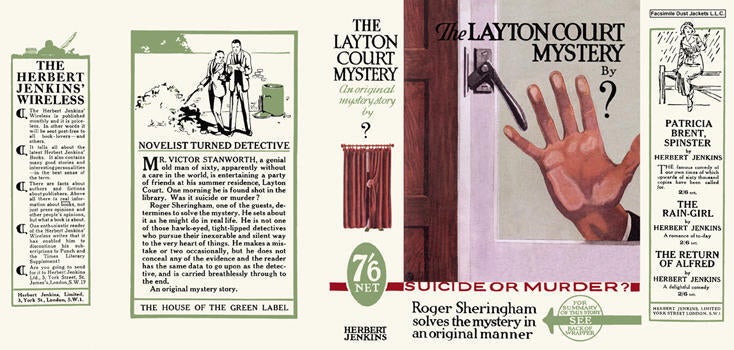
My take: The Layton Court Murder is Anthony Berkeley’s debut novel. It was published anonymously in 1925 by Herbert Jenkins in London as by “?” and it was the first in the series featuring amateur sleuth Roger Sheringham. It was followed by The Wychford Poisoning Case published in 1926 as by the author of The Layton Court Mystery by Collins, in London.
The complete series, published until 1934, is made up of ten books and several short stories collected in “The Avenging Chance and Other Mysteries from Roger Sheringham’s Casebook,” by Crippen and Landru, 2004, with a second edition with an additional story by Crippen and Landru, 2015. See the full bibliography below.
The story begins with Roger Sheringham being invited to a party at Layton Court, a country house hosted by Victor Stanworth, a wealthy and charming man. However, the weekend takes a dark turn when Stanworth is found dead in his library. The matter seems pretty much staightforward. Both the door and windows of the library were locked from the inside. Mr. Stanworth held a small revolver in his right hand, his fingers still convulsively gripping the trigger. In the center of his forehead was a small circular hole. His head lolled indolently over the back of the chair, his open eyes staring up at the ceiling. Not to mention a note that read: “To whom it may concern. For reasons that concern only myself, I have decided to kill myself.” And his signature at the bottom. In short, it doesn’t seem like it will take the coroner very long to arrive at his verdict.
However, Sheringham, skeptical of the suicide theory, decides to investigate. With characteristic confidence, he interviews guests, deciphers clues, and challenges alibis. Over time, he develops theories that prove misleading, if not completely wrong, but which serve to uncover dark motives and secret relationships. Ultimately, Sheringham’s unconventional investigation leads him to unmask the murderer in a denouement full of unexpected twists.
In conclusion, The Layton Court Mystery is a classic example of the Golden Age detective fiction, notable for its wit, social satire, and psychological insight. It stands out, in my view, thanks to the character of Roger Sheringham, an arrogant amateur detective who frequently makes mistakes in his conclusions; its narrative style, which mocks the genre’s conventions; its unexpected twists and its subtle critiques of other detective novels. However, as some critics have already pointed out, long discussions and monologues take up most of the narrative, which at times makes the story a bit dull.
The Leyton Court Mystery has been reviewed, among others, by Nick Fuller at “The Grandest Game in The World”, Kate Jackson at “Cross-Examining Crime”, Martin Edwards at “Do You Write Under Your Own Name?” and Noah Stewart at “Noah’s Archive”(with spoilers).
About the Author: Anthony Berkeley Cox (1893 – 1971) was a popular British satirical journalist, crime and mystery writer, and literary critic who wrote under the pseudonyms Francis Iles, Anthony Berkeley, and A. Monmouth Platts.
Cox was educated at Sherborne School and University College, Oxford. With the outbreak of the First World War, he enlisted, attained the rank of lieutenant in the 7th Northumberland Regiment and was gassed in France. Invalided out of the army, his health was seriously affected for the rest of his life. Details about his professional life in the years immediately after the war are somewhat sketchy. As time went by he devoted himself more and more to writing.
Cox’s professional writing career began around 1922, writing satirical stories for Punch and other popular publications. His first detective novel, The Layton Court Mystery, was published anonymously in 1925. In a period of fifteen years, between 1925 and 1939, Cox published twenty-four books, including fourteen classic full-length detective stories and two sublime phycological thrillers.
In 1930, Cox founded the legendary Detection Club in London together with leading practitioners of the genre, such as Gilbert K. Chesterton, Agatha Christie, R. Austin Freeman, Baroness Orczy and Dorothy L. Sayers. In fact, the Crimes Circle in The Poisoned Chocolates Case can rightly be considered a predecessor of the Detection Club in fiction.
In 1938, he took up book reviewing for John O’London’s Weekly and The Daily Telegraph, writing under his pen name Francis Iles. He also wrote for the Sunday Times in the 1940s and for the Manchester Guardian (later The Guardian) from the mid-1950s until 1970. A key figure in the development of crime fiction, he died in 1971 in St John’s Wood, London.
His 1932 novel (as Francis Iles), Before the Fact was adapted into the 1941 classic film Suspicion, directed by Alfred Hitchcock, starring Cary Grant and Joan Fontaine. Trial and Error was turned into the unusual 1941 film Flight from Destiny starring Thomas Mitchell.
Bibliography:
Roger Sheringham series: The Layton Court Mystery published as by “?” (Herbert Jenkins, 1925; Doubleday, 1929); The Wychford Poisoning Case: An Essay in Criminology published as by the author of The Layton Court Mystery (Collins, 1926; Doubleday, 1930); Roger Sheringham and the Vane Mystery (Collins, 1927; reprinted by Collins as The Vane Mystery; US title: The Mystery at Lovers’ Cave, Simons & Schuster, 1927); The Silk Stocking Murders (Collins, 1928; Doubleday, 1928); The Poisoned Chocolates Case (Collins, 1929; Doubleday, 1929); The Second Shot (Hodder & Stoughton, 1930; Doubleday, 1931); Top Storey Murder (Hodder, 1931; US title: Top Story Murder, Doubleday, 1931); Murder in the Basement (Hodder, 1932; Doubleday, 1932); Jumping Jenny (Hodder, 1933; US title: Dead Mrs. Stratton, Doubleday, 1933); Panic Party (Hodder, 1934; US title: Mr. Pidgeon’s Island, Doubleday, 1934); and The Avenging Chance and Other Mysteries from Roger Sheringham’s Casebook (Crippen & Landru, 2004); 2nd edition with an additional story (Crippen & Landru, 2015).
Other Crime Novels: Cicely Disappears published as by A. Monmouth Platts (John Long, 1927, a shorter version appeared as a serial, The Wintringham Mystery, as by A.B. Cox, in The Daily Mirror); Mr Priestley’s Problem published as by A.B. Cox (Collins, 1927; US title: The Amateur Crime (Doubleday, 1928), The Piccadilly Murder (Collins, 1929; Doubleday, 1930); Trial and Error (Hodder, 1937; Doubleday, 1937); Not to Be Taken (Hodder, 1938; US title: A Puzzle in Poison (Doubleday, 1938); and Death in the House (Hodder, 1939; Doubleday, 1939).
Novels as Francis Iles: Malice Aforethought: The Story of a Commonplace Crime (Gollancz, 1931; Harper, 1931); Before the Fact: A Murder Story for Ladies (Gollancz, 1932; Doubleday, 1932); and As for the Woman: A Love Story (Jarrolds, 1939; Doubleday, 1939)
Collaborative works with members of the Detection Club: The Floating Admiral (Hodder, 1931; Doubleday, 1932); Ask a Policemen (Barker, 1933; Morrow, 1933); Six Against the Yard (Selwyn & Blount, 1936; US title: Six Against Scotland Yard, Doubleday, 1936); and The Scoop and Behind the Screen (both collaborative detective serials written by members of the Detection Club which were broadcast weekly by their authors on the BBC National Programme in 1930 and 1931 with the scripts then being published in The Listener within a week after broadcast. The two serials were first published in book form in the UK by Victor Gollancz Ltd in 1983 and in the US by Harper & Row in 1984)
Further reading: Elusion Aforethought: The Life and Writing of Anthony Berkeley Cox by Malcolm J. Turnbull (Bowling Green State University Press, 1996); The Golden Age of Murder by Martin Edwards (Harper Collins, 2015)
Ranking the Work of Anthony Berkeley by Kate Jackson
The Urbane Innovator: Anthony Berkeley, Aka Francis Iles by Martin Edwards


 A Crime is Afoot