Five armies, three days, two authors, one battle…

By Michał Paradowski

            Recently Charles Singleton, who oversees the (amongst the other things) Century of the Soldier 1618-1721 series, asked me to write new entry for the Helion & Company blog. I was to write something about the new book, ‘Confrontation of Kings, 1656. The Three-Day Battle of Warsaw in the Swedish Deluge, 1655-1660’, that I co-authored with Michael Fredholm von Essen. My first thought was to write some overall information about the battle, typical mix of interesting facts about the armies and commanders involved, maybe something about the sources we that we used. But then I have completely new idea: what about writing about the process itself, about how two authors co-operated while writing the book? And here how the story goes…

            It was July 2022, when Charles contacted me, mentioning that Michael had some proposal for me. I then received an email from Michael himself, in which he mentioned that he was contracted to write a book about the Battle of Warsaw in 1656, largest fight of the 1655-1660 Polish-Swedish was, known also as ‘The Deluge war’. He thought it would be more interesting and useful, if such book presents new perspectives of the battle. That’s why he wanted to check, if I may be interested in co-writing the book about the battle. At that time, I was still writing my Against the Deluge. Polish and Lithuanian armies during the war against Sweden 1655-1660, so I already had quite a lot of researched materials for the Battle of Warsaw itself. At the same time, I already had another volume (The Khotyn Campaign of 1621. Polish, Lithuanian and Cossack Armies against the Ottoman Empire) planned, so I could not commit to another book until mid-2023. Considering that Michael also had some of his books in writing, he very generously agreed to wait with our new ‘joint venture’ until I finish my already started projects. Charles was happy to wait for the new book as well, so he gave us a green light.

            Fast forward to August 2023, when the work on the new book, at that stage still untitled, could begin. Considering that Michael lives in Sweden, and I live in Scotland, one can imagine that there were plenty of emails exchanged since then. Already in 2022 Michael prepared very good overall plan of the work, which was a great start, as we could more easily divide the topics we would individually focus on. It was very new and very interesting experience for me, as I never worked as a co-author on the historical book. I have my own ways of research and writing, so had to learn a new approach and aligning my text with my co-author. Luckily Michael, with his vast knowledge and with so many books under his name, was a brilliant leader of this project. Small suggestion or correction here and there, good discussions on the topics where we may have some minor disagreement or a different point of view, plenty of sharing the information and updating the text. He also showed a lot of patience, even though at the time I was rather stubborn on certain matters.

As for the way how, we divided the work. Michael focused on Swedish and Brandenburg armies, I wrote about Polish and Lithuanian ones. Tatar auxiliary force was very good example of the co-authoring, with some basic outline written by me but then vastly updated by Michael. In similar way we wrote about the three days of the battle, with overall framework of the text gradually updated, corrected and improved to show different point of view on the battle. We used plenty of the primary sources, available in Swedish, Polish, German and French. More modern research was utilised as well and we often pointed out how the way that the battle was described by different researchers changed through the years. We also co-operate closely on the choice of the proper illustrations, to ensure that they highlight the text and provide the good visual company to the description of the battle. As for the colour plates, so closely associated with the Century of the Soldier 1618-1721 series, we worked with our long-time collaborated, very talented Sergey Shamenkov.

There is a question I am often asked by my readers: how long it took to write a book? In this case, thanks to the long trail of emails between Michael and me, it is fairly easy to trace it. If we take August 2023 as a start of the work, it would be just over a year to finish it, as by mid-September 2024 manuscript was sent to Helion & Company. Afterwards of course few months working on corrections, proofreading, updates to the colour plates – all those necessary steps to ensure that book end up the way both authors and publisher wants.

Working on Confrontation of Kings, 1656. The Three-Day Battle of Warsaw in the Swedish Deluge, 1655-1660 was definitely very interesting experience for me. I am very grateful to Michael for inviting me to co-write this book and to Charles and lovely folks at Helion & Company for their support. I think this new book would be of a great interest to readers on the English-language market, as it provides with very detailed description of the armies and the events of the battle. Having authors from both Sweden and Poland helped with showing a wider perspective and different points of view, providing most up to the date study of the battle available in English. There are many more interesting battles between the Polish-Lithuanian Commonwealth and Sweden, so who knows, maybe we will see some more co-authored efforts in future…

Confrontation of Kings, 1656: The Three-Day Battle of Warsaw in the Swedish Deluge, 1655-1660 is now available to buy here.
Frontier Soldiers of New France, Volume 2: From Snowshoes to Tomahawks – Adapting to the Wilderness Battlefield (1683-1760)

By Kevin Gélinas

Kevin Gélinas, author of Frontier Soldiers of New France, Volume 2, discusses how French soldiers adapted to the challenging North American climate.

At the end of the Seven Years War, New France spanned from Hudson Bay in the north to the mouth of the Mississippi in the south, reflecting French efforts to broaden their influence, extending beyond territorial claims. For more than a century, they engaged deeply with Indigenous populations, forming crucial economic and military alliances that helped maintain control over this vast territory and defend it against both British encroachment and hostile native tribes.

This expansion was further facilitated by colonial troops, particularly officers, who played a vital role in orchestrating the defence of the territory and establishing a military presence at the various forts and trading posts while pushing westward. Among them was the colonial officer Louis-Joseph Gaultier de La Vérendrye, the son of the famous fur trader Pierre Gaultier de Varennes et de La Vérendrye, who became the first European to cross the northern Great Plains and see the towering peaks of the Rocky Mountains in present-day Wyoming in early 1743, 61 years before Lewis and Clark’s expedition in 1804.

French officers arriving in Canada in the 1680s quickly realised that European military tactics were ineffective in the rugged, roadless terrain of New France, where seasonal travel required snowshoes or canoes and made traditional artillery and cavalry unusable. Over time, they adopted Indigenous warfare methods that emphasised mobility, stealth, and small-unit raids while still maintaining European discipline and command structures. The fusion of Native American tactics with European military coordination created a highly effective and uniquely adapted fighting force on the frontier.

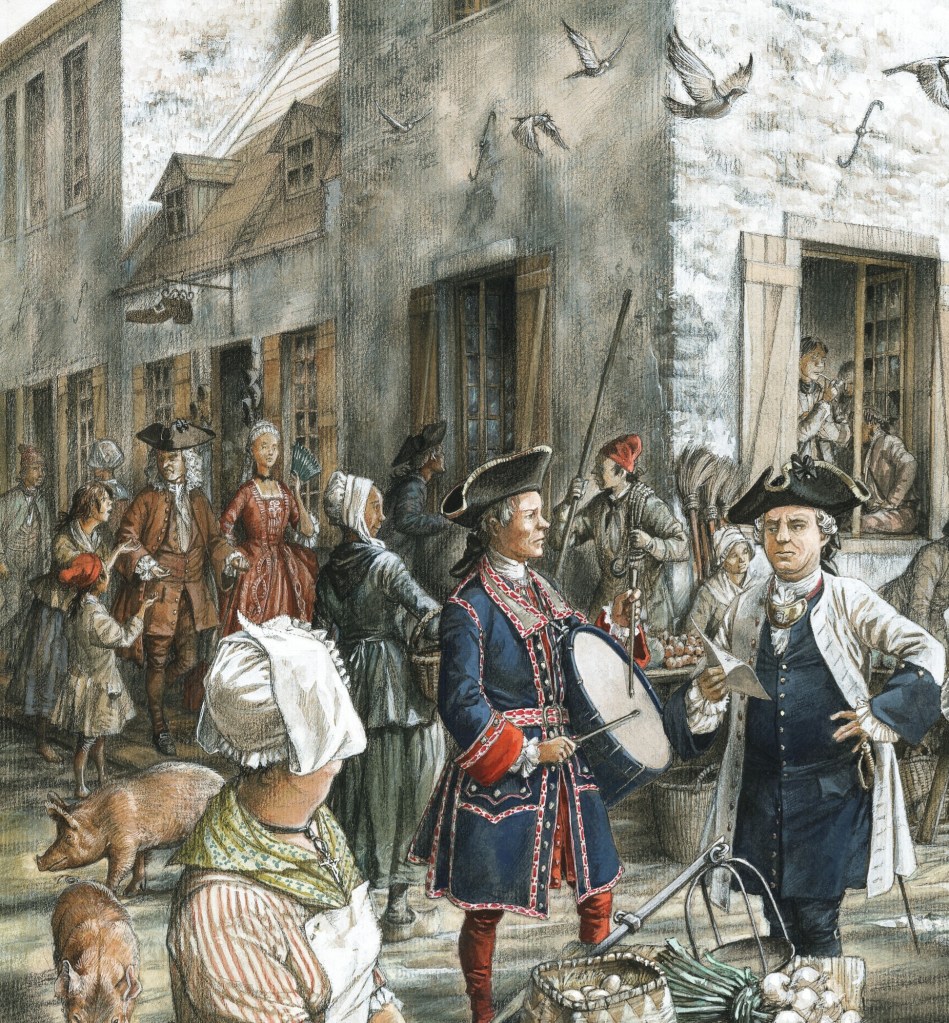
Detail from an illustration by Francis Back depicting the Montreal market of 1749. The scene shows an officer in his official attire, reading an ordinance, while a nobleman in the background, wearing a tricorn hat and a “perruque à la cavalière,” holds a fashionable cane, a symbol of status among the Canadian elite. The colonial officer is shown wearing the 1732 uniform of fine white cloth, lined and cuffed with fine blue cloth, and trimmed with gilt buttons. His brass gilt gorget, which would have probably been of the popular bilobate type, signifies that he is on duty. (Francis Back © Raphaëlle and Félix Back)

By the mid-eighteenth century, most colonial officers were Canadien-born and integral members of the noblesse canadienne. They often donned lavish small swords, silver-mounted walking canes, powdered wigs, and elegant habits while strutting about in towns or socialising at formal gatherings, including dances and balls. As incredible as this may seem, as far west as Kaskaskia in the Illinois Territory (near present-day St. Louis, MO) and as early as the 1740s, the French dressed in the latest fashions from the court at Versailles. For instance, upper-class women, such as Petit de Coulanges’ daughter, wore a “robe à panier” or robe à la française (sack-back gown), drank imported French wine, and enjoyed soirées filled with violin playing and billiard games. On duty or during formal occasions, these officers wore their regulation dress, complete with gorgets, and were armed with a spontoon and a small sword, attire that reflected their rank and was indistinguishable from their European counterparts.  

Remarkably, when leading small-scale wilderness raids on the frontier, these officers donned their ‘à la Canadienne’ kit, tried and tested by the milice canadienne, which was a distinctive blend of French west coast sailor attire and Indigenous clothing. They chose lightweight hunting guns for long-range accuracy and convenience, and for close combat against the enemy they armed themselves with hunting swords, sabres, cutlasses, tomahawks, pistols, and butcher knives. Such a campaign outfit would have stood in sharp contrast to the formal military dress expected at the time and would have been seen as unbecoming of a French officer back in Europe. Following the example set by the officers when performing guerilla warfare, the colonial soldiers quickly adopted the ‘à la Canadienne’ style of clothing, while retaining their regulation-issued muskets, powder flasks, cartridge boxes, and buff leather waist belts, leaving behind their encumbering swords and replacing them with tomahawks in the field.

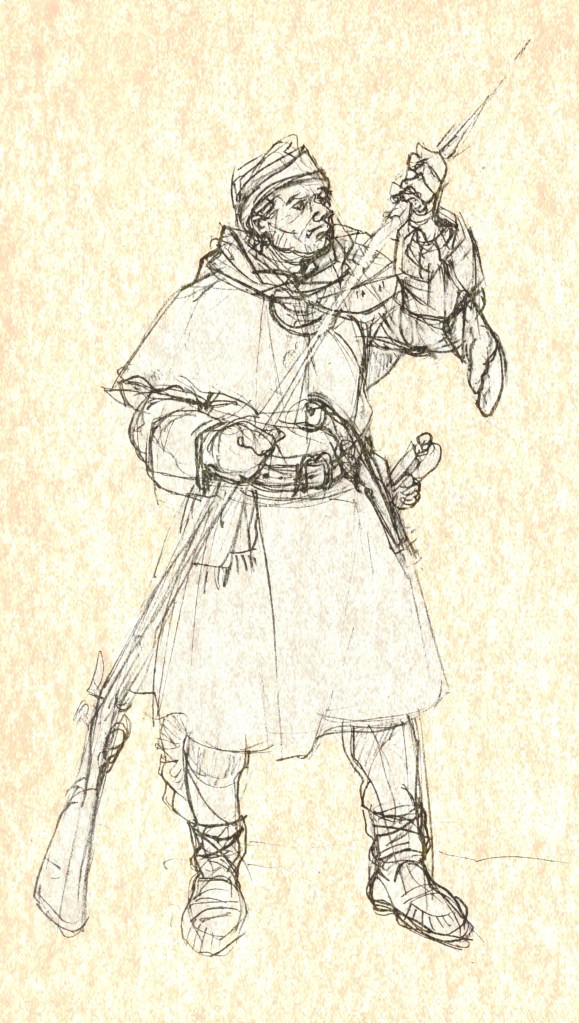
Line drawing by Francis Back portraying a colonial officer in his winter wilderness campaign outfit, wearing a camail, a small mantle that became fashionable in the early 1730s, over his capot. He also wears a gorget, identifying him as an officer, along with a common stocking cap, mitasses (Native leggings), and winter moccasins. He is shown reloading his fusil, having removed one of his mittens, which is attached to a cord running the length of his arms to prevent it from being lost or dropped. A Native style slit pouch, pistol, and cutlass are carried on his leather waistbelt. (Francis Back © Raphaëlle and Félix Back)

Before the 1750s, it was customary for colonial officers and soldiers to receive standard campaign-issue supplies before expeditions, campaigns, detachments, voyages, or when stationed at forts and outposts. Certain items were specific to either winter or summer operations, and the quantity provided to each man varied depending on factors such as rank and the nature and duration of the mission. Most of these supplies, intended for all the men who comprised the fighting forces (militiamen, Native warriors, and soldiers), were typically identical. In fact, most items such as point blankets, awls, knives, and flint strikers were drawn from the same stockpiles in the King’s storehouses used as trade goods in the interior. The arrival of the metropolitan battalions in Canada in 1755 marked a pivotal shift in the operational landscape. From this point forward, the equipment inventories for both officers and enlisted men of the colonial forces were rigorously controlled and systematically regulated for each campaign by the newly arrived high-ranking military superiors.

Garde-magasin, circa.1750 – The storekeeper, or garde-magasin, played a crucial role in overseeing and managing the storage and inventory of goods, including supplies issued to the colonial troops. For instance, Jean-Baptiste Grégoire Martel de Saint-Antoine, storekeeper for the King in Montreal from 1743 to 1757, was a member of Intendant Bigot’s clique and involved in the Affaire du Canada, a scandal of corruption and financial misconduct related to the management of military supplies and resources during the 1750s. (Francis Back © Raphaëlle and Félix Back)

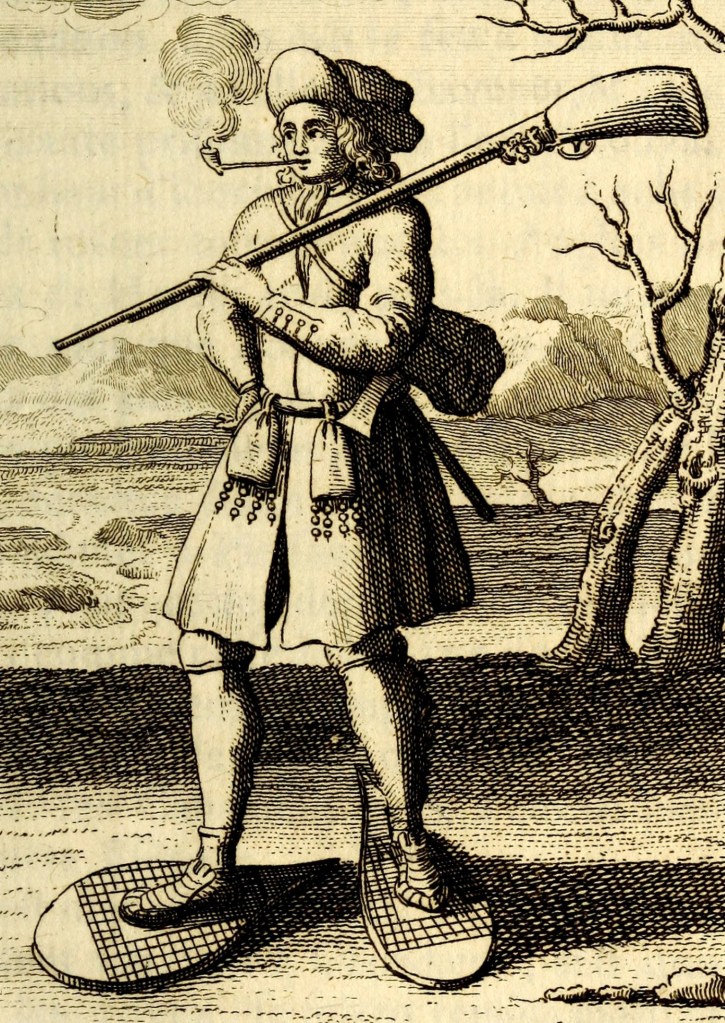
With the exception of Bacqueville de La Potherie’s engraving of a Canadian in snowshoes heading to war during d’Iberville’s 1696–97 campaigns, most likely showing a Canadian militiaman, or perhaps a colonial soldier, no other known images depict such troops in winter campaign attire. As a result, our understanding of a colonial soldier’s summer or winter campaign appearance is largely based on fragmented sources and speculative reconstructions, which have given rise to persistent myths. In recent decades, misinterpretations, fuelled by limited documentation, romanticisation, and reliance on outdated sources, have shaped perceptions of their appearance and the campaign-issued supplies they received.

This engraving by Bacqueville de La Potherie, likely showing a Canadian militiaman or possibly a soldier heading to war on snowshoes, is the only known image that may represent such a combatant in winter campaign dress. Created to illustrate d’Iberville’s campaigns in Newfoundland and Hudson Bay (1696–1697), it provides a rare visual glimpse into the period. Though somewhat naïve in style, the image offers a general sense of the clothing and equipment used during winter campaigns, which will be discussed in the book. According to Marcel Fournier, during his 1697 expedition to Newfoundland, Le Moyne d’Iberville brought 100 Canadiens, including 30 colonial soldiers. (Claude-Charles Le Roy Bacqueville de La Potherie, Histoire de l’Amérique Septentrionale, 1722. Canadiens en raquette allant en guerre sur la neige, Creative Commons)

Thus, Frontier Soldiers of New France, Volume 2 aims to re-examine the clothing, arms, equipment, and supplies issued to the colonial troops during wilderness military operations in New France between 1683 and 1760, using the most current research available. Combined with a wealth of complementary period sources, iconography, extant artifacts, and archaeological evidence, a more complete picture of each of these objects begins to take shape, shedding light on the ingenuity, bravery, and resourcefulness of the French soldiers who waged war in the wild, uncharted reaches of the North American frontier.

You can register interest in Frontier Soldiers of New France Volume 2: Campaign Clothing, Armament, and Equipment of the Colonial Troops in North America (1683–1760) here.

Indigenous Peoples and the ‘Beaver Wars’ in North America

By Laurence Burrows

Having finished the draft of the forthcoming Helion book, War on the Turtle’s Back: Indigenous Peoples During the Period of the Seven Years War in North America, 1752-1766, I decided that my next book project would be a history of the wars fought by Indigenous Peoples of the Eastern Woodlands of North America during the 17th century, the so-called ‘Beaver Wars.’ Perhaps the most well-known appellation for the period, here I have used it as a convenient title for the book. However, it is a misnomer, the ‘Beaver Wars’ were actually a series of unrelated conflicts and for differing motives, mostly not over access to furs, as Indigenous Peoples sought to gain balance and security. Importantly, to give context to the wars, information on beliefs, governance, trade, daily life and its adaptations to new circumstances, and the changing fashions of Indigenous Peoples during the period are related. 

Although European goods had been available on the Atlantic coast and in the Gulf of Saint Lawrence since the first half of the 16th century, this rapidly increased when professional fur trading companies from France set up at Tadoussac in the 1580s with the agreement of the Innu (Montagnais) people. Indigenous Peoples were great travellers and extensive trade networks by waterways and forest trails already extended through the woodland areas to the Mississippi valley already existed. This new source on the periphery of the Turtle’s back became important for the seemingly powerful materials that could be obtained. Not least among these were metal objects, superior to native copper, including hatchets and knives, and kettles which could be fashioned into arrowheads and spearheads, giving those who possessed them some tactical advantage against their foes in extant conflicts.

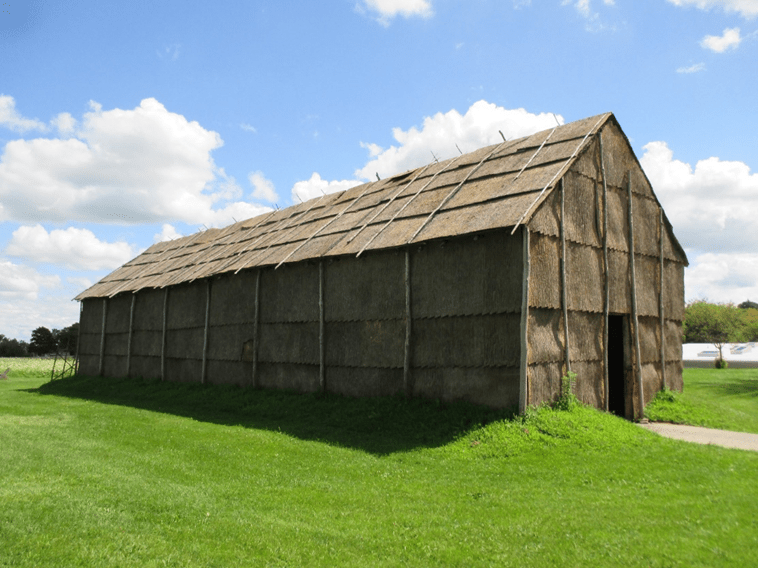
Seneca Longhouse, Ganondagon (near Victor, NYS).

Around 1570, the Mohawks and probably the Oneidas (two nations of the Haudenosaunee or Five Nations Iroquois Confederacy) started raiding the Innus and their Algonquin ally along the Saint Lawrence in order to obtain these new goods. Then in the summer of 1609 a Mohawk war party met one of Innu warriors with their allies the Algonquins and Arendahronon Wendats (Huron Rock nation) for a ritual battle near Ticonderoga on Lake Champlain. Not expecting anything else the Mohawks were surprised when their opponent’s invited guests, Samuel de Champlain and his companions, emerged from the allied formation to fire their arquebuses at them causing three casualties and they to flee, the first-time firearms had been used in action in the northeast of America. The Haudenosaunees needed to counter this new terror weapon brought by the newcomers. Not only did this encounter lead to an abandonment of open battlefield tactics and the use of field fortifications but it, in effect, also rendered protective amour and shields obsolete. Appreciating the power of these new weapons, which caused grievous wounds compared to those of arrows, made it a priority to obtain firearms both to protect themselves and to control the fur trade. The book will present the adaptation of indigenous tactical doctrine, additionally giving account of the whys and wherefores of how war parties were formed, campaigned and fought.

Wendat (Huron) Armour.

In 1614 the Mohicans permitted the Dutch to establish a trading post at present-day Albany. Through treaty with the Dutch the Mohawks were able to trade for guns with them. However, the Mohicans had them pay a tariff for the privilege. Tensions arose and in a war between 1624 and 1628, the Mohawk defeated the Mohicans extending their territory, the ‘rafters of the longhouse,’ up to the west bank of the Hudson River and direct access to Dutch guns and trade goods. The Mohawk, having become conversant firearms, dictated to their inherited tenants, the Dutch that they wanted modern flintlocks rather than the matchlock muskets that equipped most European armies at the time. And so, ambushes of Wendat and Algonquin fur fleets travelling to trade with the French merchants along the Saint Lawrence continued.

The Siege of Onondaga 1615.

Adding to those lost due to other forms of mortality, in the mid-1630s epidemics of smallpox, measles and other diseases brought over from Europe struck indigenous communities, possibly causing significant losses in population in the short term. This also resulted in some loss of knowledge, the wisdom of elders. Grief at loss of family, made extremely traumatic by the numbers dying, spurred a need to replace the dead and assuage their spirits, resulted in in an on-off intensification of existing wars between the Haudenosaunees (vilified by the Jesuits in their Relations) and other Indigenous Nations – the so-called ‘Mourning Wars’ – from 1635 to obtain captives for adoption (who would play their part in forthcoming campaigns). Even so, nearly surrounded by nations allied with New France, the Haudenosaunees made peace overtures, as required by the League’s constitution. These were ignored or rejected. From 1648 a series of mostly stunningly executed large-scale campaigns against neighbouring Iroquoian-speaking nations by the Haudenosaunee nations integrated thousands of captives through adoption by clan mothers to ‘requicken’ their populations, both physically and spiritually. By the mid-1650s, the Haudenosaunees had adopted so many captives that they outnumbered the native population.

Haudenosaunee (?) War Club (Cleveland Art Museum).

To the west Indigenous Peoples of the Great Lakes met with French explorers and missionaries, which led to opening access for them to European trade goods and guns, and choosing to forming alliances with New France. Even so, disease and incursions by the Haudenosaunees and other conflicts in the region between Indigenous Nations caused a ‘shatter zone’ throughout the Ohio valley with frequent diaspora, which, nonetheless, led to nations sharing from a ‘common pot.’ Furthermore, chapters in the book will also cover conflicts occurring elsewhere, such as the involvement of Lenape and Wappinger Peoples in Kieft’s War; the Pamunkeys in Bacon’s Rebellion; and the Westos in the Carolinas.

Cohoes Falls, Mohawk River (Photo: Beyond My Ken).
The Champlain Valley (Photo: HbBrown).

Heiho, The Art of War – thoughts on the large battles of 16th century Japan

Two years ago, we published Bushidan: Miniatures rules for small unit warfare in Japan, 1543 to 1615 AD by established writer of novels and rules for both wargaming and role-playing Pauli Kidd. In April at the Salute Wargames show, we shall be publishing Pauli’s latest rule set Heiho, The Art of War: Wargames Rules for large battles of Sengoku period Japan, 1560-1615. Designed for any scale of miniatures, the rules depict massed battles of the period, which saw armies with strengths from 20,000 to 100,000 men. The game reflects the unique mixed arms deployment styles of the period, as well as the often-elaborate battle formations. Games are played on a table divided into square grids – or not, if players want to use more traditional measurement and movement.

‘Heiho, The Art of War’ is part of a partnership project between Helion and Wargames Atlantic. The ‘Heiho’ ruleset will feature in forthcoming Wargames Atlantic boxed sets of their ‘epic’ scale (12mm-15mm) Japanese Sengoku era army boxed sets.

In the Katori Shinto Ryu, when we rise and approach a training partner to ask them to train with us, we say “Onegaishimasu”. In this context it means “I have an honourable request”, or ”Please join me on this journey”.

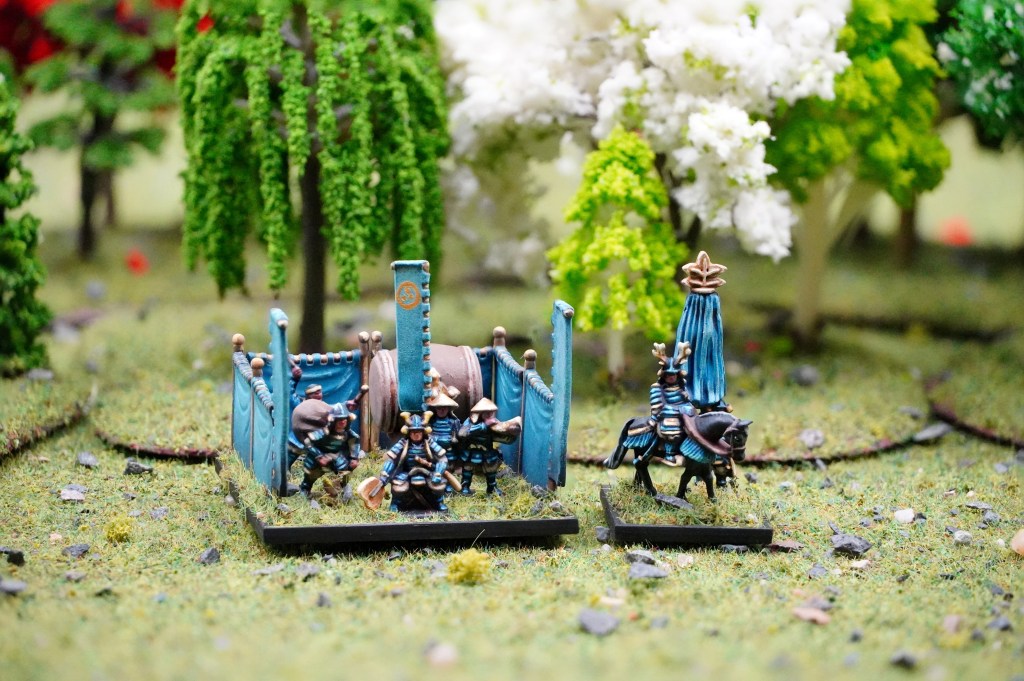
The Daimyo contemplates his strategies

So – Onegaishumasu!

“Heiho (The art of war)” is game about the big battles that were fought at the end of Japanese “Age of War”. In these battles, the great daimyo warlords raised armies that numbered tens of thousands of men and fought battles that were truly Napoleonic in scale. New battlefield technologies created radical changes in battlefield tactics, and sophisticated military systems arose.

Long experience with wargaming the 16th and 17th centuries showed at there were no rules that were truly suited for depicting this great age of samurai warfare.

Firstly, there was the matter of deployment. Japanese armies in no way organised themselves in the linear formations so beloved of wargamers. Clans deployed their troops as ‘sonae’ (effectively brigades) of mixed arms troops. A sonae fought in depth, coordinating skirmish lines, firearms troops, shock infantry and cavalry – sometimes with integral artillery as well! Troops could strike well ahead of the main body in spoiling attacks or skirmish lines. There was a sophisticated set of tactical notions on sonae deployments – some being based around defence in depth, or in serried defence coupled with envelopment – other styles were based upon attacks in wedges, serried lines, central or flank attacks. Sonae in turn were gathered into “te” (divisions), which acted as independent forces capable of attack, defence and independent missions.

There were many textbook styles of deployment for armies themselves. Florid names aside, the styles sift down to plans such as attack in depth, attack concentrated on one or more flanks, defence in depth, attack in depth…. Where possible, reserves were kept, and armies seldom engaged rashly.

Ashigaru move through the forests

Down at the individual sonae level, the period saw troops being broken down into several distinct types: firearms troops who were equipped with matchlocks, spear armed shock troops, and cavalry. There were also often archers integrated into units of shot – either attached as individual archers supporting each small team of 4 musketeers, or as small, dedicated support formations. Likewise cannon and super-heavy firearms were used support weapons within the sonae.

Cavalry had undergone their own evolution. They were extremely capable both fighting while mounted or on foot and were ready and willing to dismount. They often worked closely with infantry in mixed arms sonae. Eastern cavalry had evolved into a force largely equipped for melee combat with the yari. Western forces, who often operated in closer terrain, used a lighter, looser-formed cavalry that was utilised in a skirmishing fashion at need. Some clans were even advocates of mounted fire with carbines and pistol, using their cavalry as mobile firepower (and thus being able to dismount them like dragoons).

Samurai were an incredibly useful resource. All cavalries were samurai – but samurai also had their uses as elite heavy infantry, as elite firearms troops. They were a limited resource, however, and were massively outnumbered by the rank and fil commoners.

Samurai heavy infantry was valued as a back-up for the spear armed infantry, following up their attacks, or flanking enemies once the spear had engaged them. They were also useful for supporting cavalry. Cavalry could be useful as part of all-cavalry sonae who could range swiftly across the battlefield. These formations were, however, often fragile. It was recommended that all sonae contain a mounted element that could be used to destroy fleeing foes or help support the infantry battle lines.

SO!

“Heiho” took choices to bring out some of this period flavour without drowning play in too many details.

The basic unit used in play is a ‘sonae’. This is composed of several bases of troops – each of a set type. The sonae can also contain small support elements such as archers and artillery. These do not add to the numerical fighting power but instead give bonuses to the sonae under set circumstances.

A sonae is about 1000 men. Some elite formations were larger.

“Heiho” decides to depict sonae deployment in the field abstractly by having players ‘stack’ basses of troops into columns. These columns represent each formation’s prioritisation of different troop types in battle.

When sonae engage, they choose a general deployment style in secret, and some styles have a bonus against others. The missile troops attack their opposite numbers, hoping to disrupt the enemy formation and make it vulnerable. Sonae may elect to keep their distance and skirmish, or close into battle.

A body of Ashigaru armed with Yari’s is supported by other armed with bows and arquebuses

Once melee is entered, the numerical strength of the sonae is modified by advantages in the tactical deployment chosen. The lead ranks of the column engage (and can have advantages if properly supported by the right sort of following ranks!). The second ranks then engage – and the result of the overall melee is decided.

If a unit is driven off in melee, a victor who has kept a cavalry reserve will wreak extra havoc on their foes.

Command and control is represented by “zanshin” (situational awareness). A commander has a limited stack of zanshin points. These can be used to issue orders, to micromanage combats and to rally troops.  A particular hallmark of the period is “commanding from the enclosure”, where a commander crated a static command post and controlled the battle via a network of trusted couriers, observers and sub commanders. The game thus lets players chose to “command from the saddle”, having a general who rides the battlefield surrounded by staff, and “commanding form the enclosure’, where the C in C has a static HQ. Commanding from the saddle allows a general to directly intervene in the battle, but their attention can be caught up in local affairs! Commanding from the enclosure requires a general to pre-plan some of the tide of battle beforehand. Commanding form the enclosure requires planning and forethought but becomes an easier system to control the battle once armies become large!

Some clans were renowned for quirks in training, equipment or character. Heiho allows unique clan profiles to be created. An army can consist of troops from many different clans.

The armies face each other

Sub-commander in the period ca with their own rather radical personalities. Some were rash, some were pompous and over-technical. Some were loyal while others were untrustworthy. All were utterly opportunistic. Heiho generates random character traits for subordinate generals. Part of a commander’s skill is placing the right man the right job.  A fierce, rash commander might be perfect for a central attack but might also lead you into trouble. Zanshin is often used to retrain commanders rather than give them specific orders!

Some of the Wargames Atlantic box art that will feature in Pauli’s new book

I chose to do a game that would be played on a tabletop that is divided into clear, square ‘sectors’. This takes out so much of the arguing and bitterness between players, and speeds play immensely. However, the players are also given the option to play the game ‘old school’ with tape measures. It is, after all, YOUR game!

I hope the game gives everyone hours of enjoyment.  I am personally damned keen to get some more armies painted for this ASAP.

The rules can be used with any scale of figures

You can register interest in Heiho: The Art of War Wargames Rules for Large Battles of Sengoku period Japan, 1560-1615 here. The book will be available at Salute in April 2025.

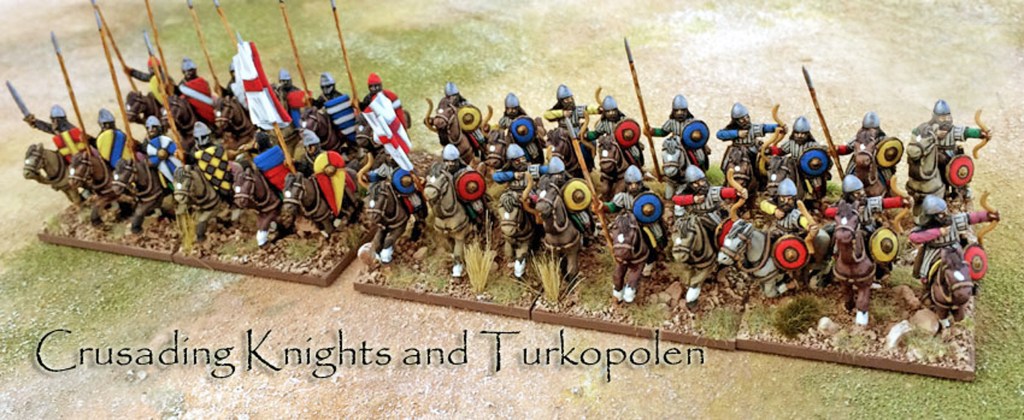
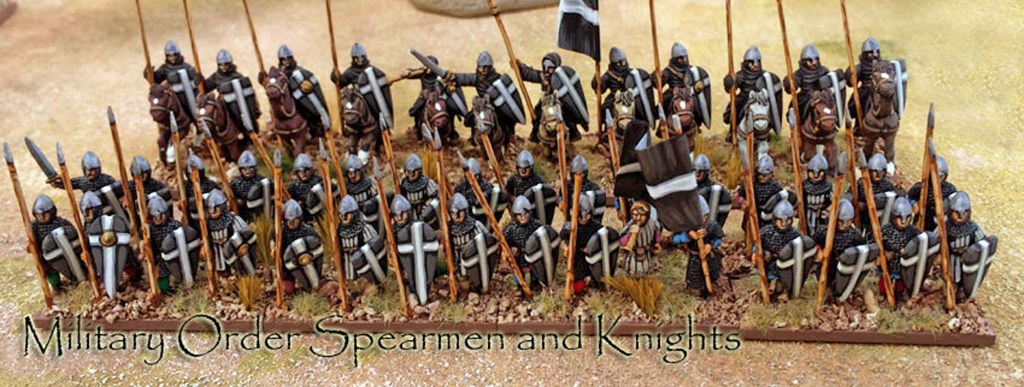
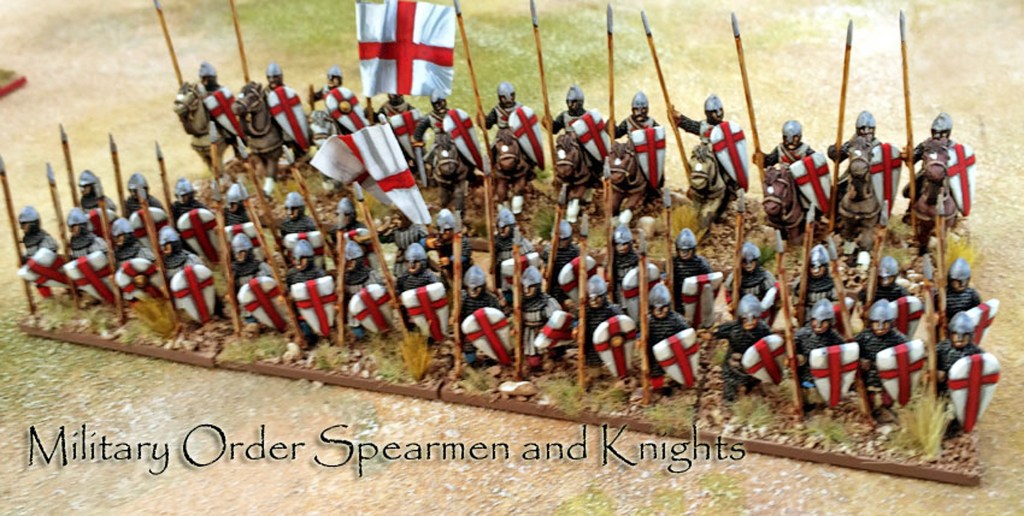
Swords of God, Wargaming the battle of the Crusades: Game Design Philosophy and thoughts about fighting the wars of the Crusades

Rules Writer Matt Moran, based in the Wargames heartland of Nottingham is about to publish his first book with Helion. ‘Swords of God’ covers large battle action in the era of the Crusades in the Holy Land. In this blog, Matt discusses the ideas behind the narrative based rules.

Wargames and role-playing games are far more intertwined than many folks admit. Dungeons & Dragons was originally a wargame, and Warhammer was a way to sell more D&D miniatures. Both of them present a conflict to be resolved, either as a one-off or part of a longer campaign. Role-players play a character, while wargamers are invited to inhabit the part of a general who exists in a very different social fabric to themselves (unless you too pay the iron price for your daily coffee). Even games written as pure exercises in system mastery assume some understanding of the era being recreated, and some by-in to the concept of your position as commander, whether corporal, colonel, or king. Crucially, while reaching a narratively satisfying resolution for either requires some collaboration from everyone around the table, both wargames and RPGs take a little agency away from players for exactly the same reason.

Wargames used to have game masters too, who resolved the effects of each general’s actions according to their probability of success. But even with a disinterested third party, human nature leads to consensus, and consensus necessarily hangs in a predictable, compromised, mean average space that is the antithesis of the unexpected highs and lows we call drama. And why play if things aren’t exciting? That kind of outcome resolution is for algorithms, not games nights.

And here we find where that stolen agency is placed: in resolution mechanisms (often random number generators) that tell players how things go rather than letting them decide. This is the chaser in the beer, the gin in the tonic, that not only keeps things moving along by cutting out a certain need for discussion but also – more importantly – offers the occasional unexpected outcome that both players can accept with only minimal grousing! We see here a distinction between the rules (as written in the book) and the game (as experienced in play around the table). The rules propel or constrain the game to push the action in a certain direction, whether narrative, simulationist, or brutally, simple competitive. Sometimes they help achieve the players’ aims, and sometimes they don’t (this dissonance is what makes a game seem ‘unrealistic’). No game can cover the infinity of existence in its finite pages, but every game tries to cover what’s important to the topic at hand and patch any logical holes in the rules of play. And those rules must try for brevity, so that they don’t impose a stutter in the rhythm of play.

Of course, when unexpected outcomes are too frequent (like 1 or a 20 on a twenty-sided die, for example), the irregular becomes the norm. That’s why a bell curve of probabilities is better for games that want to sail through calmer waters to more reproducible results. And what better bell curve than 3d6 (god bless G.U.R.P.S.)?

This is, of course, a trick. Swords of God isn’t really based on G.U.R.P.S., any more than it is on D&D or Warhammer.

The rulebook’s DNA principally comes from Apocalypse World by D. Vincent and Meguey Baker. Since 2010, its 2d6+modifier resolution system has led to a whole genre of RPG called “Powered by the Apocalypse” (PBTA), from dozens of authors. While this short summary looks like a retread of Fighting Fantasy, the secret sauce in PBTA is that instead of a generic resolution system for a genred game, PBTA gives genred resolutions to underline the genre being recreated. That means there are Moves for the clichéd, the stereotypical, the defining actions of the sort of fiction being played in. They have names like ‘Get Your Way’ or ‘Dive Into Danger’, perhaps ‘Rip Open Reality’ for particularly dangerous mages. Each of these evocative titles tells you what modifier to add to your roll, and lets you – yes, you the player – choose one or more results from a curated list, all of which keep the action moving forward while reinforcing the type of story being told and the role being filled by the player.

“Play to find out” is D.V. Baker’s motto, and a fine one it is for wargames as well as RPGs. Having been a competitive 40k player in the mid-00s and a dedicated follower of all sorts of rank-and-flank wargames since, I dislike a game whose shape can be divined from the mere shape of deployment. I want a story, and I want it to have twists!

And what greater war story is there than the Crusades? I don’t just mean in the sense of character arcs, nemesis crushing hubris, ironic rewards and deserved punishments. I mean that the story we tell ourselves of the Crusades is nearly always a hundred percent wrong except for a few broad strokes, and yet the story lives on in a hundred different forms across movies, novels, games, art, popular history books, and regressive racist jeremiads by the intentionally ignorant. The Crusades are so rarely history and so completely a story that we tell ourselves that to my eye they occupy a uniquely liminal space between myth and history – perfect fodder for a 13th century-style troubadour’s songs. This is why the game is based first on psychological studies of the Crusades, and then tweaked and deepened using more traditionally historical works: since mental models of the Crusades are far more prevalent and believed-in than the ‘facts’ history has bequeathed us, it seems after to focus on making each game an engaging story instead of prioritising a rigorously accurate simulation of ‘physical reality’.

None of these are really digressions. Swords of God (the rules) takes the part of a game master, a troubadour, a bard who wants to tell a gripping tale of blood and heroism. This keeps the game moving by eliminating the need to resolve any and all null results. If a bard wouldn’t linger on them, the rules skip past them. Swords of God (the game) focusses on the narrative, letting players lose themselves in decision-making rather than cold-blooded strategising. The Move system borrowed from PBTA keeps outcomes within a believable range while also giving plenty of air-punching successes and groan-worthy failures.

You will almost never know how things are going to turn out before a game of Swords of God begins: if nothing else, it has a robust terrain and scenario generator that keys off each general’s relationship to the divine. Here is where the history becomes a story. The special rules for each army (lists in the back of the book) aren’t based on such fluid (and in many ways recent) concepts as nationality and religion; they depend on your general’s personality and how they see themselves as a tool of the divine. Avenger? Martyr? Disinterested professional soldier? All these and more offer Faith Trees that essentially let you spend army morale to activate special abilities and keep the game in the balance right up to the final turn.

The Crusades have been part of my life since I was a small, not just those in the Levant but in Iberia, the Baltics, and more. If you want to let the Crusades into your life, weave a surprisingly widespread tapestry with Swords of God!

Swords of God is a narrative wargame that brings the Age of Crusades (c.1060-1460) to life on your table. Rather than attempt direct simulation of the physical aspects of warfare, the rules instead take inspiration from chansons de geste and other romantic literature of the time to create a faster-flowing, more abstract struggle still worthy of a song.

This grid-based game fits battles of up to 30,000 men a side onto a 6’ x 4’ table, but any size of table can be used if your unit bases are smaller than the ‘Impetus’ standard of 120mm by 40mm, or more numerous than the sands of the sea! Centred as it is on the command and control of key personalities in each army, the game’s simple points system makes any size of battle possible. The game also contains a quick chart to help you pick the right size of table for your battle.

Inspired by psycho-historical studies of the Crusades like Avner Falk’s Franks and Saracens, and based in part on Vincent Baker’s seminal Apocalypse World (PBTA) rules engine, Swords of God’s deep but simple mechanics promote meaningful tactical choices while ensuring the action always moves forwards. Among other things, it features:

  • A unified mechanic based on the roll of three six-sided dice.
  • Heavy focus on player choice through a Move system that lets you pick the outcome of your actions from a narrow list.
  • Gridded movement to get the action started quicker. The sides of each square are equal to half the width of a unit base. This also means that the game can be played at literally any scale!
  • Scenario generation that takes into account your generals’ personalities and the table’s landmark terrain.
  • Army morale systems that differentiate units of the same type and keep games competitive to the last turn.
  • Seven sets of special rules based on the army commander’s relationship with the divine. In an era of personal oaths and charismatic authority, these special rules extend to their army as well.

Army lists for campaigns in Iberia, the Baltics, the Languedoc, Bohemia and the Levant feature curated spreads of unit types, while the ‘Faith Trees’ available to generals of any religion grant special rules based on their emotional connection to the divine and the religious war that has engulfed your table. Each one gives an army a different feel, providing a great deal of replayability even within the same campaign.

Register interest in Swords of God: Wargaming the Battles of the Crusades here.

The Battle of Pavia, 24 February 1525

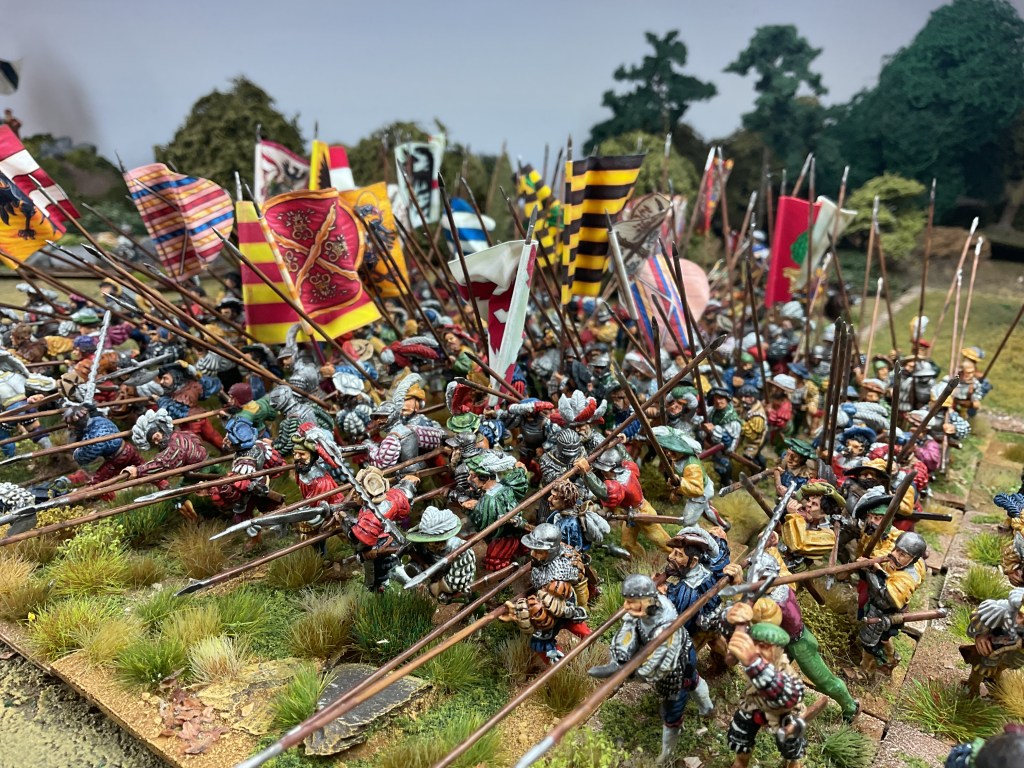
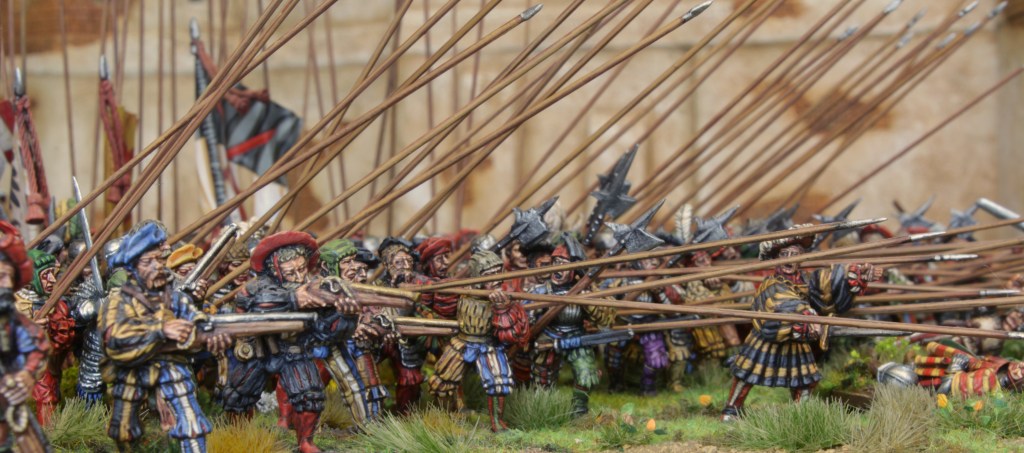
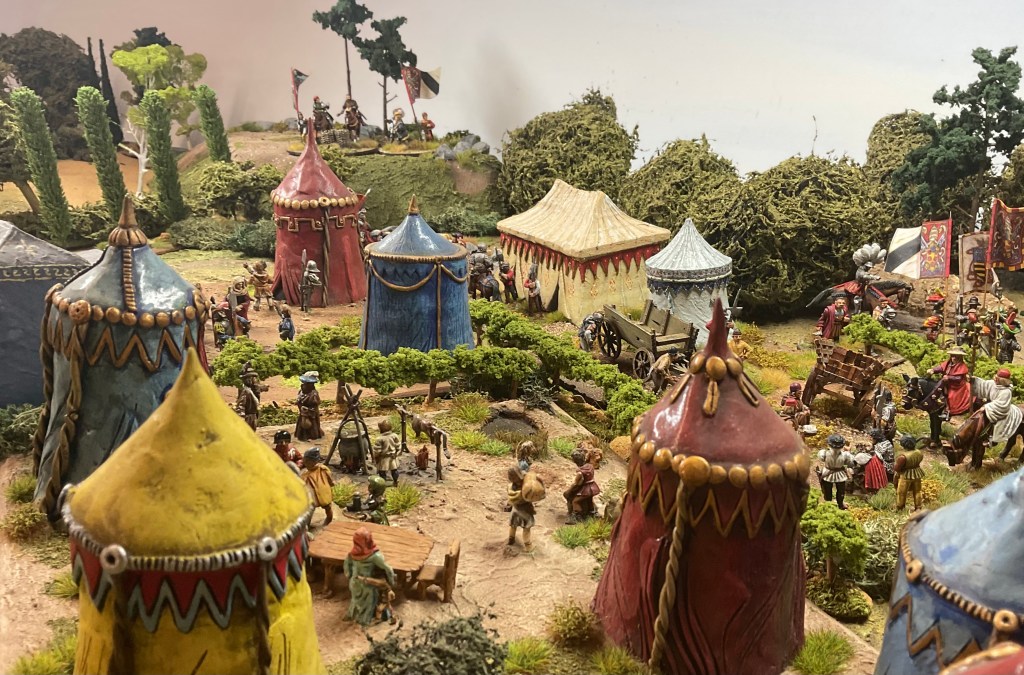
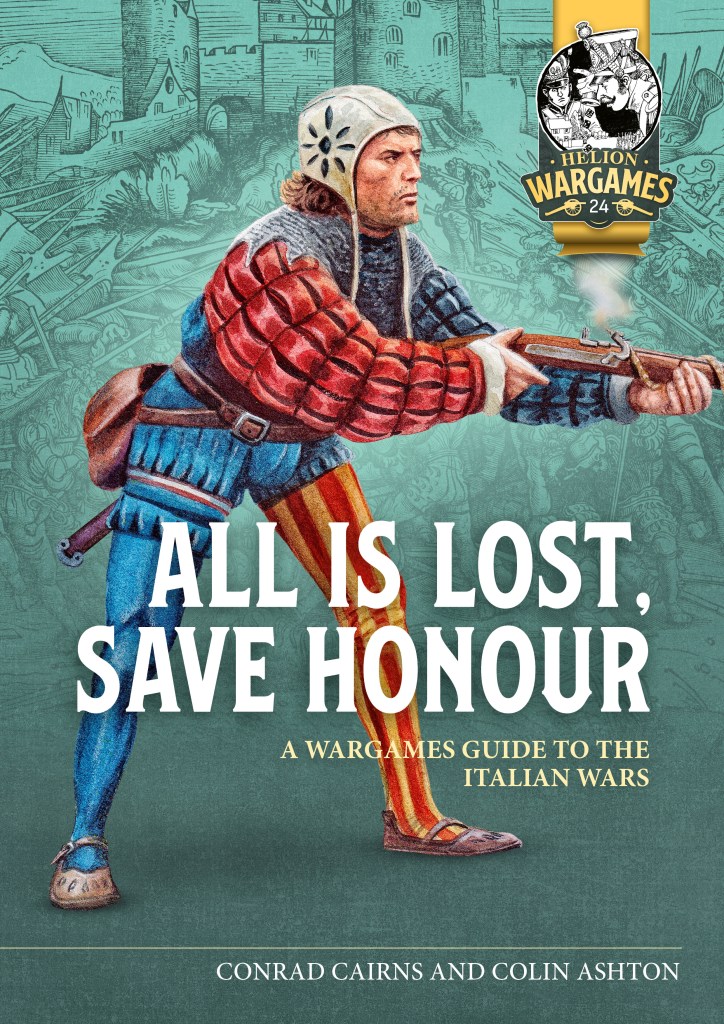
In April, we publish ‘All is Lost Save Honour: A Wargamer’s Guide to the Italian Wars.’ The book is a collaboration between Helion author Conrad Cains and a friend of the company, Colin Ashton. Both writers have studied the Italian Wars for many years and have extensive wargaming figure collections representing the forces of the conflict. Today, 24th February, marks the 500th anniversary of the Battle of Pavia, arguably the most significant battle of the Italian Wars.

February 2025 marks the 500th anniversary of perhaps the most pivotal battle of the Italian Wars. It is also undoubtedly one of the most written-about and wargamed battles of this period. The idea of presenting yet another wargaming take on the battle might seem daunting—someone, somewhere, will always find issue with my interpretation. However, thanks to the many resources available online, it becomes clear that while tabletop setups and orders of battle may vary, the core elements remain largely consistent. Having played my ‘get out of jail’ card, what follows is an account of how I planned my game and how it played out in the Burrow.

Having marched all the way from Germany, through the alpine passes, these Landsknechts are eager for action—and loot! From All is Lost Save Honour.

For those unfamiliar with the battle, the French army, under King Francis I, had been besieging the city of Pavia since October 1524. The city was held by an Imperial garrison commanded by Antonio de Leyva, who had no intention of surrendering. Despite a French bombardment and costly assaults, the defenders remained resolute. The siege dragged on, with the French well-supplied while the city suffered. Raids and sorties were frequent, and both sides experienced high rates of desertion and sickness.

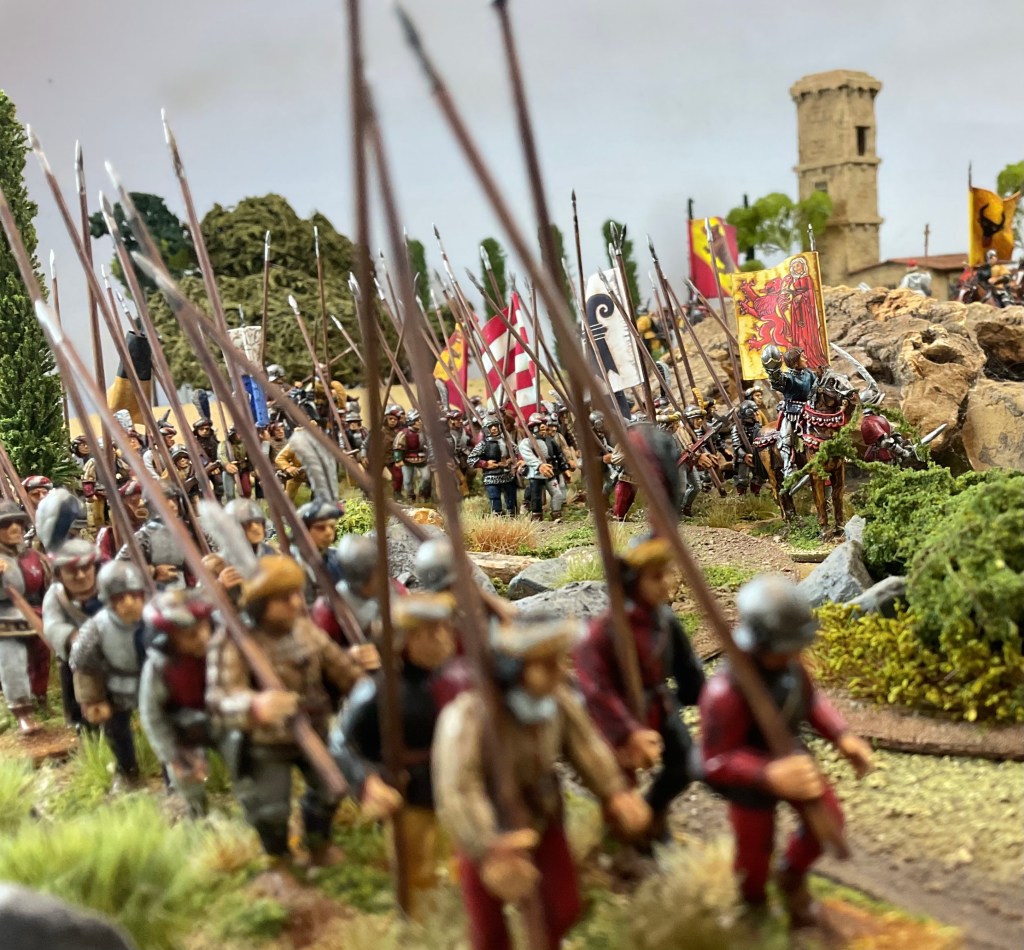
Imperial Landsknechts, led by Georg von Frundsberg, aim to settle scores with the Swiss. From All is Lost Save Honour.

An Imperial relief army set out from Lodi on 24 January 1525, capturing Sant’Angelo—an important French garrison—to secure their rear before marching to Pavia. They established a camp east of the city, effectively besieging the besiegers. Both armies remained in position for several weeks, suffering further losses from disease and desertion as they waited for the next move.

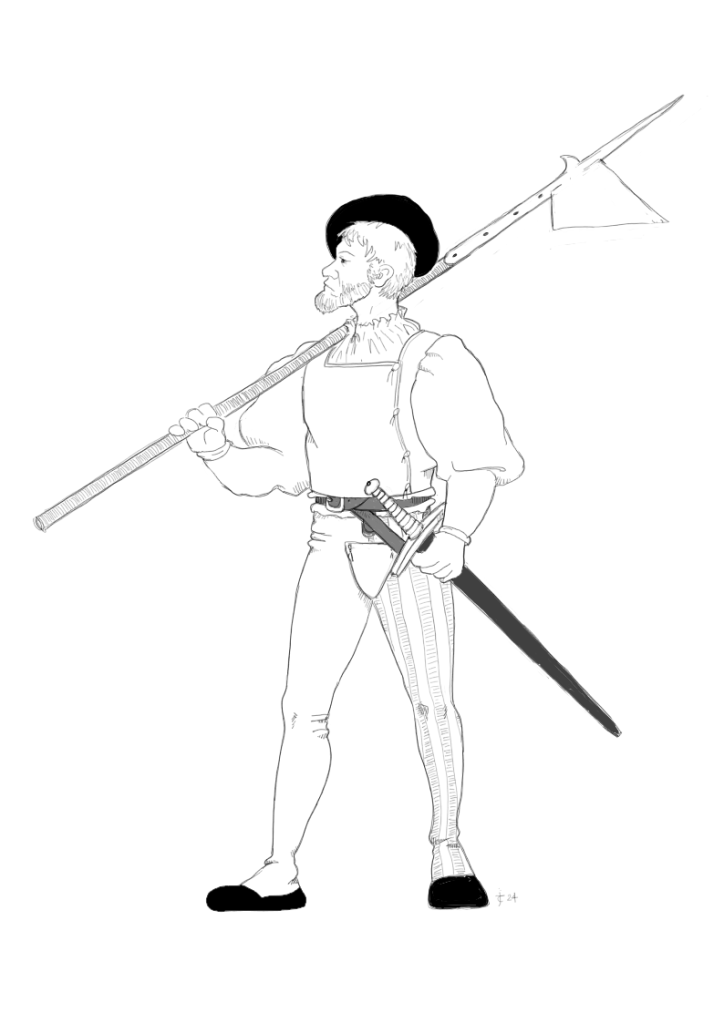
A Swiss halberdier, from All is Lost Save Honour.

On 24 February, the Imperial army launched its assault. Under the cover of artillery fire and early morning mist, over 18,000 Imperial troops advanced northwards, breaking through the walls of Mirabello Park and catching the dispersed French army by surprise.

Forces Engaged

France – King Francis I and a host of noble commanders

  • 1,200 gendarmes
  • 2,000 light cavalry
  • 8,000 Swiss infantry
  • 5,000 Landsknechts
  • 4,000 Italian infantry
  • 6,000 French infantry
  • 53 cannons (mostly positioned in the siege lines)

As many French troops were stationed outside Mirabello Park, the numbers available within it were reduced.

Imperialist – Charles de Lannoy, Marquis de Pescara, Charles de Bourbon

  • 800 men-at-arms
  • 1,500 light cavalry (three companies)
  • 12,000 Landsknechts
  • 5,000 Spanish infantry
  • 3,000 Italian infantry
  • 17 cannons

This excludes the 6,000 men in the Pavia garrison but accounts for approximately 5,000 Germans and Italians left to defend the Imperial encampment.


A map showing the deployment of the armies at Pavia, from All is Lost Save Honour.

Course of the Battle

Imperial sappers broke into the park, allowing their army to march through. Outlying elements of the French camp were quickly overrun. One thousand French light cavalry and 4,000 Swiss troops moved to counter the advancing Spanish arquebusiers. Francis I deployed his gendarmes and successfully drove off the Imperial men-at-arms, routing their supporting cavalry. However, successive uncoordinated French attacks were repulsed, largely due to the effectiveness of the Spanish arquebusiers. The French Landsknechts of the Black Bands clashed with their Imperial counterparts and were massacred. With their cavalry isolated, King Francis was captured. A sortie by the Pavia garrison added to the French army’s destruction, capturing its main camp and forcing a retreat.

The French camp about to be overrun by the garrison of Pavia. From All is Lost Save Honour.

French losses were severe, with around 10,000 dead, including all of the Black Band Landsknechts. Notably, several thousand Swiss troops were captured but allowed to return home after paying ransom. Imperial losses were far lower, numbering under 1,000.

Wargaming Pavia

Most players will likely start the battle at the point when the Imperialists break into the park. The challenge for the French is to react swiftly and decisively to prevent the Imperial army from reinforcing its entry point—a difficult but achievable task. The Imperialists, of course, will not make this easy. Feeding more troops into the fight over time creates a dynamic and colorful game. Introducing a delay in the French ability to act on their orders during the first turn, along with movement restrictions through their camp, adds further tactical challenges.

How It Played

I used Pike and Shot rules with several house modifications for period accuracy. The Imperial infantry swiftly seized Castello Mirabello and fired ineffective volleys at the French in their camp. The Black Bands were disordered and unable to move for several turns. Francis I led his gendarmes in a charge against the Imperial men-at-arms, routing them and their supporting light cavalry. However, the French gendarmes soon suffered heavy losses from arquebus fire and artillery due to poor saving rolls, forcing them into a disorderly retreat.

Where did all those Spanish arquebusiers come from? From All is Lost Save Honour.

On the left flank, the French artillery misfired catastrophically, rolling a double 1 and either exploding or running out of ammunition. Meanwhile, Imperial Landsknechts charged the disordered Black Bands, nearly breaking their leading block. The Swiss attempted to counterattack but, faced with overwhelming odds, withdrew.

The Swiss move to deploy alongside Mirabello Castle, from All is Lost Save Honour.

On the other side of the stream, the Black Bands were finally routed, taking their supporting French infantry with them. Francis led his gendarmes in a desperate charge into the Imperial Landsknechts’ flank, only for his unit to suffer three excess casualties. A roll of three sixes sealed his fate—Francis was unhorsed, trampled, and captured alive.

The Black Bands, Landsknechts in the pay of the French. From All is Lost Save Honour.

An enjoyable game overall, and one that mirrored history quite closely. The French had moments of brilliance but suffered from poor luck at critical moments. I admittedly forgot about the Imperial cannon outside the park, and the garrison, wary of Swiss reinforcements, remained behind the walls rather than launching a sortie.

French Gendarmes move towards their destiny and, for many, a grisly fate. From All is Lost Save Honour.

All is Lost Save Honour will be released at Salute on Saturday, April 12. Thanks to Conrad, Colin, and all our collaborators for their contributions. Click the link to register interest and receive updates:

Register interest in All is Lost, Save Honour here.

When the Armies of Bernadotte and Davout clashed in 1813

By Patrik Björk

The rivalry between the two French maréchaux Louis Nicolas Davout and Jean-Baptiste Bernadotte is well-known to many Napoleonic enthusiasts. The background to the conflict and the fact that Davout and Bernadotte ended up fighting each other, are perhaps less well-known.

Both maréchaux were highly skilled, successful and intelligent, and arguably among the best Marshals of the French Empire. While Davout was exceptionally zealous and loyal to Napoleon, Bernadotte was, however, considerably more self-willed.

Louis Nicolas Davout.

At the twin battles of Jena-Auerstedt in 1806, Bernadotte arrived late to the battlefield, which forced Davout to take on the main Prussian force on his own, incurring heavy casualties. Bernadotte’s late arrival was at least partly due to confused orders from Berthier, but Davout was outraged. Napoleon let Berthier write to Bernadotte that ‘the Emperor was not used to seeing his operations sacrificed because of vanity and etiquette of command’, and relations took a turn for the worse.

At the battles of Eylau in 1807 and Wagram in 1809, relations between Bernadotte and Napoleon plummeted. By 1810, Bernadotte had been dismissed and was practically unemployed, when a series of remarkable events led to him being elected Crown Prince of Sweden. Two years later, Napoleon opened his Russian Campaign by letting Davout invade Swedish Pomerania. The assault came as a surprise, and Davout had soon conquered the province from his former brother-in-arms Bernadotte.

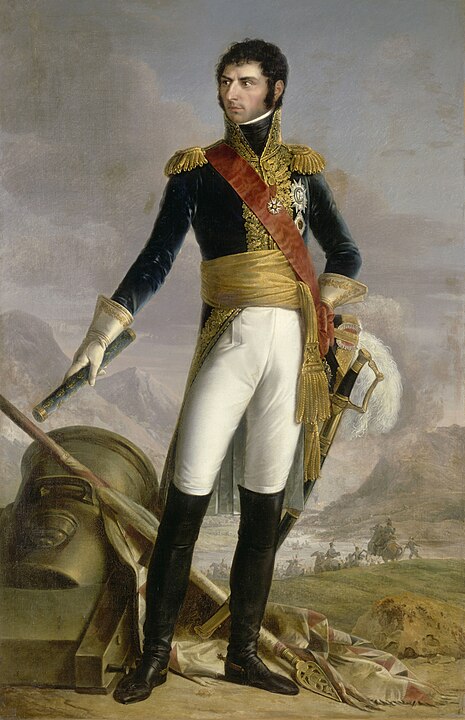
Jean-Baptiste Bernadotte.

In early 1812, many of Bernadotte’s Swedish subjects were eager to join forces with Napoleon, to take revenge after defeats against Russia. Bernadotte, however, anticipated that the French invasion would fail, and convinced the Swedes to stay neutral. When Napoleon had crossed the Niemen, Bernadotte allied with Tsar Alexander, and the two invited Britain to join the alliance.

By 1813, Napoleon had been driven out of Russia, and Swedish troops were shipped over to the Continent to re-conquer Pomerania. Davout was in charge of 30,000 French and 10,000 Danish troops in Northern Germany, and when Napoleon counter-attacked and won the battles of Lützen and Bautzen, Davout drove the Allies out of Hamburg before an armistice was concluded.

When the armistice ran out, Davout attacked eastwards from Hamburg against Bernadotte’s right flank. At the same time, Oudinot attacked Bernadotte from the south, while Girard attacked from the southwest. At the battles of Großbeeren and Hagelberg, Bernadotte defeated Oudinot and Girard, before his troops drove back Davout’s Franco-Danish advance force at Retschow on 28 August 1813.

For fear of being outflanked, Davout retreated west and took up a position along the Stecknitz River between Hamburg and Lübeck. Bernadotte continued south but returned to take on Davout once Napoleon had been defeated at Leipzig.

Davout and Bernadotte were well aware of each other’s military competence and apparently realised that a major clash would lead to considerable losses. Bernadotte, therefore, considered offering Davout free return to France but desisted when the British protested loudly. Instead, the Swedes prepared for ‘hot battles with the brave French.’ Davout, however, had an equal amount of respect for Bernadotte. When superior allied forces appeared along the Stecknitz, Davout pulled back his French forces to Hamburg without a fight, leaving the Danish in the lurch.

The Franco-Danish forces had been outnumbered as well as out-manoeuvred, and while Bernadotte defeated the Danes and eventually took possession of Norway, Davout was surrounded in Hamburg. He once again proved his loyalty to Napoleon and did not leave the city until 28 May 1814, long after Napoleon had abdicated and Louis XVIII had returned to France.

You can register interest in The Northern Coalition against Napoleon: The Campaigns of Bernadotte, Britain and the Swedes 1810-1815 here.

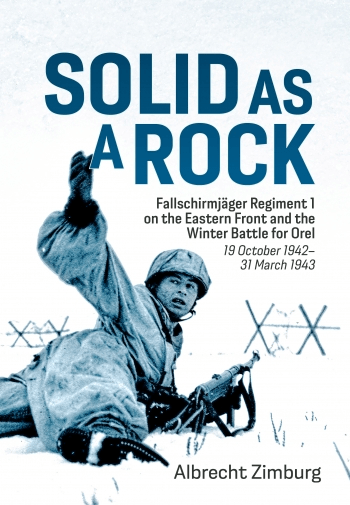
From Genealogy to Paratroopers on the Eastern Front

By Albrecht Zimburg

My main hobby is genealogy. I collect details of my ancestor’s biographies such as dates of birth, professions, living conditions etc. However, as most of my ancestors, especially on my father’s side, were in the military, I inevitably became involved in military history. What helped me to understand military matters was the fact that I was trained as a military officer myself.

While researching in the Austrian State Archives, I came across a manuscript written by an Austrian general who had fought in the Revolutionary and Napoleonic Wars from beginning to end (1792-1815) and had even risen to become the Austrian Chief of Staff. The publication of this autobiography in 2008 was my first book project. It opens a window to another time for the reader. It also showed me that in many ways the Austrian soul has not changed much since then.

My second book project was to publish my father’s war memoirs. He was a paratrooper in the Fallschirmjäger Regiment 1 and rose from an ordinary soldier to Lieutenant. His memories were written down by his father, during or shortly after the war, but without context. In addition, place names were misspelled, and details and recollections were given that could not possibly be verified in the available literature. Furthermore, much of the primary source material on the paratroopers was destroyed in the final months of the war in 1945.

Unearthing archival materials

Fortunately, the Bund Deutscher Fallschirmjäger (Association of German Paratroopers) gave me unrestricted access to their archives. I was lucky enough to find what I was looking for! There was also a lot of useful but hard-to-find material in the files of the various higher commands available in the German Federal Archives. The German military bureaucracy worked perfectly for a long time. It’s incredible how much paper was produced!

I was delighted to receive positive feedback on my second book, including a phone call from a retired police general who wanted to express his enthusiasm in person. Of course, every author is pleased to hear this, but as a mountaineer I know that once you reach the top, behind there is always a higher peak to climb. I must add, however, that these two books have only been published in German.

The paratroopers in the Winter of 1942-43

I had now built up a comprehensive knowledge, in particular, of the Fallschirmjäger Regiment 1 on the Eastern Front in the winter of 1942-43, its longest deployment to date. Works on the German paratroopers report in great detail on the parachute missions at the beginning of the war, such as Eben Emael or Crete, or the fighting at Monte Cassino, but this mission is either completely ignored or only touched upon.

As there is no satisfactory publication on this deployment, I decided to share my knowledge and write this book.

In the Association’s archive I also found a number of personal recollections and little-known articles that I was able to include as it was important to me to present the soldier’s point of view.

The paratroopers, used here as pure infantry, had to endure hardships and battles which ultimately formed the basis for the exceptional defensive capabilities of the 1. Fallschirmjäger Division in Italy. The paratroopers were primarily an offensive weapon and the new divisional commander Major General Heidrich, who had been an instructor at an infantry school during the inter-war period, recognised that there were major defence deficiencies. So he made it a point to train and drill his troops accordingly.

For most of the division, the winter was relatively quiet – probably the main reason why it has not received much attention in the literature. The situation was quite different for the Fallschirmjäger Regiment 1. After the fall of Stalingrad the 2. Panzer Armee desperately needed reinforcements to stabilise the collapsing front, which they eventually did, forming the northern part of the Kursk Bulge. Fallschirmjäger Regiment 1 was part of this reinforcement. My book describes, as far as the sources allowed, the small actions, reconnaissance patrols, raids and assaults north of Smolensk, as well as the fierce fighting south of Orel. In particular, there is very little literature on the fighting of the 2. Panzer Armee, but there is a great deal of surviving archive material.

A special event, which is described in detail, is the deployment of the III. Battalion of the Fallschirmjäger Regiment 1 in Velikiye Luki in January 1943.

I became familiar with the Soviet side through the works of David Glantz, whose books ‘After Stalingrad’ and ‘Operation Mars – Zhukov’s Greatest Defeat’ provided an important basis for a full understanding of these battles. I hope that, although the book is written largely from the German point of view, I have succeeded in conveying this overall picture. I also hope that I have succeeded in correcting, or at least putting into perspective, some of the myths that have arisen on the German side.

Another strong point of my book are the maps and sketches included to support my narrative. All have been drawn by me from original material.

A special feature of this book is the number of paratrooper casualties, which has never before been available in this form. Getting accurate figures was a particular challenge, as the various documents mostly mention enemy losses. I had to extract all the wounded, killed and missing from the casualty lists. Using publicly available databases, I was able to cross-reference the data and establish whether any of the wounded had later died of their wounds. I had to take each of the 1,444 dead, wounded and missing ‘in hand’ and research what had happened to them.

Solid as a Rock: Fallschirmjäger Regiment 1 on the Eastern Front and the Winter Battle for Orel (19 October 1942-31 March 1943) is now available to buy here.

The Best Army in Europe: The war record of the Prussian army in 1792-5

By Garry Wills

Introduction

At the battle or ‘cannonade’ of Valmy (20 September 1792), 156 miles into France from the Rhine, the  French Armée du Centre, commanded by Kellermann, and the Armée du Nord, commanded by Dumouriez, faced the Duke of Brunswick’s Prussian Army. When the French stood their ground, the Duke of Brunswick retired back to the Rhine. The casualties were light, the French lost 300 men of the 32,000 engaged, and the Prussians suffered 180 casualties out of 34,000. The poet Goethe, who was present at the action, afterwards wrote ‘here and today, a new epoch in the history of the world has begun’. In this new epoch the Prussian army was soon to be dismissed as an outdated relic of the age of Frederick the Great. This view was only reinforced in 1806 when Napoleon’s Grande Armée swept away the successors of the Prussian army of the War of the First Coalition, killing the Duke of Brunswick in the process.

However, at the outbreak of the War of the First Coalition, the Prussian army was a highly respected force across Europe, its reputation had been further enhanced by its invasion of the United Provinces in September and October 1787, in support of the Stadtholder, who was facing the Patriot revolt. The invasion by 25,000 men under the Duke of Brunswick was smoothly executed, and Utrecht and Amsterdam occupied without significant resistance and order soon restored. Similarly, the army’s rapid mobilisation to the border with Poland in 1789, placed Prussia in a strong position relative to both Russia and Austria when it came to the dismemberment of Poland in 1793 and another counterinsurgency operation was undertaken to suppress the Poles.

Indeed, Valmy while highly significant, was not representative of the overall performance of the Prussian Army during the War of the First Coalition. In his Data Book,  Smith lists 22 actions fought by the Prussians against the French in 1792–1795, of which 12 involved more than 20,000 combatants and 10 were smaller actions.

Actions involving more than 20,000 combatants’:[1]

WhereDate#Prussians#French#AustriansResult
Longwy*23/8/92  23,0002,60013,731Victory
Verdun*2/9/9223,0004,1280Victory
Valmy  20/9/9236,00052,0000Defeat
Raismes08/05/9311,00030,00060,000[2]Victory
Mainz*10/04–23/07/9315,000?23,00021,850Victory
Pirmasens14/09/938,00012,0000Victory
Biesingen17/11/9313,000[3]20,0000Victory
Kaiserslautern  28–30/11/93  26,000134,0000Victory
Weissenburg Lines6/12/93–9/02/94  ~5,00035,00033,000[4]Defeat
Schifferstadt  23/05/94  30,000[5]20,000?Defeat
Kaiserslautern  23/05/94  46,00015,0000Victory
Kaiserslautern17–20/09/948,500?16,0006,000[6]?Victory

Actions involving less than 20,000 combatants:[7]

WhereDate#Prussians#French#AustriansResult
Sierck les Baines19/08/92850??0Victory
Fontoy23/08/92>6006000Victory
Montcheutin [8]15/09/922,6006,0000Victory
Limburg10/11/921,2001-2,0000Defeat
Weiler27/03/933,000[9]4,2000Defeat
Alsheim30/03/934,00024,6000Victory
Kettricherhof20/08/931,9003,2000Victory
Bitsch17/11/931,2007390Defeat
Landau*20/8–23/12/93~13,0003,8000Defeat
Schänzel12–13/07/946,0009,0000Defeat

Thus of the 12 larger actions the Prussians were victorious in nine, while in the 10 smaller actions they were victorious in five.

These results can be compared to similar numbers for the French army throughout the War of the First Coalition. In this period the armies of France fought 144 battles of more than 20,000 combatants, winning 75 and losing 69. They also fought another 139 lesser actions winning 67 and losing 72. On this simple analysis the Prussians, with an overall ‘win rate’ of 63%,  were at least as successful as their French opponents at 50%. Even ignoring the extreme actions where the French were outnumbered by their Prussian opponents by more than 2:1 (usually the sieges marked (*)), the Prussian ‘win rate’ is still 63% for larger actions and 59% overall.

The Duke of Brunswick

The Prussian army had thus shown that it could face the challenge of the French republican armies on their own terms. In agreeing the 1795 Peace of Basel and withdrawing from the First Coalition, King Frederick William II was not recognising the inferiority of his army in the Rhineland, instead he was choosing an independent course, focussed on Poland, rather than accepting British subsidies with the attendant requirement to serve British strategic schemes.

As a footnote to this story it is also worth highlighting that, at the time of the War of the First Coalition, Karl Wilhem Ferdinand, Duke of Brunswick (1735–1806) was widely regarded as the foremost general in Europe. He began his career in 1757 and after serving under Frederick the Great was ultimately appointed a field marshal in the Prussian Army. A good indication of his reputation is that the Duke of Brunswick was considered both for the command of French armies in 1792 and for the position of supreme commander of the Allied Forces in Flanders in 1794,  towards the end of the Duke of York’s period in command of the British forces.[10]

Wargaming

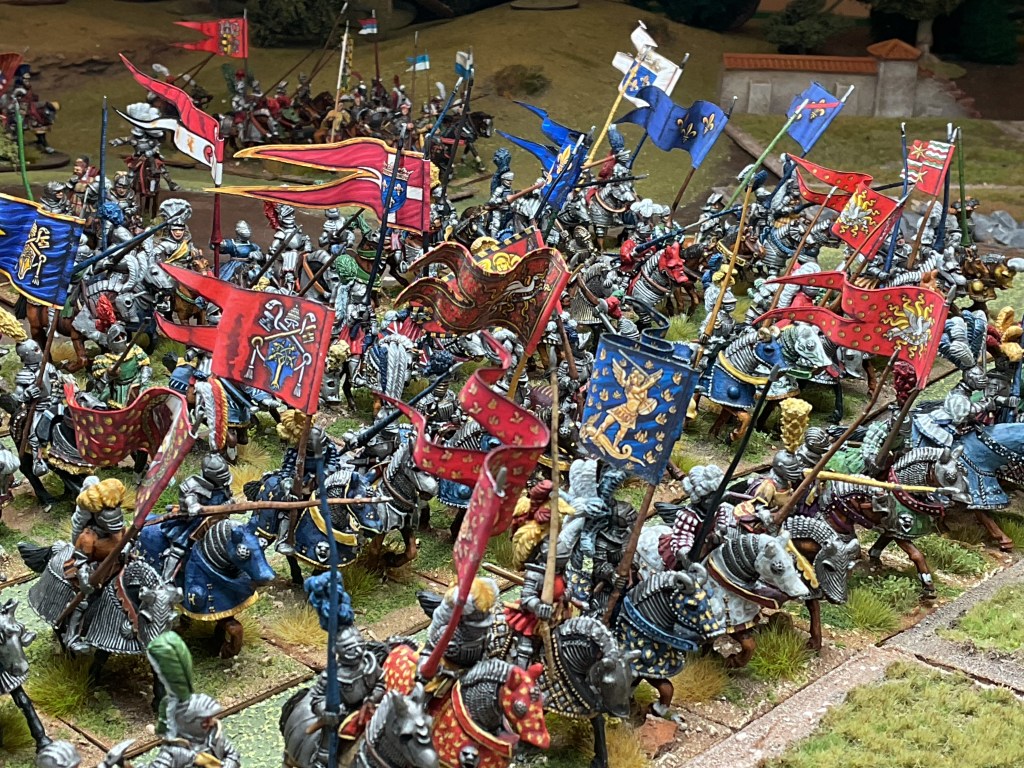
The performance of the Prussian Army makes it a prime candidate for wargamers interested in the War of the First Coalition as it is certain to give the French Republicans a good game. Several of the battles or combats detailed above offer potential scenarios for interesting gaming with the Prussian army on the wargames table. Each scenario will offer the challenge of dealing with two armies of differing organisations and increasingly different ways of war. In Throwing Thunderbolts the scenario for the Prussian army is Pirmasens in September 1793. In this action René Moreaux led the Corps des Vosges in an attempted surprise attack on the significantly outnumbered corps of the Duke of Brunswick in the garrison town of Pirmasens. The Duke smartly repositioned his army to face the threat from an unexpected direction and routed Moreaux’s corps, despite being outnumbered by 50%. My game of this scenario will be on display at both Salute 2025 (London) and Partizan 2025 (Newark, UK).

For more information on my games see my Youtube channel at @garrywillswargamerauthor or on my website www.caseshotpublishing.com. My book Throwing Thunderbolts: A Wargamer’s Guide to the War of the First Coalition, 1792–7 is available here.

[1] Digby Smih, Greenhill Napoleonic Wars Data Book (London, Greenhill Books, 1998), pp.24–7, 45, 49–50, 56, 62–3, 65–6, 80–1,92.

[2] Includes some Saxon allies

[3] Including small numbers of Austrian grenadiers and Bavarians

[4] Includes a small number of British and Dutch

[5] Including some Bavarians and Hessians

[6] Including some Hessians

[7] Smith, Data Book, pp.24–6, 32–3, 45, 52, 61–2, 65, 87.

[8] Involved 5 battalions of the old Royal Army

[9] included a small number of hessians

[10] Alfred Burne, The Noble Duke of York (London, Staples Press, 1949), p.188; Philip Haythornthwaite, Who was who in the Napoleonic Wars (London: Arms &Armour Press, 1998) pp.48–9.

The Elite Guards Division: Culture, Camaraderie, and Challenges (1915–17)

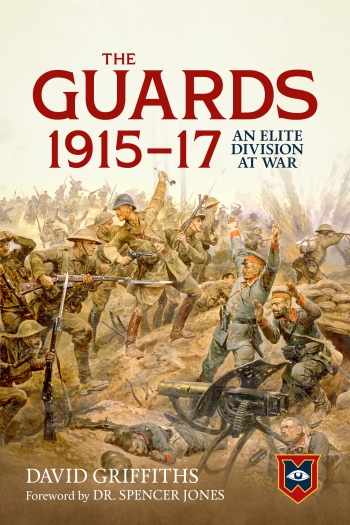
The Guards Division of the British Expeditionary Force (BEF) during the First World War represented a unique fusion of elite training, aristocratic leadership, and battlefield determination. Its story from 1915 to 1917 offers a compelling lens through which to examine the evolution of military strategy, discipline, and the challenges of maintaining cohesion in the face of devastating warfare. David Griffiths’ latest release The Guards 1915-17: An Elite Division at War is the first history of this illustrious division during these years to have been written since 1924.
Formation and Culture of Excellence

Established in August 1915 under the leadership of Earl Cavan, the Guards Division was not merely a conglomerate of regiments but an embodiment of the British Army’s highest standards. Unlike other divisions, its officer class was drawn predominantly from the British aristocracy, ensuring a unique social exclusivity and a strong esprit de corps. As historian David Griffiths notes, the division’s culture revolved around “the Guards way of doing things,” emphasizing discipline, smartness, and the rigorous upholding of traditions.

This commitment to excellence extended to its soldiers, who underwent relentless training to meet the exacting standards of the Guards. The regiments within the division—Grenadier Guards, Coldstream Guards, Scots Guards, Irish Guards, and Welsh Guards—were meticulously prepared, blending battle-hardened veterans with rigorously trained recruits. The camaraderie and psychological cohesion that developed became a critical factor in their battlefield resilience.

Battlefield Adaptations and Challenges

The division’s early engagements, such as the Battle of Loos (1915), exposed the steep learning curve faced by even the most elite troops. Despite their high standards, the Guards Division grappled with challenges beyond their control, including insufficient coordination, evolving military tactics, and the sheer brutality of trench warfare. These battles underscored the need for combined arms operations and highlighted the cost of incomplete strategic planning.

By 1917, during the meticulously planned attack at Pilckem Ridge (part of the Third Battle of Ypres), the division demonstrated how far it had come. The success of this operation was a testament to the Guards’ ability to adapt, leveraging their cohesion and discipline in a war that demanded innovation as much as bravery. However, the path to mastery was paved with losses, as the division suffered heavily in earlier battles such as Flers-Courcelette and Morval on the Somme in 1916.

Legacy and Lessons

The Guards Division’s journey during these years reveals not only its strengths but also the vulnerabilities of even the most elite formations in modern warfare. While its cohesion and high morale often compensated for strategic and logistical shortcomings, the First World War demanded constant adaptation to a rapidly changing battlefield.

This narrative reminds military historians and strategists of the enduring importance of unity, culture, and leadership in forging effective combat forces. For scholars of the First World War, the Guards Division serves as a case study in balancing tradition with innovation under the harshest conditions.

In a conflict that fundamentally reshaped modern warfare, the Guards Division maintained its reputation as an elite force while embodying the broader transformation of the BEF. Its story, as captured by David Griffiths, is not only a testament to military excellence but also a reflection of the human cost and complexity of war.