
It’s the Middle Ages but Not as You Imagine Them
By Michael Fredholm von Essen
Merchants played a powerful role in the Baltic region, as well as on the Continent. Most powerful was the Hanseatic League, which was a multinational business concern divided into three subsidiaries, each known as a Drittel (‘Third’). These were the Wendish-Saxon Drittel, under Lübeck; the Gotland-Livonian Drittel, under Visby; and the Westphalian-Prussian Drittel, under Dortmund. From an economic perspective, no Scandinavian king could compete with the wealthy Hanseatic League, which produced revenue streams that northern kings only could dream of. Then, as now, money was a key source of conflict. In Scandinavia and the Baltic region, trade decided the fortune of kingdoms.

The Nordic Middle Ages were different. Yes, you will find the expected kings, barons, knights, and crusaders, and chivalric tournaments were popular, but Scandinavia and the Baltic Sea region contained so much more. Piracy, for one thing. The Baltic Sea was at times controlled by a confederation of pirates, known as the Victual Brothers, which were led by their own ‘king’ of the Baltic. Their fleets might consist of up to 100 ships and 2,000 men. When the pirates accepted mercenary service, they received knightly rates, significantly higher than those of other mercenary companies. In the fifteenth century, the Victual Brothers extended their zone of operations to the waters of the North Sea, Iceland, and Greenland, which still hosted thousands of Nordic settlers who collected provisions and hunted on the North American coast.
When Charles, the editor of Helion’s new series A Time of Knights, asked me to contribute a book on the Battle of Visby 1361, I immediately accepted. Visby was, and is, the only urban centre on the island of Gotland, the largest island in the Baltic Sea and, incidentally, the one on which I grew up. Legends and stories of the battle remain common on Gotland, and for more than a century, battlefield archaeology has given us an increasingly better understanding of the event. The Battle of Visby was the culmination of a major campaign, in which a professional Danish invasion army confronted the militia of the Gotland Republic. The battle had all that Charles expected from the new book series, including predatory kings, battle-hardened knights, rambunctious mercenaries eager for coin, pious but learned churchmen, a confirmed saint, rumours of witches, and the walls and towers of a proud city – but also wealthy merchants with gold and silver that might make any king jealous.

Visby was a Hanseatic city. The wealth of the Hanseatic League primarily came from two sources. From around 1200 onwards, the League’s greatest revenue stream derived from the world’s then most important fish market, the annual Scanian herring market. It was held in autumn from St. Bartholomew’s Day to St. Dionysius the Areopagite’s Day on the shore between the two small Scanian castle towns of Skanör and Falsterbo. When the herring market approached, fishermen would arrive from near and afar to erect huts, trading booths, and temporary shops close to the area where the herring was spawning. When this seasonal event took place, it was said that herring was so abundant that one could scoop up the fish with one’s hands. There is evidence that commercial fishing of herring in the region took place already around the year 800 AD.

The demand for fish was huge in western and central Europe. Following the very nearly universal acceptance there of Catholic Christianity, the Church was able strictly to forbid the eating of meat on Fridays and during Lent, the 40-day fast from Ash Wednesday to Easter. But fish was permitted nourishment, and none was more easily available than Baltic herring. Herring had a high fat content, which also made it an inexpensive source of protein during winter. Moreover, merchants had found that it was possible to conserve fish by salting. This discovery, apparently made in the twelfth century, enabled the export of herring in barrels as far afield as to France, Spain, and Italy.

But originally of even greater importance was the Eastern trade, which followed the route from the Baltic through Novgorod and Kiev to the Crimea and Constantinople. The mother trade of the Baltic, it was first dominated not by the cities of the League but the independent merchant-farmers of the Gotland Republic. The Eastern trade, which emerged already in the first centuries AD, was the foundation for Gotland’s wealth and importance. It made the Gotlanders northern Europe’s leading merchants and brought huge volumes of gold and silver to the island. The Gotlanders brought furs and wax from Novgorod and the East to Germany, Flanders, England, and elsewhere in the west. Furs were an important luxury product, while wax was of extraordinary importance since all churches for religious reasons needed constant supplies of wax candles. In return, the Gotlanders exported weapons and other goods to the East. They also traded in iron, copper, fish, timber, whale-oil, and other necessities for European lands. England, for instance, imported both wooden staves for longbows and essentials for shipbuilding such as tar, pitch, hemp, flax, and especially timber from the Baltic region. Without the Eastern trade, England would have had far fewer of the longbows and warships that in time came to symbolise English growing military and naval power.

In 1361, King Valdemar of Denmark coveted Gotland’s wealth. Meanwhile, Gotland suffered from tensions over trading rights between the traditional rural merchant-farmers, the Gotlanders, and the Visby burghers, many of whom were of German origin, of the Hanseatic League. When King Valdemar landed on the island with Danish knights on horseback and experienced German mercenaries on foot, his chief adversary was the Gotland Republic’s well-armed rural militia. While many merchant-farmers had the means to raise armed men, the militia was untrained. Defeated twice, the Gotlanders withdrew to Visby, expecting the city’s burgher militia and mercenaries to join them against the invaders. Would the Visby burghers join the Gotlanders in the battle against the Danes?
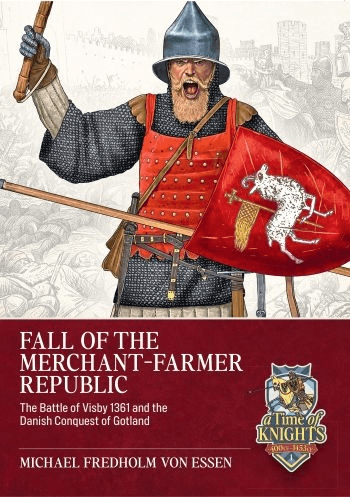
You can purchase Fall of the Merchant-Farmer Republic: The Battle of Visby 1361 and the Danish Conquest of Gotland here.













 The Helion & Co. Military Book Blog