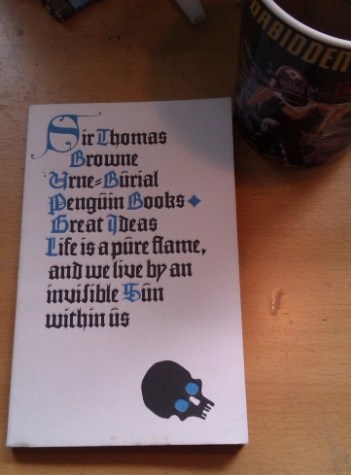
When you study the funerary practices of Anglo-Saxon England, sooner or later you’re going to come across Sir Thomas Browne. This is weird because, although Thomas Browne wrote about the funerary practices of the early English, he didn’t know shit about them. His work on the subject, Hydriotaphia, or Urne-Buriall, is really just (I say “just”) about memory and mortality, together with an overview of the burial customs of what I do not feel unjustified in calling “the ancients”.
Now, the photo above is of my copy of this book in the Penguin Great Ideas series, but that is not where I first read it — that was in a much older version, which made the crucial point of including the “Epistle to the Reader” that goes with this. I say crucial because it is the Epistle ( you can read it here) which includes this utterly fascinating quote:
When the bones of King Arthur were digged up, the old Race might think, they beheld therein some Originals of themselves; Unto these of our Urnes none here can pretend relation, and can only behold the Reliques of those persons, who in their life giving the Laws unto their predecessors, after long obscurity, now lye at their mercies. But remembring the early civility they brought upon these Countreys, and forgetting long passed mischiefs; We mercifully preserve their bones, and pisse not upon their ashes.
Now, when reading this, you’ll be bumbling along, thinking “silly old Browne thinks the ashes in the urns are Roman rather than Anglo-Saxon so he thinks that they’re not his ancestors, unlike King Arthur, whereas actually he’s probably more closely — wait, what?!“
Pisse upon … what?
“Pisse not upon their ashes” is one of those “don’t do it” phrases that isn’t at all comforting. It’s like if you were sitting next to a guy on a bus and he turned to you and just slowly said “don’t worry. I’m not gonna eat your eyes.” Well, I wasn’t worried until just now. Did Thomas Browne know a lot of people whose first thought when they saw a funerary urn was “yep, I bet a smart fella could pee on that”?
Well, possibly.
(I could swear I’ve written this all somewhere before. It’s not unlikely; I do love Thomas Browne.)
Anyway, as you may know, my PhD thesis was about something called charcoal burial, which is where you get a body laid on a thick layer of charcoal. You also find burials lined with ash in the middle ages. Now, it may be that these are symbols of penitence — St Martin was big on lying on a bed of ashes, for instance — but it may also be that it has a hygienic purpose, with the idea of the ashes or charcoal being to absorb fluids from a decomposing body and keep the grave clean. Late Anglo-Saxon culture was very big on keeping everything clean, clean, clean.
So could it be that what Thomas Browne is saying is that an urn full of ashes looks like a chamber pot to him? I mean, it would make sense to line the interior of a chamber pot with a layer of some kind of absorbent (technically adsorbent, and you can thank that PhD for my knowing that fact) material like ash? Like a cat’s litter box, in fact. In a lot of ways, it seems like it would be a good idea.
The problem is that we know, for instance, that chamber pots sometimes had the faces of politicians people didn’t like, or Napoleon or whoever, on the inside (those are later than Browne, but I imagine the tech remained pretty unchanged). Here, for instance, is one with Captain Basil Hall, the guy who pissed off (hah!) 19th-century Americans by writing a rude book about their country (I imagine Isabella Bird was aware of this). Here is a slightly weirder one: “congratulations! I sent you a chamber pot with a picture of a little man who looks up at your genitals!”
Additionally, I can’t, in my admittedly unscientific quick search, find any reference to the practice of ashes being put in chamber pots, except for a little one here. And yes, I love the fact that there exists not only a chamber pot glossary but a chamber pot glossary so huge it has to be broken down into individual letters.
I’m not sure that means there weren’t ashes in what was known as “the article.” There may have been. If there isn’t, we’re back to square one with Thomas Browne, Pee Weirdo.
Pee Weirdo or not, Thomas Browne wrote some amazing sentences. Every time I hear someone writing something that’s supposed to sound old-timey, going all theesy-thousy and coming out sounding like The Mighty Thor, Thomas Browne leaps into my head and gives them a kick in the area. Observe:
To be knav’d out of our graves, to have our sculs made drinking-bowls, and our bones turned into Pipes, to delight and sport our Enemies, are Tragicall abominations, escaped in burning Burials.
Personally, I think modern funeral directors should play that point up more: if you get cremated, your enemies will never turn your bones into a flute!
Although their bulk be disproportionable to their weight, when the heavy principle of Salt is fired out, and the Earth almost only remaineth; Observable in sallow, which makes more Ashes than Oake; and discovers the common fraud of selling Ashes by measure, and not by ponderation.
Some bones make best Skeletons, some bodies quick and speediest ashes: Who would expect a quick flame from Hydropicall Heraclitus?
That’s right, it’s a sly dig at market traders, then an effortless shift into a groan-worthy joke about pre-Socratic philosophy. You can’t fuck with that. Also, this passage sounds best if you put a long pause in before “ponderation,” then hit it with a knowing emphasis.
Right, OK. Hopefully I have convinced you that Thomas Browne is amazing and also maybe that chamber pots were like a kind of human litter tray. My work here is done.


 The Gonzo History Project