
A Washington last will and testament is a legal document comprising the directions of an individual (testator) concerning their assets in the event of death, created in the form prescribed by law.
Making a last will and testament is often a good option for anyone who wants to steer clear of disagreements and confusion. An elaborate and effectively written last will can be important to your loved ones and relations after your death even when you do not have lots of property and assets.
Here, you will find a Washington last will form available in PDF and Word (DOCX) formats. You will also find the details that answer common questions about estate planning, the kinds of last will Washington recognizes, and how to create a valid document.

Build Your Document
Answer a few simple questions to make your document in minutes
Save and Print
Save progress and finish on any device, download and print anytime
Sign and Use
Your valid, lawyer-approved document is ready
The table below summarizes Washington's core will requirements: who may make a will, how many witnesses must sign, and which alternative forms of a will the state recognizes. A testator must be at least 18 years old and of sound mind, and every will must be attested by two or more competent witnesses.[6][1]
Last Updated: September 2026. This guide is reviewed and updated regularly to reflect current Washington law. If you notice an error or outdated information, please contact us.
| Requirements | State laws | |
| Statutes | Chapter 11.12 – Wills | |
| Definitions | Section 11.02.005. Definitions and use of terms. | |
| Signing requirement | Two witnesses | 11.12.020 Requisites of wills—Foreign wills |
| Age of testator | 18 or older | 11.12.010 Who may make a will |
| Interested witnesses | Allowed, but the witness may lose part of their own gift | 11.12.160 Interested witnesses |
| Self-proving wills | Allowed | 11.20.020 Application for probate—Hearing—Order—Proof—Record of testimony—Affidavits of attesting witnesses |
| Handwritten wills | Recognized if meeting certain conditions | 11.12.020 Requisites of wills—Foreign wills |
| Oral wills | Recognized if meeting certain conditions | 11.12.025 Nuncupative wills |
| Holographic wills | Not recognized | 11.12.020 Requisites of wills—Foreign wills |
| Depositing a will | Possible with the clerk of the Washington Superior court | 11.12.265 Filing of original will with court before death of testator |
1. Consider your alternatives. Prior to beginning, it is advisable to determine if you’d like to use the assistance of a legal professional or create the entire document yourself. In the event that you wish to write the last will yourself, choose the type you will go for: a handwritten will or perhaps a free last will and testament form.
2. Indicate your details. Establish the testator and their details: full name and address (city, county, and state). Check the information you entered as well as the remainder of the passage, which includes “Expenses and Taxes.”

3. Specify the executor (or executrix). The next step is to select the executor of your last will and testament, the person liable for ensuring all you write in this document comes true. To achieve that, you have to indicate the executor’s full name, followed by their residential specifics (city, county, and state).
Ensure you choose someone who resides in the same state as you do. If you don’t, there’ll be extra paperwork and hassle, since every state has different rules for out-of-state executors. The primary executor may be unable to serve due to illness, death, or unwillingness, so it is wise to name an additional executor with the same details as the primary one.
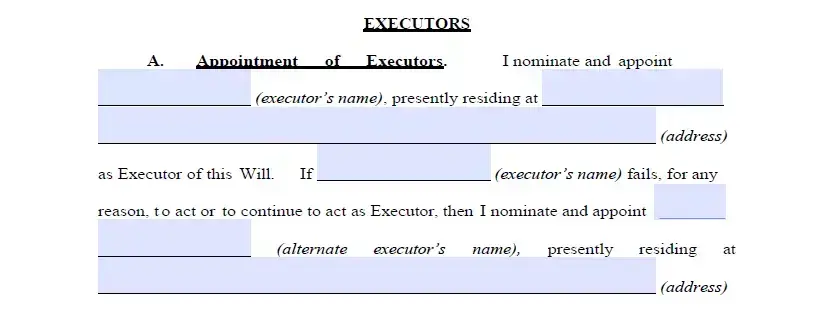
4. Appoint the guardian (optional). If you have underage or dependent children and don’t want the court to pick a guardian for them when you’re no longer here, it is possible to appoint someone you know as a guardian for your children.

5. Indicate your beneficiaries. At this stage, you establish those who are going to receive your estate. Enter their full names, places of residence, and your relationship to them (spouse, child, friend).
6. Allocate assets. List your assets and describe how you want to distribute them amongst your inheritors if you have something on your mind other than splitting the estate equally. Property could include:
Please be aware that there are things that cannot be distributed in the last will and testament, for example, life insurance and shared and living will property.

7. Proceed with the witnesses putting the signatures on the document. For a Washington will to be legitimate, it must be signed by two or more competent witnesses who subscribe their own names to it.[1] Washington does not disqualify a witness just because they are also named in your will, but under Wash. Rev. Code 11.12.160 an interested witness can lose part of their own gift unless at least two other witnesses have no interest in the estate.[4]
To avoid that risk, choose witnesses who have no interest in your estate. Consider picking witnesses younger than you so that they’ll be around if the will is contested in court or some other problem arises. After a careful review of every page, you and the two witnesses fill out your full names and addresses and sign the document.


Washington recognizes more than the standard typed and witnessed will. Under Wash. Rev. Code 11.12.420 (Uniform Electronic Wills Act, RCW 11.12.400 through 11.12.491), an electronic will is a will for all purposes of the law of this state.[2] That means a will you create, sign, and store electronically carries the same legal weight as a printed and signed paper will, as long as it meets the state's other signing and witnessing rules.
A valid Washington will must be in writing, signed by the testator, and attested by two or more competent witnesses. The witnesses subscribe their own names to the will, or sign a qualifying affidavit under Wash. Rev. Code 11.20.020(2).[1]
Someone else may sign on the testator's behalf if they do so in the testator's presence, including electronic presence, and at the testator's direction.[1] A will validly executed under the law of the place where it was signed, or the testator's domicile at signing or at death, is also recognized in Washington.[1]
In Washington, it’s not necessary to notarize your last will. But in case you would like to attach a self-proving affidavit to the last will, you must notarize it.[3] If you make your will self-proving, the court won’t need to speak to the witnesses to ascertain the validity of the document, which will expedite the probate.
The testator must fulfill testamentary capacity requirements in order to write and change their last will, including being of sound mind. There are generally two requirements to fulfill: soundness of mind and age. In most states, you’ve got to be over 18 years in order to make a will. Soundness of mind means that you are conscious of your estate as well as the heirs of your possessions and thoroughly understand the aftereffects of your actions.
Under Washington law, you do not need to attach a self-proving affidavit to your last will and testament. Adding one is still worth doing. In the affidavit, you and your witnesses state the same facts you would otherwise have to testify to in court to prove the will.[3] The affidavit must be sworn to before a person authorized to administer oaths, such as a notary public.[3]
If you would like to disinherit your marriage partner, it will most likely be impossible. Washington is a community property state. Each spouse automatically owns one-half of the community property, and when one spouse dies, state law confirms that one-half share to the surviving spouse regardless of what the will says.[5]
In Washington, it’s possible to disinherit your spouse only with regard to your part of the property. Before getting married to someone, you can conclude a prenuptial agreement with that individual. It’ll help you to modify the way in which the marital property ought to be allocated on divorce or your passing. This is perhaps the only way to disinherit your marriage partner or limit her or his share.
For the others, it’s legal in Washington to disinherit family members in your will. Your adult children or other members of the family can be lawfully disinherited totally in your last will and testament. For doing that, include certain sections to your last will and testament.
Yes, it’s possible to change it. In Washington, in case you haven’t engaged in a contract mentioning otherwise, you can repeal or alter your last will at any moment. Moreover, it will be a good idea to revise your last will and testament at the time you go through a major life event such as:
In case the last will is lost or damaged, as indicated by Washington law, the court will admit it. However, the probate court can be unlikely to take anything except for the original of the last will to probate.
As outlined by Washington law, the absence of the will is assumed as its revocation. That suggests that the trustee must provide proof of the last will and testament’s validity, which in turn might be found to be quite complicated.
| Related documents | Times when you may need to make one |
| Codicil | You would like to make a single or several minor alterations to your last will. |
| Self-proving affidavit | You would like the probate to be easier in due time. |
| Living will | You want to be sure that, if you’re incapacitated, you are treated how you’d wish to. |
| Living trust | You need extra safety and privacy when the time to distribute your property comes. |
This page is general information about Washington last wills, not legal advice. For advice on your situation, talk to a Washington attorney.
Unless noted otherwise, the sources below are from the Revised Code of Washington.
