Showing posts with label MIFF. Show all posts

Friday, 12 December 2025

Happy 11th Birthday to and from FILM ALERT 101

Vale David Stratton 1939-2025

Happy Birthday to Film Alert 101. This blog started up in November 2014. Since that time there have been 3177 posts and, allegedly according to the stats kept by the blog itself 2,321,193 page views.
 Over the last twelve months the page views have exceeded 708,000. The highest viewed post over the last 12 months may perhaps be a surprise to many, myself included, but it was signposted as an Open Letter to Bill Mousoulis about Angie Black’s THE FIVE PROVOCATIONS. It was posted way back on 13 September 2018 and I cant really explain why it would continue to be so favoured. If you want to read it  click here  

The highest page views of all time have been recorded for a fiery piece from the late David Stratton who, back in August 2020 took serious exception to MIFF caving in and withdrawing the film THE TROUBLE WITH BEING BORN from its line-up. David’s piece click here  followed an earlier one by Tom Ryan, also in the top ten of all time click here and both of them led to a strong response from critic Karl Quinn which is also in the Top Ten. click here Nothing like a bit of film festival controversy, as I discovered when, way back in 2016, I published what was for a long time the most read post, a piece by Tony Rayns about the state of the Busan Film Festival and the sacking of its then director click here 

Here’s Tony’s final paragraph of that one.

“I had very little first-hand knowledge of the “dark days” under military governments in Korea (my first visit to the country was in 1988, when the worst was over), but I know from Russia, China and Singapore amongst other countries how authoritarian governments work. They don’t believe in debate and don’t tolerate opposing points of view. Their first instinct is not to meet opposition with counter-arguments but to silence it. When Busan Metropolitan City Council tells BIFF not to screen a documentary that’s critical of the government, it’s a textbook example of an attack on free speech and an impulse to silence opposing voices. Apparently Korea’s right-wing politicians haven’t noticed or understood the changes since 1993. Apparently they are nostalgic for the “dark days” of censorship, of silencing dissenting voices and of strict social control. I’ve always thought that Korea has a very bright future, and I’ve said so in public many times, but the pig-headed political tactics of Busan’s city council mark a step back into the past. It makes no sense to me.”


Sentiments that are still relevant all over…


Over the last twelve months the following people were contributors and I thank them all: Janice Tong, Rod Bishop, Bruce Hodsdon, Barrie Pattison, Tom Ryan, David Hare, John Baxter, Joel Archer, Frank Shields, Pat Fiske, Adrian Danks, Michael Organ, Ray Edmondson, James Vaughan, Bruce Beresford, Alena Lodkina, Peter Tammer, John Timlin, Barrett Hodsdon and Zac Tomé.

If you click on any of the names above it will take you through to one of their contributions.

Thursday, 18 January 2024

Defending Cinephilia 2023 (4) - Peter Hourigan raises a few questions about the contribution of SIGHT & SOUND

 Reflections on Cinephilia.


                It’s a nice concept to celebrate – a love of all things cinema. But looking  back at 2023, I’ve found my willingness to get involved in this to be wilting somewhat. I still love the films, but some of the trappings have not engaged my enthusiasm. And it’s not just the films but a lot of those trappings – the way of watching, the venues, the writing about films – that are also part of the experience. And they can have a negative impact on your response to a particular film. Think of watching a dupe copy of a film, in a grungy cinema with inadequate light from its projector!

                That’s why I’m going to dedicate my look back at a year’s Cinephilia to Sight & Sound, which has done a great job of evaporating my enthusiasm for a lot of cinephilia. A key factor was their 10 Best Films poll, results of which were released at the start of the year. I’ve generally enjoyed this . It’s a fun event, a bit of diversion each decade to see what’s gone up in general esteem, what’s dropped down the list, what's disappeared.                 

                 But this year, Sight & Sound has wallowed in overkill. I’m not going to check back, but even before the poll results, they were devoting pages to articles, lists and trivia about the poll, presumably to hype us up in anticipation of the results. 

                   It was an interesting set of results – and I even had a personal frisson in one of my comments being quoted in the article about one film. 

                   But Sight & Sound has not let this idea rest before the next poll for 2033. Again, pages of editorial are still being swallowed up by what ultimately is really trivia, at the expense of more relevant, informative pages. And I am more than bored with mention of the poll. 

                     So, I no longer really look forward in anticipation to the next month’s issue.  But that feeling was aggravated by my worst experience in subscribing to any magazine over many, many years. For much of 2023, it was touch and go as to whether I’d even receive my hard copy of the issue. Several times, when I contacted the subscription managing company for my now overdue issue, I was told that issue was now out of print, but they would extend my subscription.  Big deal. When I’ve faithfully maintained my complete archive of S & S going back about sixty years, that was not much compensation.

                   The last few issues have arrived as expected, and they seem to be coming in new wrappers, so perhaps the delivery issue may have been resolved.  But along with my growing dissatisfaction with the magazine’s contents I am now
questioning whether I want to continue subscribing. 

                    It’s no longer comprehensive in its reviews – and they can’t even arrange them in alphabetical order for ease of consultation. And credits are now even less than adequate. The magazine has suffered the fate of other publications placed at the mercy of designers, so sections are colour-coded but with no thought of whether print on pink paper is easily readable for all eyes. 


The greatest film of all time according to the Sight and Sound 2023 poll
Jeanne Dielman, 23 quai du Commerce, 1080 Bruxelles
(Chantal Akerman, 1976)

                    It is also succumbing to the break-outs on articles, lists of trivia with articles or reviews and then overlong pieces on one film, so they don’t have to cover quite as many films. And then the pages devoted to some reprinted from an issue of thirty, forty or more years ago. Again, less material about current cinema, which used to be the reason for reading S & S. 

                    This curmudgeonly attitude I’ve developed has spread. I couldn’t get motivated this year to do Senses of Cinema’ annual World Poll. Somehow, lists and lists and lists have less appeal. (Though I’m sure there is one person whose list will stand out in boredom again this year as he lists about 250 films he’s seen in the year, usually stuffing it with as many obscure films to show he’s seen things others haven’t. And often, can’t. )

                  End of grump. There were good and satisfying experiences from viewing. Lots of good TV/streaming nowadays.  Perhaps the two that I remember as being particularly enjoyable were Cédric Klapisch’s  Greek Salad  (which sent me down a rabbit revisiting earlier Klapisch movies) and The Gilded Age from script writer Julian Fellowes. 

                    Some travel earlier in the year was the inspiration for several other rabbit holes to explore.  Visiting Cuba had me revisiting a number of the wonderful films especially from the 1960s and 1970s. Memories of Underdevelopment (Tomas Gutierrez Alea) meant even more to me this time around, added to by tracking down a second-hand copy of the 1965 novel by Edmundo Desnoes. Then there was the thrill of coming across the wonderful poster for another seminal Cuban film, I Am Cuba (Mikhail Kalatazov 1964) in a chaotic bookshop in Havana.  It’s now framed and on my wall. 

                  As well, a superb visit to Easter Island sent me searching for what is probably the only feature film filmed on the Island, Rapa-Nui  (Kevin Reynolds, 1994).  It’s not an especially good film, but I loved travelling to the island once again. And it is generally fairly faithful to one of the traditional, historical events in the island’s history. 


About Dry Grasses (Nuri Bilge Ceylan) 

And to finish a few stand-out films from MIFF 2023.  About Dry Grasses (Nuri Bilge Ceylan) was a known master director in top form. A surprise from Serbia was Lost Country (Vladimir Perišić
). The Chilean documentary The Eternal Memory  (Maite Alberdi)¸moved me in its portrait of the end of a long relationship through dementia, and its sense of how much our memory is who we are. I also liked Frederic Wiseman’s A Couple.

Monday, 21 August 2023

Melbourne International Film Festival - Sydney's supercinephile Barrie Pattison ventures south to discover old films by Dario Argento and new films Marco Bellocchio, Catherine Breillat and more.

Editor's Note: The Dario Argento Retrospective reviewed below is also screening weekly on Thursday nights at 7.00 pm at the Randwick Ritz beginning on Thursday 24 August. The Ritz is screening eighteen Argento titles (cf twelve screened at MIFF). Details of the Ritz season, times, dates, bookings etc, which is presented in association with the Italian Institute of Culture, Sydney, may be found IF YOU CLICK HERE

************************

Visiting Melbourne for the first time after the pandemic was revealing, an unwelcome reminder of how far Sydney is falling behind with movies. They still have their Chinatown Twin, ACMI’s pretend Cinémathèque and their IMAX theatre which was playing Oppenheimer in the format said to be unique in the Southern Hemisphere. Not only did they have the venues but an audience which would fill them up. Breaks your heart really.


The incentive was the Melbourne International Film Festival, which had some of the material I’d missed in Sydney and a Dario Argento (above) retrospective.  That one was a reminder of researching “The Seal of Dracula” in the days of Paul Naschy, Hitchcock rip-offs, Phantom of the Paradise and the European Fantastic Film Festivals. 

Time was Argento was my favorite filmmaker. I once found myself with a single night in Paris and three hundred plus films to choose from. Agonising! I was still under the spell of Suspiria, which had revealed Argento as the Federico Fellini of the splatter film and was banned in Australia while the rights were held by an independent distributor. Three weeks after the rights passed to Fox, it would open with a twenty second censor cut.  But that is another story.
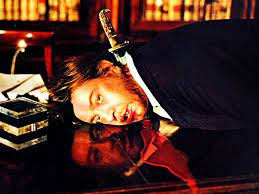
Deep Red

I elected for Argento’s Profondo Rosso/ Deep Red, the film he made before that. Good choice as it turned out, probably his best work - a mix of sensation and style that was right on my wavelength. That and Suspiria were in the MIFF season. Not always easy to find, the director’s other works generally fail to match those peaks but they are all recognisably from the same hands. In addition, the MIFF showings came via the Instituto Italiano di cultura which meant modern restorations - not always a good thing  but no faded, cut and worn film prints, along with original Italian language sound and English subtitles.

The tracks were an interesting study in themselves. On show, Argento’s second film, the 1971  Il gatto a nove code/Cat O' Nine Tails belongs to the hundred percent post synch era of Italian film and is particularly distracting - we open with Sergio Graziani’s Italian-speaking voice issuing from a blue-eyed Karl Malden’s lips. James Franciscus is better voiced by long-time dubbing actor Pino Colizzi. The lack of background ambiance is obvious, with only odd footsteps and vehicles added in. It’s early days for Morricone but his score has to do the heavy lifting.  

Karl Malden, James Franciscus, Cat of Nine Tails

Nine Tails 
was the one that gave Argento his least satisfaction. It opens promisingly with blind man Malden out walking on the street with his young niece Cinzia De Carolis, in front of the suburban Terzi Institute for Biological Intelligence. He overhears a suspicious conversation from a parked car (his enhanced hearing is a plot point) & has the girl describe the men in the vehicle they have just passed.

Being Argento Giallo, there’s a sinister figure break-in at the institute, where they can’t work out what’s been taken, and murders accumulate. Carlo Alighiero, one of their scientists, is shoved off a Metro platform to be cut in half by a train. The police now interview the Institute personnel (suspects!) including Terzi Director Tino Carraro’s glamorous daughter Catharine Spaak, in ridiculous fetishistic outfits. She and Franciscus make out but that doesn’t go well when James becomes suspicious about her reluctance to drink from the tetrahedron milk packs the villain has poisoned with a hypodermic - customary Hitchcock reference. Malden heard Spaak fingering the gold watch chain round her neck and deduces that the incriminating information in her medallion has been missed by the police, before her garrotted body was buried with it in the family vault.

Turns out that what was stolen was a file with the chromosome structure of one of the board, showing the homicidal tendencies the institute is studying cf. the 1952 British The Brain Machine. The charts on the institute walls resemble Malden’s Braille puzzle table - Argento conspicuous decoration like Spaak’s squid pattern wallpaper.  

The murderer abducts Malden’s niece and ties her up in a rat-infested room, so the amateur investigator duo appoint themselves tomb robbers and break into the Terzi mausoleum. We get the already characteristic sequence when Franciscus finds himself locked in with his burglar kit inadequate to secure his escape, till the door opens to show Malden with blood dripping off his white stick, which proves to be a sword cane.

The rooftop chase finale is an anti-climax after this, though hands gripping the lift cables got a great yuk reaction from the audience.

Adriano Celentano, The Five Days

MIFF also aired Argento’s next film Le cinque giornate/The Five Days/The Five Days of Milan declaring it an Australian premiere, which is a bit of a liberty. I saw it several times when it was a staple of the Italian language circuit in the seventies, presumably playing to the immense following of Singer Star TV personality Adriano Celantano. (they say his on-air recommendation was instrumental in returning Berlusconi) He makes an uncharacteristically glum lead here.

A historical spectacle set against the 1848 Milan rising against the Austrian occupation, where Adriano has been jailed. A cannonball breaching the prison wall sets him free. He finds himself partnering with baker Enzo Cerusico in a series of disturbing adventures - conscripted into the dotty, murderous militia, assisting at a child birth and finding that even with the power shift they are still at the bottom of the social order. This was the first time I heard the phrase “Siamo fregata!”

The Five Days is not altogether well served by Argento’s taste for the weird and grisly - a lot of close-up bayonetting and blasting point-blank with early firearms. The final killing of the German, seen only as yellow hair thrown up in slow motion, as he is shot in front of his young mistress, comes with the eerie search of the degenerate’s house by the looting pair, that’s getting closer to Fellini. 

These striking images are coaxed out of a limited budget and there are attempts at
innovation, like playing only the sound of the baby over the cavalry charge. Marilu
Tolo does another of her vigorous, sexy turns here. Dario’s producer dad had set up The Five Days for Nanni Loy, in the wake of his imposing 1962 The Four Days of
Naples
. Apparently unsuccessful, The Five Days was eventually director, the younger Argento’s, one departure from his giallos

The MIFF dozen film line-up also included Argento’s debut The Bird with the Crystal Plumage, his 1971 Four Flies on Grey Velvet with Hollywood starlet Mimsy Farmer become sex sensation after displaying her new nose in Barbet Schroder’s More, 1971’s Deep Red , Suspiria 1977, Tenebrae (1982) offering Anthony Franciosa menaced by straight razors, Phenomena (1985) which puts a teenage Jenifer Connolly in the path of a serial killer, The Black Cat from the two part TV Two Evil Eyes (1990), Opera where Palma’s Phantom allies with killer ravens, a 1998 Phantom of the Opera with Julian Sands having sex with rats. While not complete (none of his imposing pre-director scripts were on show) this selection was extensive enough to confirm the impression of  sex, style and violence which made his work attention getting but finally limited.

Do You Like  Hitchcock?00

One I hadn’t previously been able to see, despite my best efforts and a European retrospective, was Argento’s 2005’s Ti piace Hitchcock?/Do You Like Hitchcock?, the first entry in a TV Hitchcock-themed series. The reduced budget shows mainly in having Elio Germani the only familiar face, in an Argento film without an imported star. The technicians are A-feature guys including musician Pino Donaggio.

Here we get giallo black gloves that don’t leave prints, La finestra di fronte, delito per delito like Strangers on a Train. The Hitchcock citations also run to extreme close-ups - the lift mechanism locking, the close-up of the lit cigarette end, the keys in the tumbler.

In this one, then young Germani is a film student, the sole example in movies who takes notes, even if he uses a wide-screen TV that crops Der Golem. He’s also a voyeur, watching the action in the downstairs flat from his windows. Of course, he sees a murder there.

He falls out with fetching lady friend Cristina Brondo (the one featured female not to go topless in this one) who deserts his bed, with him dumping her effects into the street bin where the bag lady scoops them into her shopping trolley. Elio sets out to investigate. He steals the victim’s bank statement, revealing a million lire inheritance and gets into the crime scene, when the char lady is busy mopping up the blood. Her supervisor buys Elio’s claim to be a reporter (again) and wants to know which paper he’ll be able to read his own name in.

When our hero is left in charge of the neighbourhood video shop, a large poster of Argento’s Il cartaio/The Card Player is prominent. Elio gets into the store computer to find the details of blonde downstairs tenant Chiara Conti, just as she comes in, with some scrambling to clear the screen before she sees her own details there. Her showing interest in her cute neighbor upsets proprietor-admirer Iván Morales.

Determined to penetrate the imbroglio, Germani hops on his moped to follow Conti’s car to work and, using his binoculars, sees her being groped by her bald realtor boss. Here the growing storm sounds are effective, as we get to the Argento set piece. Germani climbs the plants on the building where the lowlife takes the girl and is spotted, falling and injuring his knee. Unchaining the moped, which he has to side saddle,  he flees the vengeful boss through belting rain.

In full Rear Window mode, Brondo comes back to care for Germani, his leg in plaster. Plausibility takes a pounding with an attempt to add two more climaxes - a graphic near drowning and the black hoody he saw through his peephole door re-appearing, putting Brondo in jeopardy. 

It doesn’t really matter who the killer is and the nudity is gratuitous but Argento has clearly hit his stride by this one. MIFF has a history of adventurous Cinémathèque quality retrospectives - Tomu Uchida and Jean Epstein! Add Argento to their welcome break from endless Ozu and Bergman.

Short films, often a strength of these, were disappointing this time out but the event was a chance to pick up on films I’d missed in the Sydney festival.


Intriguingly one (the one?) survivor, from the days of cinema reverence and cult status for the Godards and Bergmans, is Marco Bellocchio (above), who at age eighty-three has offered what may be his best work, the new Rapito/Kidnapped, a film with ferocious anti-Catholicism (compare the director’s 1971 Nel nome del padre) which would have made it unscreenable through a large part of its director’s life - and mine. Bellocchio’s work has not always been readily available, with a wide range of subject matter and style. The films which seem to have proved most acceptable to distribution chains tend to be his intense Italian History pieces like the 2009 Mussolini film Vincere and the 2003 Aldo Moro  Buongiorno, notte/Good Morning Night but those were set closer to our own time.

This one takes place during the unification of  Italy and is played in painting-like compositions of costumed performers in historic settings, filmed without fill light so that the story seems to be engulfed in the shadows of history.

In 1857 Bologna, the constables come for Enea Sala, the six-year-old son of a rich Jewish family, claiming that his secret baptism makes him eternally a Christian, who must be removed from their control. No question of balancing here. The Jews are uniformly noble in bearing the persecutions visited upon them by Catholics, who are uniformly malicious whether through conviction or convenience. “Worse than the Pharoah” the boy’s mother, Barbara Ronchi says of Inquisitor Fabrizio Gifuni.

Young Sala is transferred to the Vatican and the company of a number of other reclaimed children, who coach him into going along with the gag to facilitate his return to his family, though he still repeats the Scherma Israel each night. Paolo Pierobon’s Pope Pius makes a personal project of the boys, while Fausto Russo Alesi the father, always in forced deference, pleads for his release. The mechanics of this campaign generates the film’s suspense and its interest. We wait for the factions invoked to act - the Rothschilds, who hold Vatican debts large enough to destroy the Church, worldwide opinion mobilised by the press to the point of possible intervention. In the face-to-face meeting between Pierobon and Alesi, the Pontiff is enraged that even the Catholic papers have been approached to urge the father’s case.

The boy’s brainwashing proceeds with two vivid lapses. The first, where Ronchi has been granted a visit and her son acts with instructed composure only to rush back to his mother’s arms as the emotion becomes too strong. Approaching the film’s end, the character, now played by Leonardo Maltese, from the Amelio 2022 Il signore delle formiche/Lord of the Ants, is part of the Pope’s funeral cortege on the way to his tomb when the mob surges over them screaming “Throw the pig in the Tiber” a chant into which he finds himself drawn.

These bursts of hysterics are uncharacteristic of the film’s grim, measured content, which includes now trainee priest Maltese called upon to use his tongue to inscribe the sign of the cross on the marble floor three times to atone to Pierobon. We also get the aging Pope’s vision of the newspaper cartoon of Jewish invaders circumcising him come to life and the scene of a wooden Jesus descending from the cross - second time this week - after The New Boy.

With the 1870 loss of the Papal states to Risorgimento troops with feathers in their hats, who break down the walls to rescue Maltese, inquisitor Gifuni is put on trial providing the film’s most intriguing and unique material, as details of the abduction and it’s likely bogus basis are tested in court.

It’s rare to find a film, where issues are central, holding attention so well. Most of the cast have been around for years without drawing our attention, which gives them the double value of experience and a lack of previous associations. They and the technicians are on top of their game. The viewer’s own belief structure is likely to fog any message content but it can’t be a bad thing to put a  work of such intense scrutiny into circulation.


Back again after a decade, L'été dernier/Last Summer looks a vintage offering from Catherine Breillat (above), once poster lady for transgressive film. We get elegant lawyer Léa Drucker briefing a teenage girl rape victim on the rough spots she faces in her legal action. This suggests the creator of 36 Fillette Blue Beard is going to deliver a smart, in character social drama. However before long, we find we’re in for a retread of Phaedra, via a Danish 2019 Trine Dyrholme movie.

We learn about childless Drucker, victim of a youthful misadventure, now in a super respectable marriage with Olivier Rabourdin, that runs to an explicit make-out scene. The pair have adopted two young Asian girls. However, Rabourdin’s teenage son by his first marriage, Samuel Kircher, is already having brushes with the law. A laboured bit of business with the kids’ keychain gift establishes his guilt in a break-in at the family home.

Léa warns him to shape up or else and that goes implausibly well, with Sam swimming with the girls on a picnic and doubling Léa on his motor scooter away from the boring gathering (OK extended traveling shot) to the livelier surroundings of a local boite. It’s not long before the two get into a sustained double close-up lip lock and a bit of “No, we shouldn’t.” They represent the contrast of the Pill Generation and the AIDs Generation. Developments like sister Clotilde Coreau catching the guilty couple or Kircher’s illicit dictaphone recordings, don’t go anywhere interesting.

On his time out together with dad Rabourdin, the kid dobs Léa in and the best the movie can come up with is Léa po faced denying it. They go to court, with her getting the kind of legal bruising that we’ve seen her describe, and paying out big.

The marriage survives and she’s back naked in the sack with Rabourdin, when the doorbell rings and Kircher is downstairs drunk...

Neither the cast or the handling are able to generate conviction and this one has to be rated a disappointment.

Art College 1994 

Jian Lu’s unexpected Chinese feature cartoon Art College 1994 is off-putting at first, with its literal, shading-free visuals and lip-synch characters.  The opening with the cartoon beetle failing to climb a wall suggests an imagery which will only dot the work - a butterfly, an insect on a diner plate, a distant flying crane.  What this one foregrounds is student characters lost in the familiar confusion of demanding what is art - Marcel Duchamp’s urinal, Andy Warhol, is the moon more beautiful than a board? One dissatisfied boy burns his drawings to be copied by another hailing it as an aesthetic statement. “Is it art because I say so?”  - all here amplified by China’s uneasy entry into the Market Economy, which introduces engulfing Western ideas, in streets dotted with Golden Arches and Superman the Movie posters. Their traditional painting instructor in a Mao Jacket promotes their Asian heritage and the bridge of Light still rates a visit. 
.
We start off with boys with haircuts done by their chums, from the dorms where the walls are decorated with posters of Rambo and The Chairman.  A pair are facing discipline for having roughed up one of their fellows, who disfigured their work. They discuss what to do with a Tracy Ermin exhibit, where only the bed can be recycled. A warden tells them not to sit on the art. One student doesn’t want to create, planning on becoming an entrepreneur. Somewhere in there, we get the killer Picasso quote “A good artist borrows from other artists. A great artist steals from other artists.” 

The leads become involved with the two girl music students, whose ambition is to give a concert together. There is a surprisingly relatable scene where they mimic the voice delivery of old dubbed Chinese movies. The glamorous one will quit to become a club singer while her plain friend’s mother has set up a meeting with the tailored student from an Ivy League university, where he studies French. He invites them all to dinner and the boys hog themselves at the buffet, in surroundings that contrast with their own grubby building, with its bunk beds and pink-painted steel window frames. 

I couldn’t help thinking about the presentations I used to do with the murky nineties Russian Agfacolor School for Beauty Appreciation two-reeler touting the slab concrete building with steel pipe chairs as surroundings from which we were told works of great artistry could only emerge.

It is remarkable that the crudely drawn characters lost in unexceptional lives become so involving. They have been voiced by home territory celebrities whose names don’t register here. Finally relating the subsequent lives, American Graffiti style, over snaps, given life by animating their still photo texture, is extraordinarily moving. I rate the film as the best I’ve seen from China since the second Wolf Warrior - maybe before. It has yet to open in its intended market.


Monday, 16 August 2021

Melbourne International Film Festival (7) - Peter Hourigan reports from the couch not the foyer on MR BACHMAN AND HIS CLASS (Maria Speth, Germany) and THIS RAIN WILL NEVER STOP (Alina Gorlova, Ukraine)

Mr Bachman and His Class

A Film Festival streaming online during a lockdown is just not the same. No coffee and conversation in the foyer, excited discussion after a good film, no long queues in the cold to get into the cinema. But at least Melbourne has gone ahead, and there are ways to alleviate at least some of the loss. A small group have got together a protocol for sharing our comments on what we’ve seen each day, and that has been great for getting feedback, and being alerted to films you may have easily overlooked.  

At a little over half-way through our group started sharing our top picks so far. My top three are Mr Bachman and His Class, Notturno and  This Rain Will Never Stop.   Tom Ryan has already written in praise of Gianfranco Rosi’s Notturno Click here to read

I started my Festival with Mr. Bachman and His Class, from German documentary filmmaker Maria Speth. I think I started with this, because it would get the longest film on the schedule out of the way. But watching it felt like watching one of the shortest films. Of course, as a retired teacher this was a bit of a busman’s holiday for me. The film follows Mr Bachman for about a year, in what we eventually learn is to be his last year before retirement.

Some commentators compare it to Frederick Wiseman’s work, but I’m sure they are really only focusing  on the length. Wiseman generally interrogates an institution, rather than a particular person. A better comparison is Nicolas Philibert’s To Be and To Have (2002) where we watched a particular teacher with a particular class (Primary level) in a specific school in France over a period of time.

Mr. Bachman is teaching older secondary school pupils in a school in Germany’s industrial Ruhr region. Speth clearly has a rapport with her subject, just as he has a rapport with his students. Several times we get shots of the classroom, where mike booms are visible, suggesting this was a long term set up where teacher and students reached a point where the film crew became invisible.  And multiple camera viewpoints make it clear that this was not filmed by a single cameraman with a single camera.

But the result is a wonderful insight into how a good teacher operates, and the value for such a teacher having such a warm, and caring, and trusted relationship with his students.  There were times I found myself laughing out loud, others when I was, well, a little bit teary.

Available to view online till Sunday Click here to book 


This Rain Will Never Stop

THIS RAIN WILL NEVER STOP can also be called a documentary, for want of a more accurate word. Andriy,  young Syrian refugee in the Ukraine is the main protagonist in this film made by Alina Gorlova. He is working as a Red Cross volunteer helping other refugees. We also meet his family, particularly his father. But this much more than just one person’s story. In fact, we’re probably about twenty minutes into the film before we really see Andriy as a person of interest.

The screen is often filled with ravishingly beautiful black and white images of often appalling scenes. Long queues of refugees waiting for rations in a mud-soaked camp. Gaunt trees against a white sky. Building destroyed. We slowly meet other members of Andriy’s family, including an uncle who has made it to Germany. A happy wedding there seems such a contrast to Andriy’s life.

We are left to put these fragments together, and we feel part of this life where fate doesn’t really let you take control of your life. Filming clearly took place over a long enough period that the director could not have foreseen what would happen within the family. The restraint in the way these moments are handled adds to the pathos of the film.


Available to view online till Sunday Click here to Book

Thursday, 12 August 2021

Melbourne International Film Festival (5) - Tom Ryan recommends SUN CHILDREN (Majid Majidi, Iran, 2020, 99 minutes)

Roohollah Zamani, Sun Children

Sun Children 
and the Contemporary Iranian Cinema

At the age of 62 and after 40 years in the filmmaking business, including a dozen features, Iranian writer-director Majid Majidi (b. 1959) can aptly be described as an industry veteran. However, that means something different in Iran from what it might mean in Europe, the UK, the US, and beyond. Or even elsewhere in the Middle East. 


Against the odds, since the 1970s, filmmakers such as Abbas Kiarostami (1940 – 2016), Darius Mehrjui (b. 1939), Mohsen Makhmalbaf (b. 1957), Bahram Beizai (b. 1938), Farhad Mehranfar (b. 1959), Abolfazl Jalili (b. 1957), Jafar Panahi (b. 1960), and Hassan Yektapanah (b. 1963) have struggled to get their work made in and distributed outside the country of their birth. Late in his life, Kiarostami (whose career is currently scheduled to be profiled at ACMI next month, September 1 – 15) moved to more amenable circumstances in Italy.


Working with minimal budgets (by international standards), languishing under a complicated and rigid system of censorship (requiring approval at various stages of the production process) and suffering from an impoverished exhibition infrastructure (a legacy of the burning of hundreds of cinemas during the revolution), these filmmakers have still managed to establish a widely admired national cinema which has also proved to be remarkably resilient. 


Western audiences, raised in environments ruled by the new technologies, could rightly regard the Iranians’ work as a poignant reminder of a lost paradise. And one doesn’t have to be too sceptical to observe that there is, at times, a certain formulaic calculation in their fable-like stories about Nature and children. 


Frequently in their films, events are filtered through the eyes of a little boy or girl, a story-telling strategy which immediately, and classically, opposes innocence to a world of brutal experience. Who wouldn’t empathise with lost and homeless children fending for themselves in unforgiving surroundings? Who wouldn’t discover, in their struggle and their ability to adapt to oppressive circumstances, a metaphor for humankind’s experience of the world? 


Majidi’s latest film – like several of his earlier ones, such as The Colour of Paradise (1999) and Children of Heaven (1997) – perfectly fits that mould. (Ali and Zahra, the latter’s central characters, in fact, share the names of the protagonist and a supporting character here.) A tale of the Tehran streets, it declares its sympathies in an opening scroll: “This film is dedicated to 152 million children forced into child labour and all those who fight for their rights. In the name of God.”


Freckle-faced Ali (Roohollah Zamani, whose performance led to him winning the Best Young Actor award at Venice in 2020) is the 12 year-old leader of a ragtag group of children who roam the city in search of opportunities. He’s a fast talker and a bit of a charmer who knows his way around, and he’s certainly no fool. But he’s just a kid in a world ruled by adults. 


When he crosses Hashem (Ali Nasirian), the local Mr. Big, he finds himself embarking on a mission by way of reparation. He and his team – they call themselves “the warehouse boys” – head off in search of a treasure that’s rumoured to be under in a cemetery next door to the local Sun School, an institute that’s committed to the needs of deprived children. To gain access, they first have to enrol in the school, then sneak into the basement and dig a tunnel from there to the cemetery.


The plot might remind one of The Goonies (1985), or perhaps even of The Treasure of the Sierra Madre (1948). And Ali is, I suppose, a bit like a kid version of George Clooney’s character in the Ocean's films (2001, 2004 & 2007). But this is about as far from a Hollywood heist movie as you’re likely to get. Majidi’s chief interest lies in the way the adult world manipulates his main characters to achieve their ends.


Mr. Big understands how to keep them loyal to him. He’s a pigeon breeder and, as he explains to Ali, he knows how to ensure that his flock doesn’t simply fly away. “Feed them well so that they come back,” he tells the boy, who’s wondering whether or not he should trust his new boss. Reassured and fuelled by excitement at the promise of a treasure at the end of the rainbow, Ali sets out to do his bidding.


Roohollah Zamani, Javad Ezati, Sun Children

The stressed principal of the school (Ali Ghabeshi) is well-intentioned, but a greedy landlord is hovering, the school is short of ready cash and the threat of eviction is looming. So as a last resort, after they’ve all been locked out of the premises, he urges his students to climb the fences and occupy the grounds and then calls on their assistance for the fund-raising activities to enable to school to meet its debts. 


It’s subsequently revealed that it’s not just the school’s interests that he’s serving here. He’s also planning on running for a place on the city council. The school’s idealistic vice-principal (Javad Ezati), who appears to be the only one selflessly committed to the needs of his students, voices his objections. One commentator has likened him to Robin Williams’ character in Dead Poets Society (1989). But the stand he takes on behalf of his charges seems doomed to defeat.


Meanwhile, Ali, who is gradually coming to understand that the world is more complex than he’d first appreciated, still has his eyes on the prize. Unfortunately, the school janitor (Safar Mohammadi) turns out to be one of many obstacles the boys face when he gets wind of what’s going on in the basement. Fearful of their plan being exposed, Ali offers him a share of the treasure to win his silence. But the janitor has his own agenda.


Iran’s official contender at this year’s Oscars in the Best International Feature category, Sun Children is a heist movie with a difference. Majidi’s characters here represent the powerless people of the world, those who, through no fault of their own, find themselves dispossessed, struggling to make sense of the machinations of those who wield social power. As its opening statement indicates, the film’s interest is in the exploited of the earth and in making us understand the ways in which their oppressors take advantage of them. Sometimes even the well-meaning ones.


Streaming on the MIFF Play site till August 22.


To hire CLICK HERE

Monday, 9 August 2021

Melbourne International Film Festival (4) - Tom Ryan recommends NOTTURNO (Gianfranco Rosi, Italy/France/Germany, 2020) which starts streaming 10 August


Stories from Hell 


Gianfranco Rosi spent three years travelling in the Middle East to make this striking film about the sufferings experienced by ordinary people in extraordinary circumstances. Extraordinary at least to those of us who live far from the turmoils afflicting Iraq, Kurdistan, Syria and Lebanon, the locations for Rosi’s contemplative study of human misery. 


Notturno (Night, in English) begins with a written statement about how history has transformed its characters’ world into the chaos of the present day. How, after the fall of the Ottoman Empire and the end of World War One, the colonial powers sketched out new borders for their countries and created a framework for chaos, for “military coups, corrupt regimes, authoritarian leaders and foreign interference”, and for a vicious cycle of tyranny, invasions and terrorism. 


However, although the sound of distant gunfire can occasionally be heard on the soundtrack alongside faraway explosions that light up the night sky, Rosi (who is, by the way, no relation to the great Francesco Rosi), doesn’t really show us any of these. His goal in making the film, he told The Hollywood Reporter, was not to report the news, but to encourage us to consider the human cost. “I think my films start where journalism ends. After the big headline news is over, that’s when I arrive, trying to find something, extremely personal, an encounter, an intimacy that somehow goes beyond the breaking news.” (click here to read it.)


So, instead of diving into the places where history is unfolding, he focuses on its legacy for the people of the Middle East: the devastated landscapes, the villages in ruins, the seeming absence of any meaningful employment. And, most important of all, the psychological consequences for those who were tortured or forced to be witnesses to atrocities or who are just trying to get by from one day to the next.


The most telling of his encounters is with a group of primary-school-aged Yazidi children in an orphanage. In sessions with their supportive female therapist, they show off their drawings and recount tales of wretched crimes against humanity perpetrated by ISIS soldiers: hangings, beheadings, beatings, monstrous cruelties… Whereas the walls of our children’s classrooms might be covered in drawings of family, friends and characters from favourite TV shows, those in the film are filled with sketches of amputated limbs, bodies lying in pools of blood, and large figures with black beards wearing black robes and wielding weapons.


Their traumas are interwoven with a range of other portraits of people living in the shadows of an oppressive situation. The adolescent whose name we eventually learn is Ali who earns money to support his family by going out with bird hunters; the group of inmates in a Baghdad asylum who are working on a play about their country’s troubled past; the Basra duck hunter going about his nocturnal business in a canoe in the marshlands, working with the help of a torch and the light cast by the flames rising above distant oil refineries; the female soldiers guarding their neighbourhood, watching, waiting, warming their hands by the fire from a stove. In contrast to Hopper/Welles and The Monopoly of Violence which are both veritable talkfests, few words are spoken by anyone in Notturno (and all three films eschew the use of soundtrack music).


Drawn from 80 hours of footage, Rosi’s film is routinely classified as a documentary, and to a degree I suppose it fits the bill. All of those who pass in front of Rosi’s camera are clearly “real” people going about their daily lives, doing what he assures us they would be doing if the camera wasn’t there. In other words, they’re not professional actors. However, such is the style that Rosi brings to his film that they are, in fact, amateur actors. They might be playing themselves, but it’s clear from the way they’re presented to us that they have been guided by the man behind the camera: they walk into carefully composed set-ups, or hold still in the distance for artful wide shots. They also frequently remain stationary, gazing into the distance, never looking at the camera, undistracted by its often-prolonged gaze. 


This becomes a key motif in the film, creating the sense that they’re all waiting for something to happen, for something to arrive from somewhere, fearful of what lies in the future for them. But scenes like these that have been strategically staged for the camera don’t fit the mould of the kind of film that one might generally describe as a documentary. 


Rosi readily acknowledges this. Asked by Mark Peranson in his excellent interview in Cinema Scope if what he was doing was “documentary or something else”, he wasted no time with his response: “It’s something else.” (see this piece in cinema-scope) And he’s open about the kinds of documentary rules he breaks. As he told the desistfilm website, his artistic choices are far from those that reign in the realm of the observational documentary. Like waiting for the right light in which to shoot (and thus to sustain the idea of encroaching darkness that pervades the film).I did not want to film with hard light or blue sky,” he says, “because otherwise everything was going to turn into something else, so I was always waiting for the clouds to come, the rain.”  (click here to read it.)


That there is wider confusion in the film community about how best to categorise Notturno is indicated by the fact that not only was it deemed to be an eligible contender for a documentary Oscar at this year’s awards, but it was also Italy’s official submission in the Best International Feature Film category. It would be all too easy, and a grave mistake, to dismiss the film out of hand because of this disagreement over how best to categorise it. 


Full program is available at if you click here


Bookings for the two scheduled cinema sessions of Notturno have reached the current theatre capacity. The film is streaming online from today 10 August. Click here to book 

Wednesday, 4 August 2021

Melbourne International Film Festival (3) - Tom Ryan recommends THE MONOPOLY OF VIOLENCE (David Dufresne, France, 2020, 89 minutes)


The Tale of a Flawed Democracy 

Borrowing its starting-point from the German social theorist, Max Weber – “The State lays claim to the monopoly of the legitimate use of violence” – David Dufresne’s polished, attention-grabbing documentary offers a provocatively thoughtful approach to its subject. The topic is the ways in which French authorities have gone about legitimising the use of violence to suppress dissent and what that might mean for French democracy (and for governments elsewhere). 


Equal time is given to footage of clashes between police and demonstrators shot on the streets of thirteen French cities between November 2018 and February 2020 and to a wide range of citizens offering their views about what we see and the lessons it provides. When Defresne shows us the violence, he generally does so by way of quoting those who’ve used their phones or cameras to shoot it or in order to lay the groundwork for a debate about it and its implications.


Some of the scenes are shocking, but he can hardly be accused of sensationalism. His interest lies in what it all means. When he uses footage of the violence, he generally does so by way of quoting those who’ve used their phones or cameras to shoot it or in order to lay the groundwork for a debate about it and its implications. “I prioritised sequence shots and I didn’t use music, slow motion, zoom effects or fast-cut editing: we kept it as sober as possible,” he told the  cineuropa website


Dufresne explains in the cineuropa interview that he set out with a solid framework in mind. “On the one hand, in terms of images, believing in some sort of cinéma vérité, in a new form of cinéma brut, and on the other, believing in language, in words, in conversation, in the dialectic.” 


To make the film, he gathered together individuals from many walks of life: scholars, blue collar workers, mothers-at-home, journalists, social workers and a couple of representatives of the gendarmerie (they’re all identified at the end, where there’s also a list of all the police and government officials who declined to be involved). And he either has them debating one-to-one about how best to make sense of the footage or offering comments direct to camera. The results are compelling. “The idea was that they should want to talk, to discuss things,” Defresne says, “to reflect and to listen to one another, even if they weren’t in agreement.” 


Some of them have been wounded during the violence that we’re shown – hands blown off by police grenades, patches covering injured eyes – and tears are occasionally shed as they recall what took place. Sociologists and historians cite various political thinkers – Weber, Hannah Arendt, Jean-Jacques Rousseau, Machiavelli, Pierre Bordieu, Guy Debord, Pasolini – and reflect on the escalating “gilets jaunes” movement that took its protest to the streets across France in recent years. 


Fallback aphorisms like “the importance of maintaining order”, “the use of legitimate power” and “the right to public thoroughfare” are sprinkled throughout the conversations and commentaries. A thwarted protestor (supported by the footage) recalls how she and her friends were brutally assaulted by police, explaining how their attempt to find a way to express their dissent peacefully had led them into what felt like “a guerrilla war”. A demonstrator concisely explains how laying siege to buildings, to businesses, ought to be seen as a challenge to the authority of the state. 


A woman reads from an eloquently written document written by Brazilian archbishop Hélder Câmara about the differences between three kinds of violence: institutional, revolutionary (“born of the will to abolish the first”) and repressive violence. A sociologist reflects on the way that increasingly sophisticated cameras have enhanced the capacity for oversight, whether they’re wielded by police or protestors (“Nothing is hidden”). 


A general in the gendarmerie proposes that the police need to be seen as victims too, of politicians who fail to understand that they need to remain at arm’s length from law enforcement. Monique Chemillier-Gendreau, an 86-year-old Emeritus Professor of Public Law at  the Université Paris-Diderot (and, for me, the star of the film), draws it all together in ways that are unlikely to make anybody feel comfortable: “Democracy is a horizon,” she says, “the view of which is concealed by a screen of false democracies that get in the way.”


There’s no question where Dufresne’s sympathies lie. But it also becomes clear that the circumstances he’s showing us and their ramifications are far from simple. The protestors are clearly subject to outrageously ferocious attacks by the highly trained and well-armed police, attacks that go far beyond the need to maintain order. But the officers are also strategically targeted by groups among those who are demonstrating. There’s footage illustrating this too and it’s a pity that those who could have elaborated on it have chosen to remain silent (perhaps because they may have been also confronted by other difficult questions).  


The film’s French title is Un pays qui se tient sage, which translates as “A Country Behaving Gently”, making reference to a scene in which the camera looks over a large assembly of students from a high school in Mantes-la-Jolie, all kneeling with their hands on their heads. Behind the camera is a policeman who’d been involved in their arrest after street protests near their school. On the soundtrack, a voice smugly quips, “Now here’s a class behaving gently.”


                                                            ***

Showing at MIFF in cinemas and online. Tickets available and a link to the film's trailer if you click here