Seat reservation
Seating charts for theatres, cinemas, stadiums and banquet halls: rows, tables, sectors, seat categories and reserved seating.
Draw the room once. Every event held there sells the same chairs, and each date keeps its own.
Drawing the room
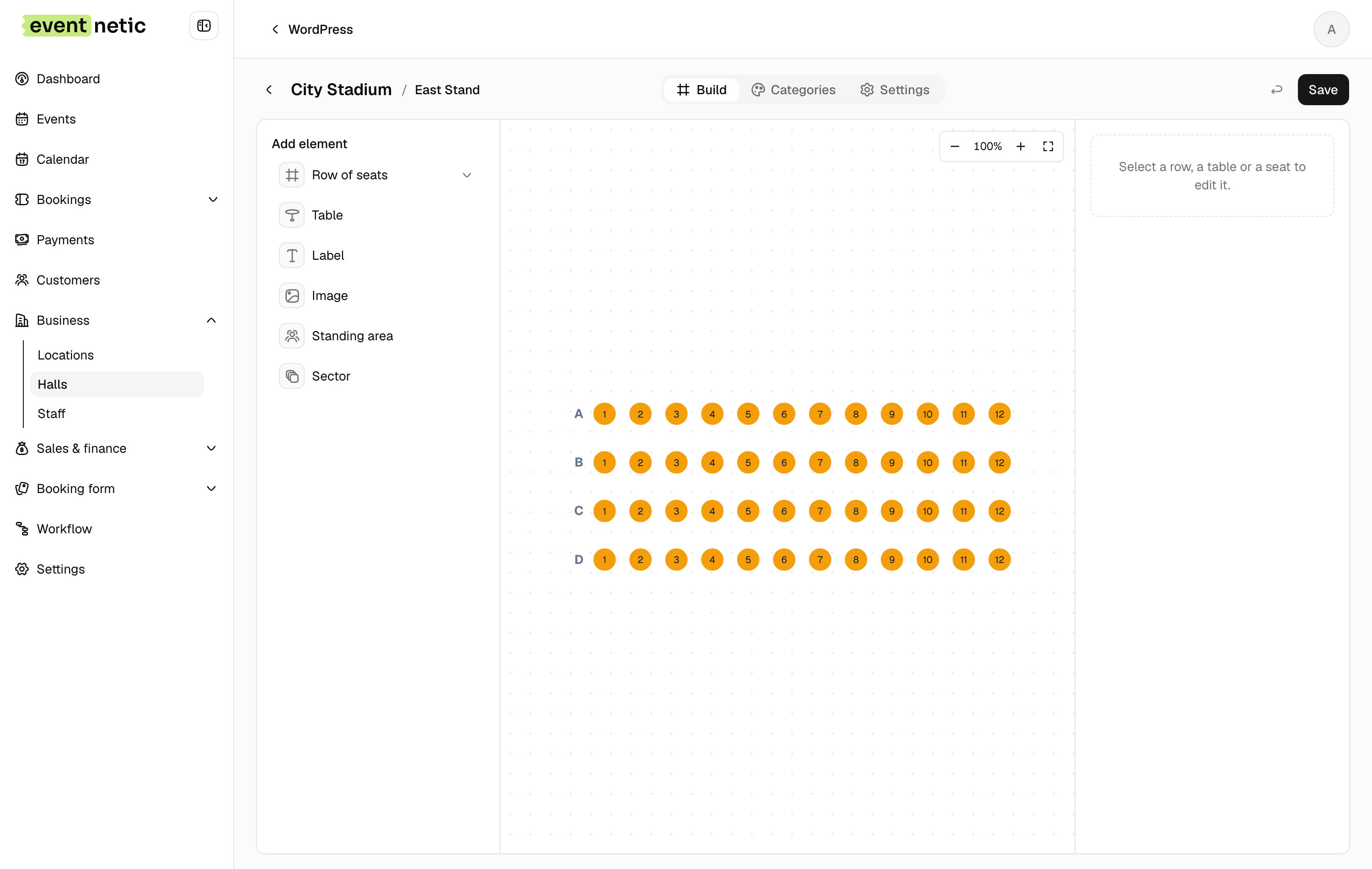
Rows, tables, standing areas and scenery go on a canvas.
Rows can curve, so a hall facing a stage is drawn as it is rather than as a grid. Aisles are set on the row itself, and the numbering runs past them.
Numbering follows the house: numbers or letters, from any start, every seat or only the odd or only the even ones, counted from the far end, and thirteen skipped if you skip it.
A seat can be round, square or chair-shaped. It can also be given a size of its own, which is how a box, a sofa or a wheelchair space is drawn without pretending it is an ordinary chair.
Tables are round or rectangular, seated all the way round for a boardroom or along the two long sides for a banquet.
Drop in the venue's own floor plan, fade it back, and trace over it. Everything rotates, stacks in front or behind, snaps to its neighbours, duplicates and undoes.


Sectors, stands and tiers
A sector is a part of the venue with a plan of its own. Open it and the canvas shows what is inside; close it and you are looking at the building again.
Sectors nest. A ground is a ring of stands, a stand is a set of blocks, a block is a wall of rows. Each level is drawn at the level it belongs to, which is what makes a large venue editable at all.
The buyer picks a stand, then a block, then a chair. That is how a stadium sells a ticket, and it works the same on a phone.

Categories and prices
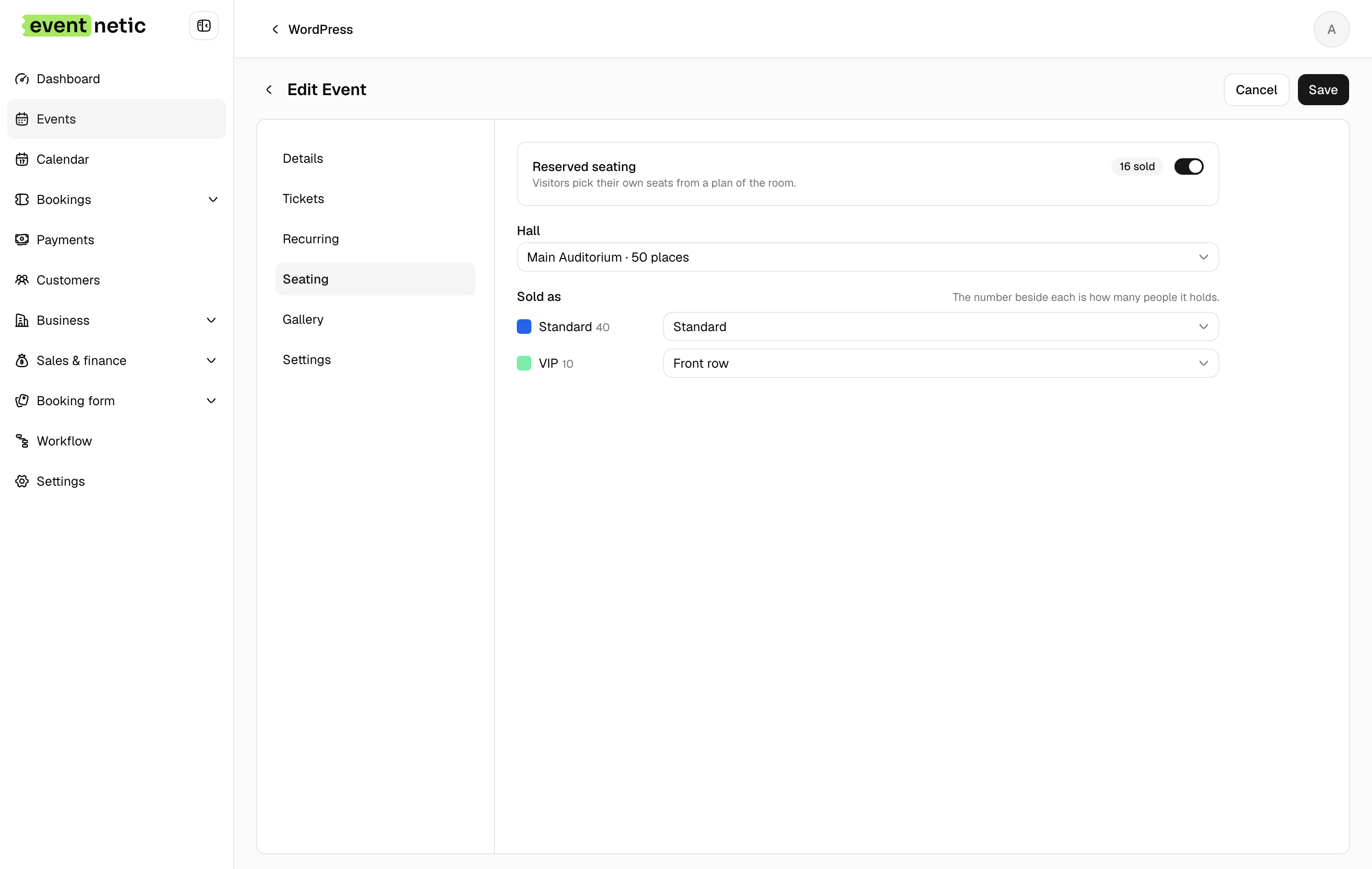
Seats are grouped into categories: stalls, balcony, circle, whatever you call them. A category is a colour on the map and a price at the checkout.
That is how the front three rows cost more than the back without becoming a separate event.
A single seat can take a different category from the rest of its row, so the middle six are VIP while the ends stay Premium. Categories belong to the venue, so VIP is defined once and means the same thing in every sector.
The same map, one date at a time
The plan belongs to the venue. What is taken belongs to the date.
Seat 14 sold on Friday is on sale again for Saturday, and the same map is shown for every showing with only that night's seats marked gone.
Seats are held while somebody is paying and released if they do not finish, so two people cannot buy the same chair.

A course keeps its chair
A booking that covers several dates, a course or a season pass, keeps the same chair on every one of them. The map shows only the seats that are free on all the dates chosen, so nobody sits in row F on Tuesday and row K on Thursday.
A package seats the tickets inside it: a family ticket of four asks for four chairs.
The view from the seat
A seat can carry a photograph of the view from it, shown while somebody is choosing. It is usually set for a whole row at once, because the view from seat 4 and seat 5 of row K is the same view.
It answers the question that stops a sale: is the cheap seat worth it, and is the front row too close.
For people who would rather not choose
Ask for four seats and it finds four together. It is called next available together rather than best available, because without knowing where you would rather sit, no row is better than another. What it can promise is that a party stays in one piece.
More in Seating
Draw the room once and sell the chair rather than the number.