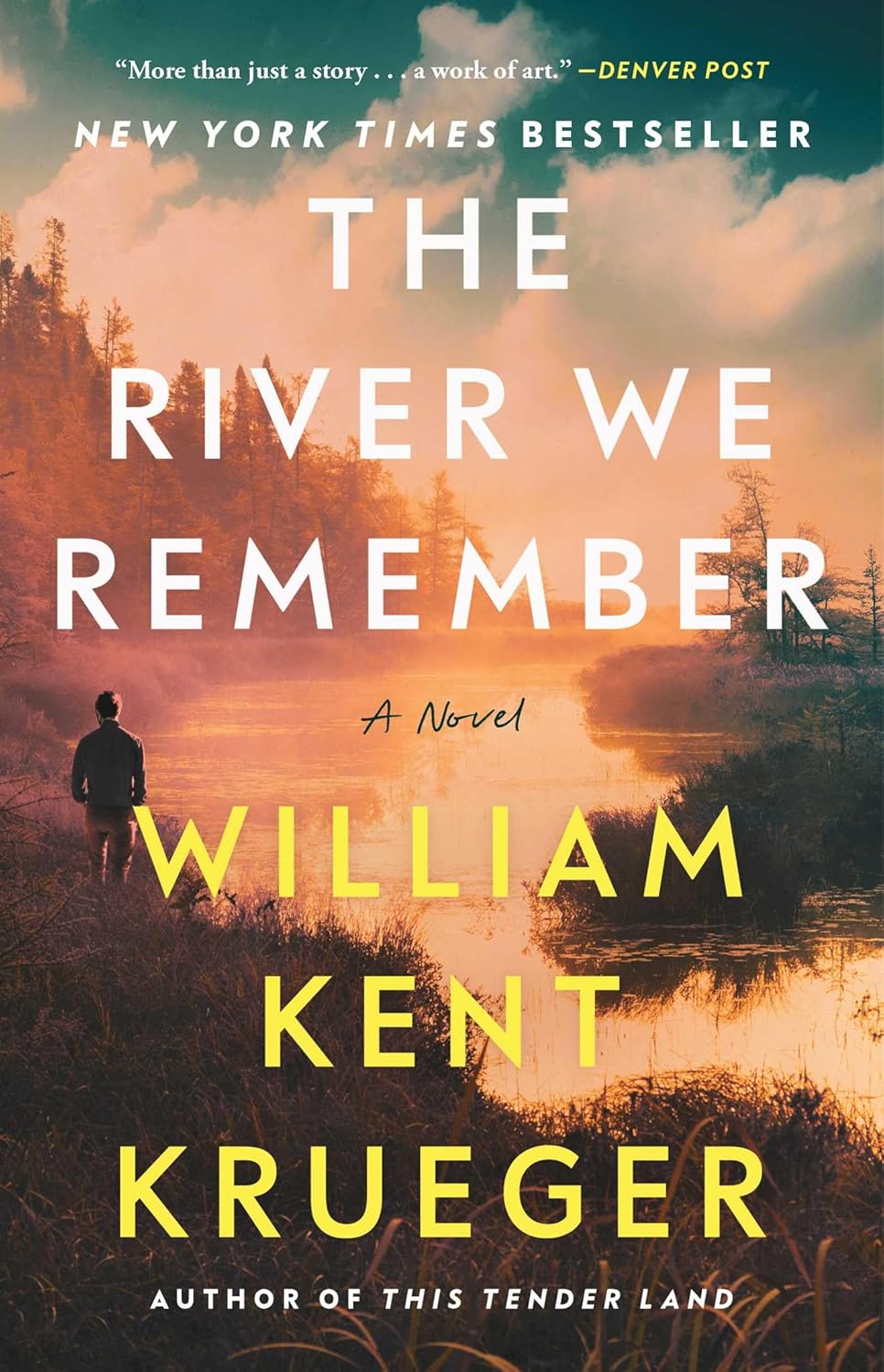
Book Review: The River We Remember by William Kent Krueger

The River We Remember
by
William Kent Krueger

Rating: 5 out of 5.

If you’re looking for a literary mystery, I highly recommend The River We Remember. This is the second book I’ve read by William Kent Krueger. Ordinary Grace is another five-star book (read my review here) and Krueger is quickly becoming one of my new favorite authors.

Like Ordinary Grace and Krueger’s Cork O’Connor series, The River We Remember takes place in Minnesota. Set in Black Earth County, this story begins on Memorial Day in 1958 when Jimmy Quinn, the largest landowner in the county, turns up dead in the Alabaster River. We soon meet Sheriff Brody Dern, his deputy, Asa Fielding, and Connie Graff, the previous sheriff who now serves as deputy when needed. Brody and his team have many questions: Was it murder, an accident, or was it suicide? How did Jimmy end up in the river? Was he dead before he went in the water?

Krueger sets up the mystery in classic style. And then he does something fantastic. I was quickly absorbed in the widely-varied community of characters and the long history of the land. As Brody investigates, we discover the deeply layered relationships between the characters as well as the demons and secrets that plague them. Men of all generations have experienced war and have had to shift gears and pretend their time overseas is neatly behind them. They bring with them a tangled mess of prejudices born from impossible wartime circumstances.

Early in the book, Jimmy Quinn’s wife, Marta comments that “war does something vile and irreparable to the human spirit, leaves thick scars on the soul,“ a statement that echoes the feelings of many.

I first noticed the smaller, typical human and family conflicts and weaknesses, but as I read, I saw the bigger picture of a Minnesota community of Americans, Native Americans, as well as Scandinavian, German, and Japanese immigrants. Although they have integrated, many are prejudiced against the generations of Sioux population who have watched the Quinn family cultivate and profit from land that was once their own. In addition, others have returned from war with hatred for Germans and Japanese.

I love when nature and spirituality are major themes in stories and here the Alabaster River, which shines silvery-white at night, figures prominently. Many scenes take place along the river, including an area called Inkpaduta Bend where we hear the plaintive cries of lives lost in violent conflict.

As for the mystery, Krueger reveals a series of events and complicated motives that made me think hard about his characters. I highly recommend The River We Remember not just for mystery readers, but for anyone who likes historical stories with complex relationships.

Thanks for visiting—come back soon!
A God in Ruins by Kate Atkinson

A God in Ruins cover
A God in Ruins

by
Kate Atkinson

Rating:

How do you reconcile the things you do during a war with how you live when it’s all over? Can you make up for what you did? This is the conflict that becomes Teddy Todd’s personal war in Kate Atkinson’s terrific book, A God in Ruins, a companion to her equally terrific book, Life After Life.

Life After Life is a “what if” story, showing the different paths and possible outcomes for Teddy’s sister, Ursula, during World War II. A God in Ruins is about Teddy and his role as an RAF pilot during its bombing campaign over Germany. You can read them independently, but I think it’s better to read Life After Life first.

Both books are ambitious reads and can’t be rushed. A God in Ruins, however, is a different kind of story, and examines Teddy’s life during and after the war. Atkinson also introduces Teddy’s wife, Nancy and their daughter, Viola and her children, Sunny and Bertie, taking the reader to the present day. As in Life After Life, this story includes a lot of time jumps and requires careful reading. But the central story revolves around one path in Teddy’s life and his role as a husband, father and grandfather.

It’s hard to explain how this story goes without spoilers, but I can tell you this: Atkinson has a beautiful writing style that creates a reading experience like no other. From the beginning, her description of the Todd family puts the reader right in the middle of their home at Fox Corner, and with the neighboring Shawcross sisters. When the war breaks out, Teddy announces he wants to fly planes, a wartime career of exceptional leadership that defines and haunts him his entire life.

The most important theme in A God in Ruins is the war and the things people must do during this time. Can you be at peace with dropping bombs? Can you make up for “the dreadful moral compromise that war imposed upon you?” Teddy deliberately chose how to live after the war – “he resolved that he would try always to be kind. It was the best he could do. It was all that he could do.” But these choices do not guarantee happiness.

As in Life After Life, flowers, trees and animals, especially foxes, hares, dogs and birds, play an important part in the characters’ lives and suggest a strong spiritual connection with nature, including the idea of reincarnation. These ideas tie into her characters’ doubts of faith during wartime. Ursula puts it just right when she says, “There’s a spark of the divine in the world – not God, we’re done with God, but something. Is it love? Not silly romantic love, but something more profound…?”

I loved every word of this book, but here’s what I loved best about A God in Ruins:

  • Teddy’s character – especially how he quietly takes care of the people in his life. His leadership of his flight crew shows how much he cares about the people around him. But his character has this great moral dilemma – he and his crew are killing innocent people, but the distance removes them from reality. Can you blame them? They’re fighting the enemy. After the war, Teddy’s love for his grandchildren comes before everything, but Atkinson throws a curveball at Teddy’s character, something that may change the reader’s opinion..
  • Sunny’s character – Atkinson reveals it bit by bit and the reader comes to understand him by the end of the story.
  • Viola’s transformation – reading about things from her perspective changes everything. Saving her point of view to the end forces the reader to completely reconsider her character.
  • The appearance of Ursula’s dog, “Lucky” from Life After Life. It’s great to see him in this story too!
  • I like how Atkinson also shows the important role that women played during the war. Many worked as pilots transporting planes, truck drivers, translators, mathematicians, decoders and nurses.
  • Atkinson shows small details about her side characters, hinting about stories and scenarios that the reader can imagine taking place in the background. This is especially true with her descriptions of Hugh and Sylvie and their marriage.
  • She makes a small jab about the Eat, Pray, Love craze – enjoyed that very much!
  • Her description of the moment of death – its effect on family members who are far apart, how they can sense it, on nature, on the world, and on what’s next.

A God in Ruins ends in a surprising twist. It has left me wondering, but I’m thinking that’s just what the author wanted! Have you read A God in Ruins? What did you think? Did you like the ending?

If you liked this review, click here to read my review of Life After Life.

Thanks for visiting – come back soon!

Slaughterhouse-Five by Kurt Vonnegut

Slaughterhouse-Five

Slaughterhouse-Five
by
Kurt Vonnegut

Rating:

Slaughterhouse-Five is hands down, a genius combination of truth and fiction. Kurt Vonnegut’s famous satirical novel is about violence and war and the idea of free will. It’s an autobiographical and fictional mix built into a story about Billy Pilgrim’s time travels on Earth and his visit to the distant planet Tralfamadore. It was published in 1969, in the midst of the U.S. involvement in the Vietnam War and became a best-seller because of its anti-war sentiment. It has been banned from some schools and studied in others and is considered Vonnegut’s most influential work. I think it is excellent in its message, its symbolism and its construction.

Vonnegut’s main character, Billy Pilgrim, jumps back and forth through time and tries to make sense of a life that has been dramatically transformed by his experience as an American prisoner during World War Two. Billy wasn’t meant for war, but there he is. His miraculous survival after the Allied bombing and total destruction of Dresden, Germany is a turning point in his life, a moment he struggles, unconsciously, to understand and beat.

Billy copes in a way no one around him can understand, by retreating inward and traveling in time, past and future and being kidnapped by aliens from the planet Tralfamadore. Tralfamadorians tell Billy that there is no real end in time. “All moments, past, present, and future, always have existed, always will exist.” They tell him that moments in time are like “bugs trapped in amber.” When Billy notes that life on their planet is peaceful, unlike on Earth, they tell him they, too have experienced violent wars, but they have a way to deal with them. “There isn’t anything we can do about them, so we simply don’t look at them. We ignore them. We spend eternity looking at pleasant moments.”

I like everything about this book. Many of characters are symbols of certain types of thought and are precisely depicted through their actions and what they say. When Billy’s daughter, Barbara treats him like a child, I found myself believing in Tralfamadore. When Billy visits his mother at Pine Knoll nursing home, I felt his mother’s tears, as she pulls all her “energy from all over her ruined body, even her toes and fingertips” just to ask Billy, “How did I get so old?” I hated Roland Weary, I felt sad for Wild Bob and the hobo who says, “This ain’t bad. This ain’t nothing at all.” I saw the irony of Edgar Derby’s fate, a teacher of “Contemporary Problems in Western Civilization” and the image of Derby’s face bursting into tears after Billy feeds him a spoon of syrup.

This is one of those books that reads quickly and gives the first impression of a story casually told, but it’s not. Every word is carefully chosen, every character is deliberately included, and every jump in time is purposefully choreographed. And despite the graphic descriptions and language and the ugliness of war, this book has a beauty about it that’s hard to describe.

While this story is about Billy’s personal struggle, its bigger story and strongest message is about war. I think Vonnegut’s description of the Allied bombing of Dresden in reverse is very powerful:

“The formation flew backwards over a German city that was in flames. The bombers opened their bomb bay doors, exerted a miraculous magnetism which shrunk the fires, gathered them into cylindrical steel containers, and lifted the containers into the bellies of the planes.”

Vonnegut continues this reverse description back to the beginning of man, where eventually, “Everybody turned into a baby, and all humanity, without exception, conspired biologically to produce two perfect people named Adam and Eve.” All that’s complicated and violent, returning to something so simple.

It took me a long time to get to Slaughterhouse-Five. I don’t think these ideas will ever leave me.

Thanks for visiting – come back soon!