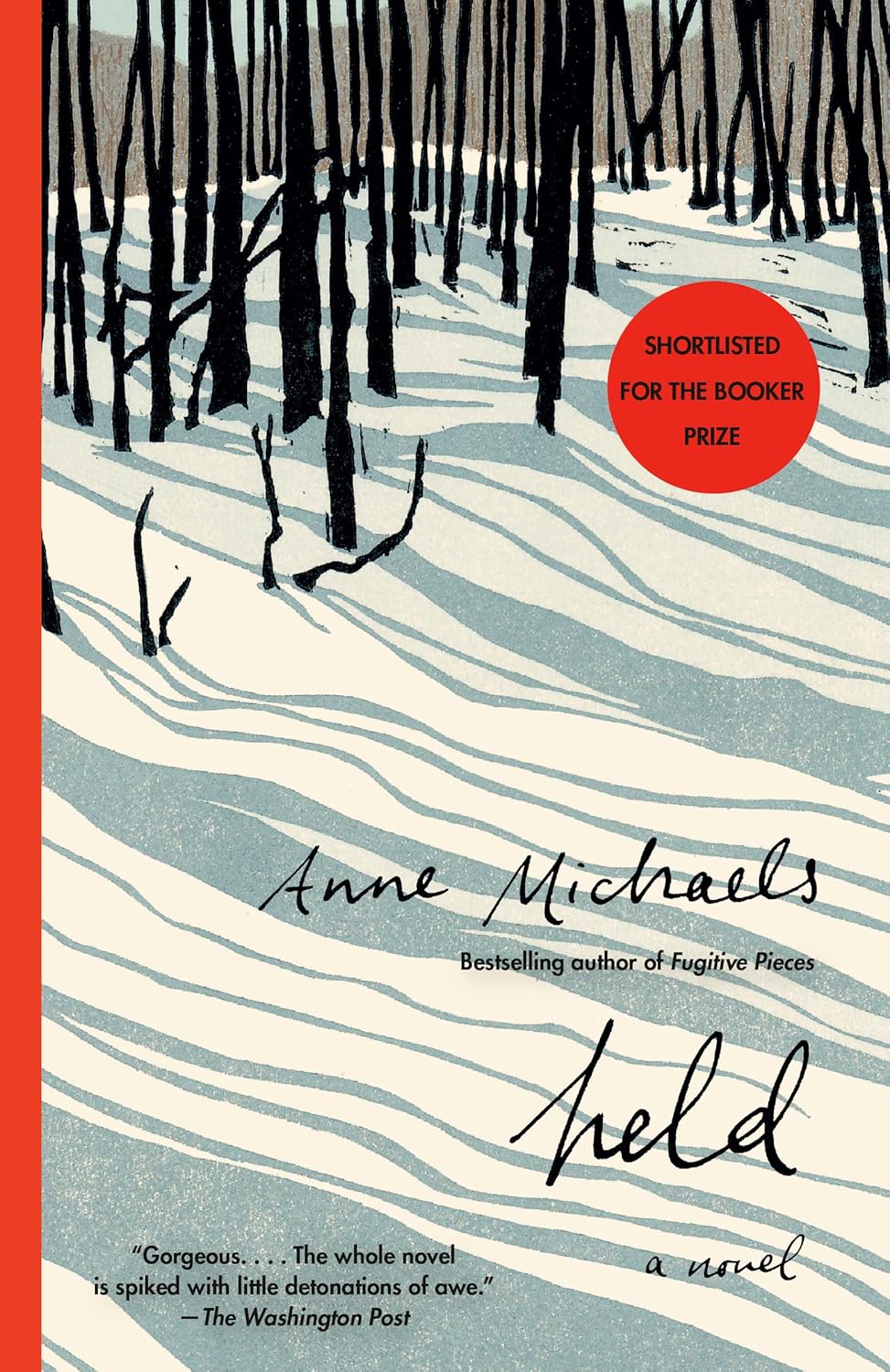
I tore through this unusual and beautifully written book that begins on a French battlefield in 1917, and covers four generations. Through her characters, memories, and dreams, the author explores the human connection to nature and the supernatural, to answer timeless questions about the meaning of life and our past generations.
Published in 2024, Held was shortlisted for the Booker Prize, received The Giller Prize, and was named a New York Times Best Historical Novel of the Year.
We first meet John, an injured soldier on a French battlefield in 1917. As he lies in the snow, he recalls how he met his artist wife, Helena, how random it was, and how deeply he loves her. Upon his return home, John resumes his job as a studio photographer, but he has changed and struggles to find purpose in his life. Then he discovers an eerie connection to the dead.
The story continues as each generation must carry on with imperfect lives. War is always in the background, referenced but not specifically defined. Throughout, each character must find meaning in the face of grief and sacrifice.
I don’t really know how to describe this book. I really connected with it! Every sentence is poetic, inviting you to think hard about its meaning. I felt the emotions of all the characters as they struggle to survive in uncertain times.
I highly recommend Held to readers who like deep-thinking stories about characters who yearn to connect with the past. Anne Michaels is a Canadian novelist and poet and author of Fugitive Pieces and The Winter Vault.
Each time I re-read a favorite classic, I finish with a new appreciation for the story and the author. It was no different this week when I picked up A Farewell to Arms. It’s such a well-known book, it’s tempting to think, “Oh, I already know that story. Why re-read it?” Why? Because each time you are guaranteed to get something different out of it. It had been at least twenty years since I had read A Farewell to Arms and I can’t remember if I’d read it only once or twice before. I have always liked Hemingway’s writing style and find his stories easy to read, but full of deeper ideas and feelings. And who doesn’t like a wartime love story?
This is a love story about Frederic Henry, an American ambulance driver serving in the Italian army during World War I, who falls in love with a young English nurse, Catherine Barkley. Their relationship is just getting underway when Henry is badly wounded and sent to a Red Cross hospital in Milan. Catherine soon follows and the two begin a romance that is wholly defined by the circumstances that surround them.
Hemingway on crutches. Photo: Britannica.com
This is a commentary on war as much as it is a romance, however and Hemingway used his own experiences as an ambulance driver during the war to tell it. He was badly wounded, just as Frederic Henry was, and recuperated for six months in Milan, where he fell in love with an American nurse named Agnes von Kurowski. They had planned to marry, but the relationship ended when Hemingway was sent home and she became engaged to an Italian officer.
In his book, he talks about the Italian countryside in typical Hemingway style, describing the color of the sky, the sparkling water and the mountains above. And then he adds the Italian troops trying to fight against the Austrians, in impossible mountain terrain. Many of his characters question the purpose of the war. One of the drivers puts it plainly, “If everybody would not attack the war would be over.”
Agnes von Korowsky Photo: Wikipedia.org
Henry sees the war clearest when he returns to duty:
Abstract words such as glory, honor, courage, or hallow were obscene beside the concrete names of villages, the numbers of roads, the names of rivers, the numbers of regiments and the dates.
It’s this new understanding of the war that drives Henry’s decisions for the rest of the story, and when it ends in a hospital in Switzerland, Hemingway leaves the reader to think about how things might have been different, without the backdrop of war.
I enjoyed all of A Farewell to Arms, but the most exciting scene occurs late in the book and involves a rough trip in a rowboat on Lake Maggiore, which borders both Italy and Switzerland. This picture helped me imagine what would seem an impossible voyage.
Lake Maggiore Photo: Wikipedia
If you’re a movie lover, you may be interested to know that there are two film versions of A Farewell to Arms:
In 1932, starring Helen Hayes, Gary Cooper and Adolphe Menjou. Directed by Frank Borzage. Screenplay by Benjamin Glazer and Oliver H.P. Garrett. It won two Academy Awards, one for Best Cinematography and Best Sound. The film was also nominated for Best Picture and Best Art Direction. Click here to visit IMDb for a full description of this film.
In 1957, starring Rock Hudson, Jennifer Jones and Vittorio De Sica. Directed by Charles Vidor and John Huston. Screenplay by Ben Hecht. Vittorio was nominated for Best Actor in a Supporting Role. Visit IMDb for more information on this later film.
If you’re a Hemingway fan, you may enjoy the following:
A Farewell to Arms, like other Hemingway stories and novels, is deceptively simple, with complex ideas, definitely worthy of a re-read or two! I may soon be returning to other Hemingway favorites. Who are your favorite authors? Do you have a favorite re-read? Has your experience been different each time?



 Book Club Mom
You must be logged in to post a comment.