A Last Look at Cumbernauld

Britain’s ugliest building finally faces the wrecking ball. What better time to revisit this threatened Brutalist gem.

Perhaps one of the most contentious, divisive and controversial examples of British ‘massive’ period Brutalism is The Centre, Cumbernauld. In spite of apparent consideration for listing, it was announced in March 2022 that the infamous megastructure would be demolished and replaced with a new mixed-use complex by its now owners, North Lanarkshire Council. So as we say farewell to another classic and arguably important post-war structure, I thought it was a good time to look back at why it was so highly regarded in its day and what, if anything, went wrong.

The first phase of the multi-level centre as originally conceived.

The concept of town planning was critical to the development of post-war architecture.  This is, fairly obviously, because the regeneration of Britain following the destruction of a long and protracted war presented architects and planners with an almost unrivaled opportunity to make significant progress in this field.  In spite of this fertile backdrop, though, what becomes clear from the rising differences of opinion between the younger generation of architects and those of the previous generation, particularly in the Modern Movement, is that the progress was to some frustratingly slow. Writing in the Architectural Review in 1957, the architectural critic J.M.Richards commented “the products of ten years of rebuilding are little different to look at from what they would have been before the war”.  Although the broader scene of redevelopment in Britain and Europe was viewed by some as unexciting, there were pockets of radical and even revolutionary design during the 1950s, making it something of a turning-point decade.  Some of that inspiring energy could be found within the continuing program of New Towns, following the act of 1946 to help alleviate overcrowding and congestion in London and other larger British cities.

One of the cities outside London marked for New Town relief was Glasgow and one of the regions earmarked for development was Cumbernauld. Cumbernauld in North Lanarkshire was positioned only thirteen miles to the northeast of Glasgow and the New Town, designated in 1955, incorporated the existing village of that name.  A comprehensive development plan was conceived by L.Hugh Wilson, then chief architect and planning officer for the Cumbernauld Development Corporation (CDC) and involved a multi-function town centre with residential conurbations around it.  The revolutionary concept here, though, was the complete segregation of cars and pedestrians meaning that residents of the housing estates could access the central shops, offices and other services without ever having to cross a road.  This was achieved by use of walkways, ramps and bridges which rose above or ploughed beneath the road system.

The infamous cantilevered ‘monster’.

The roadway itself was considered a masterpiece of planning at the time, anchored to the developing A80 (now M80) dual carriageway with no fewer than ten proposals fully designed before one was chosen, based on detailed and repeated traffic surveys.  The expectation by 1963 was that an initial population of 20,000 would rise to 70,000 and be easily accommodated along with provision for up to 5,000 cars in the central business area.

Under construction, Carbrain East Bridge on the Muirhead interchange, with Kildrum housing visible in the background.

It was the town centre scheme, though, that would become the set-piece or ‘dynamo’ for Cumbernauld, initially celebrated but later much maligned.  In 1962 L.Hugh Wilson was succeeded by new chief architect-planner Dudley Leaker although Wilson was retained as a consultant.  Group project architect for the centre building was Geoffrey Copcutt.  The concept was to incorporate everything that a town would need in one place; shopping, banks, entertainment, restaurants, civic and commercial offices, health centre, post office and a small number of penthouse dwellings.  The site chosen was not the easiest to work around, being on the crest of a hill, but the structure straddled this with access for pedestrians changing levels depending on which direction they were coming from.

Described by Patrick Nuttgens at the time as appearing like ‘a huge vertebrate monster’ (Architectural Review, Dec 1967), in his largely complementary critique, it was and remains a distinctive structure, bearing most if not all of the attributes associated with brutalism.  Imposing, asymmetrical, unapologetically modern and bristling with shuttered concrete and grey calcium silicate brickwork.  It incorporated two interconnected structural systems; the first developed as a concrete waffle system which gave the ceilings the impression of coffering and the second being six huge columns penetrating through the main structure to support the cantilevered penthouse block.

Accessed by a road which cuts through the belly of the monster, so to speak, the lower levels provided parking and loading access to storage areas.  At ground level and accessed from pedestrian walkways or by escalator from the car parks, were shops including a large supermarket, above which was a library and civic office with penthouse apartments above.

This phase one structure was opened by HRH Princess Margaret in 1967, by which time it had been applauded by the architectural press and profession.  It had its shortcomings, though, not least of which was exposure to the sometimes harsh climate with rain a frequent visitor and wind inadvertently ‘designed’ to funnel through certain places.  The grand totality of the scheme conceived in the 1950s was only partially realised, a result perhaps of the expected population increase never materialising.  The network of footpaths were confusing, the underpasses threatening and Copcutt’s centre building itself, though acknowledged as the first shopping mall in the UK, won a national poll in 2005 to decide the nation’s ugliest building.


Adapted from ‘Brutalism: Post-War British Architecture, 2nd edition

Images courtesy of The Concrete Centre and Chris Upson / Commons Wikimedia


Useful Links

Summer 1963 issue of the Concrete Quarterly with a feature on Cumbernauld: https://www.concretecentre.com/getmedia/89a2e57f-3b48-4576-9ad8-b2753cae8100/CQ_057_Summer1963.PDF.aspx

Dezeen feature on Cumbernauld demolition decision: https://www.dezeen.com/2022/03/14/cumbernauld-brutalist-town-centre-demolition-outrage/

Cumbernauld listing application status: https://portal.historicenvironment.scot/decision/500003493

Endangered Brutalism: St Peter’s Seminary, Cardross

Possibly Scotland’s finest modern building still has an uncertain future. Total restoration may be off the cards, but can it live on as a managed ruin?

One of the saddest sights to see is any building in a state of disuse and dilapidation, regardless of its period or style.  In some ways, on the plus side, they do make for stunning photography and, occasionally, locations to dystopian films – think Hanley bus station in Stoke-on-Trent as used in The Girl with all the Gifts (2016).  But that shouldn’t be the lasting legacy of modern architecture.  In researching for my book, one building stood out as a particularly forlorn example of a neglected gem, St Peter’s Seminary in Cardross, Scotland by Isi Metzstein, Andy MacMillan and John Cowell of Gillespie, Kidd & Coia.  While leafing through some back issues of Concrete Quarterly, I found a piece from 1967 profiling it in detail.

st_peters_01

Described by the reviewer as ‘virile’ and ‘rugged’, displaying its debt to Le Corbusier openly, the seminary at Cardross was a masterclass of in-situ concrete, varying in textures and finishes both inside and out to such an extent that it’s hard to take it all in at once.  The group of buildings including classrooms, study rooms, refectory, chapel and convent, formed an embrace around the sombre 19th Century baronial Kilmahew House.  Each of the three main elements have their own character but, nevertheless, form a cohesive whole.  This owes much to the strength of character in the main building, housing the chapel, refectory and study rooms, rising in stepped ziggurat-like tiers.  The vaulted ceilings, expressed both inside and out, owe much to Le Corbusier’s Maison Jaoul in Paris (1954-56).  The distinctive arched concrete forms resonate regularly in the Brutalist canon, particularly in the work of Sir Basil Spence.

maison_jaoul_bw
Maison Jaoul, Neuilly-sur-Seine, Paris, Le Corbusier (1956)

The interior of the main block has access balconies overlooking the chapel and refectory, ensuring that the spiritual and material activities of the building remained interconnected.  But the use of light and shadow, the arrangement of forms and the judicial softening influence of timber, combined to create spaces of purpose and of reflection.  The impression you get from the images is one of intelligent and sensitive response to the brief, where there is a collective atmosphere, like a club, but one that allows for individual thought and quiet rumination.

st_peters_02
The refectory overlooked by arched beams and timber parapets.

st_peters_06
The chapel with cantilevered access balconies.

The classroom block also contained a common room and library and was a striking structure in its own right.  Raised on four internal columns, the upper section cantilevers at both ends up to 40ft, quite dramatically over the sloping landscape, and is angled at each end so that the form in plan view is trapezoidal.  This was further accentuated by the concrete shuttering being arranged in a herringbone pattern and the jewel-like triangular roof lights.

st_peters_07
View towards the cantilevered classroom and library.


st_peters_plan-02
Ground floor plan.

st_peters_plan-01
First floor plan.

St Peters is a study in form and texture.  The terraced main block and convent with its rugged, brown-tinted aggregate, the accentuated arched vaulting, the exposed concrete shuttering, the sculptural pod forms of the side chapels.  If you were to cite a building that stretched and utilised the many characteristics of concrete, you would be hard pushed to find an example better than this.  Small wonder, then, that it achieved a RIBA architecture award for Scotland.  Which makes it all the more extraordinary that it fell into such comprehensive decay.

The building closed as a seminary in 1980, just fourteen years after opening.  The expected student numbers, up to 100 at a time, never materialised during its tenure and so this grand structure had always been underused.  This was, in part, due to the shifting cultural and religious landscape which meant that the Catholic Church’s predictions of population and congregational growth post-1945 didn’t pan out.  The opening of St Peter’s also coincided with significant changes in Church culture after the 1962 Second Vatican Council.  The net result was that the College, part of an ambitious post-war building plan for the Glasgow Archdiocese, was doomed to fall short of its full potential.  It remained empty for a few years before taking on a new life as a drug rehabilitation centre but problems with maintaining the modern buildings forced the operation to confine itself to Kilmahew house until its closure in 1987.  By then, vandalism dilapidation had already begun to set in to the college.

st_peters_08
The convent adjacent to the baronial Kilmahew House.

A glimmer of hope for the modern buildings arrived in 1992 with Category A listing by Historic Scotland, preventing demolition but not further degradation.  Kilmahew house, sadly, was afforded no such protection and after a fire in 1995 it was deemed unsafe and pulled down.  What followed for Gillespie, Kidd & Coia’s structure has been a series of earnest attempts to repurpose it and give the college a new and lasting future.  But conflicting interests and multiple stakeholders have exacerbated the inherent problems with the structure.  It’s remoteness and the specificity of the internal arrangements have conspired to make this a particularly difficult project to consider, even before you begin to imagine restoring any of the lost internal features and fittings or repurposing for residential or commercial use.

In 2004, the 20th Century Society raised concerns about the then plans by the Archdiocese, in collaboration with Classical House Ltd, which proposed to strip the concrete skeleton back completely, removing external cladding and window frames.  In 2008 the property developer Urban Splash took up the baton, working with architect Gareth Hoskins on an £11m project which was reported to propose converting the seminary into a health centre with additional residential accommodation in the grounds.  This was met with considerable favour, even from one of its original architects, Andy McMillan, whose response at the time was, “They are the most sensitive of all the proposals we have seen for the building, considering its original use.”

Then in 2009 the Glasgow based arts charity NVA became involved, securing Scottish Arts Council funding to develop artworks at the site.  However, the complexity of St Peters and Kilmahew and its state of decay proved insurmountable barriers and the restoration was abandoned with Urban Splash pulling out.  Nevertheless, NVA continued to work on plans for the site, including the inauguration of ‘The Invisible College’, a conceptual learning centre without walls, with a focal point at St Peter’s.  In 2013 Avanti architects, in collaboration with ERZ Landscaping, were engaged to commence work on partially restoring the seminary structures with the aim of creating an arts venue and exhibition space. This reached a synthesis in March 2016 with ‘Hinterland’, a public performance art installation that was also the official launch of Scotland’s Festival of Architecture.  With an announcement of funding to the tune of £4.2m, it looked like St Peter’s future was secure.  But with the NVA closing in September 2018, that future is once again looking bleak.

The driving force behind NVA is artist Angus Farquhar.  I asked him how he first became aware of the building. 

AF: “It had been put on my radar through a campaign run by Murray Grigor, the film maker and Nick Barley at the List around 2000. I signed a campaign with 50 other prominent artists to support saving the building.”

And what was his perspective on the run of events with St Peters?

AF: “We raised £9 million we were only £1 million short of the total required but Scot Gov had given us a £1 million loan not a grant and HLF [Heritage Lottery Fund] played hard ball over the percentage splits within the budget and gave us no flexibility. We always saw partial restoration as the way forward, it was never planned as a total refit, the emphasis on arts endeavours and the Invisible College, a flexible education model were there from the start. We wanted an iterative and step by step model driven by radical public art but this did not sit well with our more conservative and institutional funders who wanted a kind of standard heritage and tourist attraction. The tension was there from the beginning. In the end we could not find a business model that could repay loans and guarantee the levels of public attendance required due to geographical and physical parking restraints. We chose to give the money back and close the project after 10 years. The final push for it to be taken into state care as a consolidated ruin was the last attempt to save it. HES [Historic Environment Scotland] proved too scared and the Scottish Government too un-progressive to tackle and save a difficult 20th century building. Scot Gov have taken no equivalent 20th century buildings into State Care, they have hundreds of castles, stately homes etc from the 19th century and before. This is an ongoing scandal.”

I asked if he was still involved in the project.

AF: “I am often asked informally for advice when new plans come forward to save it and sadly after initial enthusiasm often bite the dust as the reality of the costs involved, the current capital spend requirements and remoteness conspire to suffocate new plans

And where do the plans stand at present?

AF: “As always the building has defeated all plans, until the next one comes along, it is now bound by scaffolding and razor wire looking much like an internment camp….a powerful brooding and sad presence.”

Lastly, I asked if an angel donor came forward and money was no object, what would be his top desire for the seminary?

AF: “consolidated ruin, open gates, no permanent staff, used for open visits and as a creative and learning forum and site for investigation across all art forms and academic disciplines.”

Sadly, it seems, the preservation of an ‘at risk’ modernist building for purely creative or altruistic purposes is a vanishingly small sector.  Much more common is conversion to luxury apartments or retail space, as with Manchester’s Toastrack.  It is only commercial gain that has any traction but all too often it is much at the expense of the original design and concept.  Even that, though, proved too much of a challenge for St Peter’s College.  Part of me reels at the idea of a Brutalist building of this magnitude becoming a certified ruin.  But if that is all the future available to it, better that than complete destruction.  Perhaps one day it might be visited and venerated as much as Stonehenge is today.  We can only hope.


My very grateful thanks to Angus Farquhar for his time and valuable contribution.

St Peters images © The Concrete Centre, photographer Crispin Eurich.


Useful links

NVA website
http://nva.org.uk/

Historic Scotland database entry
https://portal.historicenvironment.scot/designation/LB6464

A contemporary film documenting life at the college
https://youtu.be/5K8d2n1j-ak

Is Denys Lasdun’s Brutalist IBM building under threat?

I’m usually the first on the street, metaphorically, when a brutalist building is under threat of demolition or ‘refurbishment’. How do I feel about Lasdun’s IBM building on London’s Southbank?

Normally I am the first to run out with a placard (albeit virtually) and bemoan the destructive ‘upgrading’ of beautiful Brutalist buildings. It often ranges from terrible defacement, obliterating the aesthetics and original spirit of the structure, or a complete wrecking ball operation from which there is no return. I was part of the, thankfully successful, campaign to save Castrol (now Marathon) House from being ‘improved’ and I am obviously a vocal advocate for post-war architecture generally. When I heard about the plans released by Allford Hall Monaghan Morris (AHMM) to alter Denys Lasdun’s iconic Brutalist IBM building (1980-1983) on the south bank of the Thames in London, I was snorting with righteous indignation like an asthmatic bulldog. And then I saw the pictures and went . . . huh.

The 20th Century Society is a key pressure group in the fight to preserve modern era architecture, regardless of aesthetics or ethics, if they are considered historically significant. Naturally, they have taken a hard line with AHMM’s plans for the IBM building. Now, I find I am a little hesitant to gush about what they do, no matter how much I might agree with them and their principles, from the purely selfish standpoint that they published an article on their website that brutally (ahem) slammed my book. But do I agree with them about the IBM building? Should it be preserved without molestation or could the proposed building works actually be . . . well, workable?

In essence, the nominated architects AHMM propose to add additional floors and create a new space below the building by removing the hipped brick plinth. At the top of the building, the existing concrete plant housing would be clad in metal mesh. Seen from above, it looks on the face of it to be a reworking congruous with the existing features and the building’s surroundings.

3176679_ahmm.7678upperground.20.02.17
© Copyright AHMM

But when you look at the elevations from ground level you begin to see the problem. Denys Lasdun’s IBM building was designed a few years after the completion of its neighbouring National Theatre (1969-1976), also by Lasdun, and the architect specifically created a space that was subservient and complementary to it. By adding floors to the structure and reworking the plant housing, the result appears to wrestle ungracefully with its sibling next door, like it’s taken a dose of steroids and wants to give the NT a bit of a beating. Looking at one of the original plans showing the riverside elevation you can see a finely balanced symmetry between the two. The proposed reworking would undoubtedly destroy this carefully considered balance.

3173181_riba53498

And then there’s the ground floor remodelling. Taking away the shaped brick plinth not only ruins the grounding of the structure – a specific Lasdun motif – but also disrupts the way it complements the National’s opposing upward slant. And as if that were not enough, it metaphorically pulls the IBM building’s skirts up, or pulls them off entirely, exposing the sub-ground level and making the upper structure appear horribly ungainly.

3173218_ahmmlasdunibmwebcrop1
© Copyright AHMM


SONY DSC

Now these are all largely aesthetic concerns but let’s not belittle them even so. We are talking about a building that is listed, albeit only locally, but stands adjacent to a building that is listed nationally. While there may be a need for additional office space this must surely be possible to achieve without disrupting the exterior spaces unduly. One could argue that, at ground and sub-ground level, the demand for additional retail and restaurant space on the Southbank site is a repeat of the disastrous and, thankfully, failed attempt to rework the ‘undercroft’ nearby. And for the same reasons this proposal isn’t a necessary addition to the area. Surely the Southbank is crowded enough without drawing in more ‘customers’.

3173219_ahmmlasdunibmwebcrop2
© Copyright AHMM

And here’s where I find I have the biggest problem. The monetisation of national heritage, like the monetisation of anything, has become the primary goal. It should be possible to enjoy public spaces for the sake of them and not be made to feel like, or forced to actually be, a paying consumer. So much of our lives has now been turned into a revenue-generating opportunity, so much that shouldn’t be is now unduly concerned with ROI. There are times when it should not be the primary concern and the fate of an important building should not be decided on how much of an income opportunity it represents. With historic structures, even recent ones, their preservation is paramount.

So once again we may have a fight on our hands to keep the spirit and the aesthetics of another modern building intact, and the clear intentions of its architect. That it is one designed by so celebrated and renowned a luminary of the 20th Century is all the more extraordinary.


The IBM building is featured in detail in my book ‘Brutalism: Post-war British Architecture’. For more information click here.

Building of the Month: Roehampton Lane

Exploring Roehampton Lane, otherwise known as Alton East and Alton West, comprising fifteen point blocks and five slab blocks.  A feast of concrete social housing with heavy nods to Le Corbusier.  But why hasn’t it been bulldozed yet?

Alton_01

The Roehampton Lane or the Alton housing estate is one of Britain’s best known and most successful housing projects of the 1950s to survive largely untouched since its completion in 1958.  That it is a 100-acre arrangement of point and slab blocks in rough-cast and aggregate-finish concrete, together with low-rise brick maisonette blocks, makes it all the more intriguing since so many grand projects of this ilk – think the Smithson’s Robin Hood estate – have met with the business end of a wrecking ball.  So what is it that made Alton different? The key to this can be found in a report from the Winter 1958 issue of Concrete Quarterly, describing the area in its opening paragraphs:

“The site is exceptional: to the south and west, direct frontage on to Richmond Park; to the east, Roehampton Lane and village, and the recently built Alton [East] estate; to the north, a bank of trees above a meadow which is retained as a valuable feature of the scheme.”

Landscaping, it seems, was a big part of the plan and has remained so, maturing gracefully ever since, as was the preservation of historic parts of the immediate area.  The 18th Century Downshire House, Mount Clare and Manresa House were all preserved and also remain in place, now all part of Roehampton University. Alton East, a series of seven ‘point’ blocks of Scandinavian influence, was built between 1952 and 1955 while Alton West, which included both point blocks and slab blocks, was constructed 1954-1958.  The team of LCC architects led by Colin Lucas included Bill Howell, John Killick, John Partridge and Colin St John Wilson.

Alton_02
One of the point blocks, raised on square-section pilots.  The balconies accentuating the horizontal strata.  Some of the low-rise brick-built maisonettes of the project can be seen in the background.

The striking thing about the slab blocks is their outward similarity to Le Corbusier’s Unite D’habitation, although on a much smaller scale.  Bearing in mind that construction began in 1955 and will have been several months in planning, the Unite itself had only been completed in 1953 and so was very fresh to the scene.  The influence is obvious externally, although the internal arrangements are entirely different, but the impact of Le Corbusier’s beton brut direction clearly resonated with the young socialist minds of the LCC architects department.

Alton_07
The slab blocks, as seen from within the forest of rough-boarded pilotis.  Le Corbusier is much in evidence both aesthetically and ethically.

Construction of the point blocks was a mixture of pre-cast and in-situ reinforced concrete, the various elements put into place with a tower crane at a speed of one and a half floors per week.  The cladding was formed of concrete slabs dressed in mixed Dorset shingle and Derbyshire spar aggregate which appears a warm buff grey up close but a light silver grey from a distance. Even on a dull day they are bright looking buildings, giving them that Scandinavian air, if not (dare I suggest) Mediterranean.  The Alton West blocks were intended for smaller families with four apartments to each floor, arranged back-to-back to cluster the plumbing, and with stair and lift access positioned centrally.

Alton_03
The point blocks of Alton West under construction.

Alton_05
Arrangement in the point blocks with back-to-back apartments and central access stairs and lifts.

The slab blocks were originally planned to be sited on an east-west basis, maximising the south facing aspect, but the local authority feared this would create a ‘wall’ of building when viewed from Richmond Park.  So the arrangement was reconfigured to have the blocks oriented on a north-east to south-west axis. As it happens, while the blocks lose out in the daylight stakes, the overall effect is quite softening and blends well with the site.  Inside, the slab blocks each contained 75 maisonettes, accessed by lifts and stairs set off-centre to each block with six bays to one side and nine bays to the other. The dwellings were long and narrow but spanned the 40ft width of each block, affording views to the front and back and recessed to accommodate balconies and access decks.  Raised on pilotis, the blocks appear to float above the landscape while accommodating the undulating geography and were finished in rough boarded concrete. At the end of one building is a 121ft flu serving the underground boiler room, also finished in rough-boarded concrete and terminating in a trumpet rim. All of these elements; the off-centre services, the pilotis, the rough-boarded trumpet flu, combine to pay homage to Le Corbusier.

Alton_06
One of the slab blocks under construction.


Alton_04
Plan of the slab blocks with upper floor (top) and lower floor (bottom) of the full-width maisonettes.

Alton_08
Craning the cladding slabs into position.  Faced in aggregate and spanning the height of each floor, they accentuate the human scale.

Today the site remains almost exactly as it was constructed with little intrusion by later buildings and, blessedly, no re-cladding.  Merely the natural maturity of the shrubs and trees, as well as the inevitable massing of cars throughout the site, act together to tell you it’s not the 1950s any more.  The intelligence of the design, the spacious but efficient arrangement of the buildings, the adherence to socialist values in both style and construction, all blend together to make this a site that is well maintained and, I’d like to think, valued by its residents.  This is not a litter-strewn and graffiti daubed sink estate.  The proximity to large open parkland and the sensitivity of landscaping and local history are critical, I think, to its success. This was understood by its architects and is, consciously or unconsciously, acknowledged by its tenants. Alton must surely be drawn into the debate about why some post-war social housing projects have descended into slumhood while others have thrived.  I still believe that architecture itself isn’t the cause of social ills although bad architecture can certainly contribute to and magnify them. But when you look at Alton, and other estates like it, you can see proof that brutalism could work and still does.

All images courtesy of and © The Concrete Centre

Brutalist Breaks

For the longest time I have fantasised about staying in Le Corbusier’s Brutalist masterpiece, the Unite d’Habitation in Marseille, knowing that there is actually a hotel in there. This isn’t, as one might imagine, a cynical money making scheme dreamt up recently but an element of the building that was always there from the original plans; intended as a place for residents’ visitors to stay.  These days, of course, it must surely be largely occupied by devotees of the architect making their pilgrimage to his mecca for mass housing. For around 150 euros* a single room can be yours for the night.  But one doesn’t have to travel as far afield as Marseille to experience Brutalism from the inside. In Britain there are a number of hotels designed in the ‘massive’ period in which one can book a room, and it needn’t be brutal to your bank account either.

14507282
St.Giles Hotel, the upper levels jutting out over Bedford Avenue

St.Giles Hotel, just off the Tottenham Court Road in London’s Bloomsbury district, was originally intended to replace the Edwardian YMCA that was demolished to make way for it and was designed by the Ellworth Sykes partnership. Completed in 1977 it remains one of the best examples of Brutalism in the capital; a cluster of four jagged towers in rough cast concrete which jut out over Bedford Avenue. The distinctive design allows natural light into all of the rooms while the projecting concrete acts as bries soleil providing shading from the sun. The ‘saw-tooth’ arrangement allows privacy as well as uninterrupted views with no rooms facing directly onto any other. A single room can be booked off-peak for just shy of £100* which will get you all the usual stuff (safe, work desk, bathroom with shower, hairdryer, flat-screen TV, tea and coffee maker) as well as one of the most central locations for shopping and sight seeing. And if you want more Brutalism it too is on your doorstep with Lasdun’s Institute of Education and Seifert’s Centre Point both only a few minute’s walk away.

17224958
A typical room in St.Giles hotel – note the little saw-tooth window.

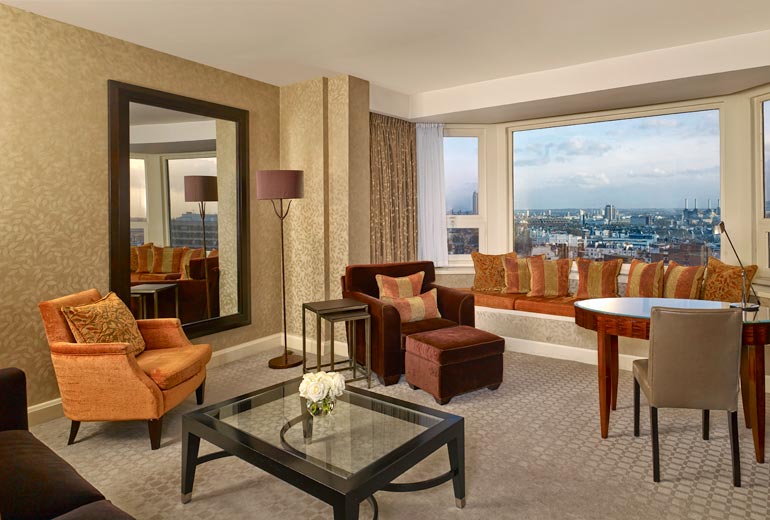
The Sheraton Park Hotel by Richard Seifert Partners enjoys salubrious surroundings situated at 101 Knightsbridge near Hyde Park. It is immediately distinctive with its drum shaped tower, bristling with protruding window bays around its surface. Completed in 1973, the original plan was to build a much taller tower but the LCC and Royal Fine Arts Commission rejected the plans and so the main feature was reduced to 55m. The podium on which the tower stands was less imposing and seems rather featureless by comparison but then the eye is so readily drawn upwards that it barely matters. Seifert seems to have been rather intrigued by geometry as evidenced by a similar drum-shaped structure at 1 Kemble Street and the eliptical sliver of Centre Point, both completed nearly seven years before Sheraton Park Tower. At present one can stay for a night off peak in a single room for about £350-450* if you shop around for rates online rather than booking directly with the hotel. As well as the usual features of a modern five star room (28″ telly, wireless internet, mini bar) you’ll be greeted with a glass of champagne on arrival (imagine that at 9am – I’d have to save it for later!), enjoy a marble bathroom with robes and slippers supplied and sleep under a duck-down duvet. You’ll wake in the morning to enjoy the view from a bank of three of those fabulous windows which will afford great panoramas if you’re high enough up.

lux412ex.138843_xx
The bristling knobbly exterior of Sheraton Park Hotel, like a concrete pineapple

lux412gr.134061_xx
Luxurious rooms with expansive views on the upper levels


The Holiday Inn chain boasts among its portfolio of coastal destinations, a fantastic example also by Seifert and Partners which remains remarkably unmolested on Brighton’s seafront, within sight of Wells Coats’ iconic inter-war period Embassy Court. Completed in 1967 it came at a time of peak activity for the architect who was also working on London’s Centre Point and another building in Brighton, the Sussex Heights apartment block, completed a year later. Originally known as Bedford Towers or the Bedford Hotel, Seifert’s block stood on the site of the Georgian hotel of the same name designed by Thomas Cooper, opening in 1829. By the 1960s it had undergone many changes of ownership until AVP Industries decided to demolish it in favour of a modern tower block. Fate took a hand in settling any arguments about pulling down a Brighton landmark pre-dating the Grand Hotel when a fire tore through the building on 1 April 1964. The opportunity to rebuild led to Seifert and Partners being chosen and the design is grand and beautifully balanced, albeit much less imposing than Sussex Heights at only 49m tall, with a strong linear emphasis redolent of Denys Lasdun’s flats at St James’s Place. A single room can be booked off-peak for just over £100* going direct to the hotel but better deals are more than likely if you shop around.

leonardo-1111996-BHTSF_32606096_S-image
Linear emphasis at Brighton but oozing with Seifert’s trademark textures

holiday-inn-brighton-3707617427-16x5
Some rooms afford terrific views of the old pier


Of course if you wanted to experience living with Brutalism longer term and have around £350,000 to £800,000 to blow, a flat in Goldfinger’s Trellick Tower can be bought leasehold. This may be an extreme way to show one’s devotion to an architectural epoch and so instead a short break in one of Britain’s great post-war hotels may be just the ticket.

*prices quoted as of May 2018 – check venues directly for current prices which do vary.

Why academics hate me so much

Untitled design

While looking at the 20th Century Society’s website, as I often do, I stumbled by chance on a book review which mentioned my own in passing.  So hateful was the comment that it literally stopped me in my tracks.

Elain Harwood is an eminent architectural historian of many years standing with a host of highly regarded publications to her name and a doctorate from Bristol University.  She is probably a world authority on British post-war buildings.  In her review of Barnabas Calder’s ‘Raw Concrete’ she set the scene by indicating that recent interest in brutalism arguably began in 2007 with the work of Owen Hatherley and a spate of well-meaning books followed although some (including mine) she dismissed as an “embarrassingly bad joke”.  Harwood went on to say that “if you see a copy of Alexander Clement’s Brutalism (2011), burn it.”

To single me out and slate my book so resoundingly and without seeming to need any evidence to support such a hammering did strike me as being rather extreme.

Really?  Burn it?  When I read this my stomach sank and I got that awful sick feeling you get when you realise you’ve made a truly monumental mistake.  Like it was you that left the iron on and burned the house down.  To single me out and slate my book so resoundingly and without seeming to need any evidence to support such a hammering did strike me as being rather extreme.

But then I am not an academic.  I don’t circulate in that world and I forget how insular and spiteful it can be.  Something Tom Sharpe wrote eloquently about, to wit: “His had been an intellectual decision founded on his conviction that if a little knowledge was a dangerous thing, a lot was lethal.” (Porterhouse Blue, 1974).  Academic authority may be hard-won but it is often jealously guarded with the agility and morality of a velociraptor.

My book was not intended as a great academic work and never claimed to be.  Neither was it supposed to be a glossy coffee-table compendium of glamorous concrete porn.  It was, however, one of the first books to explore brutalism from cover to cover instead of being a small chapter in a larger work.  It was intended to open debate, get people interested in a niche area of architectural history, one which I felt at the time to have been neglected and maligned unnecessarily.  In other words, whatever shortcomings my book may have had my intentions were pure.  Perhaps that is what piqued Harwood’s ire.  Did I get there first?  Did I encroach on her territory?  Maybe.

If I was a nutritionist giving advice on healthy diets or a general practitioner writing about the endocrine system I could understand if someone thought my work unsafe.

My discovery on the 20th Century Society’s website lent a fresh perspective on a particularly scathing review posted on Amazon in 2016 by someone enigmatically naming themselves as ‘Dr H’.  This reviewer stated my book was full of mistakes (without, I might add, anything by way of detailed explanation) and declared that it was “simply not safe to read”.  Not safe?  If I was a nutritionist giving advice on healthy diets or a general practitioner writing about the endocrine system I could understand if someone thought my work unsafe.  Like it might actually harm someone.  But a book about old buildings?  Let’s get some perspective here.  The fact that ‘Dr H’ also gave a glowing review of Calder’s ‘Raw Concrete’ on Amazon and that the review of my book was posted a mere eight months after the release of ‘Space, Hope, and Brutalism: English Architecture, 1945-1975′ by one Dr Elain Harwood got me thinking about who ‘Dr H’ might actually be.

I haven’t yet read Harwood’s book on brutalism but I know it was the culmination of several years of study and drew on her undoubted knowledge given that she is a full-time architectural historian – i.e. it’s her job.  I can imagine how difficult it must be forging a career, one that actually pays the bills, as an architectural historian.  It can’t be easy.  And I’m delighted to see more work on the subject of post-war buildings, more study, more interest generated and perhaps more examples saved from demolition.  So I’m not about to roast anyone else’s book on brutalism.  But then, I don’t need to.

My interest in brutalist buildings is deep and long held, as is my interest in architecture generally.  My book was one that was screaming at me to write.  It was one of several proposals I submitted to my publisher that they singled out – to my amazement – for me to produce.  It may be superficial, it may not be deeply academic, it may not have highly developed photography.  But it was written with care and with passion.  It was published with the expectation of constructive criticism and perhaps the odd bit of invective from those who, just as passionately, hate ugly concrete buildings – I welcome that.  But I would suggest that it might not be, like the much misunderstood architecture I write about, something to wilfully destroy.

The Origins of Brutalism

Original proposal for the Smithson house at Colville Place

During a radio interview a while ago I was asked what Brutalism is and how it came about. Indeed, as I explore in my book, there are a number of theories as to how the term came to be used in the architectural context. Often cited is Le Corbusier’s mantra beton brut which translates as simply rough concrete. Kenneth Frampton in his book Modern Architecture suggests it was coined by Hans Asplund as early as 1950. Of course, the term was brought to wider public attention in 1966 when critic Reyner Banham published his book The New Brutalism: Ethic or Aesthetic. But he wasn’t the first to put it in print and his title was inspired by fellow Team X members, and personal friends, Alison and Peter Smithson. Alan Powers in his book Britain managed to pin down the first time Brutalism was actually used in print to a brief article in Architectural Design magazine, December 1953, detailing three small house projects, one of which was a concept by the Smithsons for a residence in Soho that was never built. This fascinated me. All too often the origins of a particular word or phrase are difficult to trace precisely but here we have a documented first airing of a term that became part of the architectural lexicon. What it reveals about this often misunderstood label is even more interesting.

The Smithsons had developed a design for a terraced house in Colville Place just West of Tottenham Court Road. The site itself had been bombed but cost restrictions meant that the dimensions of any new dwelling would have to conform to the type of Georgian terrace surviving in the same street. Disagreements with the owner of the adjoining plots to the proposed house meant that, ultimately, it couldn’t be built. The concept, though, was to play with the ‘internal order’ of the building, putting the living quarters right at the top in the attic floor to receive the most daylight with the kitchen and bedroom on the storey below and studio at ground floor level. A basement beneath the pavement contained a bathroom and storage area in the proposed plans.

The crucial aspect of the design, though, was the demand for no finishes at all. The interior would consist ‘bare concrete, brickwork and wood’, there would be exposed ceilings and un-plastered walls. The beauty would be found in the stripped functionalism of the building but with a quality of work that would remain pleasing even when laid bare. This was the essence of what the Smithson’s called the ‘new brutalism’ as they stated in the feature.

They wanted the building contractor to regard the project in the same way as an industrial warehouse; purposely visible. It was this same aesthetic that was applied to one the Smithon’s earliest commissions, the Smithdon Secondary School at Hunstanton in Norfolk (1949-52). Although faintly Meisian in its proportions and the use of glazing and metal beams, the same demand for exposed ‘industrial’ structure without finishing was an essential part of the design.

What this reveals about the emergence of Brutalism as an architectural style or epoch is that the Smithson’s saw it as the next natural progression of the Modern Movement. The first generation of Modernists had set themselves apart from the unnecessary weight of faux historical reference and eclecticism. They had created a style that was pure, simple, lean and responsive to the spirit of the machine age. Brutalism was the next step; stripping away the last remnants of traditional building (rendering, plastering, finishing) and exposing the structure completely but with a standard of workmanship that would bare such exposure. Brutalism was Modernism ‘unplugged’ and it heralded the way forward for the next generation of Modernists.

This small document of 1953, therefore, represents the first utterance of this crucial step in the development of the Modern Movement. This was ground zero for Brutalism and, for that reason, could be one of the most important architectural texts of the post-war period.

Design a site like this with WordPress.com
Get started