Rose Fragrant Cloud

A Pair of Plants

Two plants that were especially photo-worthy this past week.

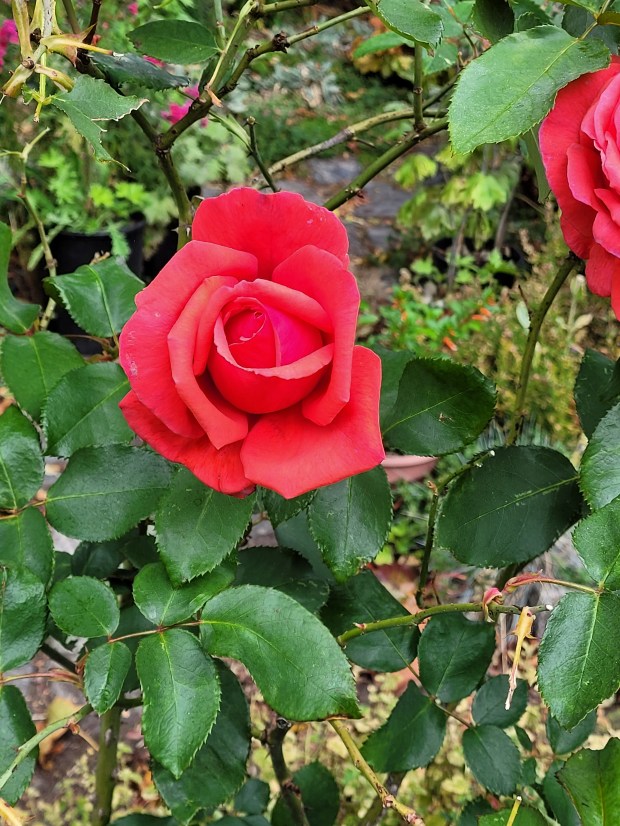
First, my rather feeble (because it’s on its own roots, not grafted) rose, “Fragrant Cloud,” with what are likely its last blooms of the year. Since spring, it was mostly defoliated twice because of black spot and partially eaten by a trespassing deer in August, but managed to produce good foliage and seven buds in September.
Second, a bouquet of pruned branches from the Smoke Bush (Cotinus coggygria) “Royal Purple.” Due to a less than optimal planting spot (too shady), this shrub produces long, whippy branches that get in the way of an adjoining walk. I finally got around to trimming it a few days ago.
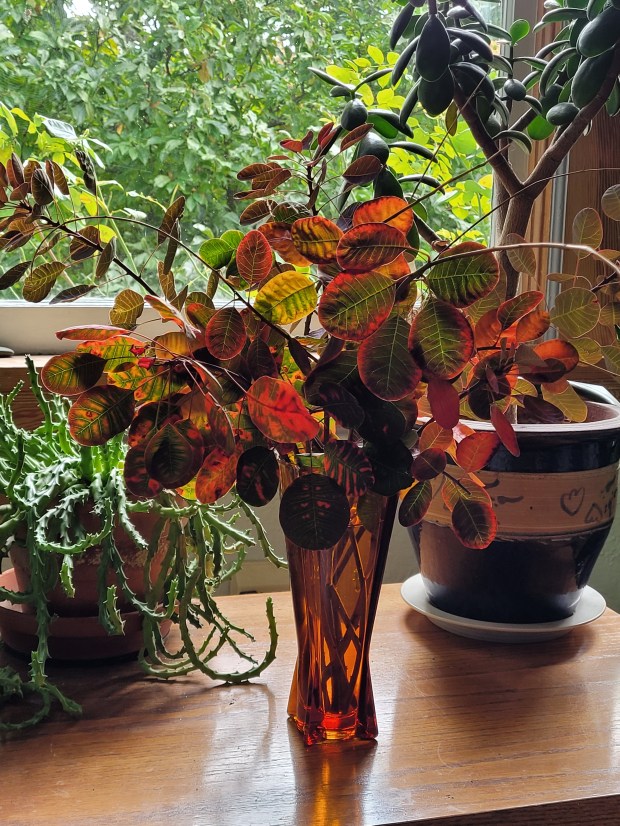
Autumn isn’t a recommended time to prune shrubs, but I decided to experiment. I do love the colours and patterns that develop on this plant’s leaves in the fall, so I brought a selection of smaller branches inside and stuck them in a vase. They look good in the weak sunlight coming in through the window.
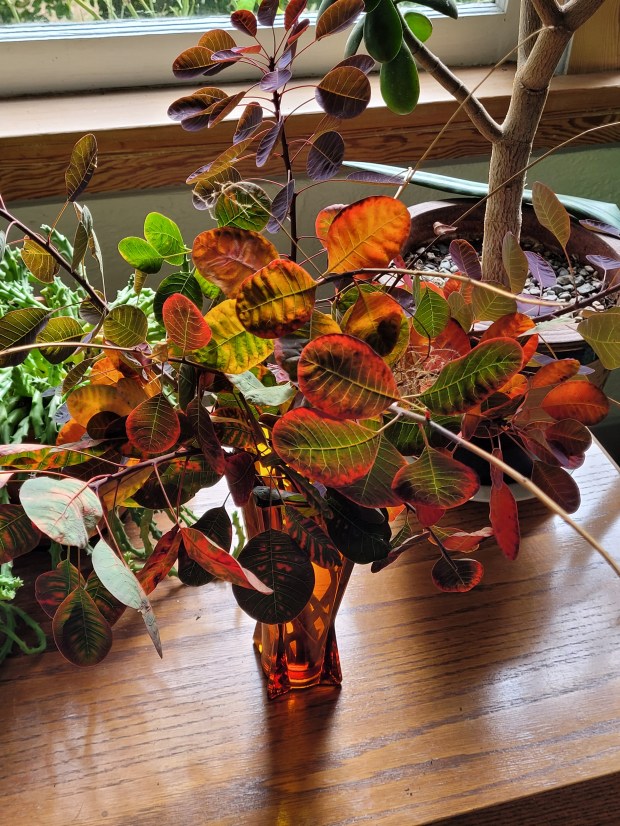
I can admire the leaf colours without going outside and around the corner of the house to visit the Smoke Bush itself.

All photos by Audrey Driscoll.

Urban deer (doe)

Everything Eats!

It’s a fact of life that all animals (including humans) must eat. No eating, no life. But for some reason, in my garden this spring more plants than usual have been gnawed, nibbled, and chomped.

To wit:

  • A small plant of Rosa chinensis “Mutabilis,” purchased last summer and carefully planted in autumn, was chomped to 2″ above ground level last winter by a deer who found its little green twigs a nice snack. It survived and is even blooming now, but it’s half the size it should be.
  • The potted delphiniums sprouted out beautifully, but sparrows decided their new leaves were a delightful salad green in March. Netting to the rescue!
  • A tomato seedling was reduced to a stub by a slug whose presence in its pot was overlooked by the gardener when lugging the pots inside for the night. Amazingly, the seedling survived and has actually sprouted a new leaf, but I don’t think it will fully recover.
  • A group of sunflower seedlings vanished overnight, eaten by something. Fortunately a couple of new ones sprouted late and survived.
  • Siberian and Pacific Coast irises budded up nicely, but several buds were found on the ground or hanging by a thread, victims of so-called “climbing cutworms,” which are actually larvae of various moths. Like the other eaters, they dine at night. They don’t eat the flower buds themselves, but chew through the stems just below the buds. For some reason this is especially infuriating.
  • The rose “Fragrant Cloud” for once escaped defoliation by black spot and developed several buds earlier than it ever has. Unfortunately, something drilled holes in a couple of them. Aphids invaded the holes and ants showed up to manage the aphids. Needless to say, the resulting flowers were rather poor, but there are some healthy buds developing now.
Flower of rose "Fragrant Cloud" damaged by bugs
O Rose thou art sick.
Image from Wikimedia Commons

All this eating had me self-castigating for carelessness and resorting to defensive measures: grinding Perlite to use as a gritty deterrent around irises, lugging pots into the shed every evening, squirting deer repellant, and creeping around at night armed with a flashlight and scissors, looking for caterpillars. I dispatched several, and most of the irises bloomed well in the end.

Blue bearded irises

Thinking about it, I’ve realized a few things:

  • It’s not surprising that the fresh growth of early spring coincides with the emergence of life forms whose sole mission in life is to eat until they move on to the next stage, which is to reproduce.
  • Buds are high-value items. Plants put a lot of energy into buds, so it’s logical that they would be targets for eaters.
  • Once leaves and stems toughen up, they are no longer of interest.
  • It’s a good idea to plant a few extra seeds, just in case.
  • Most plants survive.
Back garden August 2021

Summer’s Finale: Rose, Lily, Dahlia

Fall (autumn) is almost here. We have had actual rain in the past week, and more is predicted. I am no longer a slave to the hose and watering can.

Here are some photos from August, which is usually a dismal month in the garden–tired, seedy, and dry. This year, despite the heat dome of June and hardly any rain, the scene was blessed by three plants: the rose “Fragrant Cloud,” happy in its new big pot, two plants of the dahlia “Bishop of Llandaff” (also in pots), and a couple of late-blooming white lilies (grown in half-barrels). That’s the secret: pots (and the gardener with the watering can).

Rose "Fragrant Cloud" August 2021
White lily closeup August 2021
White lily and pink African violet indoors August 2021
Dahlia "Bishop of Llandaff" August 2021
Dahlia "Bishop of Llandaff" closeup August 2021
Japanese Painted Fern (Athyrium niponicum) and yellow leaf August 2021
Fall begins. Autumn arrives.
Back garden end of June 2021

Strange and Wonderful

We’re roasting through another heat wave on the west coast. Here are sights from the garden in July and so far in August. First the strange…

Rose "Fragrant Cloud" bloom bleached by sun during June 2021 heat wave
Flower of rose “Fragrant Cloud” bleached by the late June heat wave.
This is “Fragrant Cloud’s” normal colour
Battarrea phalloides mushroom with trowel for size comparison July 2021
The weird dryland mushroom Battarrea phalloides is back again this summer. (The trowel is there as a size comparison. It’s about 8 in. or 20 cm.)
Borage flowers from above July 2021
Borage flowers viewed from above. Sort of an art nouveau effect, I think.
Windblown cloud or maybe contrail July 2021
A wind-sculpted cirrus cloud (or maybe a contrail.)

And now the wonderful…

Borage flowers July 2021
Borage flowers
White Lychnis coronaria and Beach Pea (Lathyrus japonicus) June 2021
White Lychnis coronaria and beach pea (Lathyrus japonicus). Two quasi-weeds having a moment.
Japanese painted fern (Athyrium niponicum) and orange daylily
This Japanese painted fern (Athyrium niponicum) has outdone itself again this summer.
Heuchera "Timeless Orange" with leaves coloured cream, yellow, orange, and red
Heuchera “Timeless Orange” showing leaf colours other than orange.
Pink oriental lily from mixed batch August 2021
Another lily from the impulse buy mixed bag of bulbs.
Dahlia "Bishop of Llandaff" August 2021
Dahlia “Bishop of Llandaff.” The flowers glow wonderfully just about sunset, but the camera doesn’t pick that up as well as I’d like.
Pink dahlia flowers August 2021
The Nameless Dahlia in fine form.

That’s it for now. Tomatoes are ripening; with luck they won’t roast on the vine.

Late Summer in the Garden

August is not this garden’s best month. Since I no longer have a vegetable patch, I don’t experience that plentiful harvest thing. Except for tomatoes. I grow them in pots, and this has been quite a productive year.

August 24, 2014

Otherwise, things have that dry and rattly look.

August 21, 2014

There are a few exceptions.

Dahlia "Bishop of Llandaff" and Delphinium in new flush of growth

Dahlia “Bishop of Llandaff” and Delphinium in new flush of growth

August 9, 2014

Today I saw developing buds on my Chinese witch hazel. One branch has managed to grow into a spot that gets a bit more sun than the rest of the plant, and so will bloom next winter. The Convolvulus sabatius I thought was killed last winter is alive and well (although small), and yesterday I potted up seedlings of Gaura lindheimeri. Now the trick is to get them through the winter. For some reason I have had trouble with this plant in recent years. I don’t know if it’s because of late cold snaps (such as last February’s -9 C) or excessive wetness in the dormant season. I do have more seeds if this batch fails.

I see I have mentioned winter several times in this post about late summer. Yes, I am actually looking forward to winter, which here is green and wet, a refreshing change from endless sunshine and drought. Before that, I hope, we will have the delightful season I think of as spring-in-fall, with shorter, cooler days and rain. Many spring-blooming shrubs put out a few blooms then and the garden seems to sigh with relief. Certainly the gardener does.

My “Fragrant Cloud” rose (a rather feeble specimen growing in a pot on its own roots, not grafted) escaped being eaten by deer this summer, so is blooming again.

Rose "Fragrant Cloud"

Rose “Fragrant Cloud”

These dark red sedums have likewise been spared by deer, even though they are in the unfenced front garden. It seems to me that deer have distinct preferences;  a couple of years ago sedums had no chance, but these have been blooming for weeks.

August 15, 2014