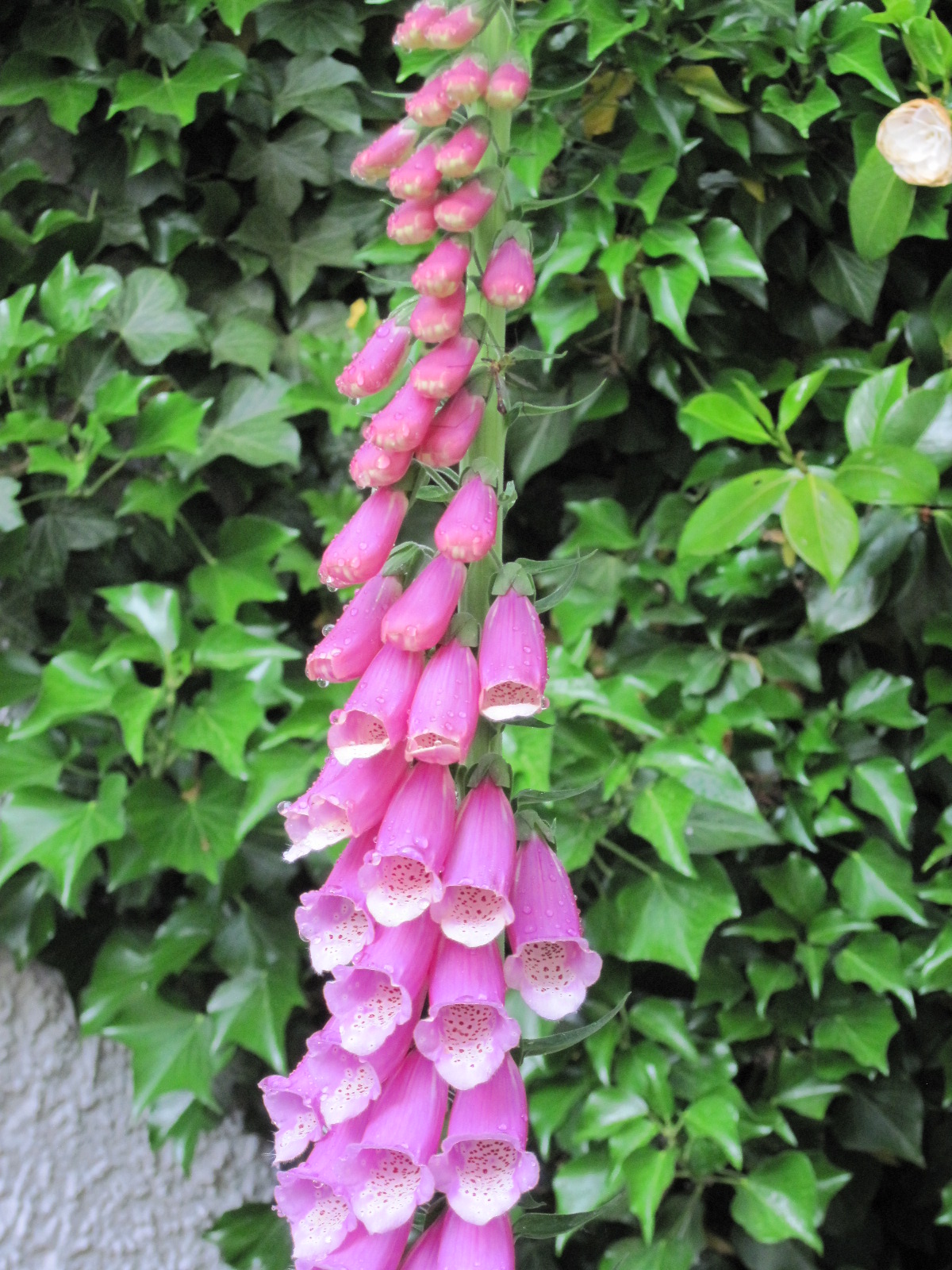
Digitalis purpurea

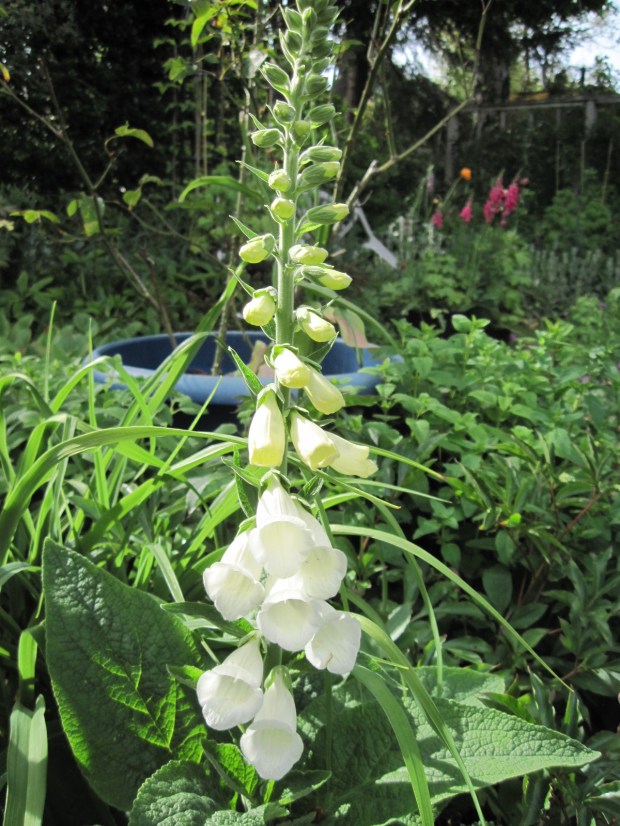
Two white foxgloves and one light pink foxglove

Are All “Alien Invasive” Plants Bad?

Foxgloves are beginning their bloom season in my garden. But guess what? Foxglove (Digitalis purpurea), that easy yet elegant and somewhat mysterious plant that blooms in mid-spring, has been declared an alien invasive in British Columbia. Some cities have actually banned its sale at plant nurseries.

Now there is a debate among gardeners: should we dig up our foxgloves and trash them, or should we surreptitiously share seeds and plants with those who can no longer buy them?

My thoughts: most suburban gardens are situated on ground that has been disturbed and altered from its natural state. They are full of non-native plants of all kinds. Aggressive invasives like English ivy, Himalayan blackberry, Daphne laureola, and Scotch broom are all over the place. Those are shrubs that spread relentlessly and are almost impossible to eradicate. Bindweed (Convolvulus species) is a herbaceous weed, but with roots that reportedly go metres into the ground, it’s indestructible. Unfortunately, it’s permanently established in the weedy grass of the municipal boulevard in front of my place.

Foxgloves, on the other hand, are herbaceous biennials that are easily lifted and pulled out. Deadheading by cutting down the bloom stalk before seeds mature prevents self-seeding. If it does occur, diligent weeding of seedlings will eradicate them in a season or two. In disturbed environments, a few foxglove plants added to the mix do no harm. Anyone who has them in their garden and likes them should grow them without guilt.
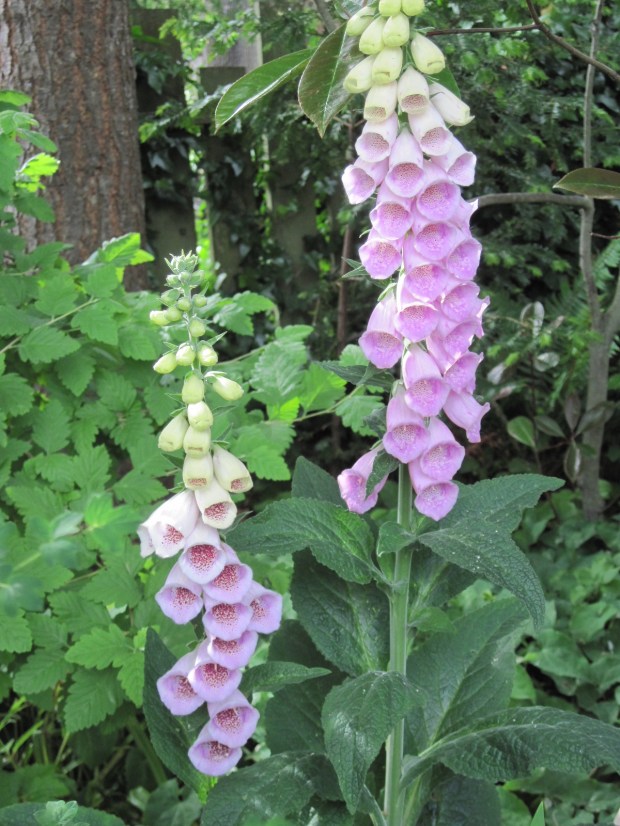
Pink foxgloves with dark spots, May 2025

Side note: notice how often invasive plants are given a geographic moniker. “English,” “Scotch,” “Himalayan,” etc. Sort of like contagious diseases named for the places in which they were thought to originate. Spanish flu, Lyme disease, German measles, etc. Same idea, perhaps: name the place responsible for the menace.

I remember a drive in my region one spring, along old logging roads. Foxgloves were in gorgeous bloom along those roads, a magical sight, but also a perfect example of why they have been given the alien invasive designation. Those roadsides are also full of Scotch broom, which is a much more serious invasive. It’s a shrub that produces an abundance of seeds that persist in the soil for decades. And former forests that have been clearcut aren’t exactly healthy ecosystems.

Those whose gardens impinge on natural areas or already contain mostly native plants obviously should not introduce alien invasives, including foxglove. Anyone doing an ecosystem restoration project would obviously remove all introduced non-native plants. But those of us who garden in places already full of alien plants need not worry about foxglove.

I’m a bit amused by one of the arguments against foxglove: it’s extremely toxic, we are told. One of the alternatives suggested is monkshood (Aconitum species). Fine, except monkshood is also extremely toxic. And let’s face it—both plants must be ingested in order to poison someone. They aren’t toxic on contact, like poison ivy, and they don’t jump up and force themselves down anyone’s throat. Even kids aren’t apt to eat them; plants with poisonous berries are more of a problem there.

One of the interesting things about some of the frowned-upon alien invasive plants is how many of them have received the Royal Horticultural Society’s Award of Garden Merit. Okay, I understand that some of these plants are native to Britain or Europe, and are only alien in North America and other places outside of their countries of origin. But that is definitely a mixed message!

Photos by Audrey Driscoll

Three white foxgloves with one pink in background and blue peach-leaved bellflower in foreground

My Tough Plants #8: Foxglove

The common or purple foxglove (Digitalis purpurea) is yet another of the quasi-weedy plants that grow well in my garden. It tolerates shade and dry, rooty soil, and is of no interest to deer (likely because the plant is somewhat toxic).

I have a bad habit of allowing volunteer seedlings that pop up in pots to grow, at least until I can see what they are. Unfortunately, if the seedlings are plants I value, I’ve sometimes failed to remove them from the pot until they’ve grown enough to cause problems for the pot’s legitimate tenant.

This happened a couple of years ago when foxglove seedlings appeared in several pots. By the time I knew I had to do something, they were quite large. I had to turn out both the freeloading foxgloves and the intended pot-dwellers and separate them. Rather than dump the foxglove plants into the compost pile, I planted them in several spots around the garden. I watered them in when I planted them, but otherwise gave them no special attention. In their resilient way, they settled in nicely.

Two white foxgloves and one light pink foxglove

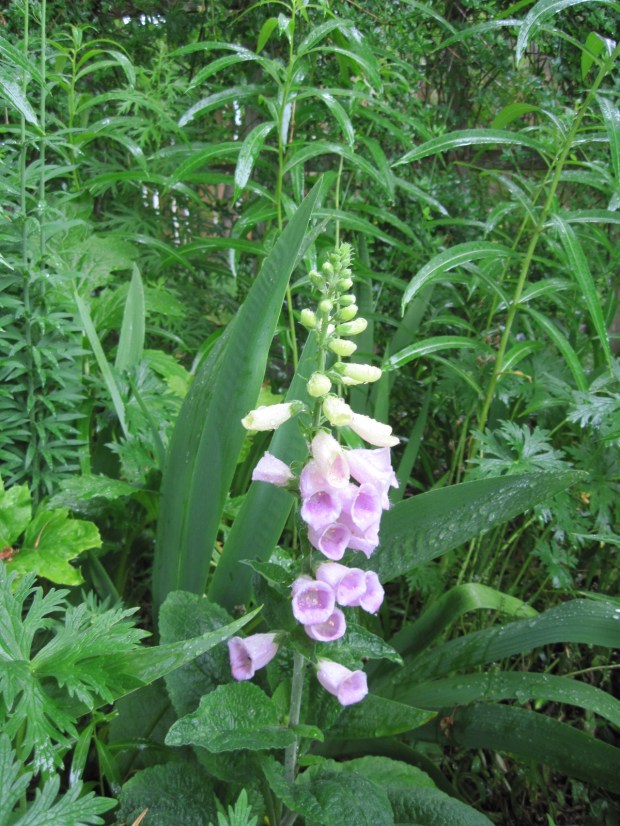
This year they are blooming well. A surprise is that most of them are white or pale pink, rather than the usual strong reddish purple colour. I know I did allow seeds to ripen on the occasional self-seeded plant with white flowers, so some of them must have found their way into the compost, and eventually into the soil I used in the aforementioned pots.

White foxglove May 2025

This experience with foxgloves, as well as my photos, shows how versatile and useful these plants are in gardens with less than ideal conditions. Plant breeders have “improved” on the species, so there are named varieties available, but I admit I have no experience with them. From the variety of colours and patterns among the plants I have this year, I see no reason to seek out cultivars which may not be as reliable as the common species. (I do have another member of the genus in my garden: Digitalis lutea, a much smaller plant with yellow flowers.)

Light pink foxglove May 2025

Foxgloves are biennials. They grow a rosette of basal leaves the first year and bloom the second year, after which they generally die. I have had the odd plant that persists for a third year, but this can’t be relied upon. To ensure its presence in a garden, foxglove has to be replenished by new plants or from seed.

The casual way to do this is to allow self-seeding or to distribute seeds in selected areas of the garden by waving stalks of ripe seed pods over them. I’ve tried this, with mixed results. Either because of dry summer weather here, or because I spread compost around the beds in spring, foxglove seedlings don’t dependably survive. A methodical approach would be to save seeds, plant them in flats or pots, grow them on, and set them in permanent spots in late summer or early autumn.

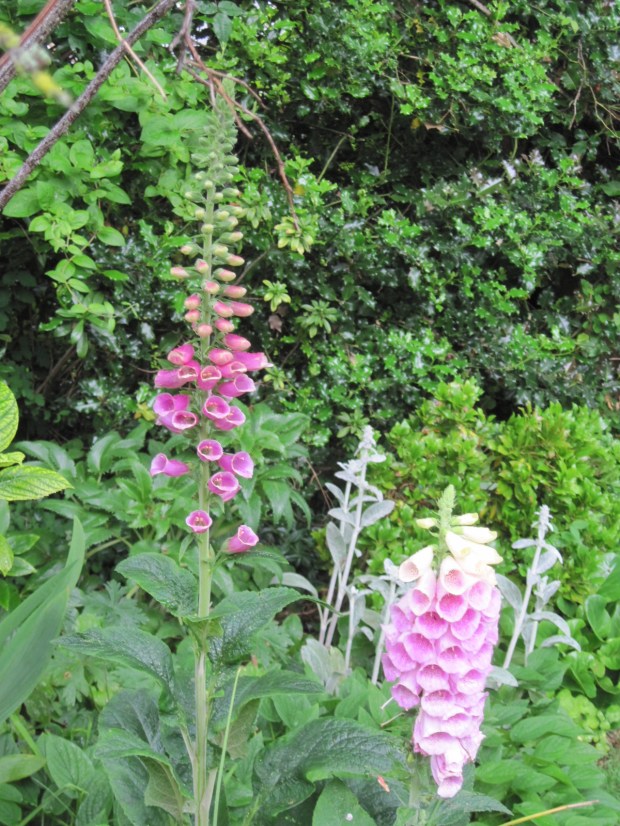
Two foxgloves, one dark pink and the other light pink

A compromise would be to watch for foxglove seedlings in pots housing other plants, removing them carefully, and proceeding as per the methodical procedure. This works for me because I put spent foxglove bloom stalks in my compost, and then incorporate said compost into soil for pots for tomato and pepper plants. Germination is reliable in the moist soil in the pots and I’m sure to notice the seedlings. The trick is to remove them sooner rather than later.

Pink foxgloves with dark spots, May 2025

Digitalis purpurea has been designated an alien invasive in some places, including British Columbia, Ontario, and the US Pacific Northwest. I have a memory of driving along a disused logging road west of Victoria in June and seeing lovely displays of foxglove along the roadsides. Although the area looked garden-like at the time, I don’t think it’s a good idea to introduce foxglove into places that don’t already have it. It’s best to cut down the bloom stalks before they go to seed; they do look pretty ugly once all the flowers are done. Judicious self-seeding as described above is okay in gardens that already harbour non-native plants of all kinds.

The plants are toxic to humans and animals, but no one is likely to eat them, and the plants do not attack people and force themselves down their throats. As far as I know, foxglove is harmful only when ingested. Foxgloves don’t have berries that might attract kids, only a papery capsule full of dust-fine seeds. Deer and rabbits know enough to avoid eating them.

I wrote a short story called “Fox and Glove,” in which the plant plays a role, along with several characters from some of my novels. It may be found in Tales From the Annexe.

All photos by Audrey Driscoll

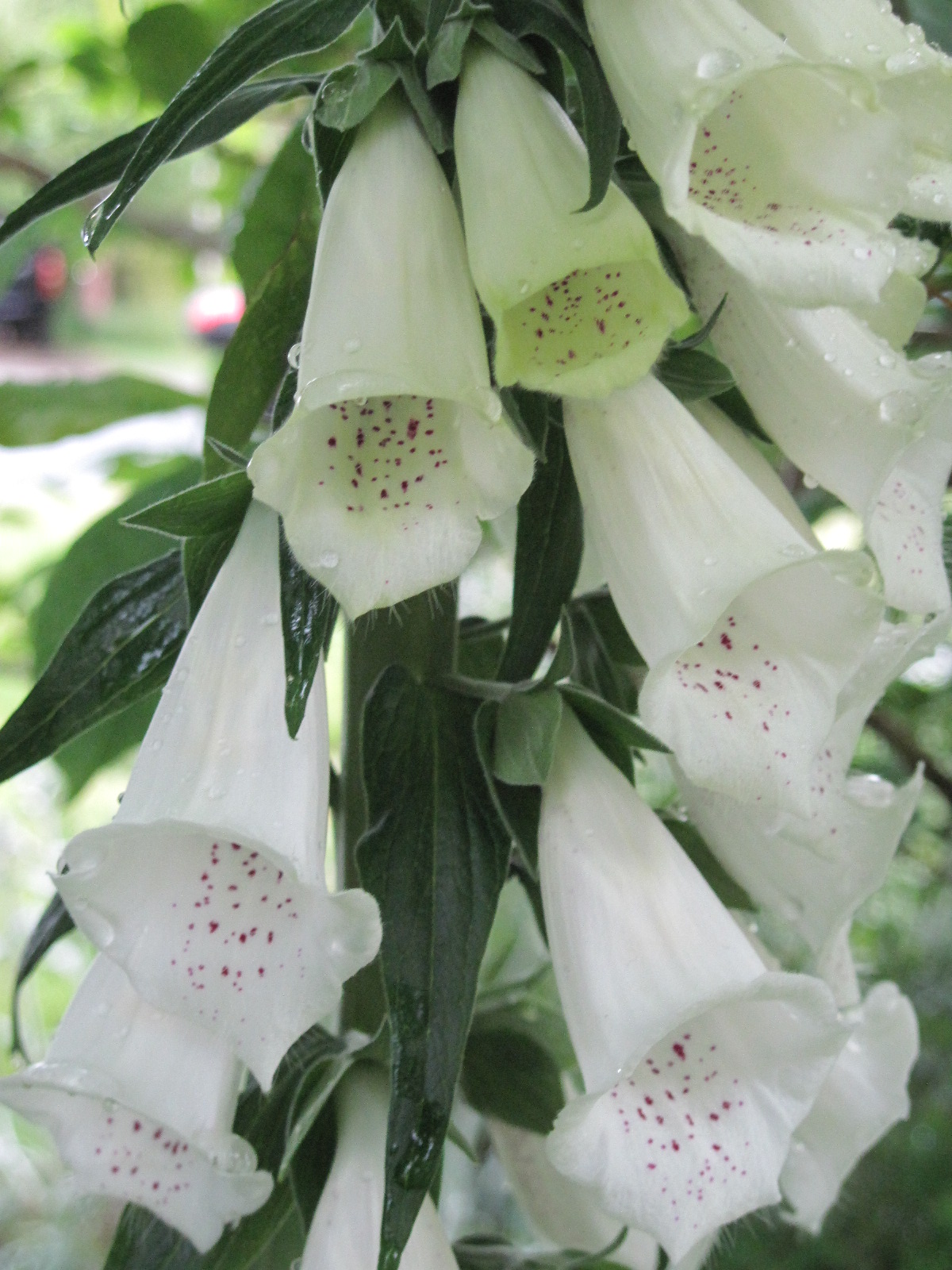
white foxglove, Digitalis purpurea

Foxglove Falsehood

I know I read somewhere that the flower colour of a foxglove (Digitalis purpurea) plant can be predicted by the colour of the leaf stems (petioles). Foxgloves are biennials; they flower in their second year of life, and then they die. Their normal flower colour is a reddish purple. It’s fairly attractive, but not nearly as elegant as the white form. Fussy gardeners who prefer the white form would therefore want to know which of a batch of seedlings would be likely to produce white flowers the following year.

If the leaf stem shows purple, I understood, the flowers will be purple. Plants with pale green leaf stems are more likely to produce white flowers. Going by this, I picked out a number of seedlings several years ago and planted them around the place. A few of them did turn out to have white flowers, but not all. Some produced blooms of a pale, washed-out pink with nothing to recommend it, and some were just the ordinary purple shade.

After this experience, I didn’t bother with systematic seedling selection. I simply let a few plants produce seed, and left a few of the resulting seedlings where they came up, in spots where a foxglove would be an asset to the scene.

Right now, I have two foxgloves with white flowers. The biggest and most impressive one has dark purple leaf stems. So does the smaller one.

IMG_2381

Clearly, the idea that leaf stem colour predicts flower colour is dead wrong.

IMG_2382

Just for fun, I checked the leaf stems of a rather impressive purple foxglove also in bloom now.

IMG_2384

Its leaf stems have only a slight tinge of purple. If I had looked at them before the plant bloomed, I would very likely have predicted pale or maybe even white flowers.

So much for that notion. Consulting that fount of info, Wikipedia, I find this in the article on Digitalis purpurea:

The colours of the petals of the Digitalis purpurea are known to be determined by at least three genes that interact with each other.[6]

The M gene determined the production of a purple pigment, a type of antocianin. The m gene does not produce this pigment. The D gene is an enhances of the M gene, and leads it to produce a big amount of the pigment. The d gene does not enhance the M gene, and only a small amount of pigment is produced. Lastly, the W gene makes the pigment be deposited only in some spots, while the w gene allows the pigment to be spread all over the flower.

This combination leads to four phenotypes:

  • M/_; W/_; _/_ = a white flower with purple spots;
  • m/m; _/_; _/_ = an albino flower with yellow spots;
  • M/_; w/w; d/d = a light purple flower;
  • M/_; w/w; D/_ = a dark purple flower.

If I could understand the above and make practical use of it, I might be able to predict flower colour in foxglove seedlings. I’d probably get more white flowered plants from my self-sown foxgloves if I pulled up any purple types before they reached full bloom, so as to keep their pollen out of circulation. But I am constitutionally incapable of pulling up (i.e., killing) any plant that is vigorously growing and about to bloom. I even have trouble dispatching certain weeds. So I’m not likely to go around “roguing out” any purple flowered plants if they look good.

In the meantime, I’ll enjoy the blooms I have, and let the white one (which, according to the above, is the white with purple spots phenotype) produce seed. Foxgloves seed like crazy. I’ll harvest a small quantity of seed and sprinkle it around the garden, and in 2019 I’ll see the results.

Update: another, rather small, foxglove plant has since bloomed with white flowers. These are pure white, and without spots of any kind. And the leaf stems are very pale green, without a trace of purple. So now I’m wondering if the leaf stem colour is somehow linked to the colour of the spots within the flower. Observing stuff like this makes gardening — even with common plants — interesting.