Showing posts with label marijuana. Show all posts

Friday, January 18, 2019

The cruel, cruel things we did to LAST SUMMER (1969)


There's ever so often I catch even a time out critic evincing he's not seen the movie he's capsulizing, as in the Time Out Britannia entry on LAST SUMMER (1969), which calls it "winsome," and notes 'typical lessons are learned"? Oopsy-daisy. Either he's one sick British puppy or he's hearing the title and painting a very different sort of beach idyll in his mind. Sure, there's lessons learned in Frank and Eleanor Perry's sneakily devastating adaptation of Evan Hunter's novel, but calling them typical is like calling Hitchcock's The Birds (which Hunter scripted), an 'ornithologist's bayside holiday.'

I don't blame that writer; he probably couldn't find a copy of the film when he was assigned it, and needs must when the devil drives. To my knowledge it's never been on any official DVD or tape, in fact I'm not even sure where Max got the copy I duped that we watched so religiously during one of our drunken LBI summers back in the early 90s. I may not have a copy today for reference, or have seen it once sober, but I can attest: there's nothing idyllic or remotely typical about Last Summer, unless Over the Edge and Don't Deliver us from Evil are just like landlocked versions of Gidget and Beach Party. Can you imagine? This critic might remark that Evil is the tale of two good Catholic BFFs and their summer journey of emotional maturity, leading up to an incendiary talent show poetry recital, and Edge is about a group of kid activists fighting to save their after-school arts program. Those descriptions are both true, in their way, but so misleading.

On the other hand, misleading surfaces and morality drifting astray on invisible currents, is what LAST SUMMER is all about. It turns out to be so easy to drift away on Where the Boys Are down rip currents, invisible to the naked eye, never giving the feeling you're moving down the beach at all, and finally wash ashore by the Last House on the Left. How the hell does that happen?

The tale of three (and then four) privileged youngsters left to their own devices on Fire Island (?) over the summer, Last Summer builds to its evil gradually, to the point where our own giddy love for Scorpio-Pisces mayhem is used against us. There's sexual assault, menage a trois cinema groping, evil-confessing, seagull sadism, the kind of things kids grow up to either regret, repress, forget, unless it turns them permanent sociopath. The story of two blonde beach bum rich kids who meet and bond with a bad influence girl, who manages to keep them both turned on and that sex drive sublimated into evil decadence, and the fourth wheel downer who comes to stay, like an annoying kid sister who always threatens to tell mom.

It stars Bruce Davison and Richard Thomas (a long way from John Boy, not that, thank god, my parents ever watched that show) as a pair of beach-loafing buddies (no parents in sight) who find a wounded sea gull and Barbara Hershey all in the same day. What a break! Together the three generate what Max's mom once said about us, down on those wasted LBI summers: "a bad influence on each other." As with Eric Rohmer's summer holiday idylls, sexual tension generates in real time over whole reels, until when it finally cracks open you feel weak in the knees. As with a more decadent European 'sexual idyll' swooner like Jean Rollin, a sense of impending doom, a naturalistic series of ambiguous omens, conspiratorial glances, and burst of random hostility amidst the hypnotic momentum, reminds us constantly that the ocean is a demonic bad influence friend itself. And I love that, unlike so many beach movies, it also rains some days. During a protracted, masterful sequence, the threesome stay indoors while it rains and wash each other's hair, smoke weed, and let the air of existential melancholy that a rainy afternoon on the beach can bring wash over them. Dude, so been there. A terrible time to take acid, let me tell you. 

Max and I, during those LBI summers, had a few different girl partners in crime but our serial monogamous hetero chastity was ironclad. Alcohol only made us even more gallant. But I was later lured into latent evil via a beautiful Scorpio woman in AA, so I know how intoxicating it can all be even without drinking. 

At any rate, in 1991 this movie was the perfect thing to watch on a rainy hungover Wednesday LBI morning, drinking gin and Strawberry SlimFast while recovering from the previous night's long iguana of a night. The lagoon-side of the island gently lapping our brains into something like a parasympathetic rhythm, we loved this movie because we well knew the way the right girl could ignite all sorts of ballsy courage and decadent mischief in the right pair of unemployed but well-stocked bandmates. You could alienate all your (real) girl friends and most everyone else over a single weekend. And you'd just laugh evilly, a kind of Cruel Intentions' ghosts of Vicomte Valmont and the Marquise de Merteuil possession you were too drunk to fight (or too sober to remember)

Taken together, the right threesome can melt the rest of the world clean away in a haze of cigarettes, highballs, the psychedelics always wearing off or about to kick in. In that lifestyle one is always either coasting on the fumes or anticipating the next refill, but one is never completely sober. When someone else enters into that unholy threesome, and they cannot or will not party? Pity them, lord, for they shall be doomed to rot in hell, unless of course they're even more decadent than we are. Chances are they're just putzes who totally don't get it. 

Pity them but not to the point of inviting them.

With its great naturalistic dialogue, the success of Last Summer lies largely with the tight small ensemble cast keeping the peripheral squares at bay. It starts innocently enough, trying to save a seagull with a fishhook caught in its mouth. Their shared empathy with the bird will gradually be inverted by the stunning ending, but for now, their good deed gives them a kind of holy trifecta aura that evokes among other similar triads, like the trio dancing the Madison in Godard's Band of Outsiders (1964).


 Just mentioning rabies (if the wounded gull bites one of them), Sandy says "oh rabies my ass." Today the boys' shared smirk over her using the word "ass" might seem odd, as if they're already plotting something at the mere mention of a body part, but in the context of its era, children using this word (or any 'bad' word) in public was the equivalent of what in the 80s would have been mentioning she had weed (the anti-drug hysteria of the time was so insane that lighting up became an act of political solidarity). (1) It ends, well, no spoilers, but lets just say it ain't the 60s anymore. 

Last Summer isn't a horror movie, or a ponderous piece of 'art' either, neither surrealistic or weighty. Like Over the Edge it fools you by slowly winning you over to its protagonist's perspective which, considering their youth and the absence of strong parental guidance, is a dangerous place to be. If you grew up watching 'After School Specials' and 'safety films' on 16mm (while in class), then you were accustomed to the feel of Last Summer--but it's a cautionary tale without a narrator, or a moral, or a parent, it trusts we don't need them. Like the girls doing their Baudelaire routine in Don't Deliver us from Evil, all the movies we've seen in the past make us blindsided by a whole new swerve. If you're like me, you are highly susceptible to the 'bad influence' of any intelligent, gorgeous young person who falls into your circle. Even just as a friend, they give you a kind of high-octane cache that can cause latent Mean Girls-cliquey kind of giddy moral blindness.

The cast is all set up for menaga-a-trouble, Design for Living-style. As Peter, Richard Thomas's sadistic demonic eyebrow arches convey a real, deep propensity for evil that runs deliciously counter to his Waltons good boy warmth. But it's more than stunt casting. He conveys a real sense of nurturing and natural leadership without ever seeming older than he is. But it's a warmth made all the more dangerous by the eerily self-confident sociopathy lurking below the surface smile. The sweeter he is, the more you feel there's a reverse action building. We watch the demonic glint wax and wane in his eyes like a sinister but enticing moon.

As the smirkier blonde beta male, Dan (Norton) on the other hand, keeps his guile exposed and ever a bit sophomoric. While Peter is the type of character who won't strike until he's got the girl all but naked in his bed already, Dan plays the numbers game, so used to rejection he's built up a tolerance, to the point he wouldn't know what to do if he got one.


Lighting the fire is the new girl Sandy (Hershey), ever eager to seem more mature than she is through expressive "language," relishing the combined attention of these two blonde troublemakers. The love she shows to them, mainly to Peter, while they both lay on her lap, for example, listening to sitar music and getting high, creates a seductive bubble; the sound mixing gamely captures her whispered sutbtle breathing almost in ASMR cocoon we can feel. We're smitten; we're there; there's no lumpen Catherine Burns to drag our locus of identification kicking and screaming back to the loser's table. Not yet. 

Together, their sublimated sexual energy is a force first of good (rescuing the gull from the hook) and then, through misuse, the sublimation wanes and the fermented passions bubbles up like oil seeps. Using a kind of loose cycle incorporation of tricks perhaps gleaned from Miriam Hopkins in Design for Living, she avoids breaking up their friendship by never picking one or the other ("no sex!" - though in this case pretty close, constantly) or risking her own ostracization by either choosing or rejecting either one, rather the cycle of move-busting runs from Peter to Sandy to Dan in a continuous loop that garners intense energy as it goes. Naturally it has to find an outlet, like Sandy luring a slightly older hispanic man via personal ad on a date, tricking him into his doom at the hands of some local racist toughs.

Everyone is excellent in their naughty conspiratorial whirlwind of sexual sublimation-amped mischief; but then Catherine Burns comes loping along the lonely beach, appointing herself the ugly duckling fourth wheel. It's only during that rainy afternoon after the three of them lost in pot and hair washing that they're ready to actually pay attention to her. With a single long monologue (that led to an Oscar-nomination), recounting the last hours of seeing her mom alive --at a cocktail party that's been raging at their house for days--Burns hypnotizes us and them so completely that by the time she's done you can smell the liquor on her mom's breath, the reek of sand, alcoholic pores, cologne, sexual heat, and ocean brine, the stale cigarettes, and--finally--a fatal misjudgment of impaired motor skills that led to mom's death. 

And it's this tale (notably of mom's decadence rather than her own), set to the melancholy ominousness of the rain outside, that's just enough to get her through the door into the threesome's evil club. But then they don't know any other way to either shake her off or get her to loosen up and stop cramping their style than what they inevitably, shamefully, do. Because even though they thought, after their dope-enhanced empathy with her plight, that they might turn her bad like them she just wont quit her glum whininess. 

you know if you're an alcoholic if the first thing you notice in this pic is the (upper left) Heineken

No matter how many jump cuts from the trio's galavanting around Fire Island, the slow simmer hypnotic Baudelaire-ian budding evil of Last Summer never skips ahead. That's one of the reasons I love it, and maybe why it confuses Time Out critic so much -- it pulls off the seduction into irrevocable evil better than any other film that comes to mind, yet without ever jumping the groove of its languid beach rhythm: you can hear the waves--or if not, the faint sound of rain--in every scene. The ocean becomes like "Trevor" in The Wild Boys)! a demonic possessor, and rather than point fingers, or spread feel-bad trauma, it points out we hold on to the 'magic' of childhood at our own peril. As long as we're too small to do any real damage, nature's sociopathy flows unchecked; carry it over into adulthood, and we're going to jail.

It all makes me wonder--as I wonder with other genuinely subversive films and TV shows--if that's the reason it's unavailable (there's not even a thumbnail of it on Amazon!). Rather than rant and fume against frat boys I am forced to examine my pwn past behavior that--at the time--seemed wholly justified and awesome--especially with a Cruel Intentions marquise in my corner urging me on--but which--of late, especially--hang in my conscience. A douche bag is a douche bag, regardless of mutual consent and vehemence of one's momentary delusion that it's ever "just" sex.

Wherever the licensing keeps it from being on Blu-ray, no matter how much it looks 'winsome' on the surface, it's a film every young punk should see, for the "lessons learned" are vital. The film itself lulls us into a rhythm we're seduced by, so that when the slow erratic buzzkillery of Burns enters, we're almost privy to the wild demon that drives us to try and make her wake up and walk with the fire so we can get back to our dirty little round robin thrills without a safety-first Clyde dragging the mood down.

At the end there's still no adult in sight to shame them, but it's clear they don't even need one. These
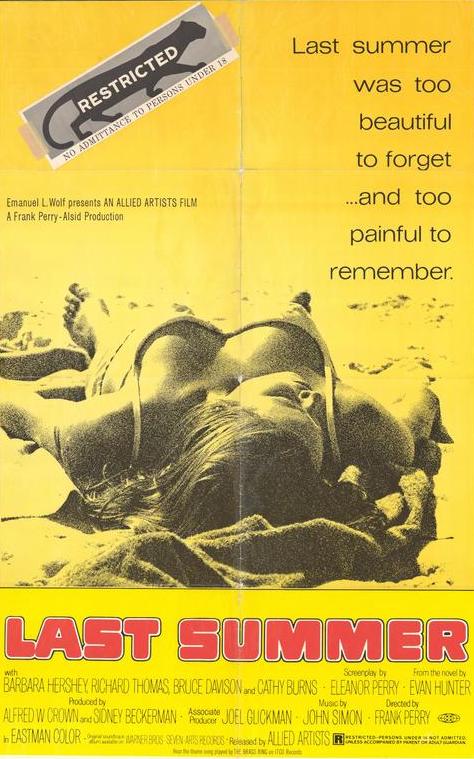
are 'good' people, usually. But they drank "truth serum" together - they fell in love as one person, and lost their connection to the consequence-ridden world. As the poster says, this summer was "too beautiful to forget... and to painful to remember." Like the first sudden gust of evening hitting your sunburned skin after a day on the beach, a sickly early fall chill runs through all concerned. The leaves can't cover their bodies fast enough to keep out the sudden, irreversible cold.


NOTES:
1.In the 60s and early 70s (I remember when the word 'suck' was first being used as a negative, i.e. 'you suck' - in fact I think I was in first grade with the girl who started it, referring to someone so immature they still sucked their thumb - in fact it was associated with the word "still" as in latency - ala "that girl Lisa, I bet she still sucks" It wasn't "you suck" but "you probably still suck" as in get the thumb out of your mouth. This was a time when 'bad words' were genuinely bad. We'd whisper them under our breath to shock each other, and then only with people who wouldn't tell on us. If you doubt, just watch Burt Reynolds movies from the mid-70s and listen for the pause (for audiences gasps and hoots and howls) at the end of every four-letter word. Just saying "Shit!" would bring the house down (one of the reasons people fainted at the Exorcist)

Monday, December 02, 2013

CinemArchetype #26: The Stoner


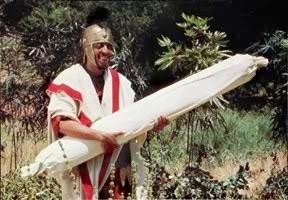
A sub-phyla of both the Hanged Man and the Holy Fool, the Stoner is both wasting their life and found nirvana. As holy as the Dali Lama, as singular of purpose in their mission as the Pope, and as frozen at the yellow wood road's fork as Travis Bickle or the Scarecrow, cometh, in his fashion, the Stoner. As lost as their or any generation will allow, if we liberal arts undergraduated within the prescribed four years at college, we weren't one of them. Somehow that's the only marker I can find to determine the stoner vs. the merely stoned, because I of course made it out in four.

The stoner in Cabin in the Woods was our confirmation that this character was ready to step into the fray, to get a spotlight of his or her own, inspiring my 2012 thesis "A Stoner Shall Rise."

1. Shaggy-- Dude in Cabin in The Woods (2010)

The signifiers and signs of horror (masks, knives, corridors, POV steadicams, phone calls, Martin Balsam in PSYCHO-style unmaskings) are now so beyond cliche they don't even need to be tied to anything substantial having a stoned hipster gesture towards them with his thumb is enough. The hipster's thumb is the new black. CABIN IN THE WOODS (2012) has taken this idea farther than anyone yet this year, metatexually refracting the cliche of attractive high school seniors heading off to the woods for the weekend into Lovecraftian abstraction. And stoners are the inevitable fifth or seventh wheel in such youthful crews, and have been since obnoxious brother in the wheelchair in TEXAS CHAINSAW MASSACRE (1977) first appeared. But he was a goner, always a periphery, but now one shall rise among them. A stoner... shall rise... man and survive, or the past tense, survave, man. And instead of a fifth wheel, lo! The unicyclist.

Yes, horror has recognized in its target audience a common thread that runs counter to general programming, the insider realization that pot protects you from evil. All along we were right to be paranoid, man, and we need Mary Jane's plant power on our side. And as so often happens, this concept is literally true as recent studies show.

What is even more troubling is that the United States Government actually did a secret follow up-study on the Virginia findings, in the mid '90's. When it only served to confirm the results of the 1974 research, and showed that THC (one of the main active ingredient in cannabis – and the one the government loves to hate), when administered to mice, protected them against malignancy, true to form, our government attempted to bury the results. Fortunately, a draft copy of the study was leaked to the journal, AIDS Treatment News, and the media covered the story. An excellent article by Paul Armentano, Deputy Director of NORML, covers this part of our shameful history. (more)

I can't really reveal what happens in THE CABIN IN THE WOODS since 'holy shit! no way! Really? O man!' reactions are so essential, but I will quote Gregory Cwik's article on it in the current issue ofAcidemic's Journal of Film and Media: "..after Halloween was labeled a morality play, its character's seemingly punished for acting immorally, smoking became a death sentence for horror characters. Instead, Whedon's pothead uses his bong as a weapon against the enemy. Maybe its a sign of changes to come." Maybe it is, if we kill enough old people first. You know the types: maybe the pot ban is good for that as so many of them die from being unable to keep food down after chemo. They refuse to smoke the pot that might help with that since it's 'the devil's weed' when all along it was their only true cure. Who's the real devil here, pops? Part of growing up should be the realization you can't believe a word Uncle Sam tells you. If you refused to read that memo, well, Darwinian nature shall take its course. Win-win. If you can't agree maybe you could stand to be higher.

2. Brigitte Fonda - Jackie Brown (1997)
When Sam Jackson's indelible character Ordell Robie in JACKIE BROWN critiques his little surfer girl's habit of being high, he says that shit fucks with your ambition, sitting around smoking pot and watching TV weakens your ambition, she says "Not if your ambition is to smoke pot and watch TV" absolutely goddamn right, sister. I sympathize with a poor recently paroled ex-con Robert De Niro in the film, caught up in her surfer girl stoner orbit, languidly staying super baked, unable to think clearly through a golden calf and green herb combo. I say this because I too have been caught up in such orbits, and Ordell too reminds me of her boyfriend (the chick I'm referring to). Damn man, writing sloppy, it's soo nice, and I can because, dig, you know, the topic.

3. Cheech and Chong, of course
I've never been a big fan, for their humor is way too dumb for me, but it is of its era. They are the groundbreakers, for the likes of Harold and Kumar, films like Half-Baked and How High? And on and on. I'm trying to remember where I know the girl above on the far right from, what other movie where I totally fell in love with her, back in the 70s. Man, brain cells, am I right?

4. Reincarnated (2012) Snoop Lion
(top 3 pictures are also from this film)
A mind that is at once endearingly straight-forward and fathomlessly guiling, it takes a certain forceful naivete to decide to convert to Rastafarianism and drop the dog in your name, switching whole phyla of the kingdom, dig, from a dog to a cat, the sphynx, the smiling sphynx. He hard a childhood, and it's toughened him like teflon; he's split the atomic difference between the clown/serious guy dichotomoy; he's both Chuck D. and Flava, if you will (I'm old school to the point I stopped listening to rap when Dre's "Chronic" dropped. Course by then I'd even graduated from boomerang academy, if you feel me, "fam.'") The funniest part is that during his holy pilgrimage he goes to record in Jamaica's legendary Trojan studios and it's all white hipsters!

5. James Franco as Saul Silver in Pineapple Express
Right?

Saul: I wish I had a job like that. Where I could just sit around and smoke weed all day
Dale Denton: Hey you do have that job. You do sit around and smoke weed all day.
Saul: Hey you're right. Hey thanks man.

He is my favorite of all the stoners on this list, for Franco captures what I can only call the John-ism of the full-time weedbro - not dumb so much as innocent, as if born anew each inhale in the healing reset button of the weed. His friendships in with Saul and Danny McBride reflect the traditional arc of the middle man weed guy - the otherwise normal upstanding broheims and the slightly townier main supplier who is the buffer in turn-usually-with the grower and/or criminal organization who supplies him. He'd be a fool to grow it himself with any frequency, and his pride in having made a new friend, his emotions-on-a-sleeve purity keep him a kind of perennial magic Christian.

6. Alan Alda and Lily Tomlin - Flirting with Disaster
So much...

Mel: You made LSD? Is that what you're saying?
Richard Schlichting: We made LSD.
Mary Schlichting: Yes, yes. We made acid.
Richard Schlichting: And we gave it out to people who needed it. You know that there are hundreds of pharmaceutical executives in this country... that are selling drugs, FDA approved drugs.
Mary Schlichting: On the open market.
Richard Schlichting: Over the counter with incredible side...
Mary Schlichting: Horrible side effects.
Richard Schlichting: Terrible side effects. And these people are not in jail.
Mary Schlichting: They're not in prison anywhere.
Richard Schlichting: They're, they're, they're in country clubs or playing golf. They're having drinks.
Mary Schlichting: They're running the country, Mel.

7. Jim Breuer, everyone - Half Baked (1998)
Course, man! Everyone but the character played by Dave Chapelle, who gives up weed for some animus-dominated straight edge girl who don't understand the value!

Gregory Hines, who understands the value: History of the World Part 1
---

8. Rory Cochrane in Dazed and Confused (1993)
"Behind every good man there is a woman, and that woman was Martha Washington, man, and everyday George would come home, she would have a big fat bowl waiting for him, man, when he come in the door, man, she was a hip, hip, hip lady, man."

9. Michael Caine - Children of Men (2006)
I love so much about this movie, including the careful and accurate attention to proper use of a flask (and why Clive Owen reminds me of me), but the whole "oh man, like no children are being born anymore, so why not kill ourselves." And meanwhile there's immigrant problems and overpopulation all at once? That seems foolish, and very very Catholic, having your "holy mother of God whom I adore I am so unworthy of your breast milk, ai Maria" nonsense, positing Catholicism against itself, as in we all live only for the mother and the child so if we can't have them, then surely it must be not a sin to suicide. But Michael Caine sees through it all as a very believable weed grower with a dying, crazy wife for whom he buys a suicide kit and later goes out in a literal and figurative blaze of glory -- pull my finga!

10. Jeff Bridges - The Big Lebowski (1998)
"Take 'er easy, dude. I know you will, too."

11. Brad Pitt - True Romance (1993)
Here the stoner is again in the Tarantino-scripted Tony Scott directed putter on the mapper and way to Pulp Fiction layer. Dig, but is there such a character in Pulp Fiction? No, man, by then the guy was onto harder stuff. That's that Roger Avery shit, the coke and heroin mix-up guy. Shit that movie was dope, though.
Wait, so Brad Pitt in True Romance, a pretty easy role to pull off -- he don't even stand, yo!
 "Get some cleaning products?"

12. Claude - Over the Edge (1979)
"... Give the darkness to Claude, let him smoke it and peer unafraid into Bosch folios; let Matt Dillon create modern indie junkie comovage cinema with Gus Van and Francis Ford; Motorcycle Boy, YOU Live! We... we belong dead. We who have burned so very brightly, Roy, but not to last, we will go now, into the beyond. And never before or since will the bus ride to juvenile hall seem like such a triumph, a march into Valhalla on the rays of a beautiful sun. One day, when the world is much righter."
Dude, what the hell was I on when I wrote that, man? Optimism.

How am I going to pull this all together? Do I need to? Even if you never tried it you have to admit that this list reflects a pretty peaceful bunch. Sure they throw slushies and cavort in the flames but they don't shoot unless first shot at, and in general they prefer to sit around and watch cartoons, which leaves them safely off the streets and out of the way of the hustle and bustle. Which is good, because there's no room at the top anymore -- too many damned people, climbing over each other like those zombies in World War Z. So forget it, man, forget it. Weed, man. It's the dead end on the road through life, but just how far do you need to drive man, before you realize you're still in the goddamned driveway? 

Sunday, October 24, 2010

And that's how you play get the guests: SCORE (1974)


The title above is a line from WHO'S AFRAID OF VIRGINIA WOOLF? (1966), delivered by Richard Burton after he demolishes the entire foundation of another couple's marriage (my review here). One thing that's nigh un-demolishable is the WOOLF itself, a great film based on a great Edward Albee play, which proved a reliable blueprint for Jerry Douglas's all-nude 1970s stage play version. Score AKA No One's Afraid of Virginia Woolf, (no doubt jumping into the foamy after-ripples from the splash of Oh, Calcutta!) answered Albee's titular question, at least for the pre-AIDS era. Douglas' play must have been a success too, however relatively minor, because, like Albee's original, it had a film adaptation. Via artsy provocauteur Radley Metzger, SCORE takes the same 'all night musical beds' pair of married couples structure and reimagines it for the age of swinging. This is what would happen if George and Martha were druggy ex-pat bisexuals instead of bitchy drunks, and Liz Taylor went after Sandy Dennis and Burton punked out George Segal and they all got high and did poppers and Valium and god knows what else...

SCORE, like most of Metzger's works, transcends the problems that so often result in tediously boring 1970s softcore erotica. In the age of hardcore we've become used to 'using' sexual imagery for a quick release, then forgetting about it. As a result, unless we have 'matters' in hand, sex is seldom sexy once its 'present' onscreen. It can be a forbidden thrill to think about, but without special skill behind the camera and maybe half a roofie chased with a quart of whiskey you may either fall asleep or find yourself having an anything-but-sexual fantasy while waiting for the soft focus and slow gropes to die away and an actual movie to appear. The 'wallpaper' camp factor lasts around ten minutes, and unless the music is good, like sitars and bongos trippy level good, it can grate on your nerves. Radley Metzger, though, is that rare diamond in the horny rose bush. He's classy but visceral, witty but earthy, human and warm but not sappy or daft, smart enough to know you can put Shakespeare into smut just as easy as you can put smut into Shakespeare.

As a result of Metzger's care (and the tenor of the trippy times), SCORE is a genuinely subversive high water mark above the usual lowbrow hetero-male-centric sexual rubric. It's a gay seduction film for straight men, or a bi-curious film that satisfies curiosity how other quarters halve. Like a cat killer that raises cats from the dead, this is the movie that should have gone on while Elliot Gould was brushing his teeth at the end of BOB AND CAROL AND TED AND ALICE (1969). He'd have run screaming from the screen!

A look at the stars begins with the ladies: the head hedonist Martha-type, Claire Wilbur is strangely reserved (she played her role originally onstage) and kind of manly, but that suits the role. As the hotter younger gamin, Lynn Lowry is cat-eyed (she was 'Ruthie' in the 1982 CAT PEOPLE remake!) and convincing. She seems to be really having fun and rolling along with the story wherever it may go. Her squeamish new "straight" husband (Calvin Culver -- I'm sure it's his real name) is kind of too gay from the get-go to convincingly resistant to cross-pollination, but he looks good without a shirt and has a sweet smile (sadly, he died of AIDS in 1987). Gerald Grant is the worldly, knowing Jack (the Georgie-Boy). He was in only a handful of other films: both his haircut and acting are unnervingly uneven, but Metzger's tart dialogue carries him through and he seduces Calvin like he's played 'get the guests' all his life. In this case, that means he and Claire each have until midnight to seduce their same-gendered 'newbie' opposite.


All in all, regardless of your current marital status, not only is SCORE an important movie for anyone anxious to learn the ABC's of seduction, it's also a feel good movie for the gay matchmaker in us all. Many's the night I've helped counter the odds as a lesbian wingman back in the 00's. Between my hot AA lesbian sponsee and me in my peak condition, all the exits were covered. Still, that didn't mean we always caught our quarry, especially if she sniffed out our Dangerous Liason-style game like a frightened deer. Sometimes you can turn 'em, most times you can't, but it's a great team-building exercise. Before all that, whilst still drinking, I lived in Hoboken with a hot bisexual swinger, and I'd feel a vested interest in her seduction stratagem as well. I'd work to keep her prey entertained but when said prey ran hurriedly off with mixed signals and tedious straightness intact to catch the midnight Path train back to Manhattan, we'd drown our collective sorrows.

Watching SCORE reminded me a lot of that, except, well, the title says it all! Path trains not an option.

So while on the one hand you are rooting for this pair to seduce this younger couple, on the other hand, 'gulp' if you are a straight male you are kind of put in the position of having to imagine all sorts of 'new sensations' which straight males are not often forced to reckon with while being too high to object and too vulnerable to being ceaselessly flattered by some hot hairy... shirtless... male. If you're not gay, maybe this movie will prove you wrong. And at least do your hosts the credit of inhaling some freakin' poppers before you make up your mind.

What are poppers like? I've never done one!


Could part of 'straight' middle America's rabid hate/fear of gay marriage and openly gay soldiers be similar to the reticence and denial of the younger couple in this film? Is it a metaphor? Or is it that our reign on our straight imaginations is so tenuous we can't help imagining acts that then freak us out and repel us yet we can't stop obsessing about them, like a poison ivy itch of the mind? We don't like to imagine our parents doing 'it' either, for example, and generally they respect that by not talking about their sex life in our presence. Can we put two and two together and realize fear of homosexuality is fear of our own imagination, of the way we can't let mental images go, the way we become obsessed by threats that don't exist, all tied into our own conception of our verboten primal scene? Thus, by subconscious illogic, if f we don't repress our cultural gayness (in accordance with our subconscious' bundled anxiety portfolio), we may have to watch our parents have sex, and that would be horrific. Better to not be born, better to inhale our own amyl nitrate birth and exhale into a whole new self, one more open... and more opened.


As for the SCORE score, an obnoxiously off-key Yardbirds impression song "Where is the Girl" repeats way too much in the beginning but the big climax scene that's the last 20 minutes or so rocks with a funky bongo and distorted electric cello score that gets the blood racing. Similarly, the actors are also a bit stilted in the beginning but come into their own pretty quick once that cello starts, especially cat-eyed Lowry, who taps into a kind of sensational wickedness as she begins to take some control and play along; a natural born swinger just now blossoming as the pot, pills and poppers help her shucker loose from her old limited shell.

And of course that slow coming into her own also parallels WOOLF, wherein Burton's character starts out all old and tired and set in his set fusty history prof ways and as the night heats up and the drinks fly down, he catches fire and comes alive with wit-fueled malice. SCORE though, is in the end much nicer. Because no one is bemoaning lack of children, or being mean to one another. The games of 'get the guests' here have no malice, just a kind of refreshingly even-keeled bravado, by which husband and wife stand as well-matched opponents in a friendly game of 'turn the newbie on and out'. Nothing warms my heart more than seeing someone 'open up' into new realms of being... while doing weird drugs.

And SCORE's big finale climax is methodical and ingeniously edited so that when the seductors agree, each in their separate killing chambers, that midnight will be the 'game's' deadline, everything begins to heat up in crazy crosscuts, to the point of no-return right at the stroke of twelve, cooking like no one's business, until the separate seductions bleed together and the will-they-or-won't-they becomes a tied-up, twirling funhouse mirror blur of identity that rockets SCORE out of the WOOLF-ish woods and right into the rarefied air of menage-a-troisteur Donald Cammell's PERFORMANCE

I also love that the film follows only one 24-hour period in these people's lives, starting during one hung-over morning/afternoon picking up ashtrays, spent popper tubes and flung underwear from the orgy the night before,and ending during the morning clean-up of the next one. I love those kind of parties! People sing about goin' on and on to the "breaka dawn," but don't often show it in movies. With his attention to the real-time rhythms of seduction and horizon-widening and the pink lips of early dawn along the black skin sky, Metzger shows his love not only of WOOLF but of Eric Rohmer in-the-moment lyricism, and druggy orgies. Like the best of Rohmer's sun-dappled moral tales, the chase and the near-misses become so hot with SCORE that even after hooking up (scoring) the passion still undulates. And like all the best drug movies, the contact high is potent.

Incidentally, the stunning new DVD being released this week from Cult Epics is fully restored and uncut, which means... oh I shan't spoil the surprise. Let's just say, if you see just one 1970s uncut sex movie this semester, make it SCORE. And since this is a time for new things, my friend, just relax... relax... and when that first popper comes rushing through your brain, keep repeating "it's only a movie, it's only a movie.." being projected.. onto my tight sailor pants.

Look closer...at far right.. for the Metzger termite touch.

Sunday, November 29, 2009

Great Acid Cinema #1: DAZED & CONFUSED (1993)


Yeah so what if they don't do acid in it? It's still great acid cinema, as in a good trip, since a joyous awareness of living suffuses it and, like any good trip, it starts in the late morning and ends at dawn of the following day, leaving our heroes driving into the sunrise cranking "Slow Ride / Take it Easy" on their drive to a nearby city to score concert tickets. Oh yeah, when you're young, sexy, high as hell, and surrounded by the cool, confident tribe of your choice, the world is a ball. It's hard to capture on film though, without coming off cocky or snide. Can Linklater really duplicate that rare ecstatic bliss of the moment onto film?

There's no comparing DAZED & CONFUSED to other nostalgic "day in the life" teen nostalgia-thons. It belongs in its own section, as far away from THE BREAKFAST CLUB as the original WOODSTOCK is from WOODSTOCK '98. I was a newly-laid teenager taking my first girlfriend to see BREAKFAST in the local cinema, and while it resonated it also skeeved me out. There was no place for me amidst these stock types - I was too cool to be a geek (I thought), to uncoordinated to be a jock, too sober to be a burnout. I needed rescuing, by the right tribe. It would be another year or two but it happened.

DAZED would have rescued me. For one thing it would have taught me that in order to be confident, drunk, coordinated and cooler, I needed to understand it was cool to embrace pot and understand its rightful place in the culture of these United States. It's the substance that exposes the fascism that passes for high school football and class separations between jocks, stoners and geeks. Anyone who gets high is suddenly cool: less violent, less self-righteously scared (stoner paranoia is quite different from all other paranoia). A better if lazier person all around. Linklater's film gets that, yet it also understands the positive aspects of apparently brutal ordeals like hazing as far as creating important rites of passage in a mythic sense. The transition of boys to men, girls to women, the ceremonial effect of physical trauma, and the way the entire senior class works harmoniously as one giant good cop/bad cop machine, the bullies creating a trauma which the nicer seniors then step into heal, and to extend the olive branch invite into the cool kid clique, relative to the stoicism with which the beating is endured. There's a sense of interconnected belonging in DAZED that you don't find much outside of Howard Hawks. If Howard Hawks was a teenage pothead in the 1970s, this is the film he'd have made, or wanted to make.

So casual it's almost unnoticed is the ingenious way that Linklater moves gradually from a larger school cast of characters in the opening scenes to just a couple kids by the end, the ones who got transformed, who made the change, who stayed up all night: the taunted junior league (incumbent HS freshman) pitcher who takes a licking from Ben Affleck and winds up in his first make-out session; the antsy Adam Goldberg who gets his first bruises, admiring them on the way home in the rear-view mirror; the stoner quarterback who decides to not sign his sobriety pledge even though it means missing all the senior year football glory. Each finds and endures their initiation into the unknown.

The coaches who enforce this pledge are brutish caricatures (ala Cloris Leachman's hubby in LAST PICTURE SHOW) but the rest of the adults are all seen as complexly benevolent, just pretending to be enemies of the teenager universe, understanding the need for these bizarre initiations, playing their parts as parents: the dad who stays home and scares away the stoners coming to the door expecting a party, like its reverse trick-or-treat; he lumbers out after them in his big Texan get-up like the new sheriff in town, only to let out a sly grin when they're out of sight; an irate local shoots at the kids for smashing his mailbox, but you know he won't call the cops on them. He doesn't even aim to hit - it's all a rite. These adults dig that it's their job to throw up many obstacles as they can in these kids' way, but to not make them too insurmountable, and to not get mad when every last one is hurtled or ignored on that last ditch blaze out of Dodge. Without the obstacles, there's nothing gained. It's a difficult thing to even notice in one's growing up (this is all based on true Linklater adventures).

While some coming-of-age films unconsciously advocate the status quo (John Hughes) and others outright challenge it (Jody Hill, Werner Herzog) there's also in-between pictures like DAZED, which do both and neither, thus actually offering a unique hybrid wherein high school stoner cliques become like indigenous tribes of old, with all the violent initiation rites of piercing, burying alive, scarring, masked dances, etc. having been transformed into wooden paddles and threats over loudspeakers, chases and inflictions of pain, all followed by welcoming and sympathy ("Heard you got it, pretty bad," a hot girl consoles the pitcher. "In my day it was much worse," says an older mentor type). The noble endurance of pain/trauma initiates a positive response in the community, triggering sympathy and connection, and a mounting loathing for the odious Affleck.

Men tried to recapture this in the 1980s by going out in the woods to bang on drums and whatnot via the "Men's Movement," but the pain of initiation was forgotten. It's neo-pagans with their tattooings, fight clubs and acts of defiance that are closest to true bonding. The pain of a tattoo or a fight (or the terrors of an acid trip) has permanence. It creates an event from which, in neurological terms, creates all sorts of new pathways and possibilities for change. People get tattoos at certain times to mark occasions. The paddling and grilling of football creates this same mark, so does overcoming the anxiety associated with your "first time" getting high, or making out, or riding with the big kids, or standing up to a shitheel even if it means you're going to lose.


The only film that matches it is OVER THE EDGE. If you've ever been "cool" or been giddily excited to be sitting in the back seat of some badass car getting high for the first time, in quiet awe of the older longhairs in the front seat, blasting hard rock and the feeling something dangerous could happen at any moment, and yet feeling oddly safe and secure, that's the vibe Linklater captures in DAZED. While OVER THE EDGE found our kid's dogged by the aptly named Sgt. Doberman, these kids don't fear cops so much as boredom, the future, emptiness. What they don't realize is that they've created a perfect social network, right there, a community in the strict sense of indigenous populations, of cultures centuries older than our own, who understood it was dancing, drugs and cool friends that made one whole, not expensive cars and financial prosperity.


I had trouble picking a number one for this list. If it was pure hallucinatory weirdness I was going to have Jodorowsky's THE HOLY MOUNTAIN. OR EASY RIDER for the more straight-up influential counterculture, or 2001 for the arthouse. But ultimately none of those are really about us, man. Kubrick looks at man as just another form of intelligence on an endless journey of evolution discovering itself; EASY RIDER is ultimately more about condemnation than solution and Jodorowsky's endless penis/vagina humor and freaks-for-the-sake-of-freakiness gets wearisome after awhile, even when stoned out of your mind.

But DAZED leaves you on a full-blown contact high, full of that drunken giddy sense of possibility that comes from being newly free from parental curfews, open to the possibilities of the universe. We come away as happy as Mitch Kramer when he plops down into bed and puts on his big headphones to rock himself to sleep. Compare that to the up-against-the-wall headphone desperation of Carl in OVER THE EDGE and you can feel the healing. While most cool teen films spend their time pointing fingers and selling soap, DAZED AND CONFUSED whispers in your ear to meet you outside in five minutes, then drives you off to a place where you can be, as John Sebastian put it at Woodstock, "walking around this big beautiful green place, and not being afraid." When all the bullshit's cleared away through memory's uncloggable filter, that's what remains, that sense of "not being afraid" and being connected to everyone around you the way your chest is connected to your limbs, or as J. Sebastian later noted "You couldn't get one page of a book between me and that crowd" 

That's why we're here, to shrink the distance until it's less than one page between you and the crowd, and Linklater's the only one who's truly been able to capture it. DAZED & CONFUSED is the rare case of lightning actually staying in the bottle. Every time you watch it you get as high as the first. No other drug in the world can make that claim, nor group of friends, nor band, nor film. Just thinking about that awesome opening,  the orange 1970 GTO rolling slow into the school parking lot as "Sweet Emotion" pumps though the soundtrack--makes my mouth dry up, my spine tingle and my heart flutter with pre-trip-ticipation. It's our Valhalla. It's our Motorcycle Boy. It's our one shining moment.

Tuesday, August 05, 2008

Burn the money!


The most poignant moment in the new DARK KNIGHT movie is when the Joker (the late great Heath Ledger) sets fire to a giant mountain of money. The meta-textual similarity of this scene to the wasteful expenditure of the film's vast budget and its justification via huge box-office profit -- all for what amounts to a big loud explosion of nothing -- is eerily prescient. For DARK KNIGHT is really a big, loud, leftist version of DIRTY HARRY with our sympathies reversed. We can imagine Batman rushing in to save that burning money, cradling it in his arms and screaming to the sky: "Damn you, fire! Damn yooooou!" Meanwhile we look on in horror, not at the burning money, but because we realize the Joker is the only sane man in Gotham, the only "true" soul in this dark mess, the only one with inner Zen stillness and joi de vivre, the only one not hypnotized by their "life story." No matter how harshly he's screamed at (Batman growls and shouts until he's hoarse), the Joker never loses his mellow-gold cool; he's already at peace with himself and his mania. He's in the flow like one of those old drunken masters in the Shaw Brothers films, or Colonels Kilgore and Kurtz in APOCALYPSE NOW.

Everyone else in the KNIGHT is, for lack of a better word, becalmed; they can't stop fretting about their possessions (and this includes wives and children - "my wife! He's got my wife!"), locked in identification with forms -- what the Buddhists call "samsara." The Joker stands alone, a Tyler Durden in a world of Ed Nortons; Che Guevara divided by Hannibal Lecter. What did Tyler say in FIGHT CLUB? "It's only after we've lost everything that we can do anything." What was it Kilgore said in APOCALYPSE NOW? "That smell, that napalm smell, smelled like... victory." Take out your notebook, Batman, and learn what your money can't buy.

Batman's business is saving lives but he spends vast oceans of money doing so, with high tech gadgets invented just for him to use once and then get bored with, and instead of moving into the cosmic flow he agonizes about issues of vigilante justice, like that boyfriend who spends all ten years of your relationship wondering if he's making the right decision. The Wayne billions are slyly subtextually depicted as liabilities as far as Wayne's personal growth, his maturity, his gentility; he abuses privilege as Wayne and worries he'll do it as Batman. Wayne takes whole ballet companies out on boat trips on the night they have shows to perform and then jets off on a plane in the middle of the ocean and strands them, bored and confused, with only Alfred to amuse them. It's the sort of "punishment" that might happen to a straying Norma Shearer in an old "faux-risque" MGM drama, while Wayne's the sort of lonely Forbes magazine guy that New Deal artists like Orson Welles and Herman J. Mankiewicz were lampooning back in KANE, showing them off for the confused loveless hungry ghosts they were.


Even in the gold-wearin' pimp age of MTV, how can we root for such a dour bling-o-holic as Bruce Wayne-cum-Batman? We're supposed to salivate over his helicopters, his yachts, his babes, his high-tech bat toys, but rather than a materialist fantasy of accelerated accumulation, Wayne lives with the dread and guilt of the rich and powerful, the fear the whole social construct he gets to roost atop and enjoy exclusively will topple out from under him, so he has to 'protect' the 'common man.' The rich often have this guilty guillotine-phobic need to pacify the proletariat and in Wayne's case it's sliced thin with the very flimsy rationalization that the high-tech doodads his company spends millions on are there to protect and serve the tired masses, not just to show off or be used for urban pacification.

One thinks of maniacs like Imelda Marcos, who claimed the impoverished Filipino people were all enjoying her massive shoe collection by proxy; or the U.S. military, employed as corporate goons in Iraq, there to serve the interests of Haliburton instead of the taxpayer. At least Tony Stark invents his own shit, and he does it to clean up his own mess... and he fuckin' drinks like a real man... and he don't mind killin'. James Bond is also cool because he didn't pay for all that cool stuff he's got, the British did, so what do we care? Meanwhile, Batman spends and spends on a one-man military build-up, then faints at the first sight of blood.

Anyway, with global warming what it is, shouldn't Batman be riding a solar-powered bat bicycle? I mean, if he really cared about the welfare of his air-breathing Gothamites, wouldn't his billions be better served buying and securing vast tracts of rainforest? Instead he spends his billions on weapons to enforce the status quo. In short, his billions are employed in the protection of his billions and nothing more. The Joker wants to teach the world to sing (or scream)--life and death are the same thing to the man beyond opposites--but Batman just wants the world to stay quiet, orderly. Just like dear old Charlie Kane, he only lets the people rock the boat if it's not his boat, but eventually it's all his boat, and so he outlaws rockin',  for the good of the people.

Chris Nolan seems to underline the hyper-commodity fetishism of Wayne's world, offering a sly socialist critique even as he fulfills his conspicuous consumption fantasy obligations to the producers and advertisers (Alfred is always interested in knowing what of Wayne's many cars will be taken out for drives. "The Lamborghini, sir?" he says, all a quiver). Things get worse when the letter-of-the-law debating starts choking up the narrative like exhaust fumes. As Nolan illuminates the tricky balance between good and evil, rich and poor, left vs. right, he seems split on the viability of arbitrary lines in the sand, such as when Wayne's weapon designer Lucius Fox (Morgan Freeman) takes a sudden high moral ground over the use of some spy software. Batman meanwhile risks the lives of countless civilians during his reckless chases after Joker and his mob, blowing up buildings and crashing through cars - but he'll swerve out of the way, totaling his fancy hog and six other cars, a mailbox, and some street poles, to not run down Joker, because that would be wrong. What? Dude, you probably killed thirty people in that chase, so get over it! Talk about handing out speeding tickets at the Indy 500...

All this just makes Joker's homicidal glee look more and more admirable and honest, but even he is stuck with a lot of SOPHIE'S CHOICE'S REVENGE-style booby traps to spring. Does a franchise as proven as the caped crusader really need to borrow so heavily from the SAW films? But no matter, Ledger's Joker is so comfortable in his tailored purple tweeds, so free of any moral quagmire, that you can't help rooting for him and all his Colonel Kurtz-like "slug crawling a straight razor"-style clarity. What Wayne needs to do is get some blood on his hands, get his slug ass up on that straight razor. Maybe he should go kill his next steak instead of just ordering from a safe internet menu. Maybe we need to put Bush and Cheney in a room with some detainees; make them pull the trigger in person for a change.


Adding to the meta-text, before the previews was a public service announcement warning kids against smoking marijuana. It was the one where this kid is wearing about 50 t-shirts with silkscreen slogans like "Burnt out" which he gradually peels off as he gets more and more "clean" off the weed... until he's free! FREE!

The idea that altering your consciousness and expanding your perceptions and horizons through direct experience of a thing (rather than the parentally-approved contempt prior to investigation!) is bad while the ad that came on right after this anti-marijuana sermon involved the bland antics of a bunch of high school kids dancing to a cover of "Don't you forget about me - Hey Hey Hey" in the school library (ala BREAKFAST CLUB) whilst bedecked in the fall line-up from JC Penney. Thus is "indirect experience" of a thing continually fostered on the public as superior to the thing itself: you condemn the drug culture until it's sanitized, put in a museum, and can be enjoyed retro-actively through pastiche tribute. Hey hey hey, and you walk on byyyy na na na na na!

This is how the Batman justifies his petty morality too... and how the church operated in the Middle Ages, where anyone who sought direct spiritual contact instead of going through the church was burnt at the stake. In Gotham City, all enjoyment has to be done through Bruce Wayne, otherwise he'll give you such a CGI-enhanced beating! It's for your own good, but he'd never kill you, or anyone else, because that would be wrong -- unless of course it happened through collateral damage, i.e. it's not murder if the camera didn't catch it.

Dude, if you're gonna do a public service for anything threatening these kids... how about getting your head out of the sand and doing more promos for childhood obesity? Then again, those are really just more Indy 500 speeding tickets, as you can see below:


Uh huh.... if this is the "sane" America we're defending, I'm voting JOKER... on WEED! Put the coke back in coke and stop kibitzing, America! Life is too short to worry about lengthening.
Related Posts Plugin for WordPress, Blogger...