Showing posts with label Masochism. Show all posts

Monday, July 16, 2018

Criterion's Dietrich Box's Masochist Supplement (Verboten!)


The arrival this month of Criterion's Dietrich-Von Sternberg Blu-ray boxed set (all six of their pre-code Paramount collaborations) answers an unspoken prayer I made a few years ago. I envisioned a different cover to the box, and some different extras, and MOROCCO looking slightly less faded, but only a Herbert Marshall-style ingrate squawks when prayers get answered. God--it seems--really is on speaking terms with everybody. BUT - what it really needed, or I would have loved to see, was an extra via Gaylyn Studlar. Let this humble post at least fire a salvo towards redressing that wrong.

THE MASOCHISTIC SPECTATOR / DEATH DRIVE:

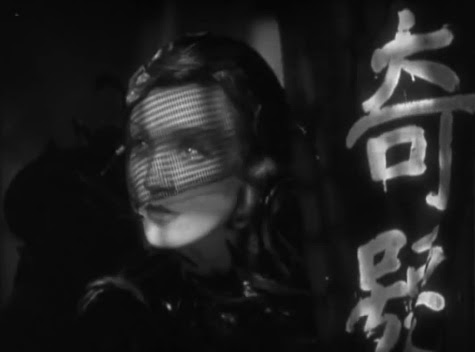
The excellent liner notes and extras explore all sorts of great elements, both thematic and texural, except for a glaring omission. There is no exploration of the very obvious masochistic subtext running through these films like a hot river. The extras are guilty of shamefully ignoring the work of progressive film theorists like Steven Shaviro and--especially--Gaylyn Studlar. Her book In the Realm of Pleasure (left) deconstructs the Dietrich Sternberg films' kinky symbolism via a theory of the cinematic spectatorial gaze as inherently masochistic. This is a theory far different from, say, that of the sadistic gaze postulated by feminist film scholar Laura Mulvey. It's Mulvey's theory that has been not only utilized but rigidly enforced in feminist film studies the last few years, to the point the masochistic gaze is almost heresy. In fact, feminist film theory has been under such brutal siege by the Mulveyan male gazers that--like ISIS in ancient Babylon--all the great old edifices are in danger of being torn down. Even Mulvey herself is like, whoa, chill, it's just a talking point, a theory, not some buzzkill holy writ. (I paraphrase).

Studlar's book, alas, is rare enough that even the more open-minded academics don't often know about it. But they should, for it is like opening a magic window into these films that makes them glow and resonate far beyond the--admittedly true and enticing--consensus of the historians, critics and academes on hand in the chosen melange of extras. Was Criterion scared Studlar's approach was too academic, too controversial (bucking the Mulvey doctrine), or just too kinky? Or were they worried Camille Paglia wouldn't be roused from her deep vampire slumber in time to rescue them from third wave feminist reactionary clawing with a potent Salon essay?

As it is, I heard Studlar's name mentioned only once in the extras. Homay King's excellent extra accompanying Shanghai Express mentions her concept of the 'heterocosm' i.e. an enclosed dream world outside space and time in which the film exists (i.e. it's not the 'China' of reality, but a kind of dream repository centered around the mystique of the 'Other').

Rather than just try and sum up the deep points Studlar makes in The Realm of Pleasure in this post, I'll urge you dig up a copy, and failing that, point you back towards some of my previous posts exploring cinematic masochism, i.e. the voyeur as masochist - subject to having no control of the events in his experience and how that relates to infancy and fear of abandonment by the mother and the embrace of death as pleasure being the ultimate act of pure control, of conquering death and moving past the pain-pleasure rim of the wheel right to the center.

50 SHADES OF GREY, 9 1/2 WEEKS, EXIT TO EDEN, SECRETARY + SHE DEMONS, Franco, Bunuel, Josef von Sternberg, Alain Robbe-Grillet (7/31/14)

According to Gaylyn Studlar (4), true masochism can only exist in dreams, conjured more out of a need to safely experience the abyss, to trick out the satisfactory endorphin rush that surges to accommodate sudden pain (as in the heroic measure of wasabi or hot sauce undergone as a food fair rite of passage); it must be done in person or in the mind where we can imagine a transformational ecstasy that ordinary movie watching doesn't accommodate. Seeing is never believing - that's why sadomascohistic literature is often more arousing than bondage films, which seem merely silly or misogynist.  The shocking Times Square marquee, coming attraction, or the film capsule review might enflame or awaken masochistic desires, but the actual film will never measure up; it's the difference between remembering your own crazy, erotic dream and hearing about someone else's. It's the difference between seeing the covers for films like Kitten with a Whip or Naked Under Leather vs. the actual--inevitably disappointing--movies themselves. Death can exist only as a promise. In practice, it's just not as sexy.

As per Studlar:
"The fatalism of Von Sternberg's films is not simply an acceptance of death as an externally imposed inevitability but the expression of the masochistic urge toward death as a self-willed liberation. In choosing death, an illusionary triumph is created: the illusion of choice... (48) 
"...masochism's obsession with death may be interpreted either as the expression of a universal instinctual urge or as the result of the masochistic wish for complete symbiosis with the mother and a return to nothingness,.... Eros is desexualized and resexualized; death becomes the ultimate fetish that fascinates with the promise of a mystical unity." (p. 123)
Only Bunuel and Von Sternberg ever seemed to use this concept in romantic surrealist cinema, and it's interesting that both adapted the same masochistic text, Pierre Louÿs "La femme et le pantin." For Bunuel, two different actresses play the Dietrich character, Conchita, in That Obscure Object of Desire: the sweet girl who entices him and the cold calculator who continually manipulates him into bankrolling her mercenary mother (and then bailing on him with a younger man). Teasingly withholding sex, but always promising it, she instinctively understands he needs and appreciates this long-term unfulfilled longing (he's rich and respected, she may be the only objet petit a he has - all other desires are already met, and thus failed). He might have some sexual liasons with her but they're never long enough to make him feel 'satisfied.' Some lovers are 'done' as soon as they climax. Well, some characters never want to be 'done' - it spoils the game, turns a long elaborate twisted ritual into a disappointingly short-lived gratification followed by shame and emptiness (be that due to impotence, premature ejaculation, or other). Similar to the two-faces of Concha in Bunuel's film, Marlene's Concha wears two outfits for separate seductions - pure white to lull the guards into letting her see the prisoner; a black mourning outfit to sway the prefect.

Maybe the whole trick to getting what you want is to deliberately want to want it rather than to have it (and so want your old wanting back, which is a double negative). Most magic tricks are part sleight-of-hand and part misdirection, but in masochism, misdirection is the trick. The slighted hands of the clock are frozen at bedtime, right before mom comes in to kiss you goodnight and turn out the lights. If you never get the kiss, the lights stay on and the demons under the bed can't get you. The guy who comes too quick or is impotent or just falls into deep depression after orgasm, for him especially is the lesson drilled home. A sexual desire's fulfillment is never a good thing. It's fatal. (2014)


If you know Marlene’s history you know she liked to sleep with a lot of different people, and broke the hearts of adoring males (and females) when they realized they would never “own” her totally had to learn to share (which her husband well knew, as he archived all her various love letters for her), and that’s where masochism and sublimation comes in. Imagine being Von Sternberg and you’re basically living at Marlene’s estate, painting a picture out on the lawn and here comes Gary Cooper’s car and you know that you wont be sleeping with Marlene all weekend, and will just have to wait til he leaves for the set on Monday, or she gets bored of him. But hey, he's gorgeous, and taller and younger than you, etc. Do you throw your canvas to the ground and have a fit? Get a gun and run around the estate like the thuggish gamekeeper in Rules of the Game? Neither one will get you anywhere but in jail or laughed at. But if you can sublimate that jealous sting into your artistic vision, ah - mon ami- you are reborn in a. The artist Von Sternberg lives for that moment, that flush of Oedipal rage and shame, harnessing its power, converting the emotional energy via artistic sublimation, Sternberg’s painting merely becomes darker and more twisted… better, in short. (full - 2009 - Bright Lights)

From: (Butterfly Moanin: DUKE OF BURGUNDY and Faerie Bower Cinema)
(2015)

And so it is that these films show us a variation of sex we are, as single perspective organisms, forever denied in real life: we get to find out what our moms were like before we were born. It's something we'll just never know in real life, except through keyholes, screens (projections, paintings, pictures) dreams, and rebirth. In these films we finally understand, perhaps, why the patriarchy, the male gaze as per Mulvey's sadistic definition, is so terrified of the female orgasm. I don't mean the little 'sneeze' girls get, or even the cherished involuntary vaginal contraction versions, but the one--eternal female orgasm--that comes later, and last forever, and increases and increases, feeding its own orgone energy flame until the alchemical awakening of the Kali destroyer / creator goddess, a withering force as devastating to the phallic tower as a great flood. When this occurs, the male gaze is blinded in the flash, and not even Oedipus' stiff braille guide rope can help him find the door, let alone that old pined-for keyhole. (More)

AUS:


WEITER MIT DEN MÄDCHEN:
Cinema's Naughtiest Germans, Part 1
Mecha-Medusa and the Otherless Child: THE RING, SHERLOCK JR., VIDEODROME (2004)
Death Driving Ms. Henstridge: GHOST OF MARS, RIO BRAVO (2003)
Naomi Watts: Cinema’s Post-Modern Mother of Mirrors
Hope vs. the Scandanivian Svengalis: THEY CALL HER ONE-EYE; I'LL TAKE SWEDEN


ANGELS OF DEATH, the Series
ANGELS OF DEATH - I
ANGELS OF DEATH - II: Great Women of Horror
ANGELD OF DEATH III: Badass Brunette Edition
ANGELS OF DEATH IV: Lynn Lowry Special Edition 
ANGELS OF DEATH V: Magic Slut Split/Subject Maenad Edition


Wednesday, September 23, 2015

Butterfly Moanin' (DUKE OF BURGUNDY and Faerie Bower Cinema)

DUKE OF BURGUNDY
(2014) Dir. Peter Strickland
"The sovereign being is burdened with a servitude that crushes him, and the condition of free men is deliberate servility." - Georges Batailles 
Emerging from its cocoon as a beautiful Shout Factory Blu-ray, Peter Strickland's Duke of Burgundy is a nod to the 60s erotic reveries of Jess Franco and Jean Rollin, only without the vampires and knife-wielding sadists. Snaking forward in a steady hypnotic rhythm, it instead examines the BDSM head games played by a pair of lesbian lepidopterists living in a dream world where it's always autumn, men don't exist, and the Gothic architecture is ever-fecund with overgrowth. The beautiful dusky purples and oranges of the butterflies and lush Victorian interiors match the women's clothes and skin textures as they come and go along their whispered cloistered flight paths, an endless repetition wherein love may be hidden somewhere, but everything else needs a safe word. 

As a throwback to the 'Eurosleaze' genre, only without the sleaze, Duke's dreamlike mood is at once boring and fascinating, eros and thanatos inextricably linked. Like Franco's and Rollin's films, it's best seen while falling half asleep (which its slow pace is guaranteed to help with). It's less a forward marching phallic arc (and its post-orgasmic snooze) and more a repeated lullaby, or the same storybook read over and over to a child in its crib by the giant mommy goddess; the feeling of giant arms and a beaming loving face the size of a large stone idol (relative to our infant height) couple to the terror of being put down, and the lights turned off--but that terror maybe preferable to the suffocating feeling of that giant mom never putting us down at all. Wanting more of mom's love than one gets is as important as having it.

Chanting and ritual create a sense of tranquility by, amongst other things, driving the ego from the microphone of the mind by boring it into surrender. Once it realizes nobody is listening to its alarmist cries, that he's getting nothing from the crowd, like a dying comedian, he finally gives up the mic and vanishing from the room, the way a cigarette snuffs itself out once dropped in an empty bottle. For the ego to deliberately court this annihilation is the secret, spiritual core of masochism, at least on an intellectual / spiritual level! That's why spiritual warriors always accept ask for the most debasing job at the ashram, the one no one else wants. Submersion into 'group' mind, the giddy rush of rioting or delirious dance floor orgies, leads to a kind of open-hearted faith in the power of us vs. them--the trick of all effective cults. The mom's giant arms restored! 

Scarlet Empress, The

That kind of repetition is found best in the films of Josef Von Sternberg with their fetishistic veils, mirrors, and inert momentum; or the ritual hypnotism of Kenneth Anger; or--especially as its so clearly referenced in Strickland's film--the 1963 Stan Brakhage experimental minute-long Mothlight.

I'm a confirmed proponent of the masochistic gaze theory posited by Gaylyn Studlar and Steven Shaviro, so I knew what to look for in Darionioni Nuovo tremolare Strickland's Duke. That's good, otherwise I wouldn't have known my boredom was a valid artistic response. I would have just rolled my eyes and said "this sucks" like my poor girlfriend watching with me said. According to his interview in the Blu-ray extra, Pete Tombs (of Mondo Macabro fame), commissioned the film, wanting a remake of Lorna the Exorcist (a very long awaited Jess Franco title, for those who've learned to wait). Me, I've learned the only way to enjoy Franco (for me at least) is while alone at dusk, falling asleep in my easy chair as the sun sets. In all other ways, certainly as narrative, or any kind of genuine erotica, his films are not very good. But in the right half-asleep or nonjudgmental state, the alpha wave receptivity of deep relaxation or illness, they're genius.

Time and again I've found a masterpiece in the same place I found an unwatchable softcore piece of crap only days before. That place - Jess Franco. 

Here's an example: I recently screened Franco's SUCCUBUS (1967) for a bunch of half-asleep kids at a European horror film class. I hadn't realized just how sex-drenched it was until they shifted uncomfortably at their desks. They hated it. So I explained my secret to enjoying it: amnesia. 

The jet-setting European sixties swinger well knew of it, that mix of language and cultural barriers and the memory-damaging effects of booze and too many parties with too many lovers. When someone comes up to you and says hello again, you don't think they're gaslighting you, you think you were probably drunk or stoned and just don't remember them. So you play it cool, take the social cues their behavior offers, don't let them know you don't remember them, that would reflect badly on you, and alienate them. So you roll with it, trying to suss out what anecdotal facts you can.  

This can even extend to a strange woman climbing into your bed in the dead of night. Maybe she's your lover and you just forgot? Can't kick her out now - it would be so rude. After all, it's the 60s.

from Jess Franco's Succubus (1967)

Maybe we're even married! Best to play it cool and act like I know who she is, and am just playing I don't - add some meta layers on it. 

This viewing strategy ties in with the post-war modernist frisson born of French-speaking critics watching liberated Hollywood films sans dubbing or subtitles in the years immediately following the 1945 liberation, in the gap between Hollywood once again releasing films with French, German, Dutch, Italian, and probably Norwegian subtitles. Starved for film of any kind, French intellectuals made a game of not understanding anything that was going on in the plot. It allowed the critics the freedom from language's structuring of the images and sounds, leading to original conception of the phrase mise-en-scène. What is going on in a film when we can't speak its language? How does it still 'talk' to us, using imagery and sound alone?


Anyway, my Succubus exercise worked. The students imagined the character/s had amnesia and now they loved it. They 'got' it this time, the modernist frisson. That's the kind of magic Franco's (and Antonioni's) best films provide. They're meant for an international audience who needs a freedom from conventional semiotics. And within that anecdote lies the paradox of how a boring film can get better with repeat viewings, especially when your ego is shut off due to repetition or sleepiness (or drugs), or not knowing the language being spoken. We can't 'turn off' into hypnotic narrative when we don't know what's going on. We're free of the burden of interpretation, and the judgments that implies. 

That's the key to Franco, and maybe Strickland too. It's cinema aimed at the unconscious mind, the place where plots and dialogue never add up, and no one speaks in their actual voice, they're dubbed in way too many languages to ever do an 'original' language track In the end that's perhaps why Fritz Lang 'got' it, as did Welles, when most critics sneered at or ignored Franco's work, unable to see past the tawdriness and terrible dubbing. Both are valid responses, and indeed, may criss cross.

This was Europe in the 1960s-70s, the time of commercial jet travel opening all borders to well-dressed imports and varying strength X-rated inserts. Western Europe became the Capital of Amnesia and Babalon Working, a time when a producer, actor, and director may easily have no language in common other than that they all found in Antonioni's Blow-Up, and drugs and alcohol were ubiquitous and there was only one rule: don't say no to psychedelics offered at a groovy party and don't ever demand to go the ER if things get too hairy. When you can't remember how you got somewhere, or the walls are bleeding, or you wake up with a stranger in a strange bed, you can't make a big deal about it. If you freak out and go all egoically clutching for the handrails, you might end up in the sanitarium or prison; worse, you might draw attention to yourself as a square, a tourist, a rube, a wally, and get everyone arrested.

That's the one rule: if things get weird you can't wimp out. There is no safe word in swinging 1967. Ride the snake. And as the mannequins assemble for the sacrifice, presume that your unbridled arrogance will convince them that you're not the designated victim.


And masochistic cinema is really about that very same modernist frisson, the enslavement to the Other that finds true fulfillment only in dreams.

Dreams that they know will end.

For fans of Franco, or Von Sternberg's Dietrich films, the repetition is what cements the film into a favorite. Seen the first time it may be well unsatisfying, dull, irritating. Seen thirty times, it's the voice of a cherished mommy goddess and her absence, the absence that makes the presence bearable. We can want to see it again because we've seen it already.

I know the drill like the back of my molar. Like the older lady in Strickland's film, I--though no sadist--have been called onto to play one in a romantic tryst, many times, and always, each time it was really the verbal descriptions of what I would do--dictated by my lover in very specific details and then repeated in slight variations each time thereafter--that got them off. Experienced that way one realizes that, for most kinks, it's about the show, the whispered declarations of power vs. humiliation rather than the practice, which seems a trite gaudy and ridiculous (maybe I'm a prude?) But I like the JVS/Dietrich films as thye ascribe to the Gaylyn Studlar masochistic filmgoer theory vs. the Laura Mulvey sadistic proprietary male gaze theory, as Z sums it up:
"Where Mulvey views the female as having no power, in a masochist reading, the woman is powerful due to possessing what the male lacks, so pleasure is not gained by “mastery of the female but submission to her” (1985:782). This is in direct contrast to Mulvey’s view, which centres on voyeurism and fetishistic scopophilia being a defense mechanism to castration anxiety." (Z- Mediated Musings)

Strickland understands these confusions of gaze; his film delves inwards to where the segmentation of a pupae abdomen circles into a set of winding fecund autumnal purple steps linking the look with the looked upon. Along with his post-giallo contemporaries, Strickland brings the modernist shiver of experimentalism into a head-on collision with the tenets of conventional narrative, letting their momentum derail each other and making something new from the train wreck, something that's neither formal/classical narrative nor avant garde/experimental, but a hybrid at once both invigorating and stultifying. In what could easily be the story of Mulvey and Studlar forever locked in a death/love staring contest, this wreck of a film shakes every pair bond to the core not through any particular eroticism but through the deconstruction of the kind of hermetic universe a loving couple creates within their shared space, a feeling of magic and second childhood, their honeymoon suite becoming an overgrown forest, a private world free of the constraints of time and outside responsibility. The stultifying comes once the outside has been ignored too long, the overgrowth chokes itself into mulch and dead leaves, leaving the stench of plant decay, what was once felt as protection and safety is now a prison, not through some shift of power, but through its own endless repetition.

In that and other senses of course it mirrors the fragmented masochistic obsessiveness of the films of Josef Von Sternberg (all those long slow meditative takes as Marlene walks around rooms, playing with this doll or that and shooting coy looks over her shoulder--as if stalling perpetually for time)--or even Bergman films like Persona (with the young boy in the experimental opening, trapped in the morgue as if reborn and tracing the blurry projection of Liv Ullman's jaw). And from there of course, The Ring and The Birds , i.e. Mecha-Medusa and the Otherless Child, i.e. the merging of the screen and the eye, the speakers and the ear, the dialogue between one's unconscious and conscious mind finally becoming audible; recognizing the monstrous absurdity of one's own masochistic sex fantasies once translated into action. (See Taming the Tittering Tourists).


Color coding, From Top: Lips of Blood (Rollin, 75); Girl Slaves of Morgana Le Fay (Gantillon, 71); Cries and Whispers (Bergman, 72)
In short, from my own perspective, I don't see a Mulveyan fear of castration in cine-masochism at all in these Eurorotica time capsules- but rather a longing for it, a longing which underwrites my own theory behind the (straight) male's fascination with an all female or matriarchal world (ala Persona, The Girl Slaves of Morgana Le Fay), one that doesn't 'include' the male figure or allow for even a projection of one's own gender based locus into the narrative. If a male figure somehow gets a toehold into this special universe, it's only as a eunuch servant, a blind man at the door who is not invited in, or an outmaneuvered future blood sacrifice ala Daughters of Darkness, the Blood-Spattered Bride, The Velvet Vampire, Girly and Vampyres.

This woman-centric film universe reflects the opposite of male-orgasm-based pornography, for the typical male sex fantasy doesn't last beyond the point of le petit mort. Men's sexuality, unless they are extraordinarily virile, dissipates immediately and drastically after orgasm; the fulfillment of the phallic hero's journey always ends in symbolic castration. This is why he begs and pleads but then, when there's no more barriers, hesitates; each orgasm is a sort of suicide, and the male knows it - once he's able to attain it, it comes too soon. The lesbian erotic scene, on the other hand, goes on and on, stopping time in its fairy tale tracks. There's no worry about premature ejaculations or flaccid impotence. The fairy bower's chthonic overgrowth ensnares and subdues narrative phallic linearity. It's something men just don't get to (or want to) see --we've already left the bed and headed for the kitchen to find a snack.

And so it is that these films show us a variation of sex we are, as single perspective organisms, forever denied in real life. We get to, in a sense, find out what our moms were like before we were born. It's something we'll just never know in real life, except through keyholes, screens (projections, paintings, pictures) dreams, and rebirth. In these films we finally understand, perhaps, why the patriarchy, the male gaze as per Mulvey, is so terrified of the female orgasm. I don't mean the little 'sneeze' or even the cherished involuntary vaginal contraction versions, but the one eternal female orgasm that comes later, and lasts forever, and increases and increases, feeding its own orgone energy flame until activating the alchemical awakening of the Kali destroyer / creator goddess. A withering force as devastating to the phallic tower as a great flood, is achieved; the male gaze is blinded in the flash, and not even Oedipus' stiff braille guide rope can help him find the door, let alone the keyhole.

Elsie Wright -w/ Cottingley Fairies

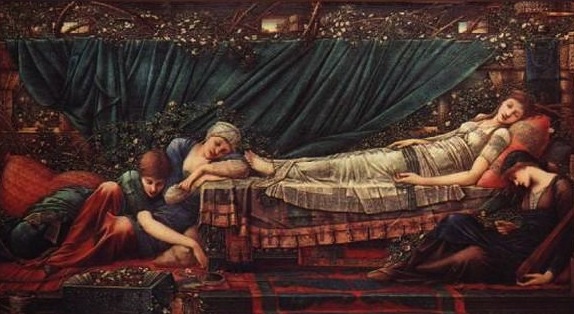
Rose Bower (Burne-Jones)

The lesbian fantasias of Franco and Rollin aren’t really meant for the chthonic dead end of fairy bower lesbian stasis, but they do draw on the same chthonic morass torpor, the way Antonioni draws on Monica Vitti’s beauty, or Fellini on circus pageantry or Welles on Welles – as a thing fulfilling in and of itself that precludes or prefigures egoic detachment from the mother. The sexuality of Fellini is--as in his best work-8 ½ and La Dolce Vita--exposed and recognized as infantile narcissism even while it's being indulged; Antonioni’s sexuality is like a dangerous ledge over the abyss and Welles’ balloon of titanic ego is inevitably punctured by the realization he can post-dub anyone in his films but a woman. Theirs are not the orgasm moments, the money shots, theirs are reminders that epiphanies, like male orgasms, are short and cheap and then life grinds on, oblivious. The trick with European reverie cinema is that this egoic puncturing never happens nor needs to. In a Rollin film, if a male character shows up who fancies himself the hunter-rescuer of the scene (as in one of Rollin’s endless string of jewel robbers) he’s peripheral --we’re invited to scorn him even as he tries to organize or tame the matriarchal nonlinear experimentalism of the hermetic female fairy bower. Like the forbidding father at the nursery he tries to shatter the fantasy of our total reunion with the mother, the memory of being an infant surrounded by gigantic adoring women, hearing their conversations as strange enigmatic words we do not understand, formatting the blank hard drive of self via the ebb and flow of mom’s attention. He tries to whip the women into linear order, but they of course devour him, like a phallic sandcastle in an incoming tide.

At this pre-egoic stage, we don’t identify ourselves as separate from mother and are therefore ‘female’ regardless of biological gender. The need to differentiate and establish oneself as male and separate from mom is a traumatizing initiation these films undo. Their drawback is their lack of dramatic arc, their inability to finish the initiation and begin journey. The butterfly motif in Duke is the ultimate irony - the caterpillar becomes a butterfly, flies off and dies (male linearity) but here, with these lesbian lepidopterists, the butterfly stays fixed in time, punned on the board, etherized on the fairy bower table– the life cycle interrupted at its peak moment...

My favorite game to play with babysitters in the 70s
Maybe I'm keen on this subject because as a child I was never very coordinated or confident on the kickball field (and hence always picked last for teams, a daily humiliation). I always just wanted to hang out with the girls; I was in love with girls in general, no real sexual desire had cohered along my polymorphic jouissance ley lines, but girls made me feel electric nonetheless. I despised boys on principle. I had one little brother and no sisters, which might explain some of it. When some girl's evil mom didn't approve of my attention, tried to force me outside into the mud with their wild obnoxious dirty foul-mouthed boys instead of upstairs with the girls it aggravated my delicate nerves. I hated those boys! The girls were pretty and sweet and I was enthralled. I also adored all my female babysitters, like they were giant idols; there were these three cool female cousins who coddled me all through my infancy, and then --boom, they weren't around anymore. Never having had a lot of physical affection from my (Swedish) mother after, say, five, I longed for three giant cute girls (relative to my size) and I didn't feel their protective young girl maternal energy again until stumbling on the Alice in Wonderland statue in Central Park (see my first film Erich Kuersten: A Poet's Journey)

Just the right size
As a child in the arms of a girl Alice size, I didn't need to exist, or get affection, or conquer any other phallic arc. I was, in other words, absorbed totally into the state of the passive masochist spectator. Of course this came back to haunt me later as I was often paralyzed when it came to busting the first move, afraid the girls I fancied would flutter away with some spiel about how 'I thought we were just friends.' And also the closer I got to said move the more my knees buckled and I felt I'd pass out. In short, sex and desire were too intense, I wanted to orbit the star, not crash into it - that was for the boys good at kickball.

Duke of Burgundy in a way operates on the same principle. The one hot sex scene is merely spoken, with the mistress struggling to keep her partner supplied with her custom-tailored erotic dom-sub fantasia. But again there's no ego formed, no linear thrust, which is why the film is so boring. But hey, that's part of the masochistic current, the Warholian love of boredom --the result of undoing the need for ego and therefore lacking a narrative arc to guide and hone in our focus the way a child's polymorphous perversity gradually 'settling' in a space beyond the narrative; the love of repetition and ritual (as in the repetitive alchemical rites in Anger's films). The oceanic experience, which the masochistic gaze in cinema mirrors, is the compromise against what the Studlar's theory of masochism admits from the beginning is hopelessly unattainable. To attain the male orgasm, or even to permit the male involvement, would break the spell.
The prince's kiss wakes us up from our dreamy slumber, the opiated medicines of the witch leading us to a sweet stasis which is broken by the kiss that whisks us back into space and time, for better and worse.

The ending is the same either way. Death is just the sign on the door through which the audience exits the theater into the lobby. The only way to avoid going in our out of that door is to become etherized, frozen and pinned to your seat. Either way, the cinema is the same; if you stay for the next show, prepare to be bored. The movie playing never changes. And its that element of inert sameness, the repetition, that works to make Duke of Burgundy both boring and artsy, maybe proves that calling something boring and artsy is redundant, and maybe it even proves that calling a film the realization of the insatiable appetite for repetition is to damn it with high praise, something only fellow post-giallo filmmakers like Helena and Bruno understand (as in the endless variations of the same scene in The Strange Color of your Body's Tears). But who likes it? Almost no one, for longer than 10 minutes at a crack. Still, in this inert symbolic re-death eroticism, Studlar's masochistic gaze is spot-welded to a Crash-style car and sent over a cliff into to the kind of Jungian ego annihilation, liberating the libidinal desires that formulate the structure of the differentiated self, which is really just a nice way of saying it's boring as fuck-all. Don't miss it. Oops you all ready did.

Friday, May 13, 2011

Red is the color of my true love's helmet: QUEEN OF BLOOD, JET PILOT

Top: Queen of Blood (Florence Marley) / B: Jet Pilot (Janet Leigh)
QUEEN OF BLOOD (1966) and JET PILOT (1957) are two fascinating examples of Russian-American relations, each with a sexually carnivorous female pilot in a red helmet wowing the American astronauts or military. QUEEN's footage of this "red" planet vampire woman's ship and various astronauts wandering across hostile Martian lunar surfaces comes recycled from a Russian sci fi film Corman bought the western rights to, 1965's MESTRE NASTRESHU. These shots are almost Bava-esque with deep red filters and eerie gel lighting. JET PILOT's woman is Janet Leigh, a Soviet military jet pilot, claiming being denied promotion for being a woman as the reason for defecting, taking Uncle Sam up on its offer of sanctuary and $$ in the west in exchange for landing a MIG on US soil. Leigh's helmet is dark red when she defects, and her hotness in that white flight outfit is not to be denied, as effective as any Martian hypnosis. John Wayne all but swoons right there in the hangar, and so do we. When that helmet comes off and that hair comes tumbling out it's like you want to drop to your knees in worship, if she says come to Russia and freeze with me - honey, you're going.


Back to QUEEN OF BLOOD: In the Curtis Harrington-filmed US footage we have Dennis Hopper and John Saxon as the recognizable faces amidst the astronauts, who in the ALIEN-prefiguring plot are sent to Mars' orbiting moon, the Island of Phobos where a being from another galaxy has crash landed. She's a vampire alien from godlessness knows where, but hey --she's a delegate so just open up your neck and be polite ---we need the eggs. The elderly Basil Rathbone, still sharp as a tack and nutty as an heir of Frankenstein, here advising the masses, with his lead scientist sageness, points out that this is a once-in-a-million year opportunity.
 

Acting as a fine mirror to issues of gender as well as Soviet-American relations of the era, the footage is matched brilliantly to its respective sides - the Dionysian and ornate deep red Russian footage for the female vampire Martian - while the Earth scenes and space ship interiors are re-shot on threadbare Apollonian sets by Harrington. The result is a perfect metaphor for the repulsion/attraction between the US and Russia...one side an ornate red samovar (Mars / the alien ship), the other an institutional gray cafeteria. Together it's like an unholy union written in the stars and read by lovers holding hands across the Berlin wall. When the astronauts of both planets get together for the flight home, the hypnosis starts and the blood drinking and the orders from on high not to harm the specimen, no matter how many human astronauts perish like so many sailors on Dracula's London-bound schooner. This time however, everyone but John Saxon agrees: save the queen! If she wants to drink Dennis Hopper's blood just warn her first: the Thorazine is long gone!


The point is, if if you ever watch Mario Bava with the sound off just for those great lighting schemes and purple gel spots, you'll love QUEEN OF BLOOD. All the metatextual yin-ynag dichotomies are in place: one one side: Russian film/Dionysian/Female/Plant/Mars/red, on the other US/Apollonian/Male/human/Earth/blue interior-shot/mammal. All these great dichotomies lining up so splendidly are just gravy on the GHOST OF MARS train of course, as is Judi Meredith with her sexy smoker's voice and enough black eyeliner to darken the sun. In short, the film would be a great double bill with Josef Von Sternberg's JET PILOT (1957) and is clearly meant for a double bill anyway since it's so short (78 minutes).

JET PILOT comes directed (mostly) by Josef von Sternberg and produced and partially directed by Howard Hughes, so you can imagine the arguments. Apparently writer Jules Furthman reshot some of it after von Sternberg left, and Hughes of course shot the airplane stuff, which is almost 1/3 of the entire film, but it's real stuff - up there in the cold air on top of the world, so like QUEEN, JET has a split identity which works meta with the Red meets White and Blue in bed scenario. Sure it gets tawdry and cheap, but there's real chemistry with Leigh and John Wayne. She seems very young, carnal, smart, and doesn't even bother with a Russian accent (unlike Kate Hepburn's dull Russian defector and Bob Hope as the John Wayne in the far less lively same plot comedy of THE IRON PETTICOAT). Leigh and Wayne cram as much lust into their restricted gazes as the censor will allow while the cold war freeze of the empty gray sky above US bases in Alaska and Russian bases in Siberia makes a fine metaphor for the general iciness that is the post-code American perennial stalemate battle of the sexes.


It's a suitable metaphor not just for sex, but for bad sex, cold sex, post-children (no privacy) sex; sex where falling in love carries a lot of dangers --the other side may be a spy, but aren't you? Like an early version of Roger Vadim or John Derek, Howard Hughes was notorious for seducing pretty girls and making them stars via inert films with awesome posters (like THE OUTLAW), and usually firing the original director along the way in order to ensure no scrap of fun or originality survived, replaced by a weary but knowing sexuality, the inertia of the well laid vs. the meticulous energy and totemic, elaborate lighting that comes from being a sexually frustrated masochistic, pining for, rather than bedding, the leading hottie. But JET PILOT is a rare exception in both their cases. Von Sternberg at least got in some good subtextual masochism out of Jules Furthman's excellent script. This pair of red star-crossed lovers constantly attempt to escape their warring governments and just get it on, alone, for a few hours. And when they do there's that comedy of remarriage sensibility - a come closer / go away back and forth that recalls the great screwball comedies.

The Russia/US divide angle also illuminates the disparate polarities’ lack of ultimate difference: when her Soviet relations cockblock it’s because she has to seem disinterested in anything but following orders -and maybe she is; when Wayne's US friends and commanding generals cockblock it’s because of a temporary housing shortage. At the same time both superpowers encourage them into bed with each other for various pumpings for information on jet maneuvers, what the other side has and doesn't --and so there's a lot of great jargon Hughes no doubt made sure was legit and Furthman made sure wasn't boring. Von Sternberg takes a cue from military olive and bathes every set in shades of green until the whole film glows in the mind like a lime in a gin and tonic with the occasional maraschino cherry; and Lenny Maltin awards it a scant two stars as if begging to be punished by the State (read instead David Thomson's cautious enthusiasm for it in his indispensable Have you Seen...? ). Find it on DVD hidden deep in an old John Wayne set that includes--Lenin preserve us, THE CONQUEROR: John Wayne - An American Icon Collection (Seven Sinners/ The Shepherd of the Hills/ Pittsburgh/ The Conqueror/ Jet Pilot)

But find it, for the sake of the red stars and white stripes! And thanks to Another Film Blog for some of the above stills!
Related Posts Plugin for WordPress, Blogger...