Showing posts with label Communism. Show all posts

Wednesday, June 13, 2018

Brecht and the Single Girl: PROPERTY IS NO LONGER A THEFT (1973)


If you're confused about why Italy continually undoes the soundness of the Euro, Elio Petri's PROPERTY IS NO LONGER A THEFT, a nihilistic anti-capitalist Brechtian satire from 1973, can surely clarify for you toute suite. (Short answer: too many Commies --and they got a funny idea 'bout money.)

The "plot" follows neurotic bank teller Total (Flavio Bucci - the blind pianist in Suspiria) as he tries to escape his meager 9-5 barely-make-ends-meet job, which mainly consists of doling out cash to greedy titans of industry who proudly brag about their non-paying of taxes, oblivious to the seething rage welling up in the little guy who counts their capital. Snapping his pea brain after a robbery, Total becomes obsessed with a rich, corrupt butcher (Ugo Tognazzi), stealing all his signifiers: little butcher hat, favorite carving knife, his car, even his mistress (Daria Nicolodi!). Launching himself on an absurdist Harpo-cum-Karl Marx-Quixote odyssey, Total wind up lost in the out-of-bound weeds of Anarchy. Burning a lire note in his boss's office ("that's sacrilege!") to signify his resignation, he justifies his identity stealing operation by staying 'pure' i.e. not stealing any actual cash: "I'm a Mandrakian Marxist," he announces. "I only steal what I need." By Mandrake, naturally, he means 'the Magician'. When it comes to films equally indebted to crime, communism and comic strips, no one outdpes Elio Petri (The 10th Victim, Investigation of a Citizen Under Suspicion, A Quiet Place in the Country).

While I'm no fan of what I can't help but read as Petri's ingenuità utopica (given allowances for its time and place), I love his deeply cynical reading of a social structure so deeply ingrained most filmmakers don't even notice it's there. The title is confusing mistake, though, a riff on an old anarchist slogan revived for the 60s, when commie ideology was snuck into movie dialogue by leftist filmmakers like Petri, Fernando di Leo and Giuliu Questi. Italians really love the idea that stealing in time of necessity is justified. Obviously they have a violent reaction one way or another to their Catholic guilt, so keep belaboring it, ever evoking the 'bread riots' of the 1940s - as seen in Rossellini's Rome: Open City. (The kind of thing America was briefly allowed to explore (i.e. between the Crash and the Code) in films like Hero for Sale and The World Changes).  Also, they had an establishment much more corrupted and deadlocked government to actually work, so chaos descended. That's why 60s Italian master thief characters like Diabolik (who would be the villains in American comics like Batman) became the heroes of Italy, encouraging the average Italian to smash and grab what they want, leading to rampant crime in the streets and all the other things anti-capitalist Commie subversives would have loved to see become the norm in the US as well. So thank you, Joseph McCarthy, after all!

Property is No Longer a Theft is a child of that mindset in more ways than one. It's on Blu-ray from Arrow, and looks and sounds great, but--if you don't believe in money but do have a Prime subscription, you can pretend you're stealing it by watching it 'free'. Just don't wonder if Arrow suddenly doesn't have any money for new restorations. It's your fault.


What drew me to the title initially (aside from being enthralled by Petri's earlier masterpiece A Quiet Place in the Country) was a recommendation from horror film historian Tim Lucas on Facebook, who pointed out its proto-giallo greatness. Total may not be a crazed killer in high giallo style, but he does threaten people with a knife. Ennio Morricone delivers one of his most surreal breathy scores; Deep Red cinematographer Luigi Kuveller twists the frame with portentous shadows and expressionist angles (lots of doors within doors), star Bucci played the pianist in Suspiria, and longtime Argento collaborator Daria Nicolodi (1) looms tall and ungainly-albeit-sexy as Anita, the butcher's mistress. When she lets loose a deep throaty laugh during one of her Brechtian fourth wall-breaking monologues, you might get an instant chill as you recognize her voice's deep masculine depths from so many Argento classics (it's the same laugh from Phenomena, when daring Jennifer Connelly to call her insects, or the mocking, snarling demoness at the Suspiria climax). Since Bucci looks more than a little like Dario Argento himself (with a Dog-eared dash of a young Pacino around the eyes) it would be easy to see Property as a kind of deranged reflection of the Argento-Nicolodi collaborative canon (1), with the Butcher representing typical 'red telephone' Italian filmmaking at the time, and Total the Argento who steers Daria free. But to what end? 
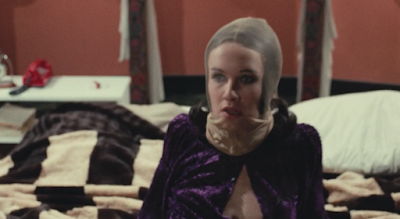

Keeping the giallo framework in mind might help today's 60s-70s-era Italian genre cinema fan keep its odd mix of police corruption and insurance scam satire (we follow the flow of $$ from robbery to insurance claim, to inventory-exaggerating, cop bribing, policy collecting, to thief selling stolen goods back to insurance company, like some giant financial food chain) from getting too mired in either didactic dissertation (In standard Brechtian practice, characters break the narrative flow perhaps too regularly) or Polanski-style young hungry male vs. olde rich male for sexually ravenous younger woman - power triangulating.

Meanwhile, weird characters pop up to keep you guessing: there's the droop-eyed chief of detective (Orazio Orlando) who seems like he's either fishing for a bribe or trying to trap the butcher into a confession with a sense of conspiratorial camaraderie ("If you're not afraid of having it stolen," he notes, during the insurance tally, "you can't enjoy your wealth"); a cross-dressing master thief named Albertone (Mario Scaccia) who teaches Total the trade (and Total in exchange, does nothing but taxes his mentor's weak, albeit big-as-all-outdoors queer heart with his irrational Ledger Joker-x-Harpo Marxist nonsense), and  Cecillia Pollizi as a dyke fence who evokes Lotte Lenya's madame in Roman Spring of Mrs. Stone albiet in a  resonant post-glam fashion. There's even Diabolik in a blink-and-miss cameo (below):

Diabolik dies in a posion gas-filled car at a security expo in Property is No Longer a Theft

It's not all surreal Brechtian digressions though. A real unhappy, even if trenchant, thread in the film is the Butcher's and Total's treatment of Anita, and her realization that neither being a sexual object or 'powerful' will generate even a flicker of human compassion from them. It's a rather sad in a reflection of the same objectifying dread animosity towards the opposite sex we see in a lot of neorealist and nouvelle vague works of the time wherein a dash of meta-awareness tries to offset the leering (i.e. make sure her legs are crossed and breasts are heaving while she tallies the day's profits in the window a butcher shop display, sigh. The Symbolism!! Is it not deep?). Naming her various succulent sweet meat body parts while addressing the camera, Petri might be referencing the first part of Godard's Contempt (the part Joe Levine wanted added to include some seat-filling Bardot nudity), or --the theme that clouded the mind of Franco Nero's artist in Petri's A Quiet Place in the Country --one of the classic devil's bargains of European film in the 50s-70s-- the relationship of the sex-hungry producer to the idealistic auteur.


By 1973, though, this was all just a bit didactic. On the the other hand, it's nice she can enjoy sex enough to get her rocks off without losing face in her struggle for gender equality. Petri does leave space for Nicolodi to--as he did for Redgrave did for Quiet Place in the Country--to quietly fill up her character's margins with traits that divulge themselves--Farber termite-style--subtly, on repeat viewing. Watching her face, for example, after the butcher instructs her to cry over the 'stolen' items from Total's first robbery. (claiming h stole way more than he really did, hiding non-stolen jewels in a suitcase in the basement to get more insurance $$). Facing close to the camera in close-up we see her crying increase and decrease based on Pirelli's proximity. When it starts to grate on the butcher's nerves, she stops abruptly and cuts into a vague smile, barely able to reign in her delight at the thought of 'earning' more expensive and useless stuff.


Neither happy nor totally miserable in the life of basically a contracted--albeit relatively well-treated--sex-worker, at least Nicolodi doesn't have to play second fiddle to some harridan wife. She and the butcher live together without any tinge of Catholic guilt. She has a nice job as the cashier at the butcher shop; he trusts her, and he buys her expensive things like nice, presumably real, pearls. She can put up with his macho abuse, aware that--in her own words to the audience--if she wasn't here, she'd still be somewhere else. She doesn't consider any of us--there in some imagined air-conditioned little Italian cinema of her mind--to be any less trapped. At least she's free to enjoy her cage as best she can, rather than just banging her head against the bars in an inevitably-doomed attempt to impress some far-away future feminist studies professor.
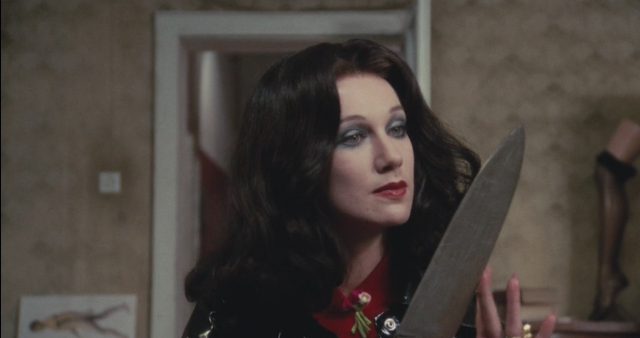
The chameleonic sexual personae of Daria: with long black hair as armed mistress (PROPERTY 1973); as can-do, sexually assertive reporter (DEEP RED 1975)

Bearing the meta-textuality still further, we find the butcher and Anita going to the adult movie show where he threatens to "send her back to work at the bar" if she doesn't obediently go down on him. He also hits her when frustrated, which doesn't seem to foster any resentment on her part, beyond a fleeting feeling of shock. On the other hand, he also goes down on her --which we know from pop culture is a sad rarity with Italian men, who consider it demeaning to them. In a way, his slapping her around, and her whining to the camera almost seem like they were thrown in last minute efforts to taint what is essentially the film's only full-formed human relationship. Everyone else treats each other the way they might treat vending machines or food products, Total--for all his commie bellyaching--is the worst of all. In the world of backwards men like Total, his rationalizing father (who enjoys the fruits of his son's thievery but doesn't want to hear where it came from), the crazy cop, the drag queen gang of fur thieves, etc., the butcher is, at the very least, reliable and loyal (he doesn't have a wandering eye). Together he and Anita work to keep a legit business in the black, and after hours they share a certain post-coital simpatico that captures the benefits of long-term casual sexual relationships that are very rarely shown in movies which usually deal only in extremes of rapture or loathing. I love the scene when she abruptly stops him from going down on her in the office while she's counting the days tallies,  by announcing she's hungry and wants a steak. He agrees and gets up and there's a moment they share of simpatico alignment, a relationship without the need for little bambinos and sacred mother-in-law's nagging everyone to go to mass. We can, if we care to, admire the way the trappings of love and family are avoided in favor of a long term simpatico entrainment, the languid way two lovers disengage and prepare to go get something to eat, not really looking at each other but totally aligned; since pleasure, wealth and convenience are the focus, and not God or family or some other phony idolatry, they are fulfilled.

When you see these names in the credits, pounce! 
That may not add up to much in the end, but what really puts it all over into classic status, is the presence of an Ennio Morricone score. Why more composers don't endeavor to follow his lead--the use of antithetical counterpoint and surreal minimalism--is one of cinema's great tragic mysteries. Most composers try to show off all the stuff they learned in music school with a lot of mickey mousing orchestral pomp, dictating our every emotion. Ennio shows how the twang of a jaw harp and a lady whispering urgently but incoherently over discordant guitar stings would work so much better than a 100 piece orchestra. Has Ennio ever done a bad score? (and in the 60s-70s he did like ten or more a year). Certainly this is one of his weirdest and most memorable (and it's on Spotify!) especially during the strange opening credits, which play over overlapped densely colored pencils sketches of all the principle players on paper that resembles marble (but with lire notes for veins) while heavy breathing repetitions of "I.... have" ("avere! av-ere!") pulse over whooshing timpani undercurrents.  Elsewhere little ominous electric bass lines, stabby little mountain king strings, and little cycling piano riffs foreshadow similar pulsing passages in his recent Oscar-winning Hateful Eight score (Hey, we all steal from ourselves - and it suits the subject matter)

Ultimately, the main problem with Theft is a not uncommon one for anti-establishment movies of the period: it gest so busy critiquing the current system, and rebelling against it, it runs out of room to find an alternative. Do communist intellectuals seriously think they'll ever weed the Stalin reality out of their Trotskyist idealism by attacking capitalism's status quo? NEVER!

Sellers takes aim at bourgeois values - The Magic Christian (1969)

MONEY IS THE ROOT OF ALL PRINTED-GREEN PAPER

An example of this same problem can be found in 1969's The Magic Christian (above)--a satire of consumer culture not unlike Property-- which finds bored millionaire Peter Sellers and his nephew Ringo learning about the world through staging of some very elaborate (and presumably overpriced) 'freak outs' to blow the minds of standard bowler-and-brolly London-suburb train commuters. You can all but trace the thought lines of these little gags back to a time when access to a flood of freely available, semi-legal high-quality LSD woke artists up to the handrails and structure of modern society. The sudden awareness of the absurdity of money and other social mores --as aesthetic things in and of themselves--are made--while tripping--instantly absurd. The cash in hand is no longer 'invisible' as a symbol for goods and services but a pocketful of green portraits of old men in weird wigs; their strange knotty faces seem to be smiling and winking to your dilating pupils. They seem to be struggling to move; en verso, the eye in the pyramid follows you around the room, blinks, and blazes light, pulling you in towards it like a tractor beam. The fact that 'normal' people don't notice these things is even funnier. "Living is easy with eyes closed." With newly opened eyes, one naturally wants to open the eyes of the sleeping straights around him, even if only for a few flash moments, like one of Jerry Garcia's onstage backflips tripping deadheads often see in concert. Pranksters like Ken Kesey and his magic bus pull over on some random small town main street to run amok for five minutes, then disappear - leaving the sleepy town to wonder if it was all just something they ate. This is art. Important. Maybe pointless. And can get you jailed.

Noble in original intent, it spun out of control too fast - too many idiots taking too much of stuff that was too strong, too often, then clogging up the ER en masse the minute they think they're dying (i.e. the 'only fools rush in' preliminary bad trip bardos); the logistics of the endless stream of runaway kids turning Golden Gate Park into a giant toilet. It was a revolution with nowhere to go.

Take that!

But in Europe, there was a movement of intellectuals ready to absorb the psychedelic culture shocks with deadpan bemusement: Antonioni, whose earlier work like Red Desert explored, in a much more abstract, intellectual way, the collapse of structuralism (even sober, he and Monica were hip to the aesthetic absurdity of bank notes) connected with the turned-on generation in such a way as to help form it (via Blow-up), leading to the idea that by keeping your behavior totally random, and embracing a kind of abstract chaos magic approach to life, you can shimmy down from the symbolic ledge and run 'free' without having to run naked, screaming, down 5th Ave with question marks written all over your body in Day-Glo paint.

Even so, some symbols - like 'Stop' signs are better left heeded for their symbolic message rather than regarded purely as red octagons. Failure to comply could lead to your death by car. Similarly, give your money away like it's a disease and you can drift so far off the grid you can't get back on, which might be important if you want to eat regularly. Screw with your own life at your own risk, and you better take that risk seriously. Vanessa Redgrave isn't playing around.

(see also: Through a Dark Symbol).

Pull the string!

That's the core of what's missing in Petri's Theft - which shows the all-importance of having a good star at the center of a work like this: the closest thing we have to a person to root for is Albertone, the beloved cross-dressing leader of a queer gang of jewel robbers who-- their identity as maligned subculture perhaps leading them towards a group loyalty--are truly grieved by his passing. (though he only shows up in the last third). This being a time when queerness was portrayed in giallos as one more signifier of freaky transgression, drag was a common enough drag sight, a symbol of the split self (and Norman Bates), in Petri's reserving of the bulk of our sympathy for Albertone show that beneath its cynical Brechtian satire, Petri's film has a genuine heart and respect for humanity and artistic perception.

If you can admit your confusion, you earn a pass.

But the price of true post-structuralist realization--of stepping free of the bullshit-- is complete paralysis. Hemmings with the ghost tennis ball in his hand, frozen in contemplation. Without real money, and real balls, the void stretches past even new life and new civilizations - it boldly goes where no man has gone before... but leaves you standing there, just a focal point for the endless nada.

One happy little family, pre-Total

You know where I'm going with this: America got around this anti-money issue with a show called Star Trek where private property no longer existed. Maybe one day we'd grow into it, but only if we didn't rush things. America couldn't afford to be nihilistic about money, not at right then, having used up all our nihilism cards on our all-consuming hobby, Vietnam. But, at least the Cold War helped externalize the Red Menace well enough that we didn't have to fight it in the mirror, unlike some people - ahemItalycoguh. 

But hey - in 1973, crime in New York City was as bad as it was Rome, albeit with less motor-scooter purse snatching (ciao, Scippatori!) and more subway knife-point mugging.

Funny, but hardly surprising, that we took the opposite approach of Italy, whose pop culture tended to idolize the crooks, encouraging readers to fantasize they were like Diabolik, robbing the country blind while bemoaning its collective impoverishment, never getting how the two were linked. Here in the USA it was the reverse, we decided to invoke our second amendment rights and make a stand. Here, we wouldn't cheer these masked crooks at all... we'd... well...let's just say, we gotta guy comin' in, and he knows just how to deal with punks like you. See you soon, pally!

(Charles Bronson Death Wish - 1974)
FURTHER READING:

1. See 'Woman is the Father of Horror' - which I argue that a lot of the success of the great horror auteurs comes from their female writing/producing partners - i.e. Debra Hill, Daria Nicolodi, Gale Ann Hurd.

Monday, June 16, 2014

Wes Anderson vs. the Trust Fund Marxists + 10 Classic films for fans of THE GRAND BUDAPEST HOTEL (2014)

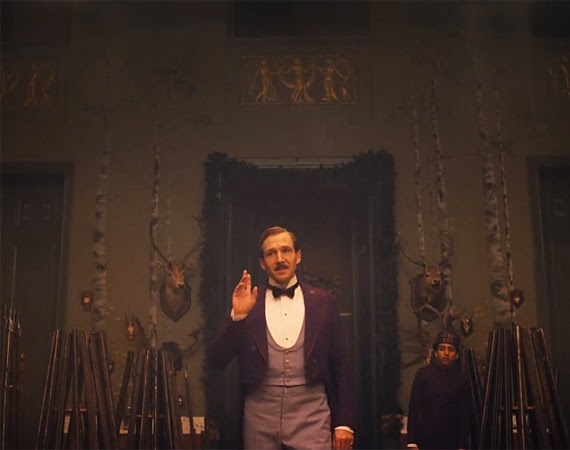
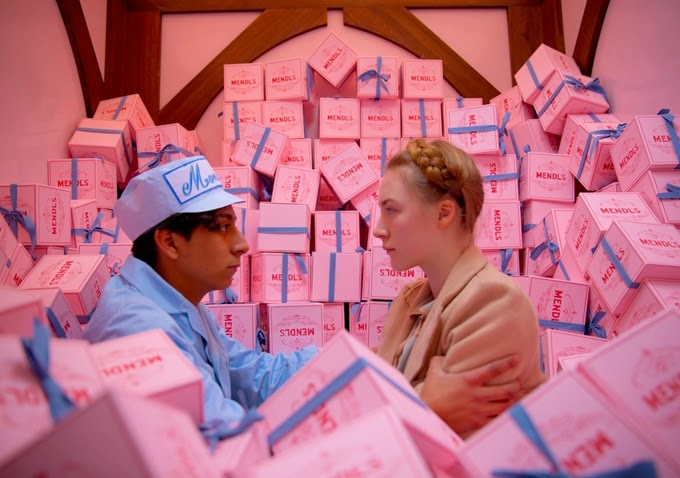
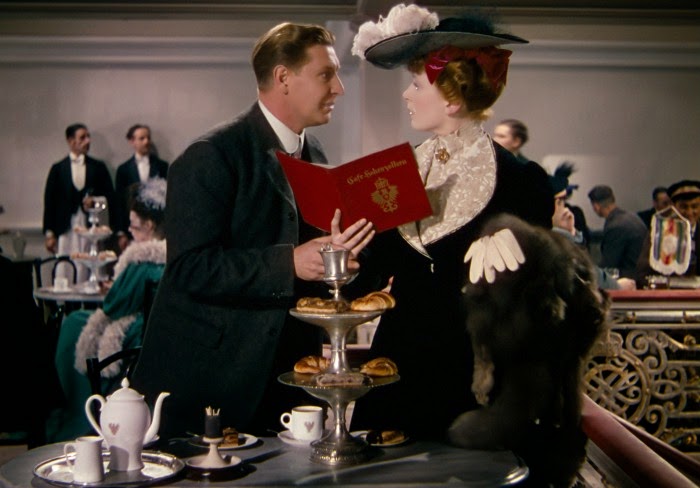
From top: Grand Budapest; Life and Death of Col. Blimp

If you're as keen as I am for pre-code Lubitsch like The Love Parade, Trouble in Paradise, The Smiling Lieutenant, One Hour with You, and The Merry Widow (this Tues on TCM!), and love Wes Anderson's previous films, then you surely can/have/will appreciate the icy frosting splendor over-melancholy birthday cake of their combined flavor in The Grand Budapest Hotel (2014), released this week on DVD. Those enthralled by Renoir will appreciate oblique references to Grand Illusion; there are also the McGuffins of Hitchcock to be found; clues and puzzles too, like The Riddler might tell on Batman; the gorgeous colors of Powell-Cardiff-Pressburger float about; the candy coatings of McGonigle are notable, as are the epic swirls of modernist Cy Twerlington --all are swirled together as if by an overexcited boy using his sister's dollhouse and tea set to relay a tale within a tale to agog younger siblings.


Seems this dollhouse hotel is run like clockwork by assiduous major domo Ralph Fiennes and his deadpan Muslim lobby boy (Tony Revolori), the latter earning the film's romantic angle, the only woman protagonist (the ubiquitous Saoirse Ronan) in the film. She dies somewhere along the time line and he grows up to be F. Murray Abraham, narrating the tale to writer Jude Law in the now gone-to-Communist bloc grey hotel, decades later. Law writes it all down, and in the future it's read by a bright young Slav girl - in the final, outer layer of the narrative Russian doll.

Anderson's previous film, Moonrise Kingdom (see my best of 2012 list) surged with young outlaw lovers' momentum detached cool and fervent devotion. It marked real progress forward for Anderson, whose past films all focused more on an emotionally-stunted father-son bromance compromised by rivalry over girls generally too mature and/or damaged for either of them to handle. Moonrise was like if Max in Rushmore hooked up with Gweneth Paltrow in Royal Tenenbaums - his two coolest characters --and neither was tongue-tied or awkward around the other but pre-possessed with the refreshing eerie confidence that the first flush of mutual attraction can bring.


But the relationship at the heart of Budapest indicates a racing away from the palm sweat stress of first love, the dangerous thrill of romance bringing confidence rather than fear. Wes heads back to the safety of the father-son surrogate bromances of his pre-Moonrise films. But--as are all attempts to climb inside the tattered remains of an old cocoon (take it from me)--it's kind of sad this reversal of progress, the capering and gamboling are less vital this time. The word on the street is that you need to see this film a few times to get all the little details, but the thing is, I don't want to. I'm not even sure I want to see Moonrise Kingdom again, at least not at the moment. What if a second viewing dims my love? Better the safety of one more viewing of The Expendables 2. Stallone, now that's a "mature" man's man! Movies about 18 year-olds in 60 year old bodies, rather than 13 year-olds in 30-40 year-old bodies, you see the grand difference, my son?


That said, the critical and financial box office success of Grand Budapest is a good sign for future auteur "quirk" art, which isn't necessarily great for "art" art, or that last bastion of hardscrabble art world outsiders, 'folk art.' Lovingly ornate tracking shots, quaint train set miniatures, impeccable 30s costumery and decor (bright pinks and deep purples) and wistful rainy day isolation hint of some deep meaning within its message about how fascism, Communism, and Nazism destroyed humanity's confidence in itself, and cakes stopped being decadent, risks trivialization. In the end it leaves one wondering if Anderson has anything left to say, other than that he wants to go back in time and live in a grand hotel before the world wars destroyed such places. Must be nice to be rich enough you can stay in the few that are still standing, and bring your whole crew, too. Must be nice.

I don't blame Anderson for wanting a nice empty safe place where no one knows his name, where cavernous steam bath facilities and snowy mountain tops give him (and we the viewer) hot and cold extremes for maximum coziness. But just because Anderson uses a self-reflexive fractal inward spiral narrative doesn't mean his films gets to shirk the cumbersome duty of meaning something. For all its feints at political relevance, Anderson's film is just a delusional reverie imagining how nice it would have been to be a first class traveller in the days before the Nazis destroyed most of fancy Europe. It's all dressed up and does have a few worthy places to go, so why does it feel still lost?

Viva La Revolution! 
Putting one's own private nostalgic wistfulness on the big screen is the purview of the rich, who can afford to create their pet time travel realities, as Woody Allen does in Midnight in Paris (see: Oscar Picks of the Bourgeoisie - in Salieri Shades). These dreamers can afford to create their own past worlds to vanish into. So while a state-funded auteur like Bergman could create vast worlds of resonance out of two women's faces in black and white close-up, he couldn't afford to build an escape-into past (unless you count Smiles of a Summer Night). For Bergman, stripping down his style only deepened his resonance, proving that where art cinema is concerned, more is less and Bibi and Liv's faces are timeless. But Budapest illustrates how unlimited freedom allows for laziness; excessive details undermine resonance. Anderson can only reap a few chuckles from the vast quantity of faces and minutely-painted flea circus settings, so it seems only fair that the military uprisings that bookend portions of this film should occur, the Iron Curtain evening up the playing field. No more rich folks getting treated like kings. Let them all eat bread. No cake!

As for Communism's good side, Anderson never shows us the starving, huddled masses who aren't willing or able to work and scrape obsequiously in 24 hours a day service for rich tourists. They might like the uniform grey and suppression of the individual, because it means they eat regularly, and are suddenly the equal of any rich punter.

It's them, the workers, Anderson should be scared of!

That said, I'm on congressional record railing against the Trust Fund Marxist movement (see: Sullivan's Jet Travels: Rich Kid Cinema) and as much as Anderson seems to be railing against spoiled rich kid collaborators in Budapest, I respect his frivolous whims. Evoking the big pre-code split during the Great Depression between social message films like Wild Boys of the Road and Heroes for Saleand musicals and escapism like 42nd Street, the Sullivans and Andersons of the world often don't factor in that their glorification of the poor might be just the imagination of a lonely Little Lord Fauntleroy, whose only friends are the household servants, and how important it is for him to feel he's bringing joy and fullness he brings to their lives by giving them the chance to serve his every need.

As one of the middle class, I can vouch that the our fantasy of being rich seldom includes having servants. But servants are an inescapable part of real wealth. And as Hegel knows, never having to ever have to fend for oneself gradually leaves the rich so unprepared for life that it's critical to their sense of self to believe there's a bond other than their room, board, and paycheck, by which their household staff are bound to them, that the servants and hoteliers love serving them hand and foot, for service's own sake, and would never abandon their 'betters' to starve or have to pack their own bags, even if said betters never tipped a dime.

Reality is surely different, but in Anderson's world these usually tertiary characters all work their fingers to the bone, 24 hours a day, to make the Grand Budapest excellent --why? Because they love to serve the jet set? Non, monsieur, because Wes Anderson's camera transcends both the trust fund 'present of liberty' Kane-ism and the socialist hand-wringing of Sullivan, and does so without careening into the life-is-a-circus Fellini-ism, just barely. So what else is left in its stead?

Let us recall that quote from William Powell as Godfrey Parks (left), the rich scion who finds his mojo by becoming first a forgotten man and then a butler for a spoiled dingbat family in My Man Godfrey. "You're proud of being a butler?" asks a bewildered Eugene Pallette. "I'm proud of being a good butler, sir," Powell says. "And  if I may so, sir, one has to be good to put up with this family." In other words, excellence of service is its own reward, even when those being served are undeserving. This pride in performance sets vast karmic chains in motion wherein even labeling someone as undeserving of special service is forgotten, as unless all judgment is suspended, there can be no good fortune. As with cult leaders, there's absolutely no difference between finding pure freedom through selfless service and being an exploitable dupe. As with the 'glorious' martyrdom offered unwed mothers in soaps of the 1930s-50s after they work their fingers to the bone for undeserving illegitimate D.A. sons, there's the dubious aftertaste that this martyrdom is really in the service of some nefarious evil 1% patriarchy, one that plays up the grace and nobility of being a second-class citizen in this, the greatest of all possible worlds, but would never be sucker enough to believe it themselves.


On the flipside of that, there's the trust fund Marxist, who blames "the rich" (i.e. his dad) for sucking the blood of the proletariat in his own (parent-funded) films. He's glamorizing the poor - but must I reach for my frothy tome of 'wise old sayings by butlers?' to find out what Burrows said to Sullivan in Sullivan's Travels (above) in order to dissuade him from his grand slumming odyssey, that "only the morbid rich would find the subject glamorous"?

Godard's La Chinoise 
Godard is my boiler plate for my Trust Fund Marxist theory, but I still love him because he's French, and so remains hilarious despite and even because of his leftist propaganda; he's trying so hard, awww, to connect the New Wave with Eisenstein, that he actually takes his own bullshit seriously, which is great. Because unless a Frenchman is actually trying to be funny, he's intrinsically hilarious; that's why the more Jean Pierre Leaud tries to look politically serious, the funnier he is. He's like Harpo Marx crossed with Young Trotsky in Love. But when he tries to be funny, ugh.... kill me.

That's the strange rich kid cinema angle that is both transcended and indulged by Anderson's film. The leads of Grand Budapest become rich because they are tireless, loyal, fearless servers of the rich, as apt an illustration of bootstrap capitalism as you're likely to find. They reject the communist ideal of equality as a given, due perhaps to proximity to the wealthy (and ample leftovers back in the kitchen) making privilege seem ever obtainable. Their jobs are frivolous -- bellhopping and major domoing aren't necessary as we all know from carrying our own duffel into a Ramada-- and so their indispensability must be underwritten by adoring old lady residents leaving them fortunes in their wills for sexual services rendered. Meanwhile the unwavering subservience of the hard-working baker (Saoirse Ronan) laboring under the callous gaze of the owner seems a bit strange. A girl this hot and fearless wouldn't need to sweat her days away in a bakery making ornate sugar-coated little cakes for the rich and imprisoned! She'd be a first-rate government agent or high-end prostitute. And is there a difference? Not according to Hitchcock or Josef von Sternberg!

TEN CLASSIC FILM RECOMMENDATIONS 
FOR FANS OF THE GRAND BUDAPEST HOTEL:

1. The Life and Death of Colonel Blimp
1943 - Dir. Powell and Pressburger 
****
Michael Powell and Emeric Pressburger's tale covers a similar 'decline of old Europe' canvas in its chronicle of of a German spy in pre-WWI Vienna, a duel with a German who will become his best friend, and World War I as recalled in the mind of an old general wrestling his younger secretary's fiancee in a Turkish bath in the early days of WW2 England. Jack Cardiff's eye-popping colors and the superlative set design make even the war ravaged countryside beautiful, and it shares Budapest's melancholy air as the onrush of mechanized warfare slowly obliterates the sporting codes and artistic splendor of old-world class.

2. The Love Parade
1929 - dir. Ernst Lubitsch
 ***1/2
One of Lubitsch's less-revered works, this has Maurice Chevalier as a romantic soldier who winds up marrying the queen of his small country, the sort that would cease to exist when the map was redrawn at the end of WWI and then be completely obliterated by the end of WW2.

3. Shanghai Express
1932 - dir. Josef Von Sternberg
****
What better place to ride from Peking to Shanghai than in a first class train compartment with two cultured high fashion courtesans like Marlene Dietrich and Anna May Wong, especially if they take such languid pleasure in shocking an MGM-style fussbudget boarding house matron. Dietrich is at her most luminous and morally ambivalent, and incredibly cool and the Chinese civil war (that left them susceptible to Japanese invasion) makes an intriguing backdrop.  See: 1933, not 1939 was the greatest year for Hollywood Movies...

4. Trouble in Paradise
1932- dir. Ernst Lubitsch
****
It took awhile for this pre-code Paramount to resonate with me, but now I dig that it doesn't 'Americanize' the dialogue like so many lazier Hollywood films, instead playing up the linguistic difficulties where everyone in Europe is constantly searching for the one language each of them knows just a little bit of, as in the excited way the Italian hotelier translates EE Horton's story of how he got robbed in his room. Like in BUDAPEST, a great fuss is made of getting the first-class hotel experience exactly right, and while Herbert Marshall isn't Cary Grant, or even Ronald Coleman, he's also not George Brent. When the situation demands it, he swoons with the best of them and even convinces you--through two layers of subterfuge--that he's genuinely in love with the moon (he wants to see it reflected in the champagne)  (See: Pre-Code Capsules 9)

5. Grand Hotel
1932- dir. Edmund Goulding
***1/2
Greta Garbo is the melancholy ballerina who finds a reason to dance again after she falls for the down-and-out baron (John Barrymore). In another room a ravishing young secretary (Joan Crawford) succumbs joylessly to the advances of an arrogant industrialist (Wallace Beery, with a terrible buzz cut). In yet another thread, a fatally ill office clerk (Lionel Barrymore) drains his life savings in a desperate effort to derive some first-class pleasure from this bleak and brief existence. Downstairs at the bar, a disfigured doctor (Lewis Stone) dispenses wry commentary as people come and go. (MUZE) 

6. The Saragossa Manuscript
1965- dir. Wojciech Has
***
Like the narrative framework of an Eastern European girl reading a novel at the graveside of an author whom we meet in flashback who in turn hears the story from one of its participants, this Eastern European film is told via an ever-more-innate story within a story within a story structure and set in a colorful past that may never have existed but at any rate is now certainly gone,

7. Secret Agent
1936 - dir. Alfred Hitchcock
***
Set in the Alps (via Gaumont's finest painted backdrops), this tale of intrigue is a fine companion to Hitchcock's original version of The Man who Knew too Much. John Gielgud doesn't make much of an impression in the lead but he looks a bit like Ralph Fiennes and hey! Peter Lorre's in it. The ever- saucy Madeleine Carroll makes a fine femme fatale (though is way too flippant and disagreeable to make a good spy) and there's a memorable chase through a Swiss chocolate factory. One of my favorite $10 public domain titles I got as a kid, from Waldenbooks at the mall, in the early years of VHS. I've seen it 200 times, but not once in the last 20 years. It needs to be on Criterion!

8. On Her Majesty's Secret Service
1969 - dir. Peter R. Hunt
***1/2
Bond in the Alps, and a great skiing downhill chase, slalom, ski jumping, cable car rides, as well as the cool vibe of having to take long cable cars to visit the evil Telly Savalas' lair. He hypnotizes a bevy of socialite debs as they sleep using colored lights and his own grinning, cigarette-congested voice uttering instant mix CD-worthy lines like "You love chickens..." That part has no bearing on Budapest, but I love it. And the Alpine adventures and clues and skulking are all on point.

9. Torn Curtain
(1966) - dir. Alfred Hitchcock
***
This later period Hitchcock film doesn't get the love it deserves, but Wes Anderson is beholden to it for the flavor of Eastern European intrigue and the near-silent museum chase scene (just the sound of footsteps for suspense, etc.), and the anxiety of being asked to present your papers and/or discovered on some Communist bloc public conveyance. It's worth revisiting, and I wrote about it way back in '04 here

10. Million Dollar Legs
(1932) - dir. Edward F. Cline
***1/2
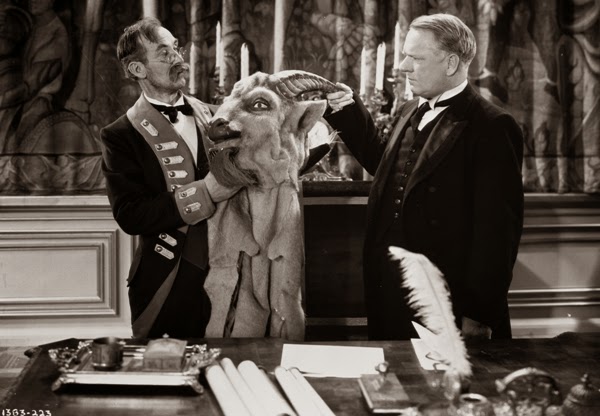
Co-written by Citizen Kane scribe Joseph L. Mankiewicz with uncredited touch-ups by the great Ben Hecht, Million Dollar Legs is the nationalism-satirizing predecessor of Marx Bros' Duck Soup, which makes sense since the heroine in Legs was married to Harpo Marx. Cockeyed Caravan's Matt Bird calls her "absurdly deadpan." Centering around the fictional nation of Klopstockia with its majordomo who can run faster than a speeding car, the president (W.C. Fields) stays on top of his plotting cabinet through games of toss wrestling, and there's a Mata Hari-style hottie spy (doing a great Garbo impression, "I'm wery fond of yumpers!"). Budapest fans will dig the colorful cast and pre-WWII fictionalized little mountain nation vibe.

Friday, May 13, 2011

Red is the color of my true love's helmet: QUEEN OF BLOOD, JET PILOT

Top: Queen of Blood (Florence Marley) / B: Jet Pilot (Janet Leigh)
QUEEN OF BLOOD (1966) and JET PILOT (1957) are two fascinating examples of Russian-American relations, each with a sexually carnivorous female pilot in a red helmet wowing the American astronauts or military. QUEEN's footage of this "red" planet vampire woman's ship and various astronauts wandering across hostile Martian lunar surfaces comes recycled from a Russian sci fi film Corman bought the western rights to, 1965's MESTRE NASTRESHU. These shots are almost Bava-esque with deep red filters and eerie gel lighting. JET PILOT's woman is Janet Leigh, a Soviet military jet pilot, claiming being denied promotion for being a woman as the reason for defecting, taking Uncle Sam up on its offer of sanctuary and $$ in the west in exchange for landing a MIG on US soil. Leigh's helmet is dark red when she defects, and her hotness in that white flight outfit is not to be denied, as effective as any Martian hypnosis. John Wayne all but swoons right there in the hangar, and so do we. When that helmet comes off and that hair comes tumbling out it's like you want to drop to your knees in worship, if she says come to Russia and freeze with me - honey, you're going.


Back to QUEEN OF BLOOD: In the Curtis Harrington-filmed US footage we have Dennis Hopper and John Saxon as the recognizable faces amidst the astronauts, who in the ALIEN-prefiguring plot are sent to Mars' orbiting moon, the Island of Phobos where a being from another galaxy has crash landed. She's a vampire alien from godlessness knows where, but hey --she's a delegate so just open up your neck and be polite ---we need the eggs. The elderly Basil Rathbone, still sharp as a tack and nutty as an heir of Frankenstein, here advising the masses, with his lead scientist sageness, points out that this is a once-in-a-million year opportunity.
 

Acting as a fine mirror to issues of gender as well as Soviet-American relations of the era, the footage is matched brilliantly to its respective sides - the Dionysian and ornate deep red Russian footage for the female vampire Martian - while the Earth scenes and space ship interiors are re-shot on threadbare Apollonian sets by Harrington. The result is a perfect metaphor for the repulsion/attraction between the US and Russia...one side an ornate red samovar (Mars / the alien ship), the other an institutional gray cafeteria. Together it's like an unholy union written in the stars and read by lovers holding hands across the Berlin wall. When the astronauts of both planets get together for the flight home, the hypnosis starts and the blood drinking and the orders from on high not to harm the specimen, no matter how many human astronauts perish like so many sailors on Dracula's London-bound schooner. This time however, everyone but John Saxon agrees: save the queen! If she wants to drink Dennis Hopper's blood just warn her first: the Thorazine is long gone!


The point is, if if you ever watch Mario Bava with the sound off just for those great lighting schemes and purple gel spots, you'll love QUEEN OF BLOOD. All the metatextual yin-ynag dichotomies are in place: one one side: Russian film/Dionysian/Female/Plant/Mars/red, on the other US/Apollonian/Male/human/Earth/blue interior-shot/mammal. All these great dichotomies lining up so splendidly are just gravy on the GHOST OF MARS train of course, as is Judi Meredith with her sexy smoker's voice and enough black eyeliner to darken the sun. In short, the film would be a great double bill with Josef Von Sternberg's JET PILOT (1957) and is clearly meant for a double bill anyway since it's so short (78 minutes).

JET PILOT comes directed (mostly) by Josef von Sternberg and produced and partially directed by Howard Hughes, so you can imagine the arguments. Apparently writer Jules Furthman reshot some of it after von Sternberg left, and Hughes of course shot the airplane stuff, which is almost 1/3 of the entire film, but it's real stuff - up there in the cold air on top of the world, so like QUEEN, JET has a split identity which works meta with the Red meets White and Blue in bed scenario. Sure it gets tawdry and cheap, but there's real chemistry with Leigh and John Wayne. She seems very young, carnal, smart, and doesn't even bother with a Russian accent (unlike Kate Hepburn's dull Russian defector and Bob Hope as the John Wayne in the far less lively same plot comedy of THE IRON PETTICOAT). Leigh and Wayne cram as much lust into their restricted gazes as the censor will allow while the cold war freeze of the empty gray sky above US bases in Alaska and Russian bases in Siberia makes a fine metaphor for the general iciness that is the post-code American perennial stalemate battle of the sexes.


It's a suitable metaphor not just for sex, but for bad sex, cold sex, post-children (no privacy) sex; sex where falling in love carries a lot of dangers --the other side may be a spy, but aren't you? Like an early version of Roger Vadim or John Derek, Howard Hughes was notorious for seducing pretty girls and making them stars via inert films with awesome posters (like THE OUTLAW), and usually firing the original director along the way in order to ensure no scrap of fun or originality survived, replaced by a weary but knowing sexuality, the inertia of the well laid vs. the meticulous energy and totemic, elaborate lighting that comes from being a sexually frustrated masochistic, pining for, rather than bedding, the leading hottie. But JET PILOT is a rare exception in both their cases. Von Sternberg at least got in some good subtextual masochism out of Jules Furthman's excellent script. This pair of red star-crossed lovers constantly attempt to escape their warring governments and just get it on, alone, for a few hours. And when they do there's that comedy of remarriage sensibility - a come closer / go away back and forth that recalls the great screwball comedies.

The Russia/US divide angle also illuminates the disparate polarities’ lack of ultimate difference: when her Soviet relations cockblock it’s because she has to seem disinterested in anything but following orders -and maybe she is; when Wayne's US friends and commanding generals cockblock it’s because of a temporary housing shortage. At the same time both superpowers encourage them into bed with each other for various pumpings for information on jet maneuvers, what the other side has and doesn't --and so there's a lot of great jargon Hughes no doubt made sure was legit and Furthman made sure wasn't boring. Von Sternberg takes a cue from military olive and bathes every set in shades of green until the whole film glows in the mind like a lime in a gin and tonic with the occasional maraschino cherry; and Lenny Maltin awards it a scant two stars as if begging to be punished by the State (read instead David Thomson's cautious enthusiasm for it in his indispensable Have you Seen...? ). Find it on DVD hidden deep in an old John Wayne set that includes--Lenin preserve us, THE CONQUEROR: John Wayne - An American Icon Collection (Seven Sinners/ The Shepherd of the Hills/ Pittsburgh/ The Conqueror/ Jet Pilot)

But find it, for the sake of the red stars and white stripes! And thanks to Another Film Blog for some of the above stills!

Tuesday, February 16, 2010

Sprays of Heaven: IN THE DUST OF THE STARS (1976)

"Help means so much more than giving you weapons." 

What happens when a peaceful rocket full of sexy East Germans are lured to a western colonized planet and are subject to drugs (the red spray is "spicy" while the blue spray is "sweet"), erotic dancing and orgiastic staring contests?  Das ist die frage in Gottfried Kolditz's colorful, cool and just plain weird film, 1976's IN THE DUST OF THE STARS (Im Staub der Sterne). Classy is the word I use to describe this crew, four women and two older guys, well-dressed and even-tempered. Nice hair.


Answering a distress signal, this East German rocketship (from the planet Cynro) emergency lands and is greeted first by a woman dressed like Pocahontas driving a combination school bus-railroad handcar who comes rumbling up to the ship in welcome like she's Robby the Robot in FORBIDDEN PLANET. Suko stays behind to spy while the rest ride over to the club to sit on divans and catch snide insults from the local bosses. Someone wants this spaceship to go home, but first, why not invite them to the party? Pocahontas comes by later with prismatic plastic fantastic invitations for each of them.

The "boss" of the planet is a fey German artiste who gets his hair painted blue and is forced to play with lite-brite and a keyboard that controls a disco dance floor full of pythons and gel-lit frauleinen. Don Draper this guy ain't. And let me tell you, his army sucks. Mostly the battles consist in a lot of standing around, working up the nerve to bust a cap, like a high school dance in Hell. These cavorting hedonists never speak, but spend most of their time spraying drugs of one color or another into their mouths, brainwashing nosy visitors with pen flashlights and doing licentious dances. The costumes aren't up to Mario Bava PLANET OF THE VAMPIRE standards but nonetheless pretty fetching, with an uncanny resemblance to UN peacekeepers. And it's nice that they change clothes about five times a day and stay color coordinated with each other, as if through telepathic EFSP (Extra-Fashion-Sense Perception). The patterns and styles are elegant and mod without being tacky or cumbersome, and they go well with the natural blonde shag haircuts of the majority of the crew. Jana Brejchová is the hottie commander (at right). She was once married to Milos Foreman!


In a way, DUST OF THE STARS is the perfect Iron Curtain counterpart to the American space fantasia of 50's sci fi films, ala: CAT WOMEN OF THE MOON/MISSILE TO THE MOON/QUEEN OF OUTER SPACE and THREE STOOGES IN OUTER SPACE, wherein dopey male astronauts land on a planets run by space women with a hankering for new blood... in their lineage and on their mandibles. In DUST there seems to be mainly dudes on the planet, at least with speaking roles (aside from Pocahontas) and the men are in weird Studio 54-esque "boytoy" attire, all ready to offer a hit of primo "spray" to any crew member with an open nostril, er, I mean mouth. And the girls in the crew are the ones who call the shots! The two men on the crew are clearly both well-laid and mildly emasculated... a perfect Euro combination that Americans can only sneer at in envy. Both Paul Lind and Mae West would have loved them!

Kind of like HELL HOUSE (the Halloween 'haunted house' wherein Christian kids finally get to dance, pretend to do drugs and worship Satan in their own way), the licentious dancing and spraying of the aliens here presumably was acceptable to the East German censors because it was negatively depicted as a trap-- set by Decadent Western Imperialist aliens--to ensnare good honest Communists.


The parties these aliens throw are awesome, but for my money nothing can beat the black tights beatnik bar modern expressionist dancing of CAT WOMEN OF THE MOON. Man, those girls just nailed it! And though one of the two men on the Cynro crew is pretty smart (usually in these films, only one paranoid crew member smells danger while the others consider him a buzzkill), the commander is a woman--and competent! Navigating her sometimes overly compassionate female emotions with the same objective grappling of, say, Kirk on STAR TREK grappling with his shoot-from-the-hip egotism, and between all of the crew is a sexually relaxed vibe (they sleep with each other and make no big deal of it? Man, those East Germans!). My favorite is the girl at lower left; what a magnificently sensual pout!


I think her name is Miu. She's played by Regine Heintze, and I love her. Also, I love the offhand way that the film's sexuality and lovely female forms are displayed without any leering and/or slavering. It's like the characters in this film actually have sex rather than just winking and drooling and then finally having one chaste kiss like they're David Manners at an ice cream social. In DUST, they just do it and forget about it. The Germans have no patience for lovelorn leering! Stand straight! Are you slouching?! Achtung!

I am grateful to Netflix for having this film on instant stream and thus indirectly introducing me to the wonderful site known as Teleport City ("Bringing you yesterday's tomorrow... today!"). I love what their writer says about the loose nature of the crew (remember this was the 70s, pre-AIDS awareness, when sex wasn't a four letter word):
Now, in addition to their refreshing gender make-up, there are other things about the Cynro crew, only subtly hinted at for the most part, that make them just a little different from what you'd normally expect from the militarily-ranked team manning your average movie starship. I think, also, that these things are meant to suggest the way things roll back on Cynro. For one thing, this gang is just a tad more touchy-feely with one another than the behavior of those serving aboard the Enterprise and its like have accustomed us to. Secondly, Suko, as a not-all-that-in-shape middle aged guy with thinning hair, clearly has the arrangement to beat onboard the vessel, as he seems to be the boy toy of at least two of the female crew members, including the Captain and her blond colleague Miu. Miu, for her part, also might have a thing for the ladies, as one later scene seems to suggest. While all of this implied hanky-panky provides the opportunity for a bit of casual nudity and light petting between the cast members, it's all presented very matter-of-factly, with none of the exploitational hubba hubba you might expect. Wham Bam Thank You Spaceman this is not -- and the tone seems to suggest that the egalitarian ethos observed on this lots' home planet extends to everyone getting an equal piece, not just of the proverbial pie, but of each other, as well.
Now I don't know about you, space neighbors, but that seems pretty cool to me. If the wall hadn't come down, I might be tempted to hurtle it. I would disagree with Teleport City about the score (they don't like it). Yes, it's a bedroom-ish low fi casio-guitar soundtrack, but it's superb in its monochromatic moodiness; it's low-fi shoegaze twenty years ahead of schedule and as such is 100 times better than those super-slick-hyper-cliched Danny Elfman orchestral/children's choir cues that have been deadening so many big budget sci fi and fantasy films here in the states in the last 20 years.


Similarly ahead of his time is the fey "boss" of the bad guys, a prancing Caligula-wannabe who parties with snakes and likes to change his hair color to match his mercurial mood. He could be knocking back drinks with any 1990s Manhattan loungecore crowd and everyone would assume he's in advertising -- but it's still only 1979 and he's a Communist playing a decadent Colonialist oppressor. And we think those East Germans were behind the times? In 1979 they were partying like it's 1997, which is to say, hard and unsmilingly.

In typical Communist fashion, the action break-out finale looks more like a labor strike than a shootout, replete with hundreds of confused, identically-dressed male extras hacking at rocks, locking arms and shuffling around in nonviolent protest. No one seems very militarily coordinated on this planet, with opposing armies running to and fro like herds of awkward antelope, but they look good, specimen-wise. Boasting a mix of modular architecture and muddy grassland roughly parallel to Gene Roddenberry's TV special futurescapes of the era, the film earns extra points for the natural and uncanny weirdness of East German design and the refreshing lack of western sexism. Not once does any male say anything condescending or object to a woman in charge. And our director manages to make the women all seem both vulnerable and strong, smart and gullible, i.e. like anyone else -- all while never missing a chance to show some sexy thighs (below left).

Much more bizarre in terms of sci fi plots is the moral quandary the crew faces: If they intervene on behalf of the oppressed workers of the planet then they'll have to stay around like a peacekeeping delegation and will probably get involved in an interplanetary war; if they just leave then they've turned their back on a people in need. This quantry makes a good modern parable for a UN peacekeeping mission in Rwanda, Liberia or Darfur--or the reason, for example, that George Bush Sr. was too smart to invade Iraq ("no exit strategy").  By the same token, the conquering Tem people know they can't kill or attack the visiting ship directly if they want to avoid an "inter-galactic incident," but the miners are all fair game, used as human shields, slave labor and so forth --again, just like real life!

Another perhaps more controversial analogy is with modern UFO philosophy--i.e. the notion that we're (as in earthlings) under the rule of trans-dimensional aliens who harvest our genetically modified souls and have worked their way into the fabric of all levels of social leadership. The space travelers tell the enslaved Tekk: "We can't build a force field around your planet so you can develop undisturbed like we would like"-- a lament very similar to UN policy toward underdeveloped nations undergoing exploitation by slick multi-nationals, or the way grays try not to disrupt our evolution even as they tinker with our DNA on the sidelines.

Whoa! Don't think I'm crazy. I've just been reading Nigel Kerner's new book all weekend. It's not that I 100% believe we're a soul farm stud on Orion's Belt, but if we in the First World can't/won't imagine there might be some extraterrestrial race for whom we're a Third World primitive society in the midst of being exploited (we learned Colonialism from somewhere) maybe we deserve all we get, or may have already gotten. Plus, our East German rocket comrades bear more than passing resemblance to the "blonde" aliens sometimes seen cruising around in saucers or European dance clubs.You will now please erase this nonsense from your mind. Alles ist schone. Alles ist schone...

Due to budget or obscure Communist censorship laws we don't see too much violence or special effects; most of the attacks are offscreen (we hear about them on the ship's radio). The big climax just involves one "important" death, which causes "the Boss" to smash his orbs, if you know what I mean. On both sides of the squabble there's a remarkably etched-in sense of collective teamwork, decision making and leadership skills. But hey, we don't have to see scenes just because the rickety sci fi framework plot requires them;  we've seen it all before -- fill in your own blanks, let your tongue feel the spray, and dig those astro-boots (right).

In the end, DUST says more about Communist fantasies of western decadence, Binaca-style spray drugs and open-sexuality than a whole festival of Amerikanische schweinhunde filmen ever could. Most devastating is the implication that the need to get high and exploit nude bodies is perhaps just a Capitalist-conditioned response to the repression and misery instilled by our Puritan forefathers. These East Germans don't need to do all that because they just have casual sex with each other, wear cool clothes, and forget about it. With a crew of beautiful, healthy German women to give your aching head a maternal massage as needed-- and/or dance while you eat breakfast, maybe you'd be just fine as a cog in the people's machine. After all, what else are you exploiting the workers and getting high for, anyway?

Related Posts Plugin for WordPress, Blogger...