Not an episode per se, we just left record on while we got together via Zoom and tried to figure out the Midgard rules from Reisswitz/Too Fat Lardies. Had a good time, but may be hard to follow. On the other hand, you might like this sort of thing.

Not an episode per se, we just left record on while we got together via Zoom and tried to figure out the Midgard rules from Reisswitz/Too Fat Lardies. Had a good time, but may be hard to follow. On the other hand, you might like this sort of thing.
Last week I had the chance to visit my friend Joe Saunders to playtest his Sharp Practice game for HotLead in two week’s time. Joe of course is the proprietor of the Miniature Landscape Hobbies YouTube channel, and a friend of the Canadian Wargamer Podcast. Here is the always friendly Joe beside one of his epic scratch built terrain boards, in this case depicting a village somewhere in Spain.

The scenario was built around Napoleon’s one visit to Spain in 1808. The Emperor is travelling cross country by coach wit a small elite escort but the details of his trip are leaked and Spanish partisans are lying in ambush. French and British troops are hastening to the site. The Emperor wins by getting from one side of the table to the other.
Close up of Napoleon (front rank on the right) with his elite escort Chasseurs of the Guard. All figures painted by Joe. The Napoleon casting is I believe a Warlord sculpt, and Joe’s tutorial on painting him is here. Napoleon is rated as a Level 4 commander, the best in there can be in the rules, so he has a ton of clout on the battlefield. The downside is that from turn on, he is in long range of Spanish guerrillas, so he needs to be careful.
When I learned that I got to play Napoleon in a tactical game, I absolutely HAD to play the French!

The game unfolded with a full run of cards allowing all units from both sides to deploy. The British had a light and a heavy cavalry unit on their side of the table, directly facing Napoleon. It was only a matter of time before they decided to charge, and while I did my best to block them with a unit of dragoons, I had deployed my other unit of cavalry, cuirassiers, on the far side of the table where they weren’t able to protect L’Empereur, which proved to be a fatal mistake.
In retrospect, Joe and I decided that both sides should only have light cavalry, as heavy impact cavalry in Sharp Practice is murderous. Otherwise, the British player will do their best to ride down Napoleon as quickly as possible and end the game.
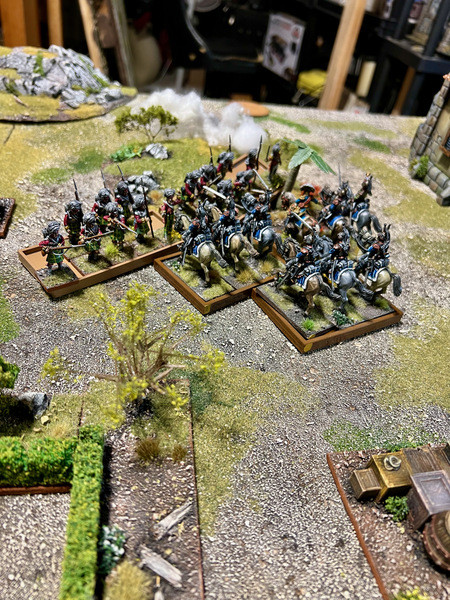
As an example of what impact cavalry can do, here are my cuirassiers charging into a hapless formation of Highlanders. The cards allowed me to hit them while the Jocks had their muskets unloaded, so they got bundled off the table with heavy losses. It was one of those rare moments in Sharp Practice where you get perfect card draws: I moved into charge range with the last card of one turn, and got to charge with the first card of the next turn. Fun when it happens, especially given how rare such moments are.
It’s always fun to help a friend think through the balance and structure of a war-game scenario. I wish I’d taken some more photos of Joe’s lovely terrain and of his wonderful collection of 28mm Naps. Hopefully I’ll get some more for you at Hot Lead in two weeks time.
Cheers and blessings to your die rolls,
MP+
Following on the heels of my last post, about the LardEh games day in Hamilton, here’s a report on the Napoleonics game I ran in he afternoon. It was the first time I’ve stepped into the role of Games Master at an event, so I was quite nervous and wanted to have the game right, balanced, fun, and looking good. The rules I chose were Too Fat Lardies’ large battle Napoleonics rules, General d’Armee (GdA), by Dave Brown and published by TFL’s Reisswitz Press imprint.
My first challenge was to finish the French ADC chits, to go with the Austrian ADC chits I made last year. In GdA, ADCs are like command or initiative points in other rules sets. They are a finite number of opportunities for the player as the CinC to influence the battle by giving orders to his brigades, and hopefully getting them to overcome the friction of the battlefield and actually do what he the commander wants. Here are eight French officer caricatures, shouting at the player or giving looks of disdain at their lack of battlefield prowess. I wanted something to add period colour and a little humour to the game.

Now to decide on the battle. I have been thinking about Wertingen, the opening fight of the Ulm campaign, which in turn led to Austerlitz and Napoleon’s stunning defeat of the Third Coalition of Russia and Austria. As the Grande Army advanced through Bavaria, two French corps (Murat’s Cavalry Reserve and Lannes’ III Corps) ran into an Austrian infantry corps under Auffenburg that Mack rashly sent swanning about on an ill-conceived reconnaissance in force. Historically the French made short work of the Austrians, but in the GMT Command and Colors scenario which introduced me to the battle, it seemed like an even and manageable fight.
Here’s the playlets table, kept fairly simple as I didn’t want the players interacting with terrain pieces when they could be fighting. I find that for 6mm games with lots of troops on the table, simple is better. The cloth mat and roads are from Geek Villain (UK), the fields are latex from Barrage Miniatures (Sp), the buildings are Timecast and the hills are scratch built.

Here is the order of battle, printed on individual unit markers that will be fixed onto 3D printed unit markers courtesy of Aaron at Project Wargaming. Each marker is for a regiment or for an individual commander. There were some mistakes that I caught when I took a closer look at the rules. In GdA only Guards units are Elite, whereas good units like your typical Grenadier unit would be rated as Veteran. Thus I told the players that for Elite, read Veteran, and for Heavy Cavalry, unless marked Cuirassier in the case of the two Aus units, the French cavalry are considered Battle Cavalry, which in GdA is most well horsed line cavalry (Hussars, Chasseurs, Dragoons). The French still outnumber the Austrians 2-1 in cavalry units, with two of the Aus regiments being Small or understrength.

All is quite in the village of Wertingen.

A view of the dispositions early on. That’s one of the voices of the Canadian Wargamer Podcast, James, setting up the Austrians at top left. The Austrians have to hold on the road intersection for 12 turns to win. In all the photos that follow, two bases placed together indicate a single cavalry or infantry regiment or battalion.
The two French players put both of Murat’s cavalry divisions and both his batteries of horse artillery on their left, with Lanne’s corps on the right. The French tried to get off to a fast start, realizing the clock was against them, but had trouble coordinating their advance in the centre.

One of the Austrian players sees a chance when the French rashly push their horse artillery forward and attack with a regiment of hussars, still in column. The Austrians suffer terribly from canister, but remarkably the survivors close, and in the melee that follows, the French gunners manfully stood by their guns and saw off the chargers. It was one of several remarkable upset results. Charging is always a bit of an uncertain business in GdA, it’s a two-edged sword indeed.

In another case of a surprise result, the Austrians throw their horse at Lasalle’s hussar brigade that is holding Lanne’s right flank, and despite their advantage of having one regiment of cuirassiers, they are thrown back.

James realized that the key to survival was aggression, and pushed his infantry forward. A fortunate volley drove the French light foot out of the north half of the village (the church square) and that reversal seemed to perplex the French players, who never used their four veteran grenadier regiments to full advantage after that.

On the Austrian right, Murat’s two dragoon brigades are slowly and relentlessly pushing forward, but they are too far away from the intersection and it is too late in the day for this to be a disaster.

With the Austrians firmly holding the centre of the table, and only a few turns remaining, the French players conceded defeat.

I had worried that the game would be a one-sided affair, with the French cruising to an easy victory, but in fact it was a close battle and the Austrians, ably and aggressively handled, had a convincing victory. Most importantly, the players had fun, I gained enough confidence to run another game at another event, and I got to know the rules much better.
Perhaps I’ve made the same fudge that the designers of the Command and Colors Wertingen scenario did by giving the Austrians more units on the table than the historical battle would suggest - from what I’ve been able to gather, the French had a 3-1 advantage. Perhaps I could adjust that by taking away one of the Austrian cavalry regiments, but I’d like to play this though again with some other players to see if there’s a different encounter. Hopefully I’ll write up this scenario for one of the magazine.
Cheers, thanks for reading, and blessings to you die rolls!
MP+
Last Saturday I made the two hour trek south from Barrie to Hamilton, Ontario, for LardEhs, the second such event run by some dedicated Canuck gamers, the first being in November. The name LardEhs is a play on Canadian speech patterns (IYKYK, if not, Bob and Doug will explain it to you here). I ran a game in the afternoon, of which more in a subsequent post, but here quickly are some of the photos I had time to take in the morning. The event attracted about 40 game masters and players, a small but impressive selection of vendors, and brought in at least one person from out of province.
Thomas Sero ran a Large Chain of Command game in 20mm featuring British and German troops fighting for Rauray, Normandy. Thomas’ village, seen here, featured many of his own scratch-built structures, including a rather fine looking church. I ran the British armour, and made the mistake of rolling too far forward in my Sherman, paying the price for not looking to my right and noticing the Panther in the orchard (top right). It was a close fought game still in the balance when we had to finish the session. Well done Thomas!

Howard Tulloch made an even longer drive than I did, coming down from Orillia to host morning and afternoon games of What A Tanker! Howard’s skills running games, honed running DBA events for years, were fully on display here, with a novel and very interesting table taking the players to somewhere in Burma later in the war.

Japanese tanks, not often seen on the wargames table, stalked British Shermans and Stuarts for much of the day. Tanks were continuously exploding, new players came and went, and much laughter was heard.

Roger Chrysler hosted one of two games of Sharp Practice, featuring a War of 1812 scenario by the late Mike Hobbs in which British troops and their First Nations allies are wreaking their revenge on Americans as they stumble out of their tents. My friend and podcast partner James (top left) along with Dan played the British/Indians, and appeared to have victory well in hand as the Mohawk warriors were last seen crashing into what was left of the American flank. Ouch.

Sean Malcomson ran a game of Infamy! Infamy! pitting angry Britons against Claudian Romans, seeking to impose their evil metric ways. I played in Sean’s Infamy game at Hot Lead this March, and was glad to have the chance again to see his colourful armies on the table.

I do love me a chariot. These are very tasty. Somebody should write a chariot rules set called “Wicker and Whinnies”, I’d buy it.

Romans grimly hold the line. I didn’t see how the game finished, but it looked like the Romans were a tough nut to crack.

Chis Robinson, a friend of the Canadian Wargamer Podcast, ran another game of Sharp Practice, an ACW battle that featured abundant numbers of cavalry. Chris ran two distinct but linked games, with the morning game having a bearing on how the afternoon game played out. Chris’ 18mm figures are highly distinct, sitting in the sweet spot for size and detail between 15s and 28s, and are very well painted. Both Chris’ games were popular and well subscribed.

A high point of this event was the $400ish dollars raised from the charity raffle to support the local university children’s hospital foundation. I want to thank Richard Clarke of TFL for donating a handsome number of red Lardies dice, which we sold as part of the fundraiser. That along with other prizes donated by various vendors and by a certain Canadian podcast show the spirit of our Lardies community.
There were a few notable absences - no games of I Aint Been Shot Mum or its successor, O Group, no flying games, and it seems that the latest Lardie publication, Mark Backhouse’s ancient big battles rules, Strength and Honour, haven’t made it over the water yet. There will be a LardEh 3 in late September, I hear, so maybe we’ll see the newest Lardie game then. It would also be wonderful to see Lardies fans in other parts of Canada follow Ontario’s lead and run similar events.
Well done to Chris, Barnaby, and all the good folk who made this event a success.
Blessings to your die rolls!
MP+
Hello friends:
It's been a few weeks since James and I released the May edition of our podcast. We took a distinctly Too Fat Lardies approach since our guest is one of the most prolific Lard ambassadors in the Great White North. A wide ranging, longish conversation with the usual natter between me and James after the interview. Very gratifying that we are ticking towards 4500 downloads since we started this a year ago. There's a give-away contest as well, have a listen for the details, answers here are eligible. Will be doing the draw at the end of May. Cheers, and thanks for listening, MP
It's been over a month since we published Ep 14, so here's TWO AND A HALF HOURS of nonsense and yakking to make up for our absence.
In the first half, we talk to Montreal-based gamer Pierre-Yves Troel, who wowed us all in March at HotLead with his participation game of What a Cowboy, a much-anticipated western gunfight game soon to be published (we hope) from Too Fat Lardies. P-Y (Mike totally mangled his name and variously called him Y-P, P-J, and God knows what else, though our guest was too polite to say anything) talks about his gaming career, discovering the TFL community through online gaming, and his growing expertise in 3D printing. We also talked about the gaming scene in La Belle Province of Quebec.
In the second half, during our Canadian Content Corner (CCC), friend of the podcast Chris Robinson checks in to give us a update on LardEh, Canuckistan's TFL-themed gaming day returning to Hamilton, Ontario on 28 March. Chris also tells us about what he and Big Rich chatted about when Chris was a guest of the TFL Oddcast. Rounding out the CCC, Mike reports on what he's learned about how the Canadian Army faced a massive challenge training an NCO Corps from scratch in WW2. We also chat about about the Guadalcanal Campaign, about gaming WW3, James' WW3 Imaginations (Mantovia and Borduria), Mike's discovery of DBA (talk about coming late to the party) and how many figures a horse and musket unit really needs. It's a wide ranging convo, good for an extra-long painting session.
Our Guest:
Pierre-Yves on Twitter: @iwouldlike2rage
P-Y's minis and painting website: http://www.iwouldliketorage.com
P-Y's contributions to the CWP Virtual Library:
Churchill's Secret Warriors: The Explosive True Story of the Special Forces Desperadoes of WW2 by Damien Lewis. Quercus Publishing, 2014.
Behind Japanese Lines: With the OSS in Burma by Richard Dunlop. Skyhorse Publishing, 2014.
Other Subjects Mentioned In This Podcast:
Events:
LardEh, Hamilton, May 28: https://twothreesixmm.blogspot.com/2022/03/lardehs-game-day-ii.html?fbclid=IwAR03DIVymyCg_GqCWmHkxIwb7LcUEUCQhJuLZOZg6bzh5Z4Kq-w1HGTYBm0
Frozen Lard Facebook Group: https://www.facebook.com/groups/frozenlard
Books Mentioned:
Battlegroup! The Lessons of the Unfought Battles of the Cold War, by Jim Storr (Hellion, 2021).
https://www.helion.co.uk/military-history-books/battlegroup-the-lessons-of-the-unfought-battles-of-the-cold-war.php
Neptune's Inferno: The US Navy at Guadalcanal, by James D. Hornfishcher. (Bantam, 2012).
Building the Army's Backbone: Canadian Non-Commissioned Officers in the Second World War, by Andrew L. Brown (UBC Press, 2021).
https://www.ubcpress.ca/building-the-armys-backbone
George MacDonald Frazer, Quartered Safe Out There. (2007)
DBA 3.0 Rules, by Phil Barker (WRG).
Our Closing March:
The Meeting of the Waters (Quick March of the Rocky Mountain Rangers), played by the band of the Royal Highland Fusiliers:
https://youtu.be/K6vw45WlSoY
Contest:
Listen closely to the podcast for details on how to win some of Bob Murch's fabulous Cossack miniatures, proceeds go to the UN High Commissioner for Refugees Fund for Ukraine.
Contact Us:
Canadian Wargamer Podcast Facebook Page:
https://www.facebook.com/canadianwargamerpodcast
Mike: madpadre@gmail.com
@MarshalLuigi
www.madpadrewargames.blogspot.com
James:
@JamesManto4
Hello friends:
On of Canada’s most well-known miniature tabletop gaming events is now in the books, and can be counted a success. After two years of Covid-induced suspension, the games were back, the players were a little fewer in number and all masked and well behaved. Congratulations to my friend James and his crew of redshirts for making it a success. You can read James’ account of HotLead and see his own photos here. There are lots more photos and videos on the Hot Lead Facebook group page here.
This was the first time I’ve stayed over at the Arden Park hotel, the venue space. Previously I’ve cheaped out and couch surfed at my friend James’ expense, but this time I went all out and my lovely bride Joy came with me to sample Stratford’s shopping delights and to do some anthropological studies of the wargaming tribe. She said “your friends are weird but nice”. Truth.
My own brief account of what I played in and what I saw begins on Friday night with on of Dan Hutter’s signature multi-player rules, where no one is a friend and the guy sitting beside or across from you is probably gunning for you, so best gun him first. The game was set in Somalia during the disastrous UN intervention there in the early 1990s: several factions of Somalis, UN peacekeeping troops, and secretive mercenaries all had their own agendas and bullets soon flew in all directions. Rules were a very simple and mostly playable version of FUBAR. Grand start to the weekend.

Test of Honour samurai game going down on Friday night, lovely table.

Chris Robinson, a friend of the Canadian Wargamer Podcast and normally an historical guy, put on a Star Wars game that looked quite attractive. It was good to hear that the young players enjoyed it.

Some of the Hot Lead crowd were playing this impromptu Victorian SF game on Saturday morning, involving big steam powered clanks AND dinosaurs.

Saturday morning I played in this beautiful WW2 game hosted by Joe Saunders of Miniature Landscape Hobbies. Joe is a friend of the Canadian Wargaming Podcast and a lovely guy.

This scratch built railway gun was done by Joe and part of the table dressing.

The game was called “Countdown to Launch” and featured the Germans trying to delay the Allied onslaught long enough to fuel, arm, and fire off this V1 rocket.

It was quite an onslaught. The Germans died in droves but managed to fire off the rocket. I confess that tanks massed track to track are an example of why I don’t personally like Flames of War, but it did deliver a fast game, and at this sort of event, with three hour game slots, you need quick fast games.

This beautiful medieval game, the Battle of Tewkesbury, was hosted by Ian Tetlow, who always puts on good looking games at Hot Lead.


On Saturday afternoon I played in Sean Malcomson’s “Hard Brexit” ancients game using Too Fat Lardie’s Infamy, Infamy rules. The object was for the Roman players to move a herd of (unfairly) taxed cattle across this table to safe harbour. The British, strong believers in No Taxation Without Representation, were trying to stop them.

Some of Sean’s beautiful ancient British figures. The British deployed from a series of ambush points.

Life got quite difficult for the Romans. Their legionaries stood in line like rocks while their auxiliary reserves ran back and forward plugging gaps and counter attacking.

The British skirmish cavalry, seen entering here, were annoying but not decisive. In the end, we ran out of time but called it a British win. I found these rules similar enough to Sharp Practice that I got the hang of it fairly quickly, and would try them again as an excuse to get some Romans to oppose my Germanic war band.

My last game at HotLead was on Saturday night. Brian Hall, one of our local masters of 6mm, hosted an ACW corps-level game featuring the Battle of Cedar Creek. Since the battle began in confusion and alarm for the Union, both forces started under blinds, with three of the four Union corps well back from the start of the action and thus the Union in a poor position to stop the Confederate advance.

By this point the Union had stabilized a line and were beginning to hold. The rules were Altar of Freedom, which I found fast playing and quite bloody. With each manoeuvre unit in the game a brigade, whole divisions were being quickly shattered, but the rebels lost too many men to sustain the assault, ending in an historical outcome.
Since a lot of my playing is solitaire, I found the points bidding initiative system in AofF to be a bit of a turn off, but as Brian noted to me, a card drive initiative system could easily be bolted on to the core combat rules for solitaire gaming.
 and
and

Finally, it wouldn’t be a convention report with the usual haul of goodies. My dear friend MikeB gifted me these Warlord Crimean War sculpts by Paul Hicks for use in my Alt-ACW project, which was kind of him.

Another friend sold me these antique Avalon Hill rules for Napoleonics, which are more of a collector’s item than a viable gaming system, though I gather they were once influential and I will try them out some day. I gather it was AH’s equivalent of GDW’s System 7 Napoleonics, though the cardboard counters in the AH set were designed to give players a taste of the system and motivate them to buying miniatures. There are some vintage adverts from minis companies of the era in the rules books.

And I stocked up on tree and basing material.

So that was Hot Lead. I ran out of stamina after four games in 1.5 days, but as I said goodbyes on Sunday it was grand to see the crowd getting ready for the traditional mass VSF game.
Huge congrats to James, Elizabeth, and the crew for making this revered event happen and I look forward to returning next year without a face mask!
Cheers and blessings,
MP
These four rough and smelly riders are finished and mustered into the ranks of the wild Dunlending hillmen opposing the Kingdom of Rohan for my Lord of the Rings gaming. These are 28mm sculpts from the Vendel catalogue that was taken over a few years ago by Thistle and Rose miniatures. I have quite a few of their hillmen foot counterparts, which I’ve collected to use as allies of my Isengard orc and Uruk army in the service of Saruman, so it’s nice to have a small mounted capability for my Dunlendings.

These are very basic sculpts, with minimal detail, but they have their own old schoo charm, rather similar to Minifigs in style. The horses supplied are likewise very basic, without a ton of detail. Because they’re such simple minis, I painted them much more quickly and basically then I usually do for, say, Seven Years War figures. I had to drill out the hands to fit the spears supplied with the minis.

I don’t imagine that the Dunlendings would have mustered many horsemen. As I imagine it, they’ve been pushed into the hills and lower mountains over the centuries by the Rohirrim, fighting a guerrilla war against Rohan’s border forts and garrisons, and retreating where the Horse Lords’ cavalry can’t reach them. They would likely have a small number of sturdy, smaller horses suited to the rough country and useful for raiding the occasional village. As you can see by the one shield, they have received some arms and pay from Isengard, who find the Dunlendings useful for keeping Rohan off guard.
One of the sets of rules I want to use for this sort of fighting is the Dux rules by Too Fat Lardies, and in the Dux the Raiders supplement there is some provision for small bands of raider cavalry, so these chaps will do nicely. Those sheep a few posts back are now in a lot more danger!

Thanks for looking and blessings to your brushes!
MP+
Hello friends:
In my last post, I mentioned that I’d been fortunate enough to spend the month of August off, and besides some overnight trips with the lovely Joy, including taking her to Paris and too many wineries. Besides Brantford County’s city of light on the Grand River, we headed east to Prince Edward County, near Kingston. On the way we stopped in the river town of Belleville with its stone buildings along the river, hoping against hope that the Museum of the Hastings and Prince Edward Regiment was open, but alas it has been shuttered since Covid.

The “Hasty Ps” as they are still fondly known are an active regiment in the Canadian Army Reserve. They were the subject of Canadian author Farley Mowat’s memoir The Regiment, describing his service with the regiment in Italy. I hope to get back here to see the museum post-Covid.

After a pleasant lunch in Belleville, onwards to nearby Picton, our base camp while we visited several excellent wineries. The Niagara Peninsula is best known as Ontario’s wine country, but there are some stellar vintage to be found in PEC. Our favourite was Karlo Estates, where we found some delicious reds in their charming barn/store.

Also found some delicious whites and serenity at Closson Chase.

Our hotel in Kingston offered a stunning view of Royal Military College, our equivalent to Sandhurst, West Point, and ADFA, as well as Fort Henry in the background.

Early morning walk allowed me to visit one of the Martello Tower fortifications surrounding Kingston’s harbour. This is the Murney Redoubt, built in 1846.

Quite a solid piece of masonry!

During the last week of August I was delighted to spend a week with my son John, who I hadn’t seen since before Covid. Despite a forest fire that had temporarily closed his local airport on Vancouver Island, and a long night camping in the terminal in Vancouver, John’s flight arrived.

One of the highlights of our visit was a weekend at my friend and podcast partner James Manto, keeper of the Rabbits in My Basement blog. We got in two days of gaming, starting with Bag the Hun on James’ nifty custom-designed mat. John and I flew some snazzy Spitfires, but our lack of coordination had us flying all over SW England.

John did manage to knock down an ME 110, saving his dad from it hail of cannon fire. I think we decided that the match was a draw.

Then a game of Sharp Practice using James’ stunningly good new Napoleonic figures. James and John teamed up as a Bavarian (James) and French (John) force, while our friend Scott supplied the Austrians and French figures from his innumerable collection. Here James shows John the fine art of stacking the deck.

Scott’s Kaiserlicks advance steadily towards John, who doesn’t appear the slightest bit alarmed. My Russian jaegers loiter calmly on the hill, keeping an eye on James’ lights in the building top right.

Russian light cavalry pile into James’ newly painted Bavarian cheveux legeres, who sadly suffer the fate of most newly painted units in their debut battle.

Things are heating up between Scott and John. Both sides’ line infantry battered their oppos into a pulp, without much of a clear result until the end, when John’s French began to fold after their Level 3 leader caught one in the head.

Meanwhile, after trading away our light cavalry for little gain in return, James and I were content to spar at long range. Russian gun trades shots with the Bavarians, spreading some shock but not adding much except smoke and decibels.
 , an
, an
James was content to skulk in his nice stone buildings, and my Russians weren’t eager to die trying to evict the sausage munchers.

In the last moments of the battle, Scott elected to throw his light cavalry into the fight. As I’ve witnessed with a lot of new players of Sharp Practice, he quite overestimated their chances of success. SP is a relentlessly tactical game. When the numbers are mostly equal, foot with loaded muskets/rifles charged by cavalry to their front, can usually see the horse off. Save your cavalry for picking off the groups with lots of shock, or work your horse around to the flanks or rear.

So a grand weekend of games and kind hospitality offered by James, thanks mate. We also got in our usual Lord of the Rings themed game using the Dragon Rampant rules, which I’ll save for my Friday Fantasy feature.
Otherwise John and I had an all too brief time in which we did a few days of paddling and another day of cycling. John pushed the old man hard and I didn’t admit my weakness, secretly chugging handfuls of Advil at night.


John’s home now and he is about to be the proud owner of a Warlord Games French and British Penninsular War starter sets and some nice fresh TFL Sharp Practice rules as a birthday present. I’m excited that this young chap was impressed enough by his gaming holiday that he wants to make the jump from the GW world. A few days after our weekend with James, I took John to my FLGS for another game of Sharp Practice, and he had totally mastered the rules. In another Napeolonic game, with us as the French, we handily defeated an Anglican-Spanish force of better quality. John skillfully used his two groups of voltiguers to harass and paralyze a cautious British player, and then brought up his formation of conscript infantry to deliver a Crashing Volley that broke the redcoats and earned us a handy win of 4-0 in Force Morale. I hope it’s not another two years before I see him again.
I hope your summer holidays were as pleasant.

 h
h